







Brief Description
This SOP describes the standardized procedure for sampling of packing materials to ensure that samples collected for testing are representative of the complete batch or consignment. The procedure is executed by Quality Control personnel, with QC and QA management responsible for effective implementation. It covers verification of the GRN, manufacturer’s COA, material specification, sampling quantity, sampling accessories, labels, quarantine status, and consignment details before sampling. Sampling is performed in a designated area using appropriate sampling plans and controlled handling practices. The SOP includes specific requirements for primary, secondary, and tertiary packaging materials, including AQL-based visual inspection and classification of defects as critical, major, or minor for acceptance or rejection decisions. It also defines requirements for sample identification, resealing, reanalysis sampling, QC sample packs, sampling-area cleaning, LAF/RLAF operation, documentation, and traceability to prevent contamination, mix-ups, and sampling errors.
Skip to PDF content1. Flow Diagram:
The flow diagram summarizes the controlled sequence for sampling of packing materials from receipt of sampling intimation through transfer of samples to the laboratory. It begins with verification of the GRN, manufacturer’s COA, specification, sampling requirements, labels, bags, and sampling accessories. The consignment is then located under quarantine, relevant details are verified, and sampling is performed in the designated area according to the applicable sampling plan.
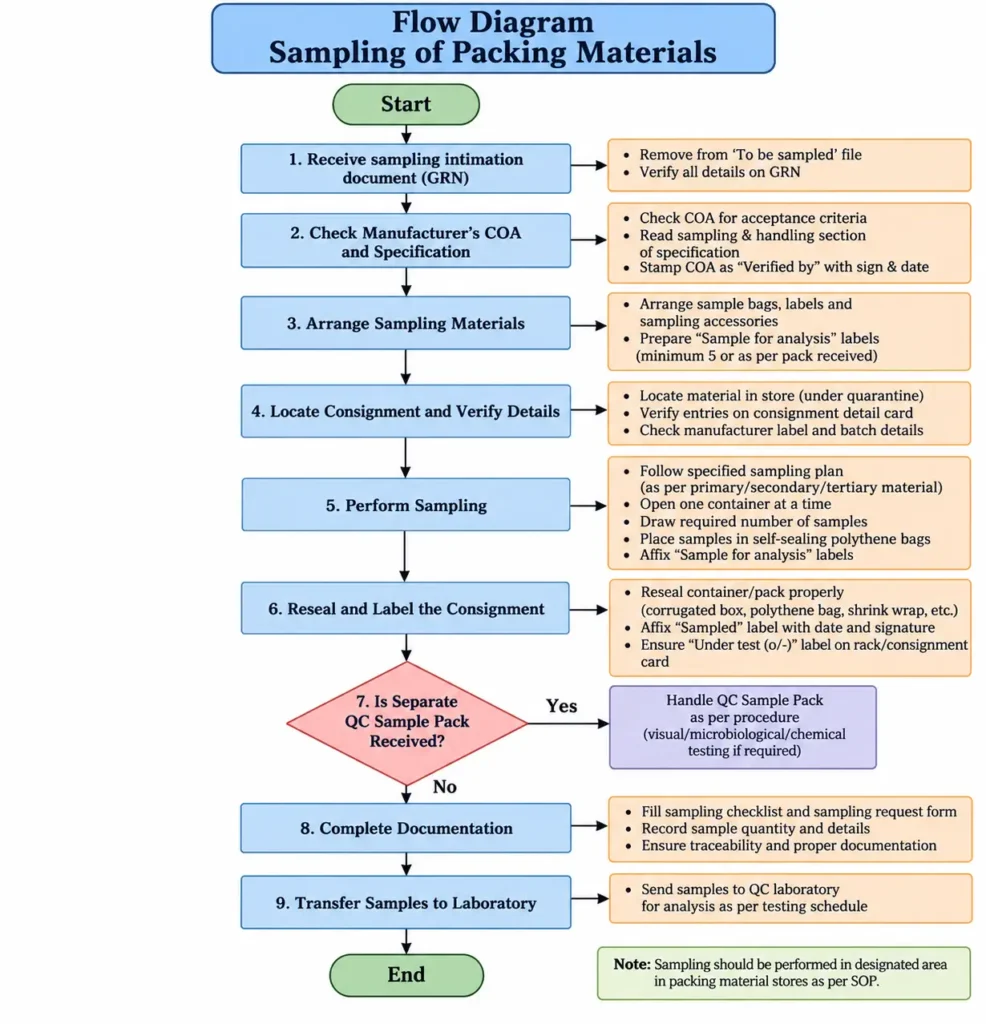
After sampling, containers are properly resealed and labeled, including sampled-pack and under-test identification where applicable. If a separate QC sample pack is received, it is handled according to the defined procedure. Sampling details, quantities, checklist observations, and traceability information are documented before samples are transferred to the designated laboratory area for analysis. The overall workflow supports representative sampling, prevention of mix-ups, proper identification, and complete documentation.
2. Brainstorming for SOP Failure:
The brainstorming diagram highlights the potential causes of failure in implementing the SOP for Sampling of Packing Materials. The central problem is surrounded by contributing factors such as inadequate QC personnel training, poor understanding of the SOP, failure to follow the sampling checklist, incorrect or insufficient sampling accessories, missed GRN/COA/document review, improper labeling of sample bags, inadequate cleaning and line clearance, failure to verify quarantine status, manpower or time pressure, and weak supervision.
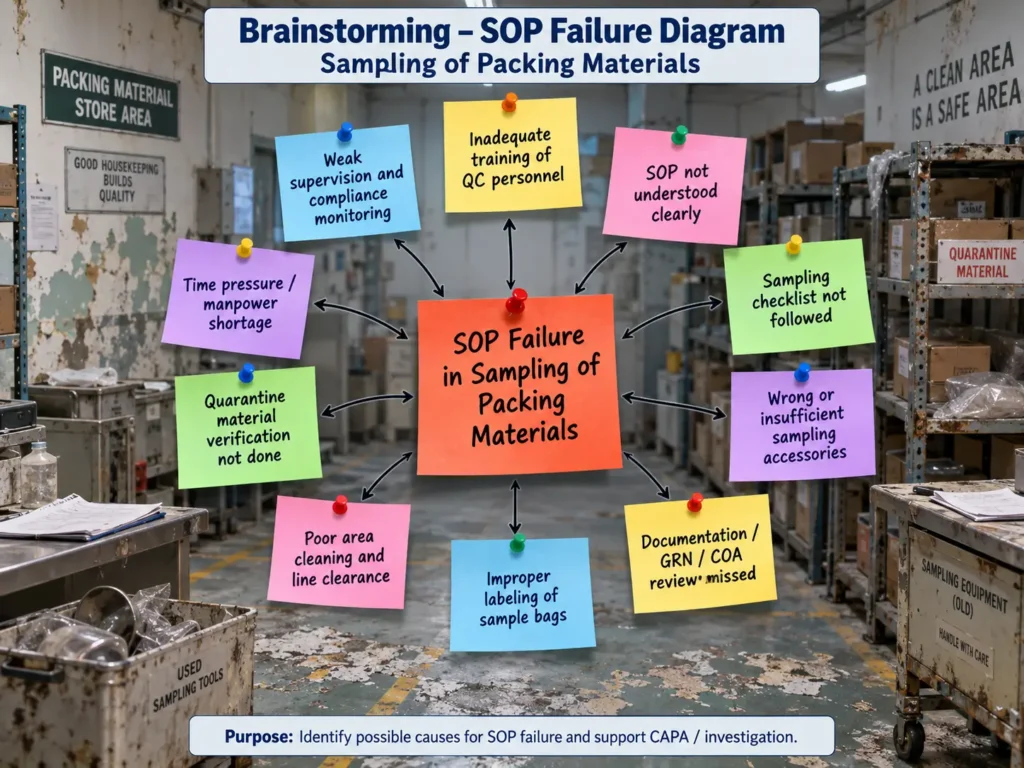
The deteriorated pharmaceutical packing-material store background represents a worst-case GMP condition, emphasizing risks from poor housekeeping, inadequate control, and weak procedural compliance. These factors may affect sample representativeness, traceability, contamination control, and ultimately material acceptance decisions. The brainstorming exercise can therefore be used as an initial investigation tool to identify probable causes and establish appropriate CAPA, training, supervision, and compliance controls. The SOP itself requires controlled sampling-area cleanliness and documented sampling practices.
3. 5-Why Analysis for SOP Failure:
The 5-Why analysis identifies the underlying reasons for failure to follow the SOP for Sampling of Packing Materials. It begins with the immediate problem that required sampling steps were not performed correctly. The analysis then links this failure to poor understanding of the SOP and checklist requirements, inadequate training and refresher sessions, weak supervision and compliance monitoring, and insufficient quality-system enforcement.
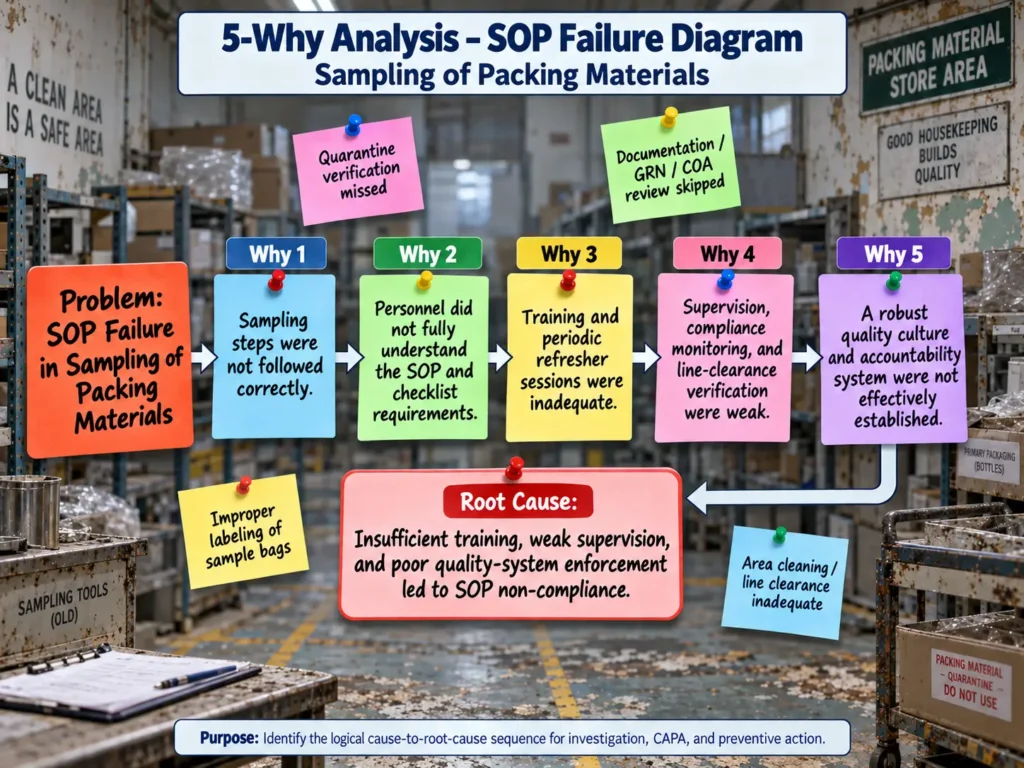
The diagram also highlights associated deficiencies such as missed quarantine verification, skipped GRN/COA review, improper sample-bag labeling, and inadequate area cleaning or line clearance. These conditions can compromise sample traceability, representativeness, contamination control, and ultimately material acceptance decisions. The probable root cause is therefore a combination of insufficient training, weak supervisory control, and poor procedural discipline. The 5-Why approach supports investigation and helps define targeted CAPA such as retraining, checklist verification, stronger supervision, and periodic compliance audits. The SOP requires documented verification of sampling details, quarantine status, and controlled sampling practices.
4. Fishbone Analysis for SOP Failure:
The Fishbone Analysis identifies possible causes of SOP failure during sampling of packing materials by grouping them under six major categories: Man, Method, Machine, Material, Measurement, and Environment.
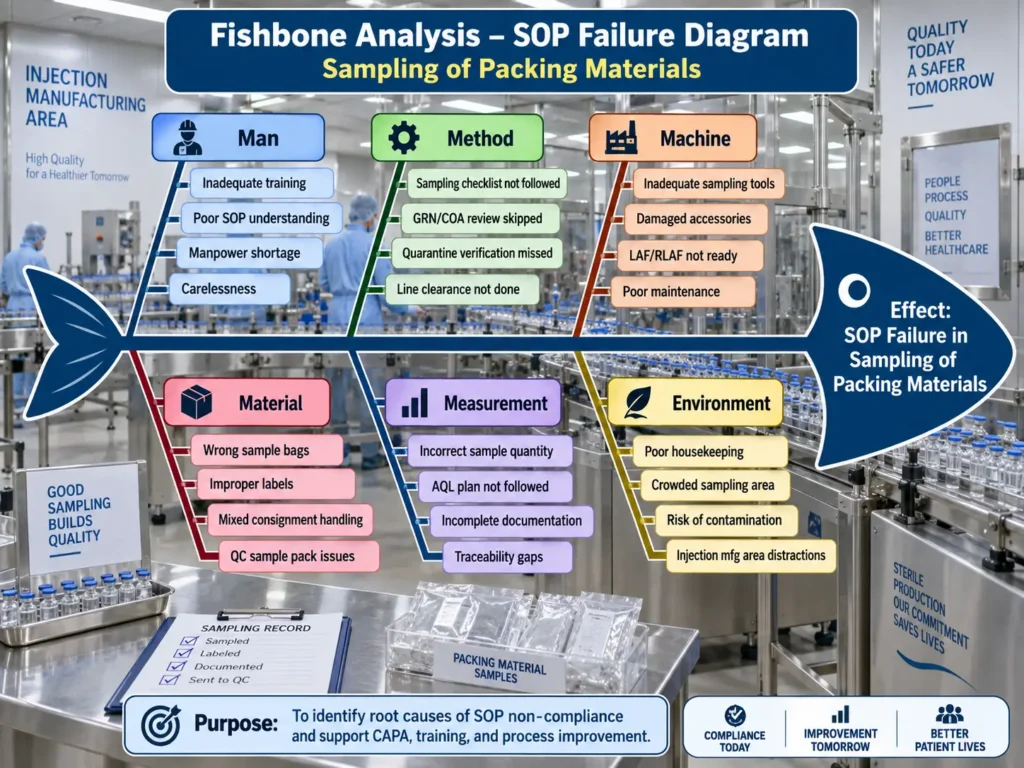
The Man category highlights inadequate training, poor SOP understanding, manpower shortage, and carelessness. Method includes failure to follow the sampling checklist, skipped GRN/COA review, missed quarantine verification, and incomplete line clearance. Machine covers inadequate sampling tools, damaged accessories, LAF/RLAF readiness issues, and poor maintenance. Material includes wrong sample bags, improper labels, mixed-consignment handling, and QC sample-pack issues. Measurement focuses on incorrect sample quantity, noncompliance with the AQL plan, incomplete documentation, and traceability gaps. Environment addresses poor housekeeping, crowded sampling conditions, contamination risks, and distractions within the injection manufacturing area. This analysis supports systematic root-cause investigation and helps define focused CAPA, retraining, procedural controls, and GMP compliance improvements.
5. Fault Tree Analysis for SOP Failure:
The Fault Tree Analysis illustrates how multiple underlying failures can combine to cause SOP non-compliance in sampling of packing materials, represented as the top event. The analysis groups the causes into four major branches: sampling not performed as per SOP, improper identification and labeling of samples, inadequate control of the sampling environment, and incomplete documentation and traceability.
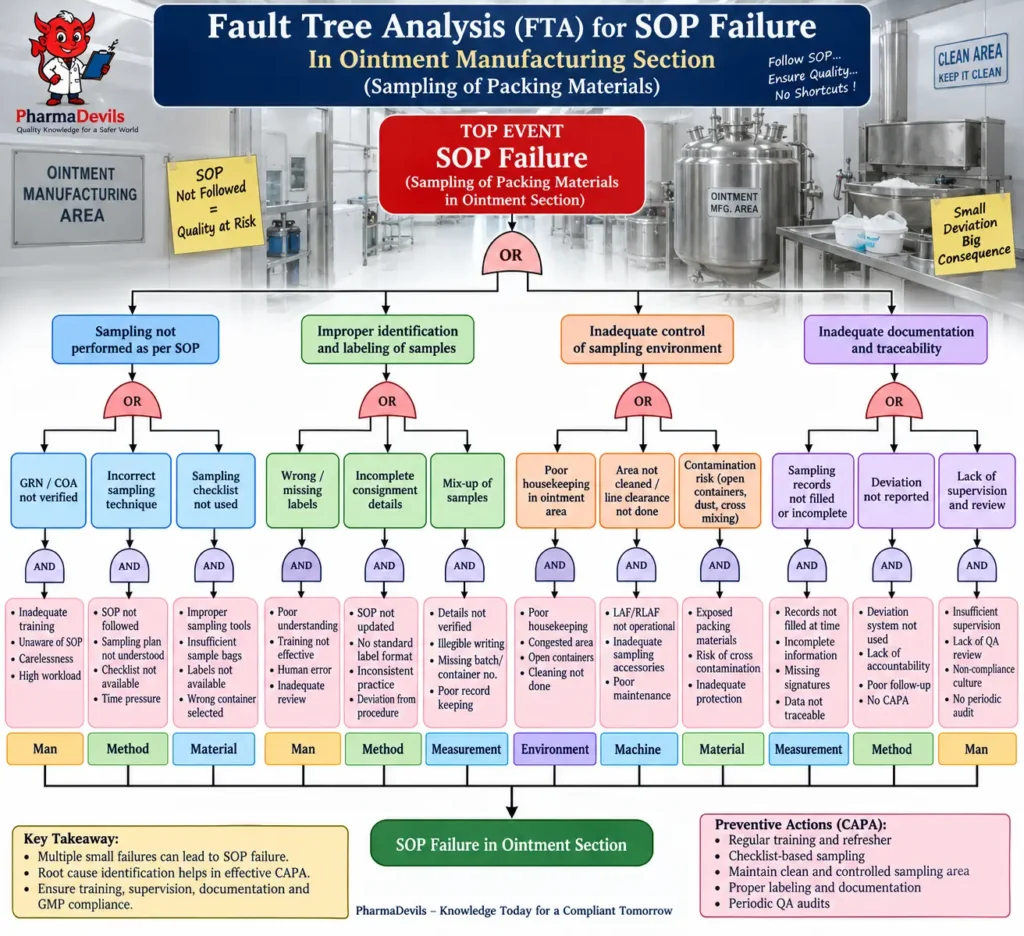
Each branch is further linked with contributing factors related to Man, Method, Material, Machine, Measurement, and Environment. Examples include inadequate training, failure to verify GRN/COA, incorrect sampling techniques, missing or improper labels, poor housekeeping, ineffective line clearance, non-operational LAF/RLAF, incomplete sampling records, unreported deviations, and weak supervision.The diagram demonstrates how several small procedural failures can collectively result in a major SOP failure. It supports root-cause investigation and helps define CAPA such as retraining, checklist-based sampling, improved cleanliness, better documentation, stronger supervision, and periodic QA audits.
Questions & Answers – SOP for Sampling of Packing Materials
Q1. What is the objective of the SOP for Sampling of Packing Materials?
Answer: The objective is to define the procedure to be followed for proper sampling of packing materials so that representative samples are obtained for testing.
Q2. Who is responsible for execution of this SOP?
Answer: The Chemist–QC is responsible for execution, while the Assistant Manager–QC, Manager–QC, and Head–QA/QC are responsible for effective implementation.
Q3. What is meant by sampling?
Answer: Sampling is the process of withdrawing a representative portion from a larger quantity or batch so that information obtained from the sample can represent the entire batch or consignment.
Q4. Where should packing-material sampling be performed?
Answer: Sampling should be performed in the designated sampling area of the packaging-material store.
Q5. What documents should be checked before sampling?
Answer: The analyst should verify the GRN, sampling intimation, sampling checklist, manufacturer’s COA, material specification, challan, consignment details, and manufacturer label before proceeding.
Q6. What condition should the material be in before sampling?
Answer: The material identified for sampling should be available under quarantine status, and the consignment details should correspond with the sampling request.
Q7. How should samples be collected?
Answer: Containers should be selected according to the applicable sampling plan. During sampling, only one container or pack at a time should be opened, and the required quantity should be collected into properly labeled self-sealing polythene bags.
Q8. What are the AQL limits specified for primary packaging materials?
Answer: The SOP specifies AQL values of 0.65 for Critical defects, 1.0 for Major defects, and 2.5 for Minor defects.
Q9. How are defects classified during AQL visual inspection?
Answer: Defects are categorized as Critical, Major, or Minor according to the individual packaging-material specification and evaluated against the applicable acceptance and rejection numbers.
Q10. What is a QC Sample Pack?
Answer: A QC Sample Pack is a representative sample quantity supplied by the manufacturer along with the consignment that may be used as a sample for analysis when the required validation is available.
Q11. What should be done after completion of sampling?
Answer: The opened container should be properly resealed, the required sampled-pack/AQL inspection labels should be affixed, and sampling details should be documented on the sampling request form.
Q12. Why is cleaning and line clearance of the sampling area important?
Answer: The sampling area should be clean and free from traces of previously handled packaging materials. Area status and usage/cleaning records must also be maintained to control mix-up and contamination risks.
Q13. What controls are required when sampling primary or sterile packaging materials?
Answer: Where applicable, the LAF/RLAF/UDAF/VLAF should be clean and suitable, operating conditions should be verified, new gloves should be worn, and only one batch should be handled at a time.
Q14. What is the general sequence of the sampling process?
Answer: The sequence is: receipt of material → registration/allocation of A.R. number → preparation of sampling materials → review of consignment → sampling → resealing and labeling → consignment-card labeling → transfer of samples to the designated laboratory area for analysis.
Q15. What is the major risk if this SOP is not followed correctly?
Answer: Based on the SOP requirements, failure to follow the procedure can result in a non-representative sample, incorrect identification, mix-up, contamination, incomplete traceability, or incorrect acceptance/rejection decision. This is an inference from the SOP’s controls for representative sampling, labeling, segregation, documentation, and AQL inspection.
Reference Guidelines:
- WHO Technical Report Series No. 929, Annex 4 – Guidelines for Sampling of Pharmaceutical Products and Related Materials. This is directly applicable to sampling of primary and secondary packaging materials and covers sampling plans, facilities, contamination prevention, sample identification, and sampling records. (World Health Organization)
WHO Sampling Guideline – TRS 929 Annex 4 - EU GMP – EudraLex Volume 4, Annex 8: Sampling of Starting and Packaging Materials. This is one of the most directly relevant GMP references for representative sampling and controls applied to packaging materials. (Public Health)
EU GMP EudraLex Volume 4 - PIC/S GMP Guide PE 009-17, Part I – Chapter 4, Documentation. Section 4.25 requires written sampling procedures defining the method, equipment, quantity to be taken, and precautions against contamination or deterioration. (PIC/S)
PIC/S GMP Publications - US FDA – 21 CFR Part 211, Sections 211.80, 211.82 and 211.84. These requirements cover receipt, quarantine, representative sampling, testing/examination, contamination prevention, sample-container identification, and marking of containers from which samples have been taken. (GovInfo)
- ISO 2859-1:2026 – Sampling Procedures for Inspection by Attributes, Part 1. This is the current edition governing AQL-indexed lot-by-lot acceptance sampling. It replaced ISO 2859-1:1999 in January 2026, so an SOP revision should reference the current edition where applicable. (ISO)
ISO 2859-1:2026