







1. Introduction – SOP for Analytical Incidences Investigation and Resolution Procedure:
The SOP for Analytical Incidences Investigation and Resolution Procedure establishes a systematic approach for reporting, investigating, evaluating, documenting, and resolving analytical incidences encountered within the Quality Control laboratory. It applies to analytical non-conformances occurring during analysis, calibration, or review activities, other than Out of Specification (OOS) and Out of Trend (OOT) results. The procedure ensures that every analytical incidence is promptly reported, scientifically investigated, and adequately documented to determine the immediate cause and root cause. It provides a structured framework for assessing analyst-related, instrument-related, procedural, and other laboratory errors. Appropriate corrective, preventive, or remedial actions are initiated based on investigation findings to prevent recurrence. The SOP also supports proper documentation, CAPA implementation, impact assessment, trending, and effective closure of analytical incidences, thereby strengthening data integrity, laboratory compliance, product quality, and the overall pharmaceutical quality system.
Skip to PDF content2. SOP for Analytical Incidences Investigation and Resolution Procedure:
The SOP for Analytical Incidences Investigation and Resolution Procedure defines a controlled system for handling analytical incidences observed during laboratory analysis, calibration, or data review. It provides guidance for prompt reporting, logging, investigation, classification, evaluation, documentation, and closure of incidences other than OOS and OOT results.
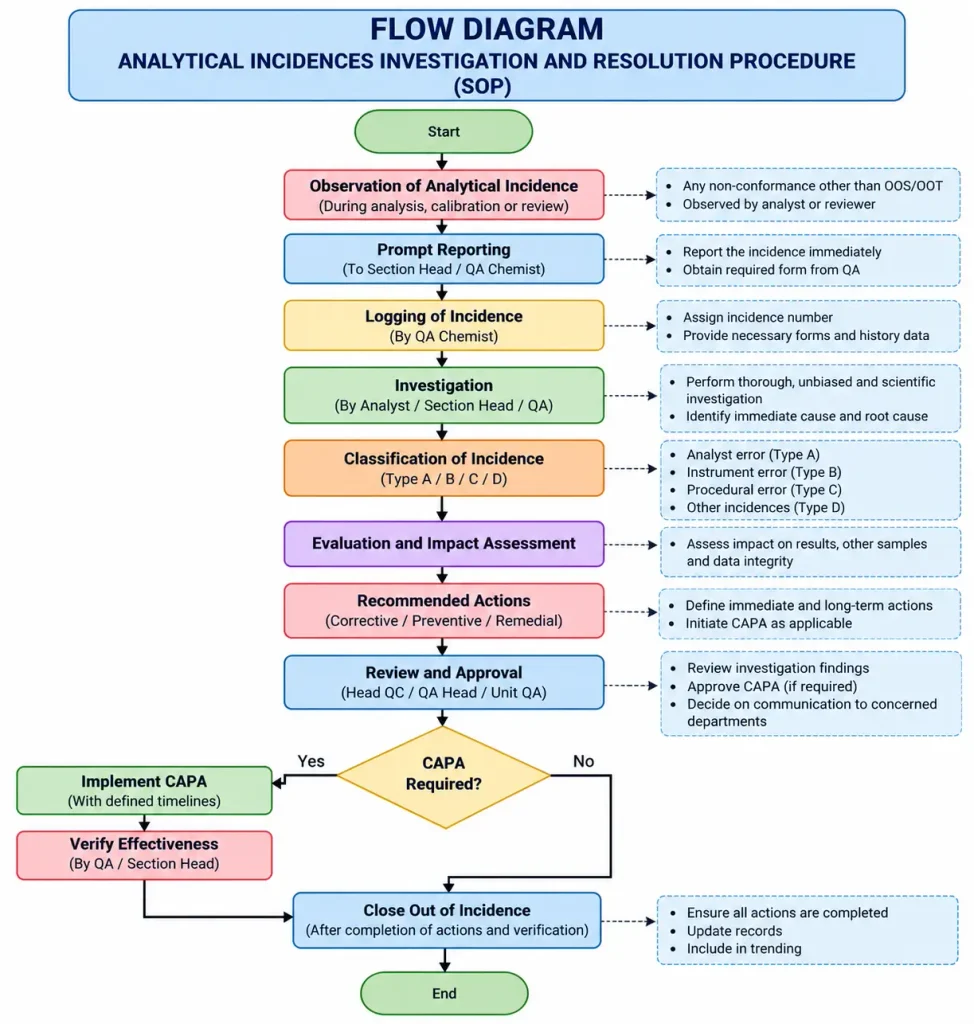
The SOP classifies incidences into analyst error, instrument-related error, procedural error, and other incidences, so that the investigation can be performed systematically and the appropriate cause can be identified. It further requires evaluation of investigation findings, impact assessment, appropriate corrective or preventive actions, CAPA implementation where necessary, and documented closure. The procedure helps ensure that analytical problems are investigated in a timely, unbiased, scientifically sound, and well-documented manner, supporting reliable laboratory results, data integrity, and continued compliance with the pharmaceutical quality system.
3. Benefits of Following SOP for Analytical Incidences Investigation and Resolution Procedure:
Following the SOP for Analytical Incidences Investigation and Resolution Procedure helps ensure that laboratory incidences are handled in a consistent, controlled, and scientifically justified manner. The procedure supports prompt reporting, systematic investigation, proper documentation, identification of immediate and root causes, and implementation of suitable corrective and preventive actions. It also helps reduce human and procedural errors, strengthens accountability, and improves traceability of analytical activities.
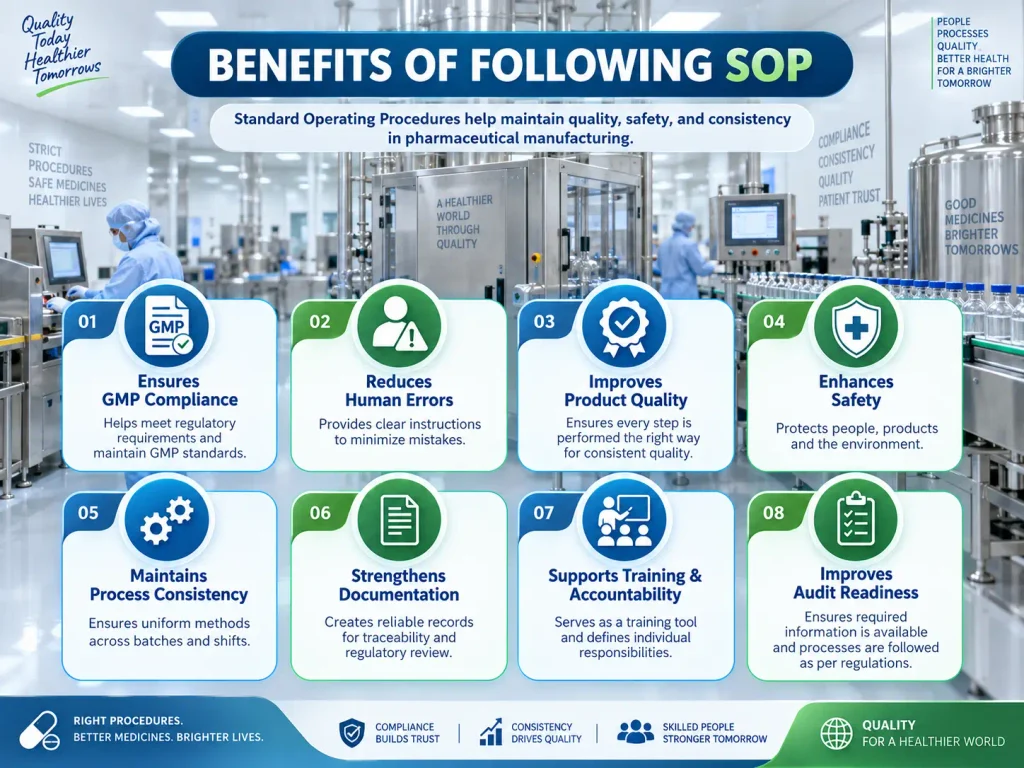
By following defined investigation and approval steps, the organization can maintain GMP compliance, data integrity, product quality, process consistency, and audit readiness. Effective implementation of this SOP also supports personnel training, prevents recurrence of similar incidences, and promotes a strong pharmaceutical quality culture across the Quality Control and Quality Assurance functions.
4. Brainstorming for SOP Failure: Analytical Incidences Investigation and Resolution Procedure:
The brainstorming analysis for SOP failure in Analytical Incidences Investigation and Resolution Procedure identifies potential factors that may lead to ineffective implementation of the procedure. Key causes may include inadequate training, unclear instructions, poor documentation, lack of supervision, time pressure, communication gaps, equipment or instrument issues, incomplete SOP review, non-compliance, and ineffective CAPA. These factors can weaken the reporting, investigation, root-cause determination, and closure of analytical incidences. The SOP requires analytical incidences to be investigated thoroughly, promptly, scientifically, and with proper documentation.
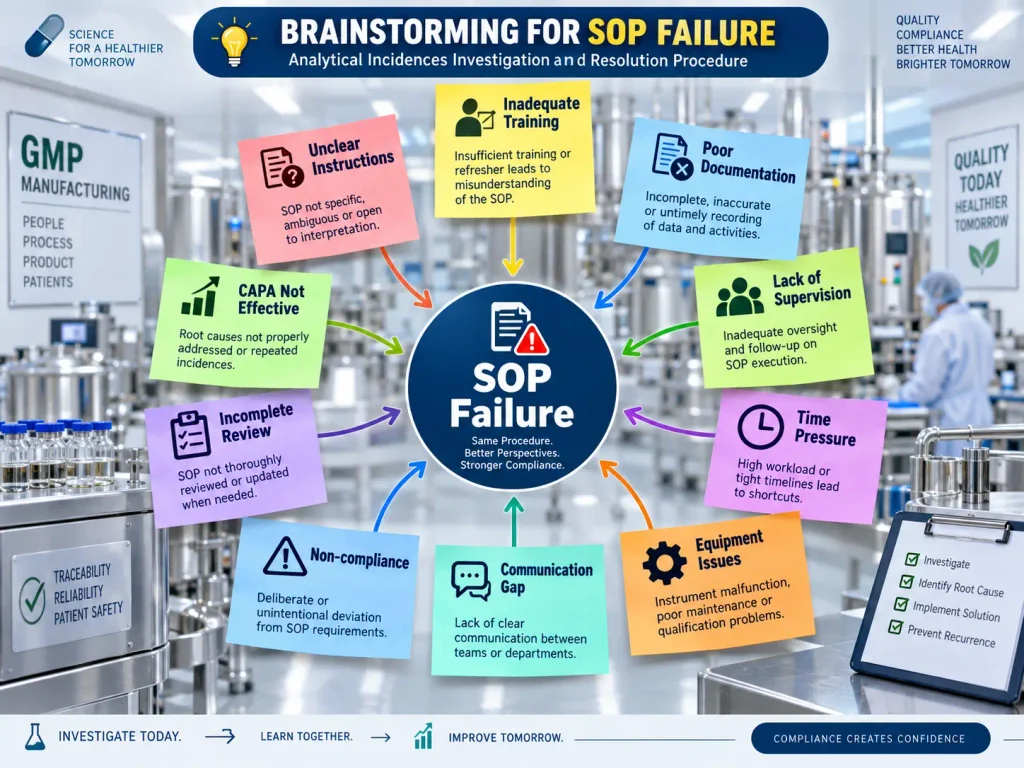
Brainstorming helps the QA and QC teams identify likely weaknesses before selecting the actual root cause. It supports focused investigation, stronger CAPA, better personnel awareness, improved documentation practices, and prevention of recurrence, ultimately strengthening GMP compliance, data integrity, and laboratory quality systems.
5. 5-Why Analysis for SOP Failure: Analytical Incidences Investigation and Resolution Procedure:
The 5-Why Analysis for SOP Failure is used to identify the underlying reasons why the Analytical Incidences Investigation and Resolution Procedure may not be followed effectively. The analysis begins with the problem that analytical incidences are not properly reported or investigated, then progressively examines why personnel failed to follow the defined procedure.The likely chain of causes includes inconsistent SOP compliance, inadequate training and practical understanding, weak supervision, insufficient periodic review, and ineffective document control or follow-up. The analysis ultimately points toward systemic weaknesses rather than treating the event as only an individual error.
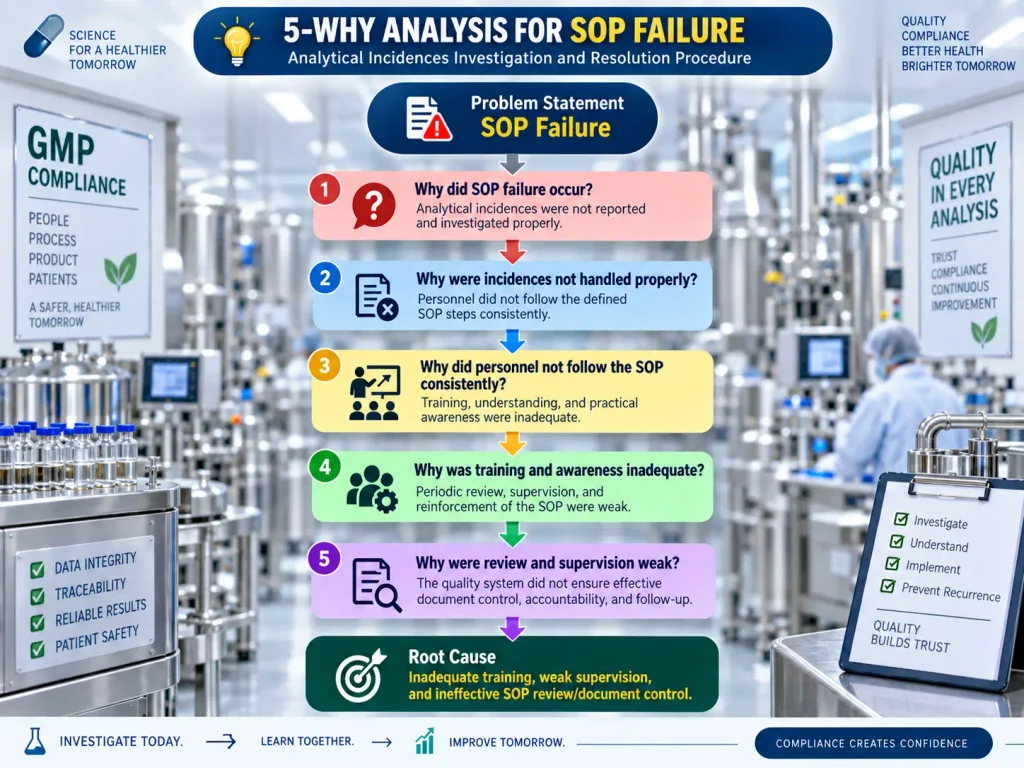
Using the 5-Why method helps QA and QC teams identify the true root cause, implement focused CAPA, strengthen training and supervision, improve SOP adherence, and reduce recurrence of analytical incidences. This supports better data integrity, traceability, reliable analytical results, GMP compliance, and continual improvement.
6. Fishbone Analysis for SOP Failure – Analytical Incidences Investigation and Resolution Procedure:
The Fishbone Analysis for SOP Failure identifies the major categories of causes that may lead to ineffective implementation of the Analytical Incidences Investigation and Resolution Procedure. The analysis considers factors related to Man, Method, Machine/Equipment, Documentation, Management/Supervision, and Environment/Work Pressure. Potential causes include inadequate training, lack of awareness, unclear procedures, failure to follow defined investigation steps, instrument malfunction, poor maintenance, calibration issues, incomplete records, delayed documentation, weak supervision, inadequate CAPA follow-up, excessive workload, and communication gaps. These factors can contribute to analytical incidences being improperly reported, investigated, or resolved.
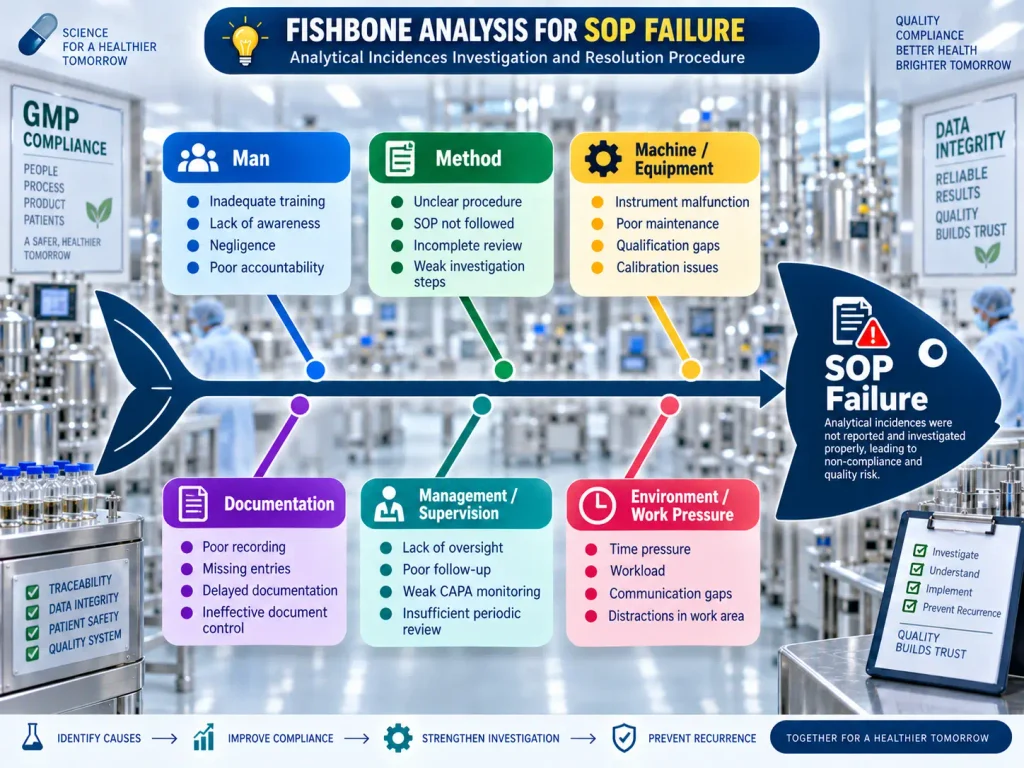
Using fishbone analysis helps QA and QC teams systematically explore possible causes, identify areas requiring deeper investigation, and develop focused corrective and preventive actions. This strengthens root-cause identification, SOP compliance, data integrity, traceability, reliable analytical results, and prevention of recurrence.
7. Fault Tree Analysis for SOP Failure – Analytical Incidences Investigation and Resolution Procedure:
The Fault Tree Analysis (FTA) for SOP Failure systematically identifies potential causes that may result in analytical incidences being improperly reported, investigated, documented, or resolved. The analysis considers four major cause groups: human error, procedure/method-related issues, equipment/technical failures, and management/system weaknesses.
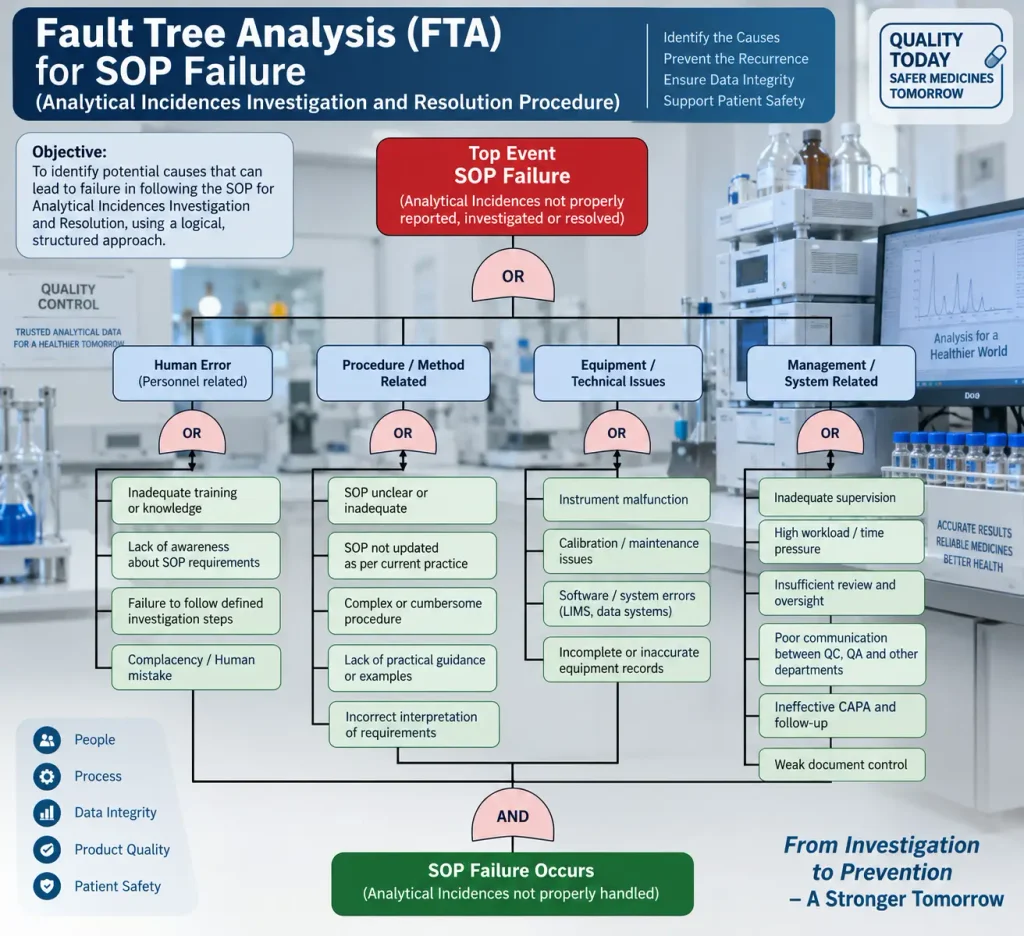
Possible contributing factors include inadequate training, lack of SOP awareness, failure to follow investigation steps, unclear or outdated procedures, instrument malfunction, calibration or maintenance problems, software errors, weak supervision, workload pressure, poor communication, ineffective CAPA, and inadequate document control. The SOP requires analytical incidences to be investigated thoroughly, scientifically, and with proper documentation so that root causes and appropriate corrective or preventive actions can be established. FTA helps organize these causes logically, supporting stronger root-cause investigation, data integrity, GMP compliance, product quality, CAPA effectiveness, and prevention of recurrence.
8. Impact Assessment for SOP Failure: Analytical Incidences Investigation and Resolution Procedure:
The Impact Assessment for SOP Failure evaluates the possible consequences when the Analytical Incidences Investigation and Resolution Procedure is not followed effectively. Failure in reporting, investigation, documentation, or closure of analytical incidences can affect product quality, patient safety, data integrity, regulatory compliance, cost, and organizational performance. Potential negative impacts include incorrect or unreliable analytical results, incomplete investigation records, increased audit observations, repeated laboratory errors, additional rework, delayed batch release, and possible quality risks. Effective investigation and resolution, however, help ensure accurate analytical results, complete documentation, appropriate CAPA, improved traceability, and stronger regulatory readiness.
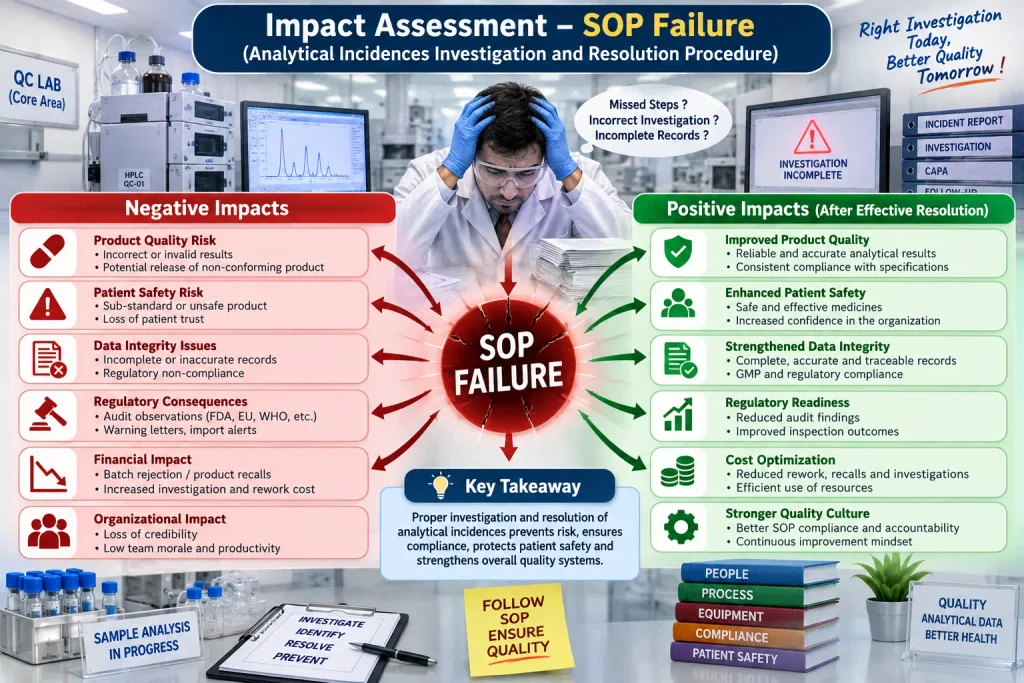
The SOP requires investigation findings to be documented and appropriate corrective and preventive actions to be derived to avoid recurrence. Proper implementation therefore strengthens GMP compliance, data integrity, product quality, accountability, and continuous improvement within the pharmaceutical quality system.
Questions & Answers – SOP for Analytical Incidences Investigation and Resolution Procedure
- Q: What is the objective of this SOP?
A: To define the procedure for reporting, investigating, evaluating, and documenting analytical incidences that cause non-conformance other than OOS and OOT test results. - Q: Where is this SOP applicable?
A: It applies to analytical incidences occurring during analysis, calibration, or review activities in the Quality Control department. - Q: Who should report an analytical incidence?
A: The analyst or reviewer should promptly report any incidence observed during analysis or review. - Q: Who is responsible for investigating the cause of an analytical incidence?
A: The Section Head is responsible for investigating the cause, deriving recommended actions, initiating CAPA when required, and concluding the investigation. - Q: What are the four categories of analytical incidences?
A: They are Type A – Analyst Error, Type B – Instrument Error, Type C – Procedural Error, and Type D – Other Incidences. - Q: What is considered an analyst error?
A: Examples include incorrect instrument parameter settings, transcription errors, incorrect dilution, incorrect glassware use, or other obvious analytical errors. - Q: What is an instrument-related incidence?
A: It is an incidence associated with instrument malfunction, such as pump, detector, or software malfunction. - Q: What is a procedural error?
A: A procedural error may occur during sampling, analysis, or reporting because written instructions are unavailable, inadequate, unclear, or insufficiently detailed. - Q: What should be done with test preparations during an investigation?
A: Relevant test preparations, standard solutions, dilutions, sample preparations, volumetric glassware, and reagents should be preserved until the results are reviewed and verified. - Q: What should happen when an analytical incidence is observed?
A: The analyst or reviewer should immediately inform the Section Head so that the details can be reviewed and the required investigation can be initiated. - Q: Why should previous analytical incidences be reviewed during an investigation?
A: Previous incidences involving the same analyst, instrument, product, or analytical method may help identify recurring problems and provide clues for determining the root cause. - Q: What should the investigation conclusion contain?
A: The conclusion should identify the root cause of the incidence and include an evaluation of the material or product under investigation. - Q: What happens if the root cause cannot initially be identified?
A: A scientifically justified hypothesis should be developed and verified through experimentation or other appropriate verification. Additional hypotheses may be evaluated if the first one is not confirmed. - Q: When is CAPA required?
A: After completion of the investigation, QA and QC review the findings and determine whether CAPA should be initiated to prevent recurrence of the identified problem. - Q: What action is required when an incidence occurs because an analyst did not follow instructions?
A: Training should be provided to the concerned analyst. If the issue relates to a broader system or practice, group training should be conducted. - Q: Why are analytical incidences trended?
A: Trending helps identify the frequency and contributory factors behind incidences and supports evaluation of CAPA effectiveness. - Q: How frequently should analytical incidence trends be reviewed?
A: Trends should be reviewed quarterly or as considered necessary, and an annual trend should also be prepared and reviewed. - Q: What is the expected timeline for completing an analytical incidence investigation?
A: The initial laboratory investigation should be completed within 48 hours, and the complete investigation should normally be closed within 30 calendar days from the date of reporting. - Q: What is retesting?
A: Retesting means repeating the test using a fresh preparation from the same homogeneous original sample associated with the incidence. - Q: What is re-sampling?
A: Re-sampling means collecting additional units from the original sample or obtaining a new sample from the batch when the initial sample may not be representative.
Reference Guidelines – SOP for Analytical Incidences Investigation and Resolution Procedure:
- Out-of-Specification (OOS) and Investigation Procedure – for analytical results identified as OOS.
- Out-of-Trend (OOT) and Investigation Procedure – for results showing an abnormal or unexpected trend.
- Deviation Handling Procedure – for documenting and investigating deviations from approved procedures or established practices.
- Corrective and Preventive Action (CAPA) Procedure – for initiation, implementation, follow-up, and effectiveness evaluation of CAPA arising from analytical incidence investigations.