






1. Introduction – SOP for Out-of-Specification Investigation and Resolution Procedure of Packing Material:
The SOP for Out of Specification (OOS) Investigation and Resolution Procedure of Packing Material establishes a systematic and documented approach for reporting, investigating, evaluating, and resolving test results that fall outside approved specifications or acceptance criteria for packing materials. The procedure is designed to determine whether an OOS result is caused by an analytical or laboratory error, sampling issue, instrument-related problem, or an actual defect in the packing material. The SOP defines responsibilities for Quality Control and Quality Assurance personnel and provides guidance for Phase-I laboratory investigation, experimentation, assignable-cause identification, Phase-II full-scale investigation, retesting, re-sampling, batch disposition, and CAPA implementation. It emphasizes scientifically sound, timely, unbiased, and well-documented investigations so that valid conclusions can be reached regarding the acceptance or rejection of packing material. Proper implementation of this SOP supports data integrity, regulatory compliance, root-cause identification, prevention of recurrence, and effective control of packaging-material quality.
Skip to PDF content2. SOP for Out of Specification Investigation and Resolution Procedure of Packing Material:
The flow diagram illustrates the systematic process for handling an Out of Specification (OOS) result related to packing material. The process begins when an OOS test result is identified and immediately reported to the Section Head and Quality Assurance for initiation of the investigation. The investigation first proceeds through Phase-I, which includes review of analytical data, raw data, calculations, instrument performance, analyst competency, reagents, standards, sampling, and test methodology to identify any assignable laboratory cause.
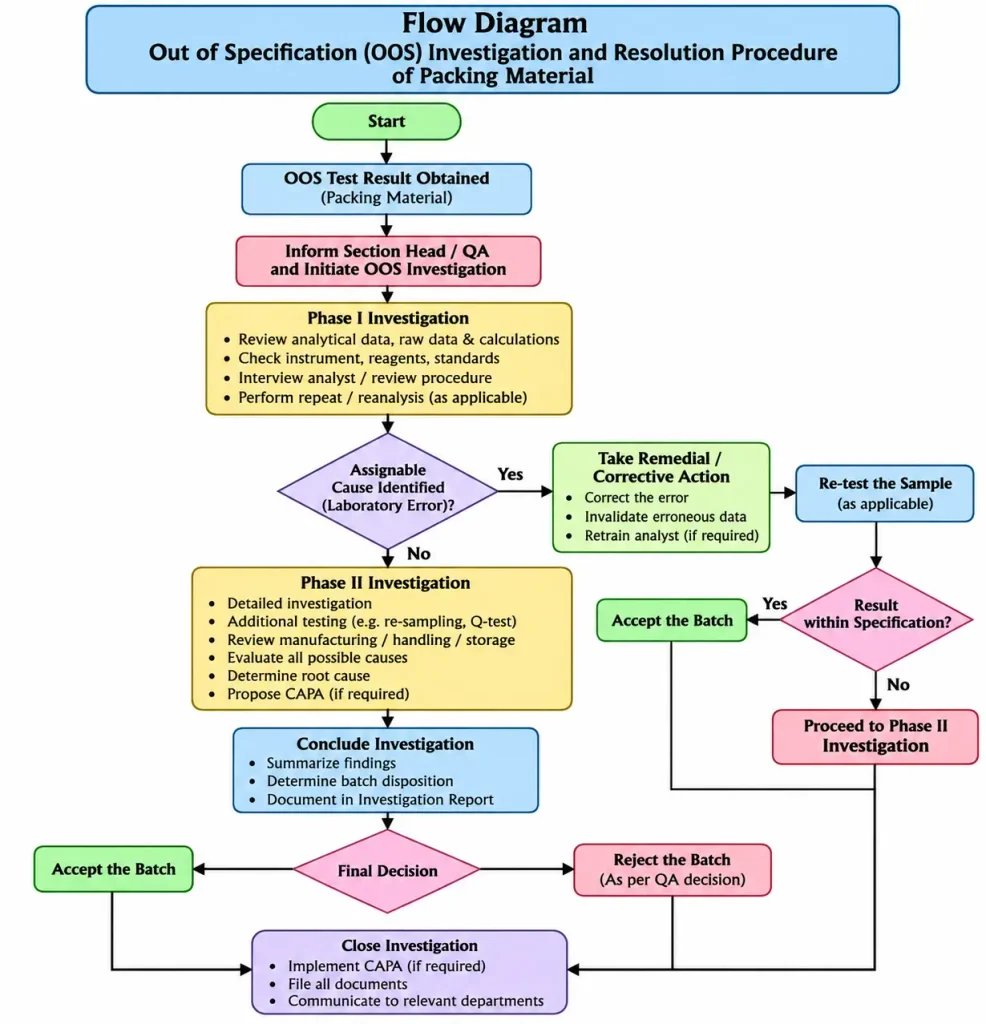
If an assignable cause is identified, appropriate corrective or remedial action is taken, followed by justified retesting where applicable. If no cause is identified, the investigation proceeds to Phase-II, involving additional laboratory testing, review of quality trends, and further root-cause evaluation. Based on the investigation findings, the packing material is either accepted or rejected, CAPA is implemented where required, all investigation records are completed, and the OOS investigation is formally closed.
3. Benefits of Following SOP for Out of Specification Investigation and Resolution Procedure of Packing Material:
Following the SOP for Out of Specification (OOS) Investigation and Resolution Procedure of Packing Material provides a structured and controlled approach for evaluating packing material test results that fall outside approved specifications. The SOP requires proper reporting, investigation, evaluation, documentation, and final disposition of the affected packing material, helping ensure that only suitable material is accepted for use.Effective implementation supports accurate identification of laboratory errors, analyst errors, instrument-related problems, sampling issues, or actual material defects. It also defines clear responsibilities for QC personnel, QC management, and QA/QC leadership.
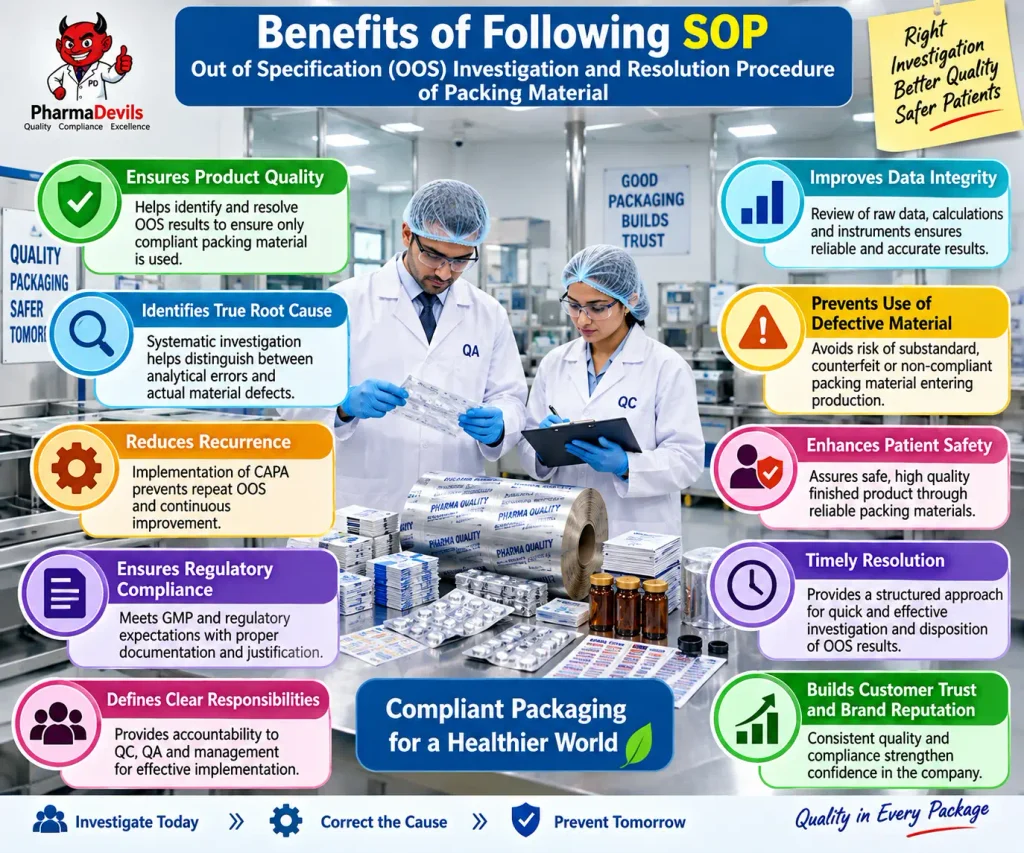
The procedure further promotes data integrity, scientific investigation, justified retesting or re-sampling, appropriate batch disposition, and prevention of recurrence through remedial action and CAPA. This strengthens GMP compliance, improves packing-material quality control, reduces repeated failures, supports patient and product protection, and maintains reliable documentation for regulatory review.
4. Brainstorming for SOP Failure: Out of Specification Investigation and Resolution Procedure of Packing Material:
The brainstorming diagram identifies potential reasons why the SOP for Out of Specification (OOS) Investigation and Resolution Procedure of Packing Material may fail during implementation. Key contributing factors include inadequate awareness of SOP requirements, insufficient QC personnel training, unclear responsibilities, incomplete documentation, analyst errors, poor sample handling, improper use of reagents or standards, and instrument malfunction or inadequate maintenance. The SOP itself recognizes analyst and laboratory errors as possible causes requiring investigation and defines responsibilities for QC and QA/QC personnel. The diagram also highlights weaknesses such as inadequate root-cause investigation, unjustified retesting or re-sampling, ineffective CAPA, poor management follow-up, and insufficient trend review. The SOP emphasizes monitoring OOS trends because repeated errors may indicate inadequate training, poorly maintained or improperly calibrated equipment, or deficient laboratory practices.
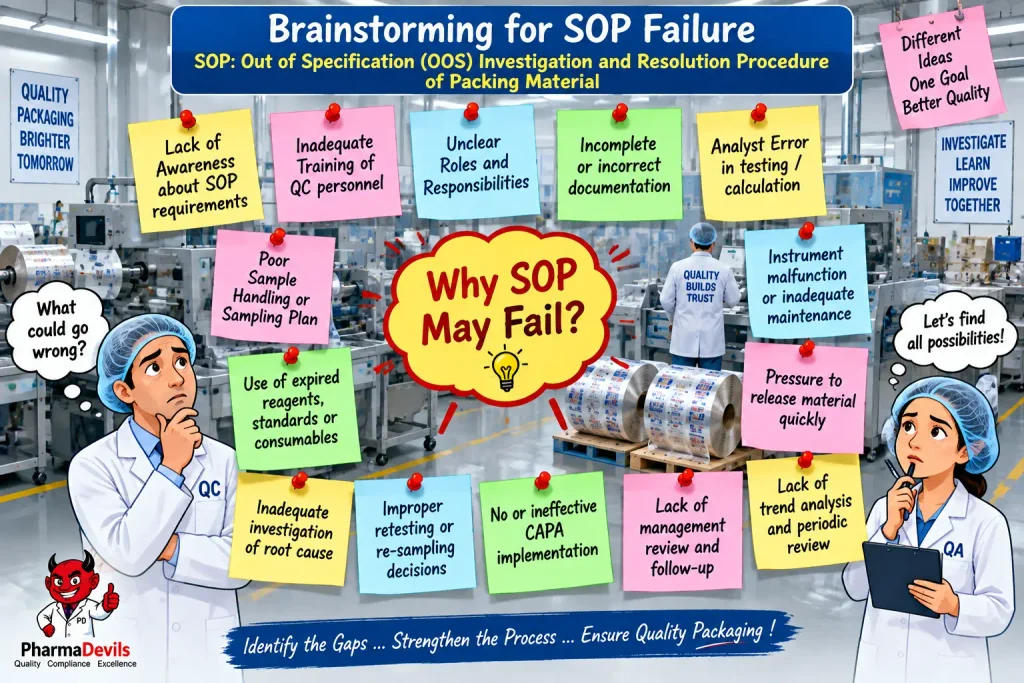
This brainstorming approach helps identify system gaps early so that appropriate training, investigation controls, documentation improvements, CAPA, and management oversight can strengthen OOS handling and packing-material quality.
5. 5-Why Analysis for SOP Failure: Out of Specification Investigation and Resolution Procedure of Packing Material:
The 5-Why Analysis for SOP Failure – Out of Specification (OOS) Investigation and Resolution Procedure of Packing Material is used to systematically identify the underlying cause of ineffective SOP implementation. The analysis starts with the problem that OOS investigations for packing material are not being performed effectively and progressively examines why the required steps are not followed. The chain of causes highlights inadequate awareness of detailed SOP requirements, insufficient training and refresher training of QC personnel, weak identification of training needs, and inadequate management review and accountability. The SOP assigns responsibility to QC personnel for execution and to QC/QA management for effective implementation, making competency, oversight, and procedural adherence essential.
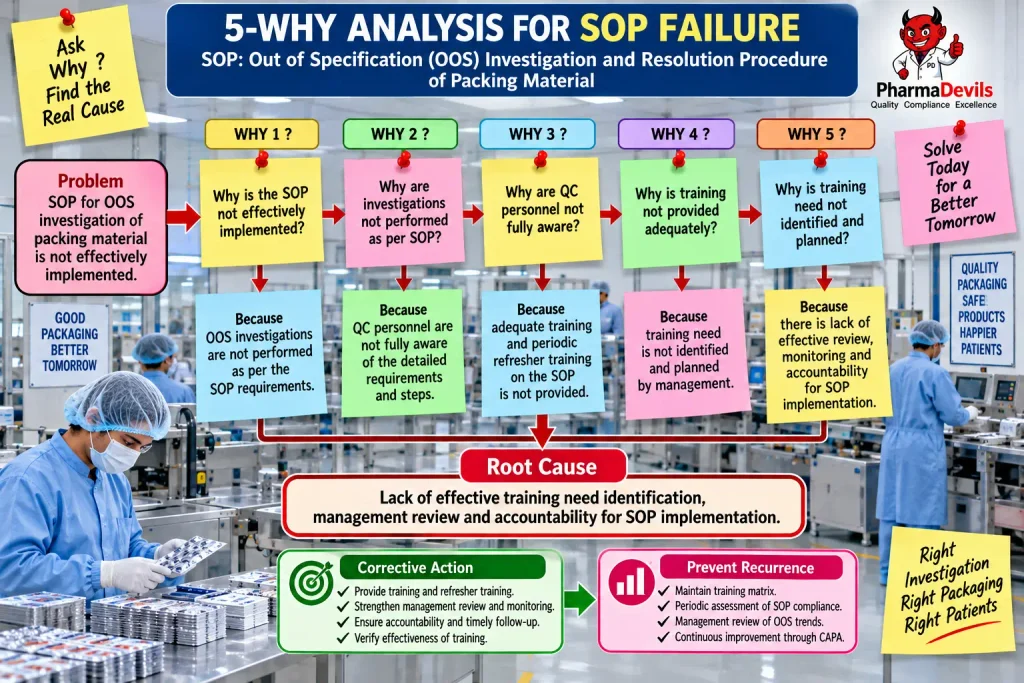
The identified root cause is therefore related to ineffective training-need identification, insufficient management monitoring, and weak accountability for SOP implementation. Corrective actions should focus on targeted training, refresher programs, management review, monitoring of OOS trends, verification of training effectiveness, and CAPA follow-up to prevent recurrence.
6. Fishbone Analysis for SOP Failure: Out of Specification Investigation and Resolution Procedure of Packing Material:
The Fishbone Analysis for SOP Failure – Out of Specification (OOS) Investigation and Resolution Procedure of Packing Material systematically identifies potential causes that may lead to ineffective OOS handling. The causes are grouped under major categories such as Man, Method, Machine, Material, Measurement, and Environment/Management.
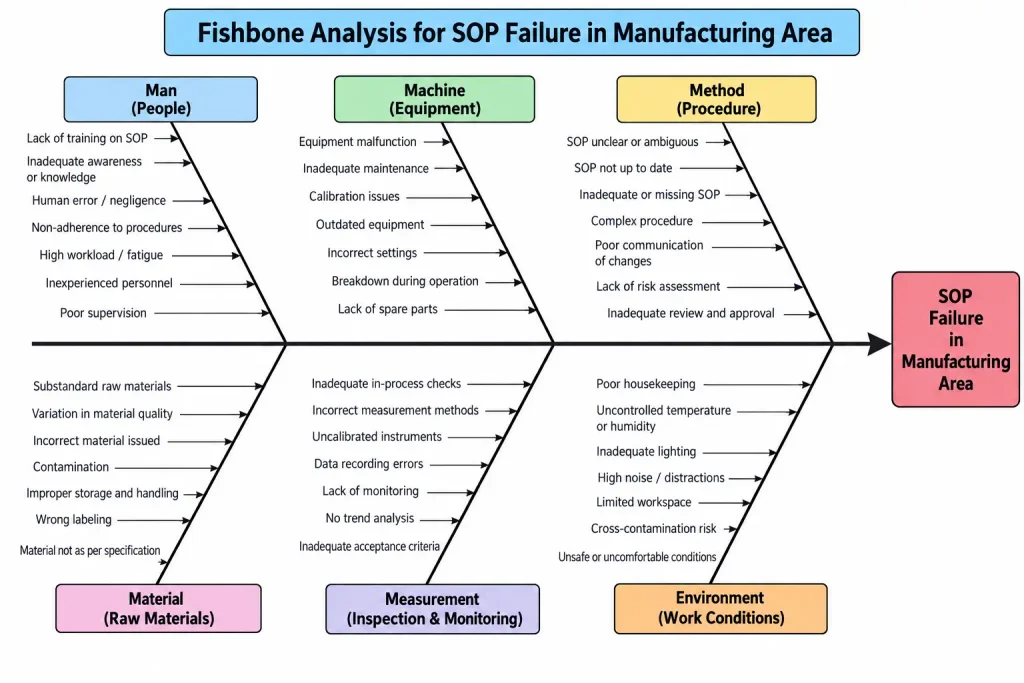
Potential causes include inadequate analyst training, lack of SOP awareness, analyst errors, incomplete investigation steps, improper retesting, poor documentation, instrument malfunction, calibration or maintenance issues, non-representative samples, damaged packing material, calculation errors, incorrect data entry, insufficient trend review, weak CAPA follow-up, and inadequate management oversight. The SOP specifically recognizes analyst and laboratory errors, instrument-related failures, sampling concerns, and calculation issues as important areas requiring investigation. The analysis helps the investigation team evaluate all possible contributing factors instead of focusing on a single cause. Identifying and addressing these causes supports stronger root-cause determination, effective CAPA, improved OOS investigation practices, and consistent control of packing-material quality.
7. Fault Tree Analysis – SOP for Out of Specification Investigation and Resolution Procedure of Packing Material:
The Fault Tree Analysis for SOP Failure illustrates potential causes that could lead to ineffective execution of the SOP for Out of Specification Investigation and Resolution Procedure of Packing Material. The SOP requires OOS results to be properly reported, investigated, evaluated, documented, and concluded for appropriate material disposition.
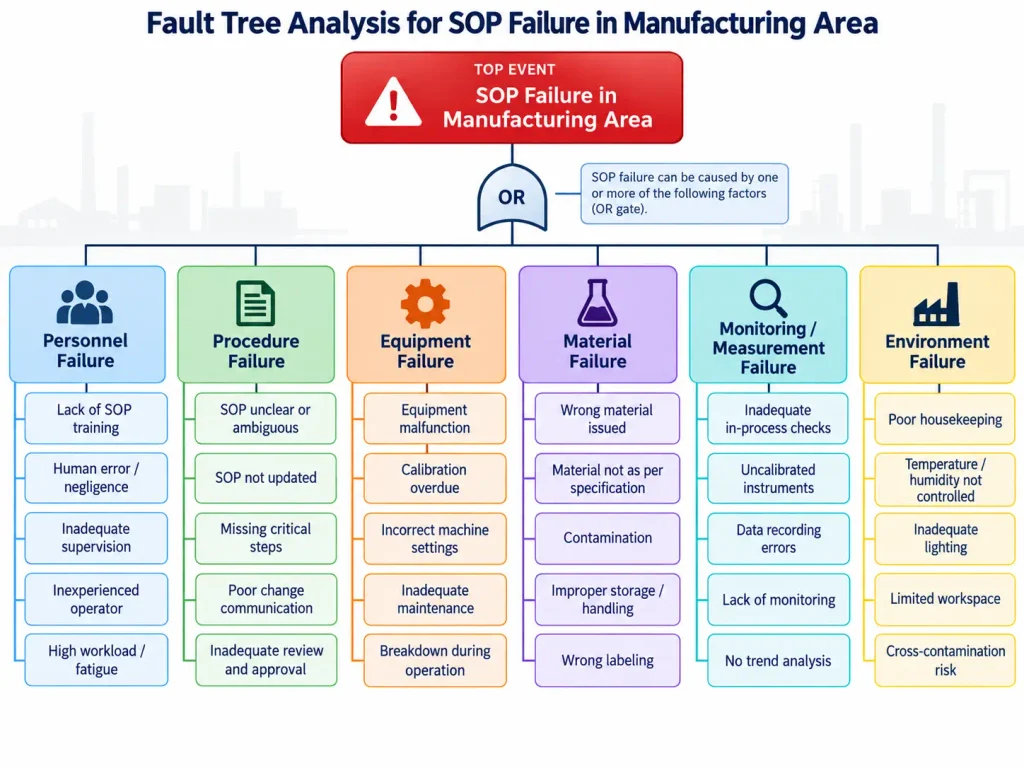
The diagram groups possible failure causes under Personnel, Procedure, Equipment, Material, Monitoring/Measurement, and Environment. Examples include inadequate SOP training, unclear procedures, equipment malfunction, incorrect material handling, poor monitoring, and unsuitable working conditions. These factors can contribute to incomplete investigations, incorrect data interpretation, delayed actions, or inappropriate OOS conclusions. The SOP assigns execution responsibilities to QC personnel and implementation oversight to QC/QA management. The fault tree is an illustrative root-cause analysis aid; these exact categories are not explicitly presented as a fault tree in the SOP.
8. Impact Assessment – SOP for Out of Specification Investigation and Resolution Procedure of Packing Material:
The Impact Assessment illustrates the potential consequences of failure to properly implement the SOP for Out of Specification Investigation and Resolution Procedure of Packing Material. The SOP is intended to ensure that OOS packing-material results are reported, investigated, evaluated, documented, and concluded through an appropriate material-disposition decision.
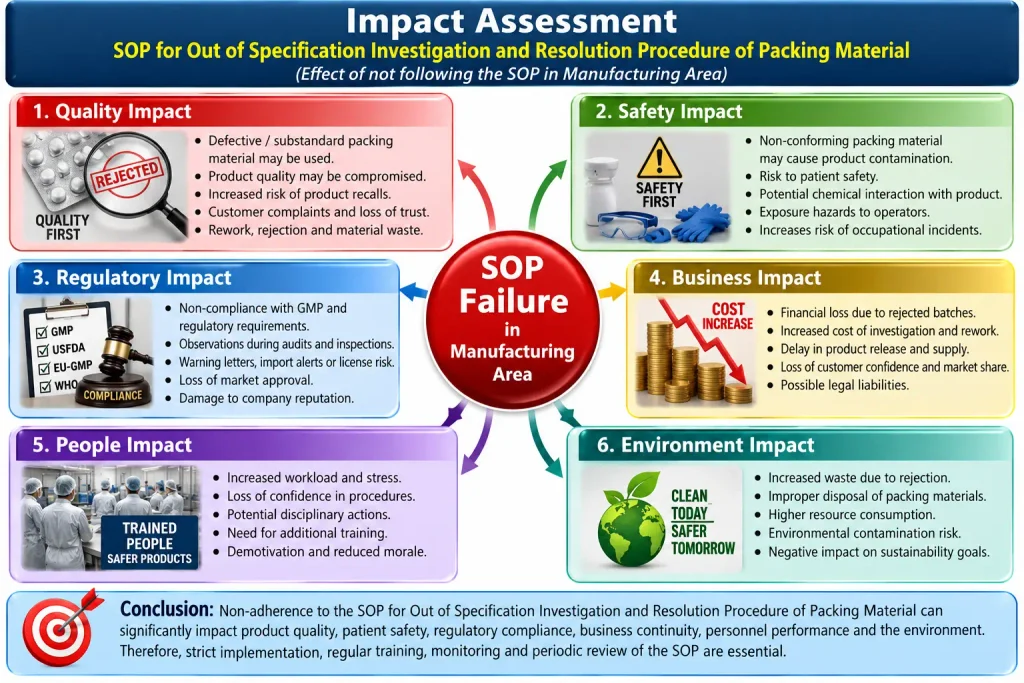
Failure to follow the procedure may result in incomplete investigations, incorrect interpretation of analytical results, delayed identification of assignable causes, inappropriate retesting, and unsuitable release or rejection decisions. The SOP assigns responsibility to QC personnel and requires QA/QC management oversight for effective implementation. Corrective and preventive actions are also required where investigation findings identify system, analyst, equipment, or procedural deficiencies. The broader quality, safety, regulatory, business, personnel, and environmental impacts shown in the image are an illustrative risk interpretation of SOP failure rather than categories explicitly listed in the SOP.
Questions & Answers – SOP for Out of Specification Investigation and Resolution Procedure of Packing Material:
Q1. What is the objective of this SOP?
Answer: The objective is to define the procedure for reporting, investigating, evaluating, and documenting Out of Specification (OOS) test results and to support an appropriate batch-disposition decision for packing material.
Q2. What is the scope of this SOP?
Answer: It applies to OOS results observed during testing of packing materials. The procedure does not apply to OOS results obtained during microbiological analysis.
Q3. Who is responsible for execution of the SOP?
Answer: QC personnel are responsible for execution, while the Assistant Manager-QC, Manager-QC, and Head-QA/QC are responsible for effective implementation.
Q4. What is an Out of Specification result?
Answer: An OOS result is a test result falling outside the established specification or acceptance criteria defined in regulatory submissions, official compendia, SOPs, or company specifications.
Q5. What is a laboratory investigation?
Answer: It is a formal, documented investigation performed by laboratory management to determine whether an OOS result can be attributed to an analyst or laboratory error.
Q6. What is an assignable cause?
Answer: An assignable cause is a cause that can be demonstrated or reproduced, such as an analytical error or instrument error.
Q7. What is meant by analyst error?
Answer: Analyst error includes mistakes such as improper sample or standard preparation, calculation errors, use of expired standards or reagents, or incorrect instrument parameter settings.
Q8. What should be done when an OOS result is identified?
Answer: The analyst should immediately inform the Section Head. The Section Head reviews the details and informs Lab QA, which allocates an OOS number and issues the Laboratory Investigation Report.
Q9. What are the main sections of the Laboratory Investigation Report (LIR)?
Answer: The LIR contains six sections: reporting of OOS, assessment of analytical data, experimentation, assignable cause identified, full-scale OOS investigation, and evaluation/conclusion/CAPA.
Q10. What activities are performed during Phase-I investigation?
Answer: Phase-I includes analyst interview and competency verification, assessment of methodology, instrumentation and calculations, review of sampling and analytical data, and experimentation to determine the root cause.
Q11. Within what time should the initial laboratory investigation be completed?
Answer: The initial investigation involving analyst interview, data assessment, sampling review, and calculation review should be completed within 48 hours of reporting the OOS result. Experimentation may extend beyond 48 hours.
Q12. What should be checked regarding instruments during investigation?
Answer: Instrument performance should be verified, including calibration, maintenance, and cleanliness.
Q13. When is Phase-II investigation initiated?
Answer: Phase-II is initiated when the cause cannot be determined during the initial investigation. It includes additional laboratory testing, quality-trend review, and batch-disposition evaluation.
Q14. Who performs additional testing during Phase-II?
Answer: Additional laboratory testing should be performed by a second analyst who is qualified in the applicable analytical methodology, in the presence of the Section Head and Lab QA.
Q15. When is re-sampling permitted?
Answer: Re-sampling is permitted only with adequate justification, such as when the original sample is non-representative, damaged, mixed up, exposed to inappropriate storage conditions, or exhausted.
Q16. What should be done when an assignable cause is identified?
Answer: The identified cause should be documented, appropriate corrective action should be implemented, affected erroneous data should be invalidated where applicable, and the findings should be evaluated by the responsible QC/QA personnel.
Q17. What is Corrective Action?
Answer: Corrective Action is action taken to eliminate the cause of an existing non-conformity or undesirable situation to prevent recurrence.
Q18. What is Preventive Action?
Answer: Preventive Action is action taken to eliminate the cause of a potential non-conformity or undesirable situation to prevent its occurrence.
Q19. Can investigation data generated during instrument malfunction be used for sample evaluation?
Answer: No. Data affected by instrument malfunction should be invalidated, the cause should be corrected, and if necessary the investigation should continue using another qualified instrument.
Q20. Why is trending of OOS results important?
Answer: Routine trending helps identify recurring problem areas. Frequent laboratory errors may indicate inadequate training, poorly maintained or improperly calibrated equipment, or inappropriate working practices requiring corrective action.
Reference Guidelines – SOP for Out-of-Specification Investigation and Resolution Procedure of Packing Material:
- SOP – Sampling of Packing Material (PM)
- SOP – Analytical Incidence Investigation and Resolution Procedure
- SOP – Handling of Out of Trend Analysis
- SOP – Deviation Handling
- SOP – Risk Management
- SOP – Corrective and Preventive Actions (CAPA)
- SOP – Handling of Rejected Materials