



1. Introduction:
Change Control is an important part of the pharmaceutical Quality Management System (QMS). It provides a controlled and documented method for managing any planned change that may affect the quality, safety, purity, potency, efficacy, or regulatory compliance of a pharmaceutical product. The main purpose of this SOP is to ensure that every proposed change is properly identified, evaluated, reviewed, approved, implemented, and finally assessed before closure. The Change Control procedure applies to a wide range of changes, including new products, manufacturing processes, process parameters, storage conditions, equipment, active and inactive ingredients, packaging materials, specifications, analytical methods, facilities, utilities, documents, computerized systems, software, and hardware. Changes may also involve building layouts, water systems, HVAC systems, equipment replacement or shifting, batch size, manufacturing instructions, in-process controls, raw-material sources, SOPs, validation documents, qualification protocols, specifications, and test procedures. According to the SOP, changes are generally classified as Minor or Major based on their potential impact on product quality, process validation, equipment, utilities, facilities, GMP compliance, and product effectiveness.The basic Change Control process includes identification of the change, proposal of the change, impact assessment, evaluation and approval, implementation, post-implementation review, and final closure. Quality Assurance plays a key role in allocating the change-control number, reviewing supporting documentation, coordinating evaluation, maintaining records, and confirming that the implemented change has achieved its intended purpose without negatively affecting product quality. A properly implemented Change Control system therefore helps ensure that modifications are introduced in a planned, traceable, scientifically justified, and controlled manner while maintaining the validated state and overall quality of pharmaceutical operations.
Skip to PDF content2. Flow Diagram:
The Change Control Flow Diagram explains the step-by-step process used to manage planned changes in a pharmaceutical Quality Management System. The process begins with identification of the change, where any required modification that may affect product quality, safety, process, equipment, facility, documentation, or GMP compliance is recognized. The proposed change is then formally documented with its reason, justification, and supporting information.
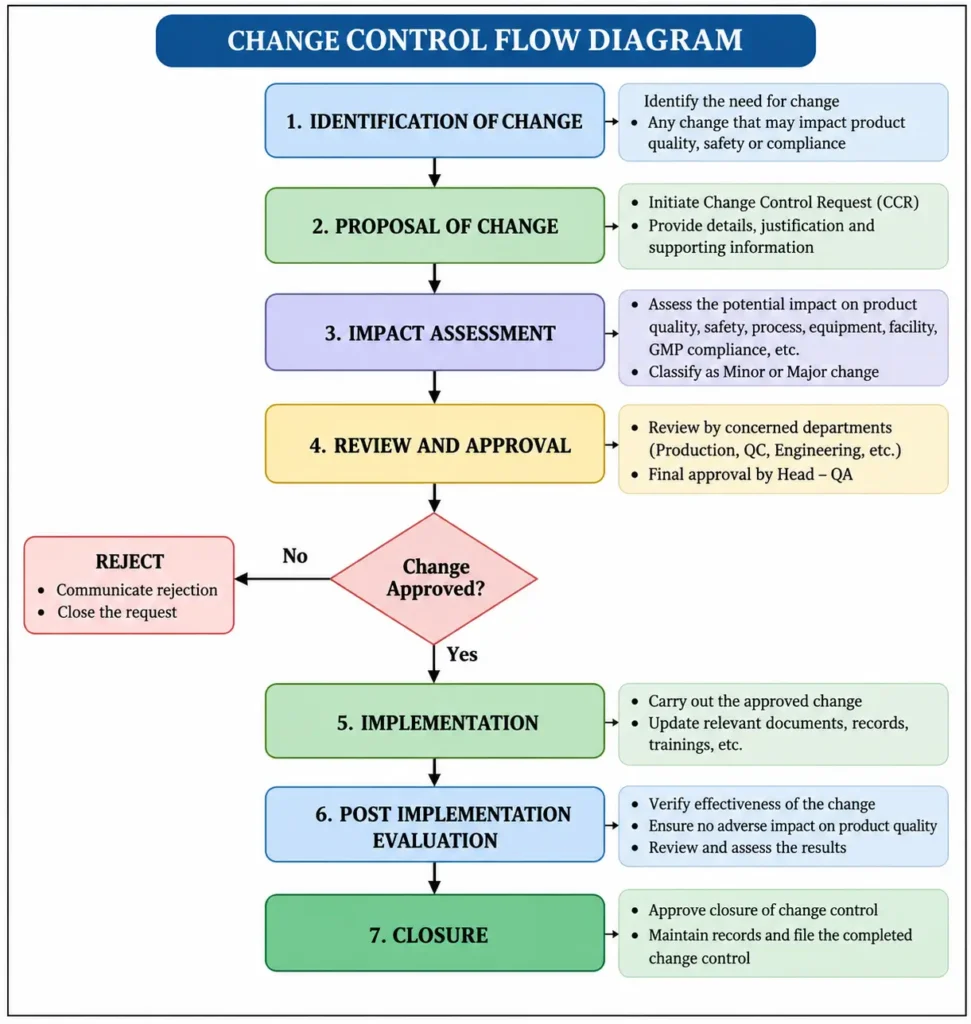
Next, an impact assessment is performed to understand possible effects of the change and to classify it appropriately, such as minor or major. The proposal is reviewed by concerned departments and Quality Assurance before a final decision is taken. If the change is rejected, the reason is documented and the request is closed. If approved, the change is implemented according to the defined action plan. After implementation, a post-implementation evaluation is carried out to confirm that the intended objective has been achieved without negatively affecting product quality. Supporting documents, records, and training are also reviewed. Once all actions are completed satisfactorily, Quality Assurance approves the final closure of the change control and maintains the associated records. This systematic process ensures that changes are controlled, traceable, evaluated, and properly documented throughout their lifecycle.
3. Benefits of Following the Change Control SOP:
The Benefits of Following the Change Control SOP diagram explains how a controlled change management system supports pharmaceutical quality and GMP compliance. The SOP ensures that every proposed change is properly identified, assessed, reviewed, approved, implemented, and documented before closure. This helps prevent unauthorized or poorly evaluated changes that could affect product quality, safety, process performance, equipment, utilities, facilities, or documentation.
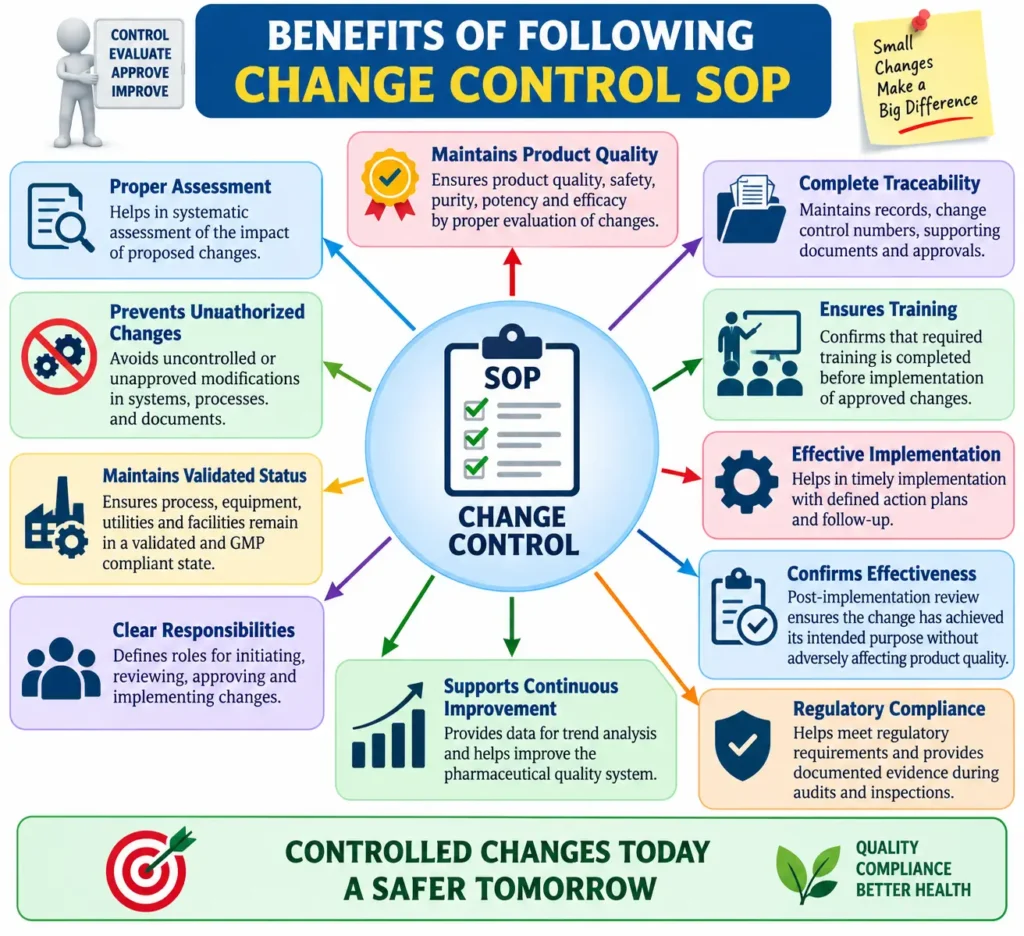
Proper use of the Change Control SOP also provides clear responsibilities to the concerned departments and Quality Assurance. It supports complete traceability through change-control records, approval documents, supporting evidence, and implementation details. Training can be conducted before implementation whenever required, helping personnel understand and correctly apply the approved change.Another important benefit is the post-implementation review, which confirms that the intended objective of the change has been achieved without negatively affecting product quality, purity, or potency. Unsatisfactory or incomplete actions remain open until properly resolved. Overall, following the Change Control SOP promotes product quality, compliance, traceability, validated status, accountability, effective implementation, and continuous improvement within the pharmaceutical Quality Management System.
4. Brainstorming for SOP Failure:
The Brainstorming Diagram for SOP Failure in Worst Manufacturing Area & Documented Error shows the possible reasons why an SOP may not be followed correctly in a pharmaceutical manufacturing area. The main problem is placed at the center, while different causes are shown around it.
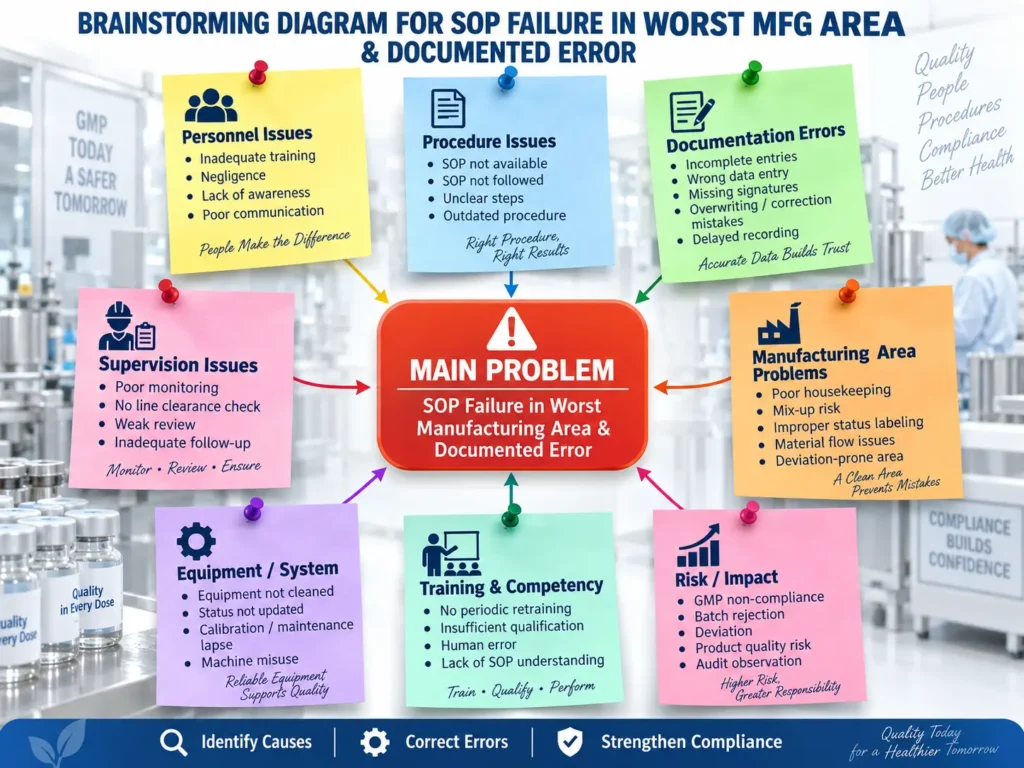
The diagram highlights personnel issues such as poor training, negligence, lack of awareness, and weak communication. It also includes procedure-related issues like SOP not being available, unclear instructions, outdated procedures, or steps not being followed properly. Documentation errors may include incomplete entries, wrong data, missing signatures, correction mistakes, and delayed recording. Other possible causes are poor supervision, improper line clearance, equipment not being cleaned or maintained, weak status labeling, poor housekeeping, material flow problems, and lack of retraining. These failures can lead to GMP non-compliance, deviations, batch rejection, audit observations, and product quality risks. The brainstorming exercise helps identify possible causes so that suitable corrective and preventive actions can be planned.
5. 5-Why Analysis for SOP Failure:
The 5-Why Analysis for SOP Failure in the Manufacturing Area is used to identify the real reason behind an SOP not being followed correctly. The analysis starts with the main problem and then repeatedly asks “Why?” until the root cause becomes clear.
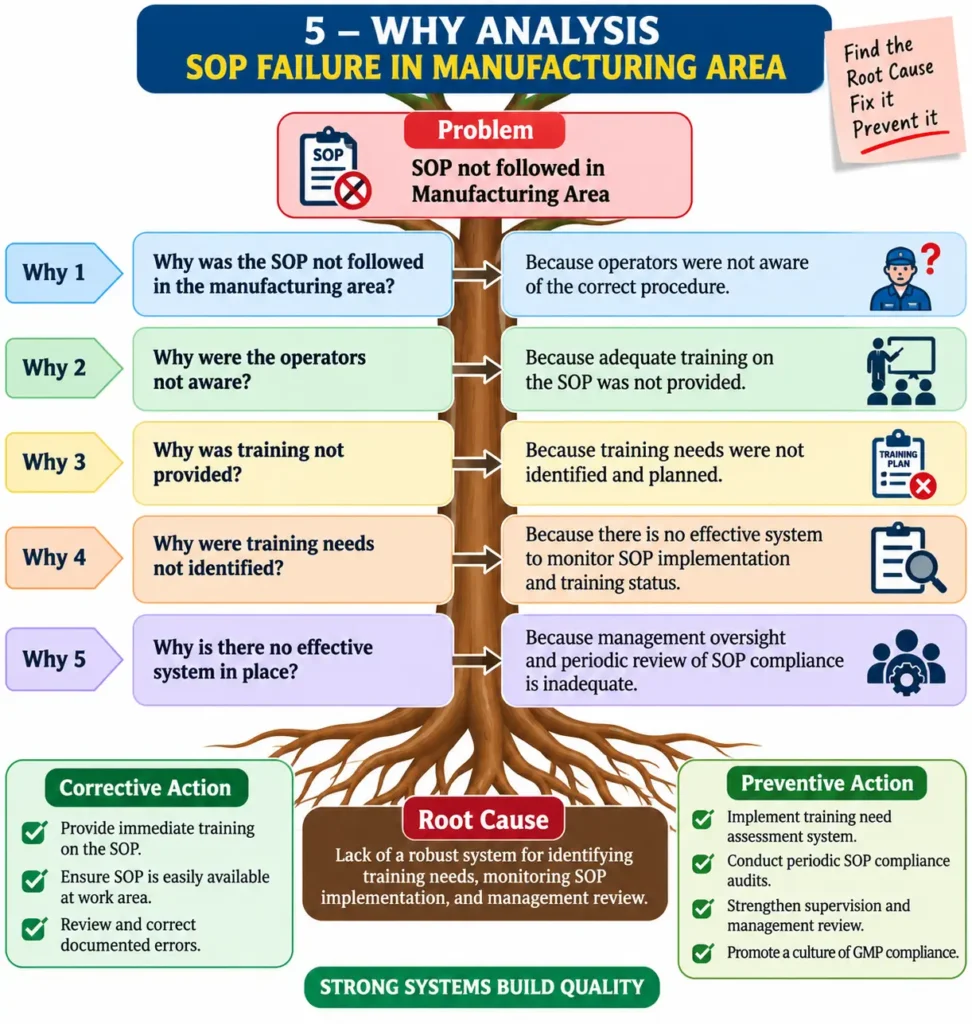
In this example, the SOP was not followed because operators were not fully aware of the correct procedure. This happened because adequate SOP training was not provided. The next level shows that training needs were not properly identified or planned. Further analysis indicates that there was no effective system for monitoring SOP implementation and training status. Finally, the deeper root cause is linked to weak management oversight and insufficient periodic review of SOP compliance. The analysis shows that the problem is not only related to operator error. It can also result from weaknesses in the training system, supervision, monitoring, and management review. Corrective actions may include immediate SOP training, ensuring SOP availability at the workplace, and correcting documentation errors. Preventive actions include periodic compliance audits, training-need assessment, stronger supervision, and regular management review.
6. Fishbone Analysis for SOP Failure:
The Fishbone Analysis for SOP Failure in the Manufacturing Area helps identify the possible causes that can lead to poor SOP compliance, documentation errors, deviations, and GMP non-compliance.The diagram groups the causes into six main areas: Personnel, Method/Procedure, Machine/Equipment, Material/Documentation, Environment/Area Condition, and Supervision/Management. Personnel-related causes may include inadequate training, negligence, lack of awareness, poor communication, and high workload. Procedure-related causes include unavailable SOPs, unclear steps, outdated procedures, or failure to follow the approved SOP.
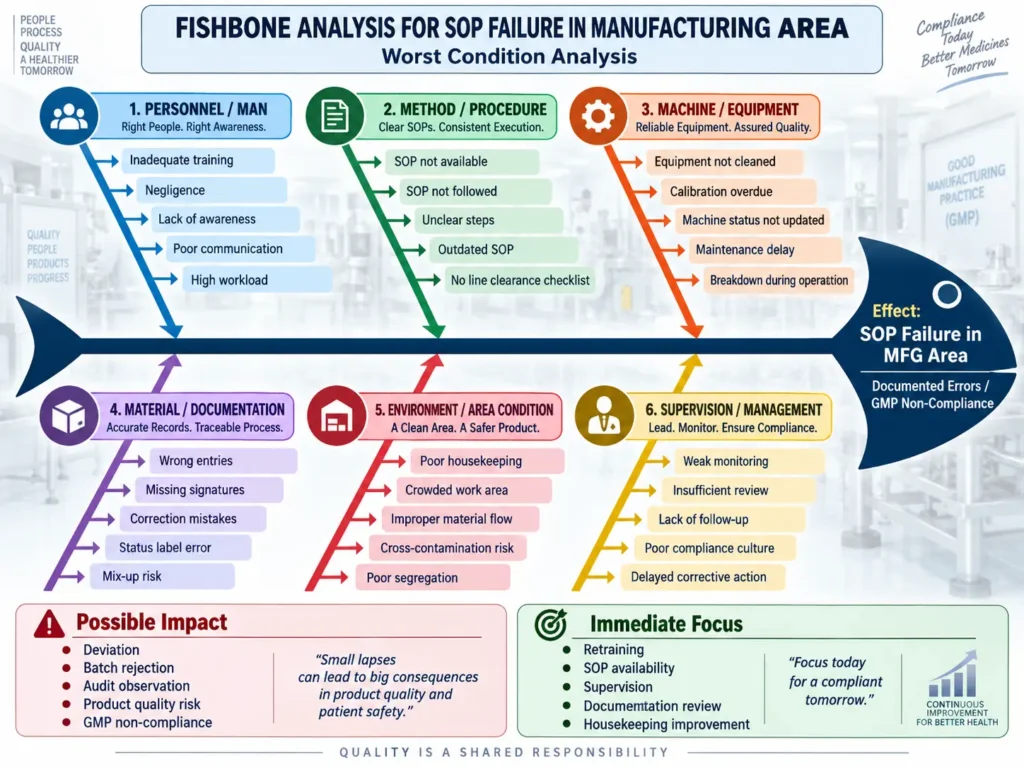
Equipment-related problems such as poor cleaning, overdue calibration, delayed maintenance, or breakdowns may also contribute. Documentation issues can include wrong entries, missing signatures, correction mistakes, status-label errors, and mix-up risks. Poor housekeeping, improper material flow, crowding, and weak segregation may create further risks in the manufacturing area.The analysis also shows that weak supervision, insufficient review, poor follow-up, and delayed corrective actions can increase the chance of SOP failure. Overall, the Fishbone Analysis helps identify the root causes systematically so that suitable corrective and preventive actions can be taken to improve GMP compliance and product quality.
7. Fault Tree Analysis for SOP Failure:
The Fault Tree Analysis for SOP Failure in the Manufacturing Area shows, in simple language, the main reasons that can lead to an SOP failure. The top event is “SOP Failure in MFG Area.” The diagram divides the possible causes into six groups: People, SOP, Documents, Machine, Area, and Supervision.
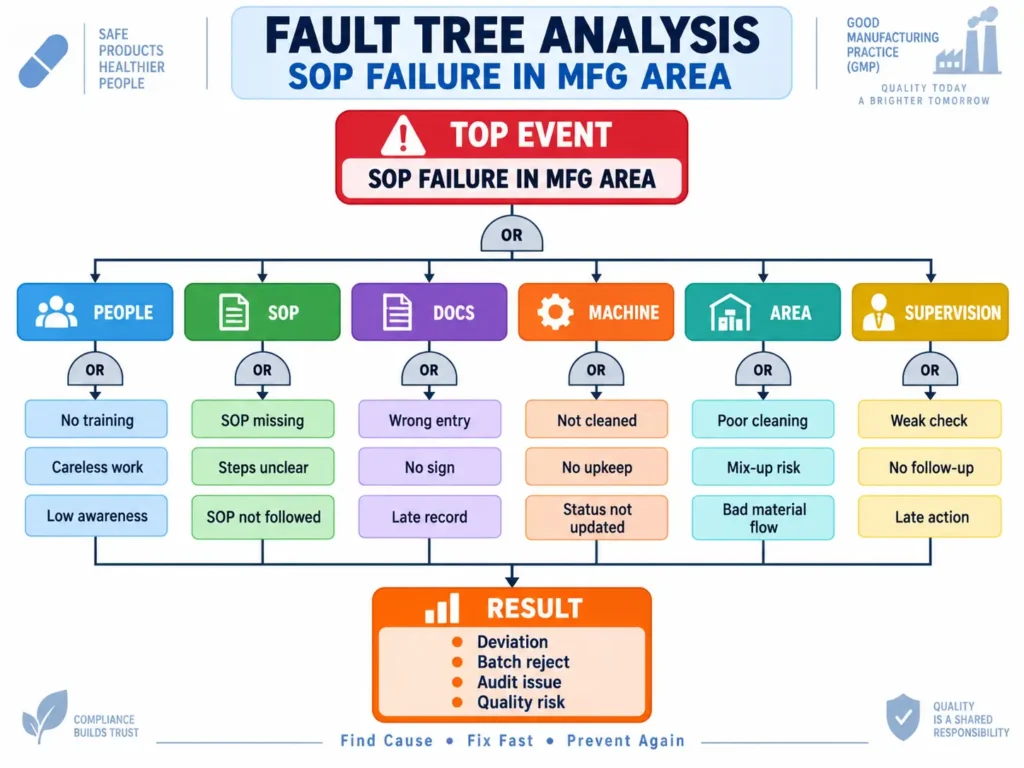
People-related causes include no training, careless work, and low awareness. SOP-related causes include missing SOP, unclear steps, or SOP not followed. Documentation problems may include wrong entries, missing signatures, and late recording. Machine-related causes include poor cleaning, lack of upkeep, and status not being updated. Area-related causes may involve poor cleaning, mix-up risk, and improper material flow. Weak supervision can also contribute through poor checking, lack of follow-up, and delayed action. These failures can result in deviations, batch rejection, audit issues, and product quality risk. The diagram helps identify possible causes quickly so that suitable corrective and preventive actions can be taken.
8. Impact Assessment:
The Impact Assessment diagram explains in simple language how a proposed change should be checked before implementation. The first step is to clearly understand what is being changed, such as a process, equipment, material, document, facility, or system. Next, the responsible team identifies which areas may be affected, including product quality, patient safety, process performance, equipment, documentation, and GMP compliance. This matches the Change Control SOP requirement that changes affecting product quality and safety must be identified, reviewed, and approved.
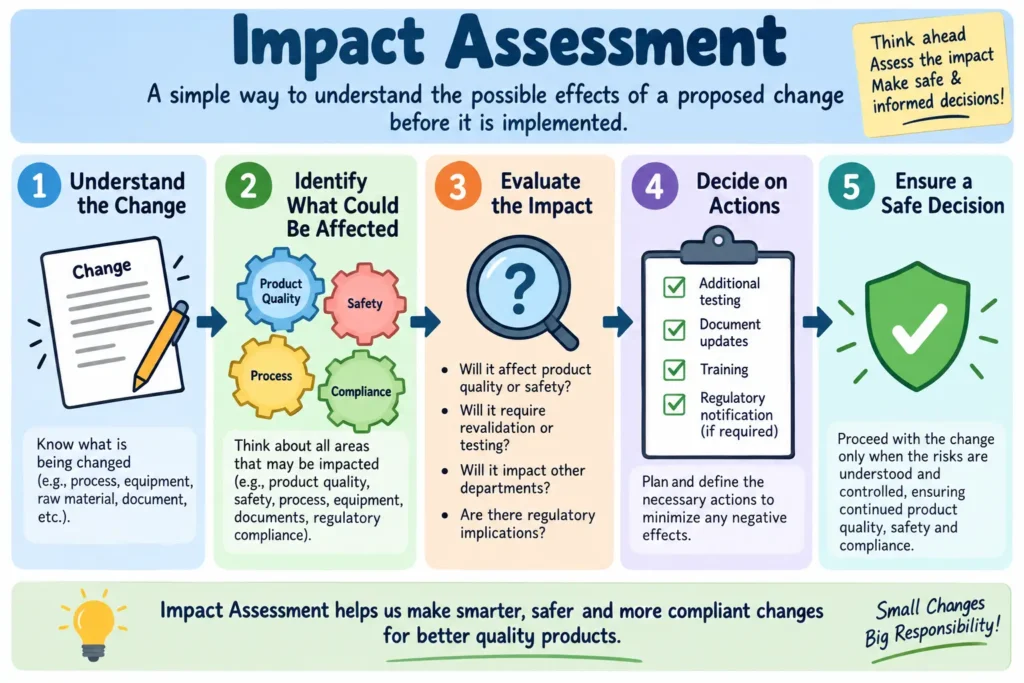
The possible impact is then evaluated to determine whether additional testing, validation, document revision, training, or regulatory action is required. The SOP also requires evaluation to confirm that the objective of the change is achieved without negatively affecting quality parameters. Finally, the change should proceed only when identified risks are properly controlled. After implementation, QA reviews the results to ensure that product quality, purity, and potency remain acceptable before change control closure.
Questions & Answers:
- What is Change Control?
Change Control is a documented system used to identify, review, approve, implement, and close changes that may affect product quality, safety, process, equipment, facility, documents, or GMP compliance. - Why is Change Control required?
It ensures that any proposed change is properly evaluated and approved before implementation so that product quality and safety are not negatively affected. - What types of changes are covered under this SOP?
Changes may involve products, processes, process parameters, equipment, materials, packaging materials, facilities, utilities, analytical methods, documents, and computer systems. - Who can initiate a Change Control?
A Chemist, Officer, or Executive may raise the Change Control request, while department managers are responsible for identifying and following up required actions. - Who gives final QA approval?
Head-QA is responsible for independent evaluation and approval of the proposed Change Control. - What is a Minor Change?
A Minor Change has minimal potential to adversely affect product identity, safety, strength, quality, purity, efficacy, validation status, or GMP compliance. - What is a Major Change?
A Major Change has substantial or moderate potential to affect product quality, safety, efficacy, validation status, equipment, facility, utility, or GMP systems. - What are the main steps of Change Control?
The main steps are identification of change, proposal of change, evaluation and approval or rejection, implementation, and post-implementation evaluation. - What is Impact Assessment?
Impact Assessment is the evaluation of how a proposed change may affect product quality, process, equipment, documents, facility, testing, validation, or compliance before approval and implementation. The SOP requires supporting evidence where necessary to show that the impact of the change has been studied. - Why is Impact Assessment important?
It helps confirm that the proposed change can achieve its objective without adversely affecting quality parameters. - What should be checked during Impact Assessment?
The change should be reviewed for its possible effect on product, documents, systems, facility, process, materials, equipment, analytical methods, validation, and regulatory requirements. - Can a change be implemented before approval?
The SOP describes evaluation and approval before implementation, with approval or rejection by designated responsible personnel. - Is training required after a change?
Yes, where required, training must be conducted for concerned departments before implementation, and training records should be attached to the Change Control. - What is Post-Implementation Review?
It is the review performed after implementation to confirm that the change has not adversely affected product quality, purity, or potency and that the intended requirement has been achieved. - When can a Change Control be closed?
It can be closed when all planned actions are completed satisfactorily and QA has reviewed the supporting evidence. If actions remain incomplete or unsatisfactory, the Change Control remains open. - What is the target closure time for Change Control?
According to the SOP, Major Change Controls should be closed within 60 working days, while Minor Change Controls should be closed within 30 working days after the logging date. - What happens if the Change Control cannot be closed on time?
The closure date may be extended after discussion with Head-QA and with proper justification. The SOP allows up to three extensions. - What happens if three extensions are completed but the issue is still unresolved?
The existing Change Control should be closed and a new Change Control should be raised by QA. - Is Change Control trending required?
Yes. QA should perform Change Control trend analysis on a half-yearly basis and review changes by categories such as facility, documents, products, and machines. - What is the main benefit of proper Change Control?
It provides a controlled and documented way to make changes while protecting product quality, safety, compliance, and validated status.
Reference Guidelines:
- ICH Q10 – Pharmaceutical Quality System, Section 3.2.3: Change Management System
Requires an effective system for evaluating, approving, implementing, and reviewing changes. It specifically recommends using quality risk management to assess proposed changes and conducting post-implementation evaluation. (ICH Database)
ICH Q10 – Pharmaceutical Quality System - ICH Q9(R1) – Quality Risk Management
Provides principles for identifying, assessing, controlling, communicating, and reviewing quality risks. It also describes tools such as FMEA, FTA, HACCP and HAZOP, which can support change impact assessment. (ICH Database)
ICH Q9(R1) – Quality Risk Management - ICH Q12 – Pharmaceutical Product Lifecycle Management
Provides guidance for managing post-approval manufacturing and CMC changes through an effective Pharmaceutical Quality System and change-management process. (ICH Database) - EU GMP – EudraLex Volume 4, Chapter 1: Pharmaceutical Quality System
Describes pharmaceutical quality-system expectations aligned with ICH Q10, including controlled management of planned changes and risk-based decision-making. (Public Health) - EU GMP – Annex 15: Qualification and Validation
Relevant where a change affects facilities, utilities, equipment, manufacturing processes, cleaning, qualification, or validation. The current Annex 15 has been operational since 1 October 2015. (Public Health)
EU GMP Volume 4 and Annex 15 - PIC/S GMP Guide PE 009-17 – Part I, Pharmaceutical Quality System
Provides GMP expectations for pharmaceutical quality systems and is aligned with the principles of ICH Q10. (PIC Scheme) - WHO GMP – Quality Assurance of Pharmaceuticals, 10th Edition
WHO’s GMP compendium covers pharmaceutical quality systems, manufacturing controls, validation, quality risk management, and other GMP elements useful when assessing the impact of changes. (World Health Organization)
WHO GMP Compendium – Volume 2