






1. Brief Description:
This SOP defines a systematic procedure for initiating, evaluating, approving, implementing, and closing changes related to pharmaceutical documents, facilities, equipment, instruments, processes, validation activities, vendors, and products. Proposed changes are supported with justification and relevant documents, assessed by the concerned department and Quality Assurance, and classified as minor, moderate, or major according to their potential effect on product quality, validated status, process performance, stability, and regulatory commitments. Regulatory Affairs and other departments participate when applicable. Each approved change receives a unique control number and is tracked through implementation, verification, training, validation or qualification, document revision, communication, and effectiveness review. Quality Assurance retains the completed change-control records to provide traceability and ensure that the facility, systems, processes, and products remain compliant and in a validated state.
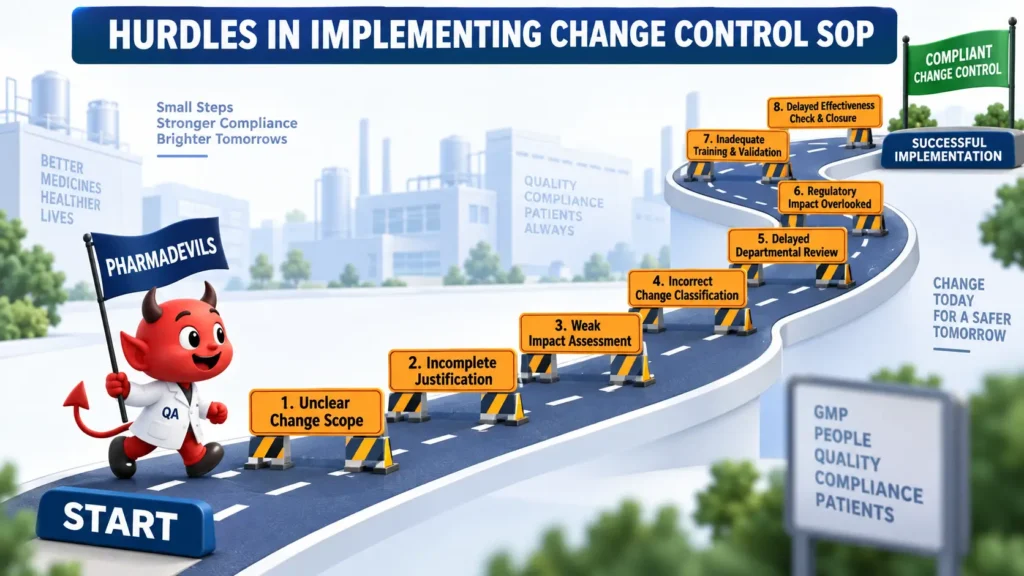
Skip to PDF content2. Hurdles in Implementing Change Control SOP at Plant:
Implementation of the Change Control SOP at a pharmaceutical plant may face hurdles such as unclear definition of the proposed change, incomplete justification, weak impact and risk assessment, and incorrect classification as minor, moderate, or major. Delayed reviews by QA, Production, Engineering, QC, Validation, and Regulatory Affairs can postpone approval and execution. Other challenges include insufficient resources, undefined responsibilities, inadequate supporting documents, poor communication, and failure to assess effects on product quality, patient safety, validated status, stability, regulatory filings, and related documents. Inadequate employee training, incomplete qualification or validation, uncontrolled implementation, and delayed effectiveness verification may further compromise compliance. These hurdles can be controlled through cross-functional planning, risk-based evaluation, defined timelines, proper documentation, QA oversight, training, action tracking, and formal closure after confirming that the change achieved its intended purpose without adversely affecting product quality.
3. Process Mapping:
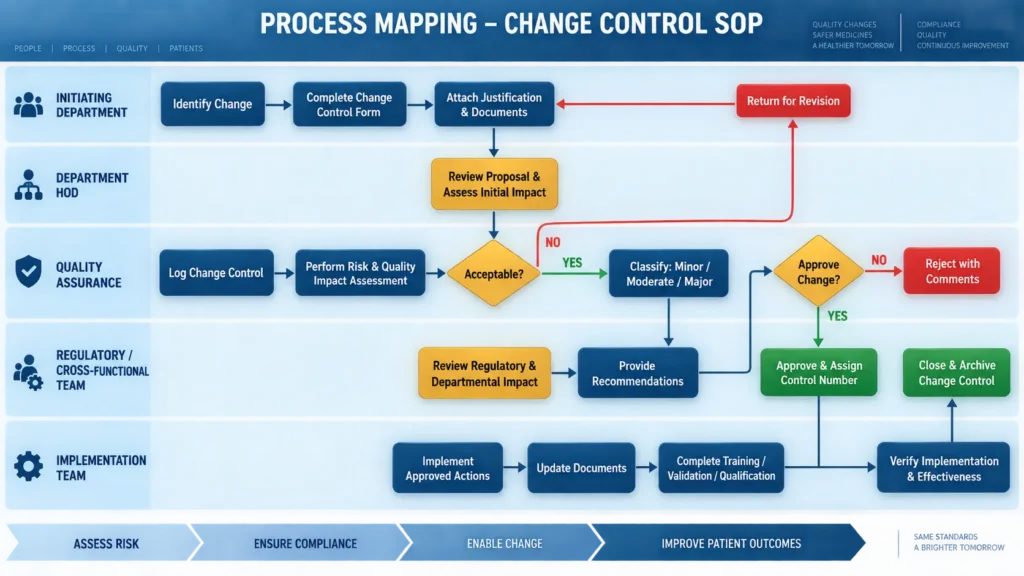
The process mapping diagram presents the complete cross-functional workflow for managing changes at a pharmaceutical plant. The process begins when the initiating department identifies a required change, completes the Change Control Form, and submits supporting documents and justification. The departmental HOD reviews the proposal and performs an initial impact assessment. Quality Assurance registers the change, evaluates quality and risk implications, and classifies it as minor, moderate, or major. Regulatory Affairs and other affected departments assess regulatory, technical, validation, stability, and documentation impacts. If the proposal is unacceptable, it is returned for revision or rejected with documented comments. Following approval and assignment of a unique control number, the implementation team completes authorized actions, document revisions, training, qualification, and validation. Quality Assurance then verifies implementation and effectiveness before formally closing and archiving the change-control record, ensuring traceability, product quality, regulatory compliance, and maintenance of the validated state.
4. Brainstorming:
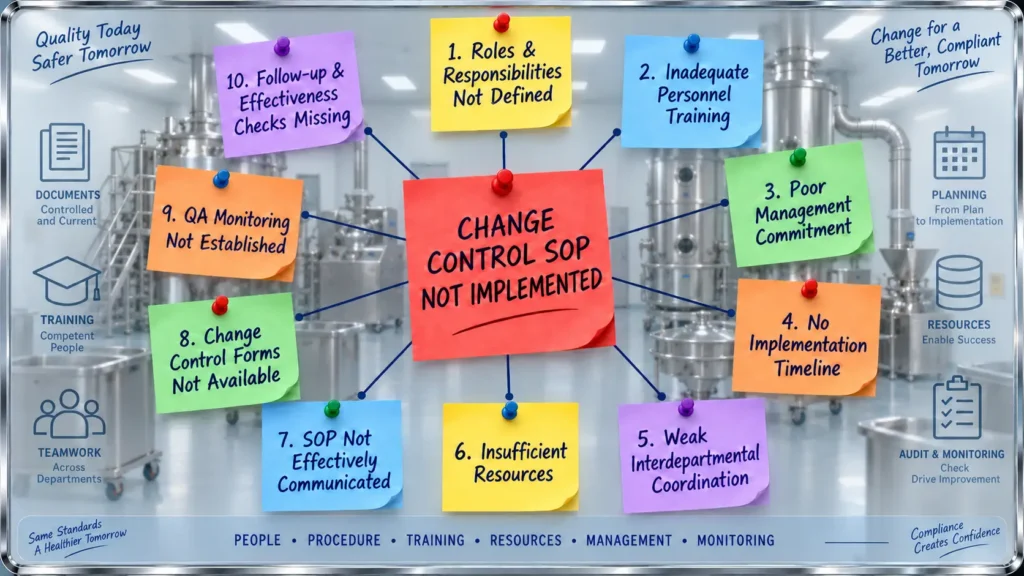
The brainstorming analysis identifies potential reasons why the Change Control SOP was not effectively implemented at the pharmaceutical plant. The main contributing factors include undefined roles and responsibilities, inadequate personnel training, insufficient management commitment, absence of an implementation timeline, weak interdepartmental coordination, and limited resources. Other possible causes include poor communication of the approved SOP, unavailability of change-control forms, inadequate QA monitoring, and missing follow-up or effectiveness checks. These factors may result in uncontrolled changes, incomplete documentation, delayed approvals, loss of traceability, regulatory non-compliance, and potential effects on product quality or validated status. The brainstorming results should be further evaluated through root-cause analysis and risk assessment to identify the actual causes and establish appropriate corrective and preventive actions.
5. 5-Why Analysis:
The 5-Why analysis evaluates the underlying reasons for non-implementation of the Change Control SOP. The investigation indicates that personnel did not follow the approved procedure because the required training was not completed. Training remained incomplete because responsibilities and implementation timelines were not clearly defined. This gap continued because QA had not established an effective system for tracking implementation and conducting follow-up. Ultimately, inadequate management oversight of Pharmaceutical Quality System activities allowed the implementation failure to remain unidentified and unresolved.
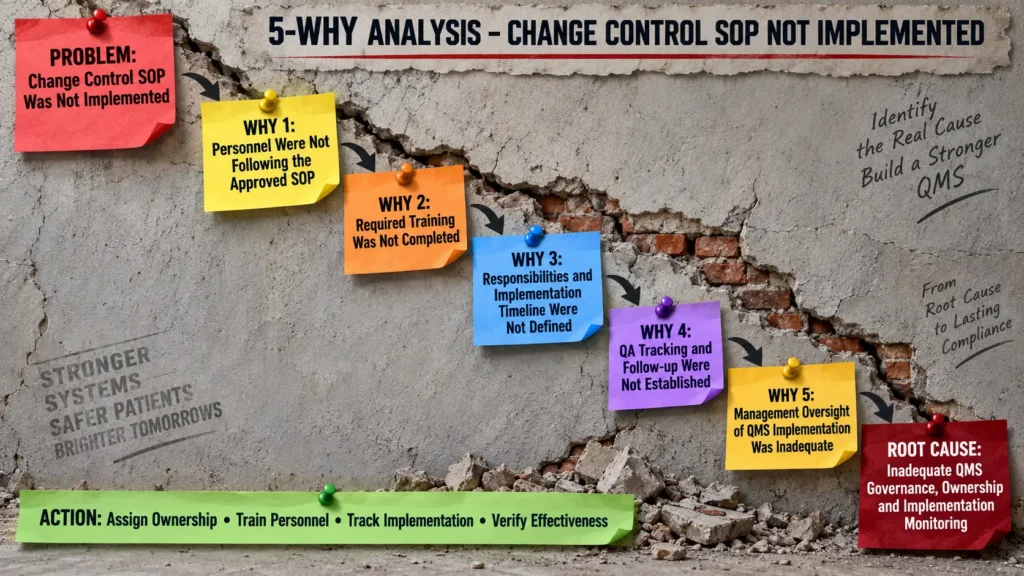
The identified root cause is inadequate QMS governance, ownership, and implementation monitoring. Recommended actions include assigning accountable owners, completing documented training, defining implementation timelines, monitoring progress through QA, escalating overdue activities, and verifying effectiveness before formal closure.
6. Risk Heat Map:
The risk heat map evaluates the potential consequences of not implementing the Change Control SOP by comparing each hazard’s severity and likelihood. The assessment identifies product-quality impact and regulatory non-compliance as critical risks. Loss of validated status, poor document traceability, untrained personnel, and mix-up or contamination are categorized as significant high risks. Delayed implementation and ineffective closure may also permit uncontrolled changes to remain unresolved.
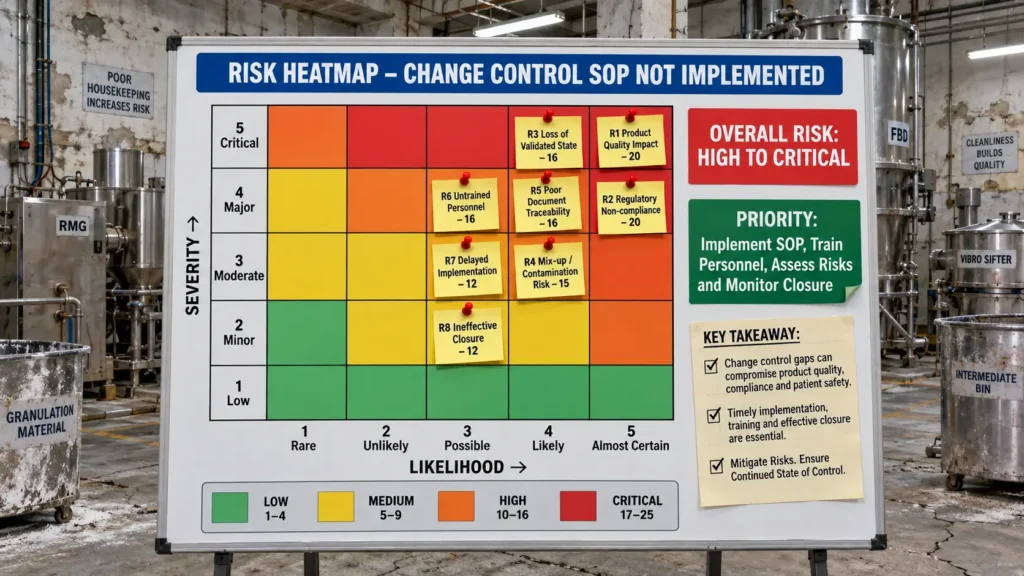
The overall risk level is considered high to critical, requiring immediate corrective action. Priority measures include implementing the approved SOP, assigning accountable personnel, completing training, performing documented impact and risk assessments, controlling all proposed changes, monitoring action timelines, and verifying effectiveness before QA closure.
Impact Assessment – Change Control SOP Not Implemented
Assessment scenario: The approved Change Control SOP was not implemented at the pharmaceutical manufacturing plant.
| Impact area | Potential impact | Risk |
|---|---|---|
| Product quality | Changes may affect identity, strength, purity, safety, stability or performance without evaluation. | Critical |
| Patient safety | Uncontrolled changes could introduce contamination, mix-up, dosage or packaging risks. | Critical |
| Validated status | Processes, facilities, equipment, utilities and analytical methods may lose their validated state. | High |
| Regulatory compliance | Changes may be implemented without assessing filing, approval or notification requirements. | Critical |
| Documentation | BMR, BPR, specifications, STPs, SOPs, drawings and formats may remain outdated or inconsistent. | High |
| Qualification and validation | Required DQ, IQ, OQ, PQ, process validation or cleaning validation may not be performed. | High |
| Stability | Changes affecting formulation, process, packaging or storage may not be supported by stability studies. | High |
| Manufacturing process | Unassessed changes may adversely affect critical process parameters, yield or reproducibility. | High |
| Quality control | Test methods, specifications, limits or instruments may be changed without proper evaluation. | High |
| Data integrity | Missing approvals and incomplete records may weaken traceability and accountability. | High |
| Training | Employees may follow obsolete documents or incorrectly execute revised activities. | High |
| Supplier/material control | Vendor, grade, source or material changes may be introduced without qualification. | High |
| Customer commitments | Customer-specific requirements may be affected without notification or approval. | Medium–High |
| Audit readiness | Absence of change records may result in major or critical regulatory observations. | Critical |
| Business continuity | Delayed approvals, batch holds, rejection, recalls or regulatory actions may occur. | High |
Overall Assessment
The non-implementation of the Change Control SOP presents a high-to-critical compliance and product-quality risk. It may permit changes to be introduced without documented justification, risk assessment, QA approval, regulatory evaluation, validation, training, effectiveness verification or formal closure.
Immediate Actions
- Stop or place on hold all unapproved changes.
- Identify changes implemented after the SOP’s effective date.
- Perform retrospective impact and risk assessments.
- Evaluate affected batches, products, systems and regulatory commitments.
- Initiate deviations and CAPA where required.
- assign responsible owners and implementation timelines.
- Train all affected employees and document training effectiveness.
- Establish a QA-controlled change register and monitoring system.
- Complete pending qualification, validation and stability activities.
- Verify effectiveness before formal QA closure.
Conclusion: No direct product-quality impact should be concluded until retrospective assessment and supporting evidence confirm that affected changes remained controlled.
Questions and Answers – Change Control SOP
1. What is change control?
Change control is a formal system for reviewing, approving, implementing, verifying and documenting changes that may affect product quality, regulatory compliance or validated status.
2. When should change control be initiated?
It should be initiated before making any planned change to documents, facilities, equipment, instruments, materials, vendors, processes, specifications, methods, validation activities or products.
3. Who can initiate a change control?
An authorized person from the concerned department may initiate it, followed by review and justification from the departmental HOD.
4. What information should the initiator provide?
The form should include:
- Present status
- Proposed change
- Reason and justification
- Supporting documents
- Expected benefits
- Preliminary impact
- Proposed implementation timeline
5. Who evaluates the proposed change?
Quality Assurance coordinates the evaluation with the concerned department, Regulatory Affairs, QC, Production, Engineering, Validation and other affected functions.
6. How are changes classified?
Changes are classified as minor, moderate or major according to their potential effect on product quality, process performance, validated status and regulatory commitments.
7. What is a minor change?
A minor change is unlikely to significantly affect product quality, process performance, validation status or regulatory filings.
8. What is a moderate change?
A moderate change improves a process, product, material, equipment or system and requires documented evaluation but is not expected to adversely affect product quality.
9. What is a major change?
A major change may affect critical quality attributes, process parameters, impurity profile, stability, yield, validated status or approved regulatory information.
10. What should be covered in the impact assessment?
The assessment should consider:
- Product quality and patient safety
- CPPs and CQAs
- Validation and qualification
- Stability and impurity profile
- Specifications and analytical methods
- BMR, BPR, SOPs and drawings
- Training requirements
- Regulatory and customer commitments
11. Can a change be implemented before QA approval?
No. A planned change should not be implemented until it has been evaluated and approved by authorized personnel, except where an approved emergency-change procedure applies.
12. What happens if the proposal is unacceptable?
QA rejects or returns the proposal with documented comments. The initiating department may revise and resubmit it with adequate justification.
13. How is an approved change identified?
QA assigns a unique change-control number and records the change in the controlled Change Control Register.
14. When is validation or qualification required?
It is required when the change may affect the validated performance of a facility, utility, equipment, process, cleaning procedure, analytical method or computerized system.
15. Is training required before implementation?
Yes. Affected personnel must be trained on revised procedures and documents before performing the changed activity.
16. Who communicates the approved change?
The initiating department communicates operational changes to affected users. QA communicates quality-system requirements, while Regulatory Affairs manages required agency notifications.
17. How is implementation verified?
QA reviews completed actions, approved documents, training records, validation or qualification reports, regulatory actions and supporting evidence.
18. What is an effectiveness check?
It confirms that the change achieved its intended objective without creating adverse effects on product quality, compliance, process performance or validated status.
19. When can change control be closed?
It may be closed after all approved actions are completed, implementation is verified, affected documents are updated, training is completed and effectiveness is demonstrated.
20. What is the impact if the SOP is not implemented?
Failure to implement the SOP may result in uncontrolled changes, loss of validated status, outdated documents, product-quality risks, regulatory non-compliance and critical audit observations.
Reference Guidelines –
- ICH Q10: Pharmaceutical Quality System – Section 3.2.3, Change Management System
Requires a formal, risk-based system for evaluating, approving, implementing and reviewing changes throughout the product lifecycle. - ICH Q9(R1): Quality Risk Management
Provides principles and tools for scientifically assessing, controlling, communicating and reviewing risks associated with proposed changes. - ICH Q12: Pharmaceutical Product Lifecycle Management
Describes regulatory management of post-approval CMC changes, established conditions and post-approval change-management protocols. - EU GMP Guide, Part I, Chapter 1: Pharmaceutical Quality System
Requires prospective evaluation and approval of planned changes, including regulatory notification and effectiveness evaluation after implementation. - EU GMP Annex 15: Qualification and Validation – Section 11, Change Control
Requires formal documentation and assessment of changes affecting facilities, equipment, utilities, processes, materials, methods or computerized systems. - PIC/S GMP Guide PE 009, Part I, Chapter 1 and Annex 15
Establishes expectations for pharmaceutical quality systems, risk-based change evaluation, qualification, validation and maintenance of the validated state. - PIC/S GMP Guide PE 009, Part II – Sections 13.10–13.17
Requires a formal change-control system for changes potentially affecting API production or control. - US FDA – 21 CFR Part 211
- §211.100(a): Changes to written production and process-control procedures must be drafted, reviewed and approved by appropriate organizational units.
- §211.160(a): Changes to laboratory controls must be reviewed and approved by the Quality Control Unit.
- §211.180: GMP records must be retained and remain available for inspection.
- WHO GMP for Pharmaceutical Products: Main Principles – TRS 986, Annex 2
Establishes Pharmaceutical Quality System requirements supporting documented control, authorization and evaluation of changes. - WHO Guidelines on Good Manufacturing Practices for Validation – TRS 1019, Annex 3
Requires changes affecting qualified or validated systems to be managed through an approved change-control procedure. - India Revised Schedule M – G.S.R. 922(E), dated 28 December 2023
Requires an effective Pharmaceutical Quality System covering lifecycle management, risk management, documented change evaluation and management responsibility.
Recommended primary references for the SOP: ICH Q10, ICH Q9(R1), Revised Schedule M, EU GMP Chapter 1, EU GMP Annex 15 and PIC/S PE 009.