







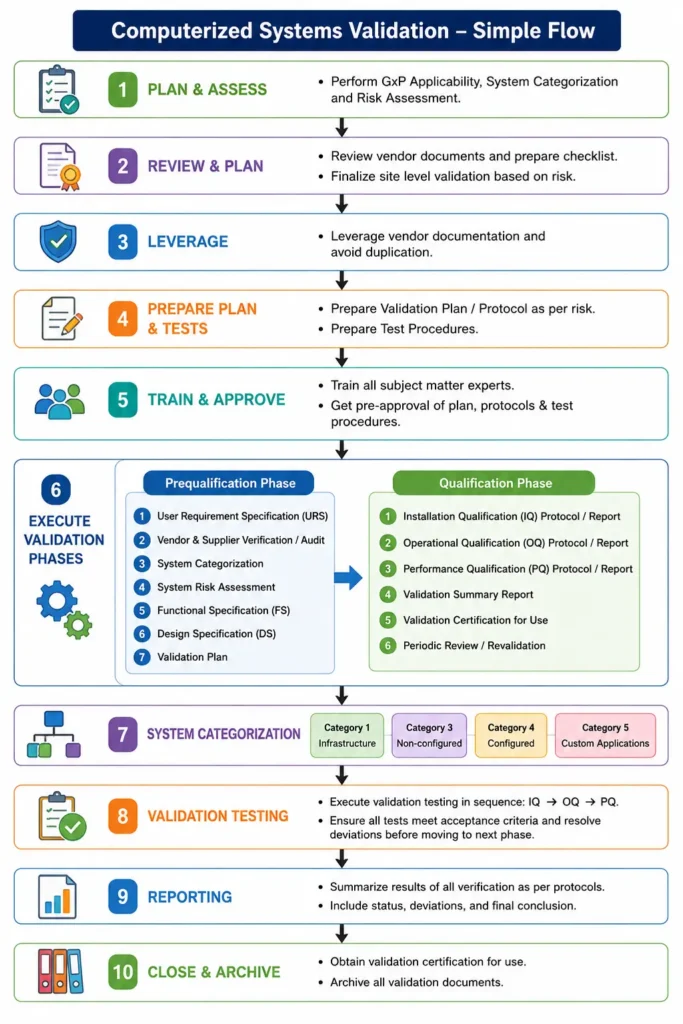
This SOP describes the procedure for validation of computerized systems used for GxP activities. It explains how to check whether a system is suitable, reliable, properly installed, and working as intended. The process starts with GxP applicability, system categorization, vendor review, and risk assessment. Based on the risk, a validation plan or protocol is prepared. The SOP includes User Requirement Specification, Functional Specification, Design Specification, and Configuration Specification. Validation testing is performed through Installation Qualification, Operational Qualification, and Performance Qualification in a proper sequence. All protocols and test procedures must be approved before execution, and trained personnel should perform the testing. Any deviation found during validation must be resolved before moving to the next stage. After successful testing, a validation report confirms that the system is fit for intended use. The SOP also covers periodic review, revalidation, system decommissioning, documentation, and required templates for maintaining proper records and regulatory compliance.
Impact Assessment
Implementation of this SOP will have a positive impact on the validation and control of computerized systems used for GxP activities. It provides a clear and step-by-step process for system categorization, risk assessment, vendor document review, validation planning, testing, and approval.
The SOP ensures that important documents such as URS, Functional Specification, Design Specification, Validation Plan, IQ, OQ, PQ, and Validation Summary Report are properly prepared and reviewed. It also requires validation testing to follow approved protocols and be performed in the correct sequence of IQ → OQ → PQ. Any deviation must be resolved before moving to the next stage.
This will improve system reliability, documentation, traceability, and compliance. It will also help ensure that computerized systems remain suitable for their intended use and are properly reviewed, revalidated, or decommissioned when required.
Question & Answers
Q1. What is the purpose of Computerized Systems Validation?
Answer: The purpose is to confirm that computerized systems used for GxP activities are properly validated and suitable for their intended use.
Q2. What should be done before starting validation?
Answer: GxP applicability, system categorization, and risk assessment should be performed first.
Q3. Why are vendor documents reviewed?
Answer: Vendor documents are reviewed to decide the required level of site validation and to avoid unnecessary duplication of validation activities.
Q4. What documents are included in the prequalification phase?
Answer: The main documents include URS, vendor/supplier verification, system categorization, risk assessment, Functional Specification, Design Specification, and Validation Plan.
Q5. What are the main qualification stages?
Answer: The main stages are Installation Qualification (IQ), Operational Qualification (OQ), and Performance Qualification (PQ).
Q6. In which sequence should validation testing be performed?
Answer: Validation testing should be performed in the sequence IQ → OQ → PQ.
Q7. What should be done if a deviation occurs during validation?
Answer: The deviation should be fully investigated, resolved, and approved before moving to the next validation stage.
Q8. What is included in the Validation Report?
Answer: The report should summarize the validation results and confirm whether the computerized system is fit for its intended use.
Q9. When is periodic review or revalidation required?
Answer: Periodic review or revalidation is performed to ensure that the validated system continues to remain suitable for use. The SOP lists it as part of the qualification lifecycle.
Q10. What happens when a computerized system is no longer required?
Answer: A change control should be initiated and the system should be formally decommissioned.