







1. Introduction:
A Standard Operating Procedure (SOP) is a controlled document that provides clear, step-by-step instructions for carrying out activities in a consistent, accurate, and approved manner. The SOP for Design and Control of Standard Operating Procedures establishes a uniform system for the preparation, review, approval, authorization, issue, distribution, revision, storage, and control of SOPs within the pharmaceutical organization. Its main purpose is to ensure that only the current and approved version of each SOP is available and used by concerned personnel. This procedure applies to departments such as Quality Assurance, Quality Control, Production, Stores, Finished Goods Stores, Maintenance, and Personnel & Administration. The concerned department is responsible for preparing the SOP, the department head checks it, and Quality Assurance/Quality Control provides final approval as defined in the document. The SOP also defines requirements for document formatting, numbering, headers and footers, pagination, annexures, revision history, and document identification. It establishes controls for Master Copies, Controlled Copies, Training Copies, Uncontrolled Copies, and Obsolete Copies, helping prevent accidental use of outdated or unauthorized documents. Periodic review and change control are important parts of the system. SOPs are reviewed within the defined review period and are revised when changes in processes, regulatory requirements, equipment, systems, or organizational practices occur. Superseded controlled copies are withdrawn, while obsolete master copies are appropriately identified and retained for reference. Overall, effective SOP design and document control support GMP compliance, consistency, traceability, training, accountability, and reliable pharmaceutical operations.
Skip to PDF content2. Flow Diagram:
The flow diagram explains the complete process for Design and Control of Standard Operating Procedures (SOPs) in a simple step-by-step manner. The process starts when a new SOP is required or an existing SOP needs revision. The concerned user department prepares the SOP in the specified format, and the Head of the User Department checks it before it is forwarded to Quality Assurance for review and approval.
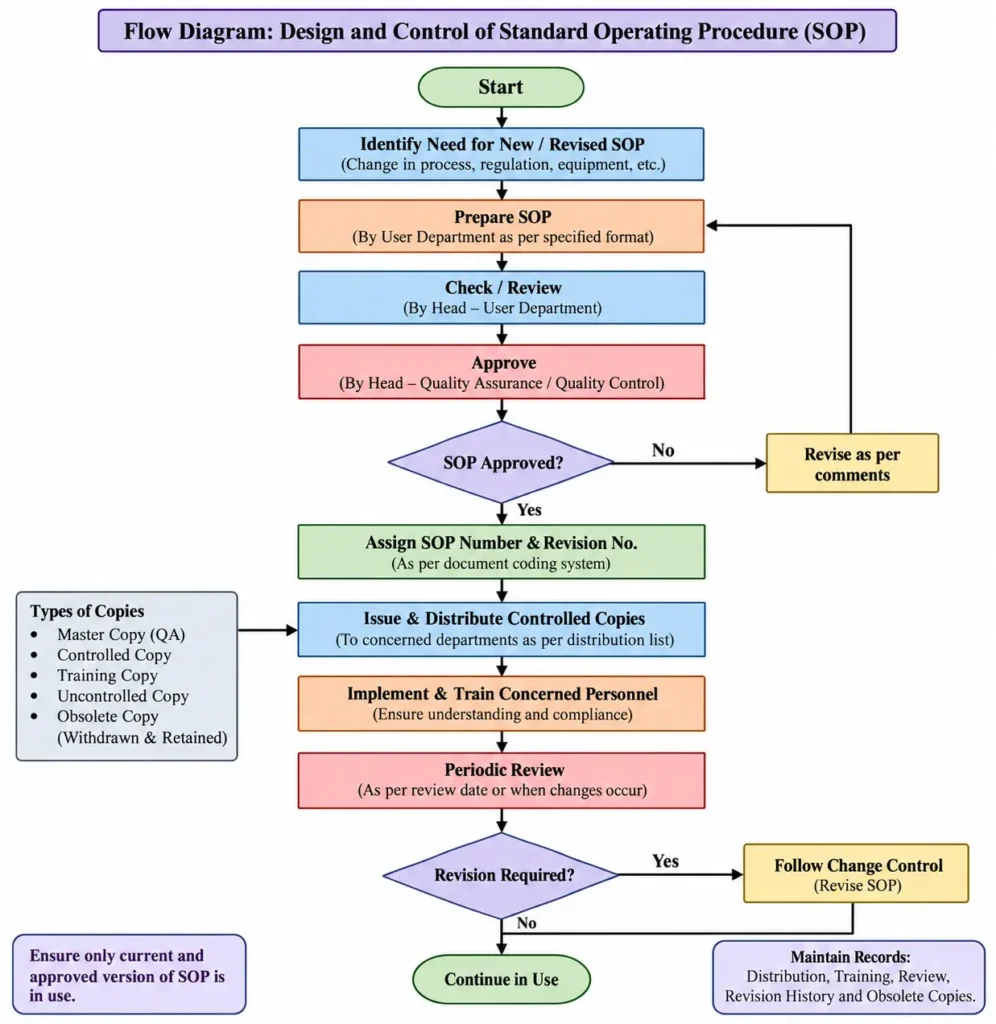
After approval, the SOP is finalized, signed, numbered, and controlled copies are prepared for authorized departments. A training copy is issued so that concerned personnel can be trained before implementation. The SOP is then periodically reviewed. If any change is required, the revision is managed through the defined change-control process. Superseded controlled copies are withdrawn, obsolete copies are properly identified, and relevant records are maintained. This system ensures that only the current, approved, and controlled version of the SOP remains in use.
3. Brainstorming for SOP Failure:
The brainstorming diagram shows the possible reasons for SOP failure in a manufacturing area using sticky notes around the main problem. It highlights several common weaknesses that can cause operators to deviate from approved procedures and create GMP risks.
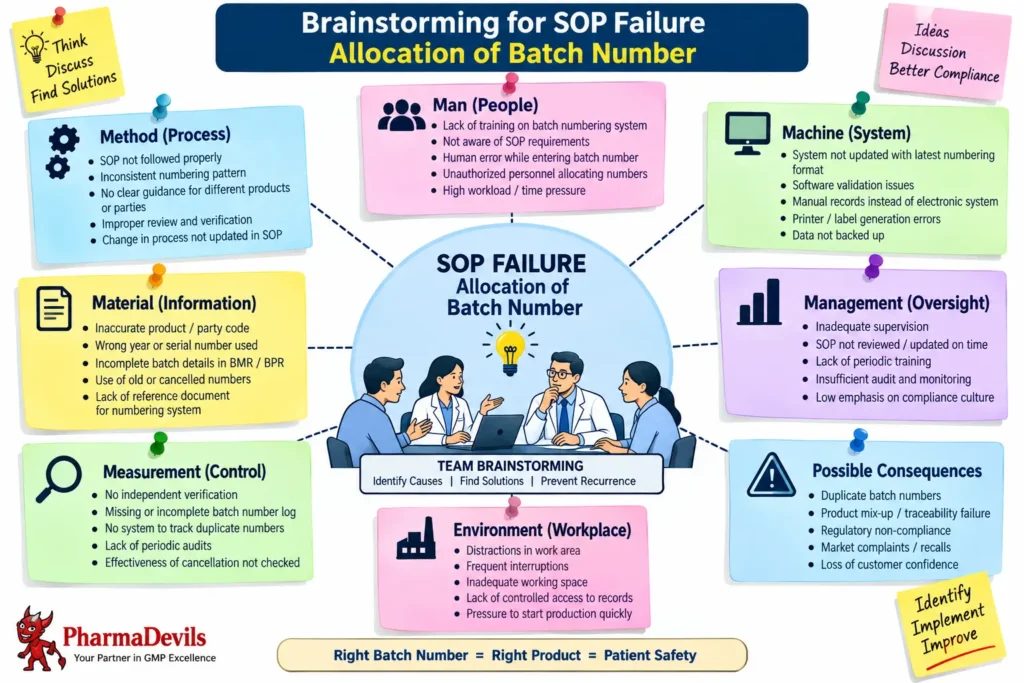
The major causes shown include inadequate training, poor supervision, weak QA oversight, failure to follow procedures, absence of checklists, pressure to complete work quickly, lack of monitoring, poor documentation, improper cleaning, wrong line clearance, operator negligence, material misplacement, improper gowning, unreported deviations, and equipment not being cleaned properly. These failures can lead to serious consequences such as mix-ups, cross-contamination, poor traceability, housekeeping problems, product quality issues, and regulatory non-compliance. The diagram also emphasizes that SOP failure is usually not caused by one person or one mistake; it may result from several weaknesses in people, procedures, supervision, documentation, and workplace controls. Brainstorming helps the investigation team identify all possible causes before selecting the most likely root cause and deciding suitable corrective and preventive actions (CAPA).
4. 5-Why Analysis for SOP Failure:
The 5-Why Analysis is used to identify the root cause of an SOP failure in the manufacturing area. The analysis begins with the problem that operators did not consistently follow or refer to the approved SOP while performing manufacturing activities. The first causes point toward insufficient training, awareness, and understanding of the procedure. Further questioning shows that training effectiveness was not properly verified and supervisors did not regularly reinforce SOP compliance. Weak routine floor monitoring, inadequate periodic review, and insufficient line supervision allowed the problem to continue. Finally, the analysis identifies the main root cause as inadequate SOP implementation and effectiveness monitoring at the manufacturing-floor level.
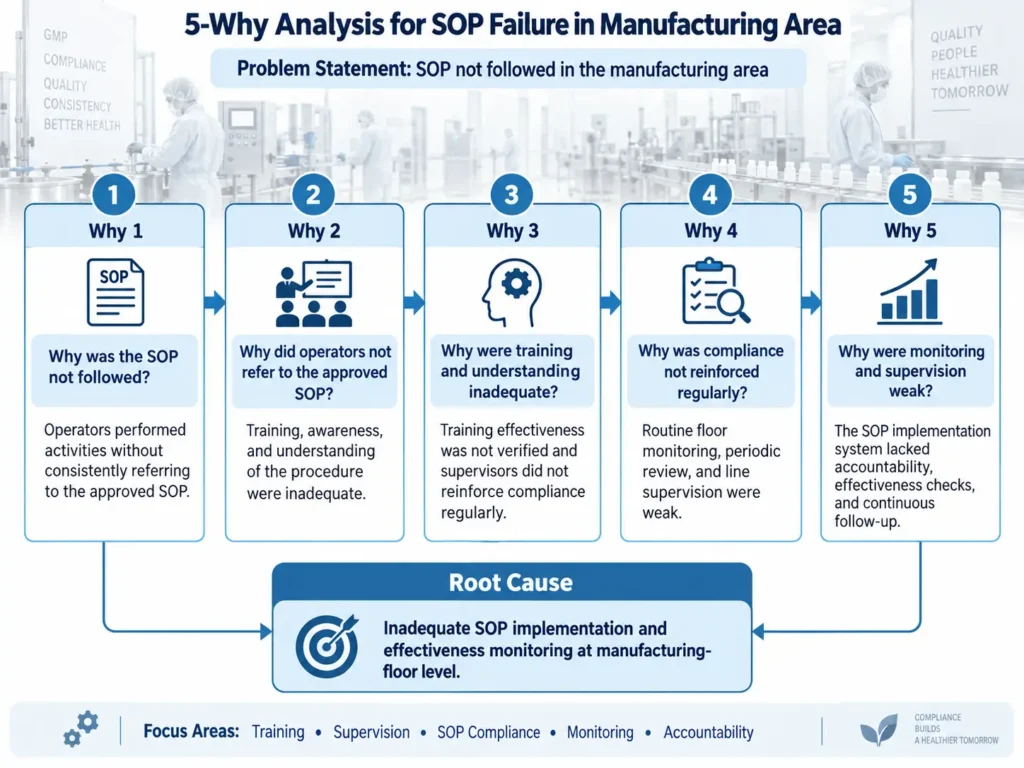
Effective SOPs should provide clear, stepwise instructions and include relevant requirements for equipment, materials, safety, work environment, records, monitoring, and process-completion criteria. The key improvement areas are training, supervision, SOP compliance, monitoring, accountability, and continuous follow-up.
5. Fishbone Analysis for SOP Failure:
The Fishbone Analysis diagram is used to identify the possible causes of SOP failure in the manufacturing area. It organizes the causes into six main categories: Man, Method, Machine, Material, Measurement, and Environment.
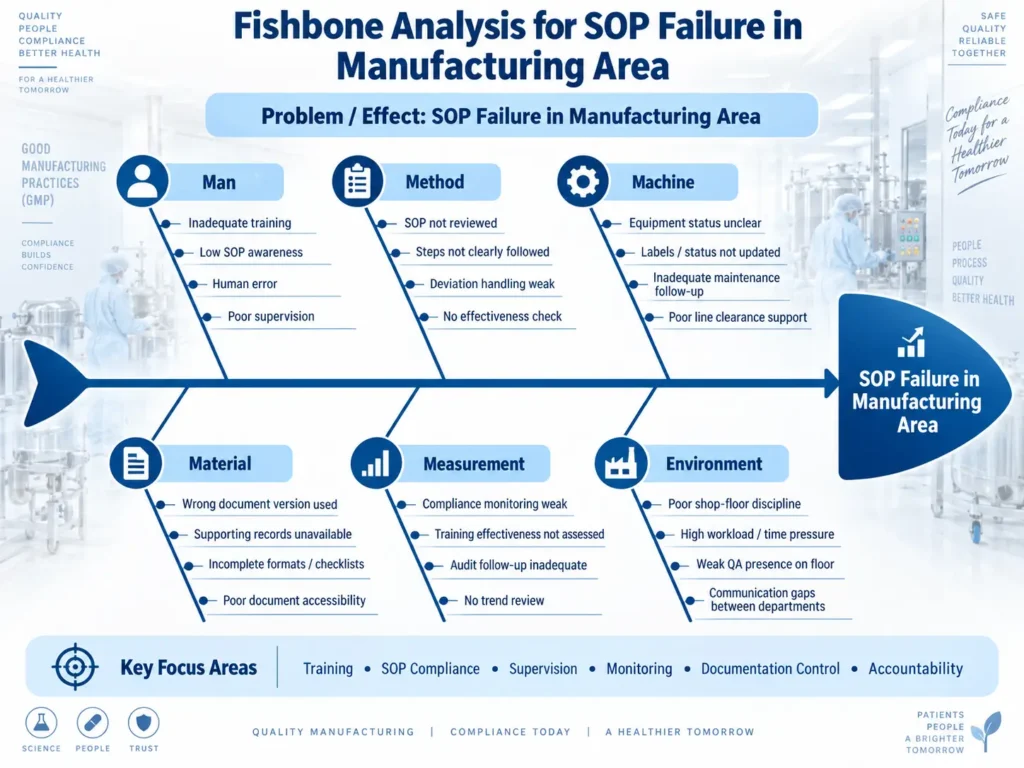
Under Man, causes include inadequate training, low SOP awareness, human error, and poor supervision. Method covers issues such as SOPs not being reviewed, unclear execution of steps, weak deviation handling, and lack of effectiveness checks. Machine includes unclear equipment status, outdated labels, inadequate maintenance follow-up, and poor line-clearance support. Material focuses on incorrect document versions, unavailable records, incomplete formats, and poor document accessibility. Measurement includes weak compliance monitoring, lack of training-effectiveness assessment, inadequate audit follow-up, and absence of trend review. Environment covers poor shop-floor discipline, workload pressure, weak QA presence, and communication gaps. This analysis helps the organization identify root causes and plan suitable corrective and preventive actions.
6. Fault Tree Analysis for SOP Failure:
The Fault Tree Analysis (FTA) explains the possible causes that can lead to SOP failure in the manufacturing area. The top event is identified as “SOP Failure in Manufacturing Area,” and the analysis breaks this problem into four major cause groups: Personnel/Training Failure, Procedure/Documentation Failure, Monitoring/Control Failure, and Equipment/Environment Failure.
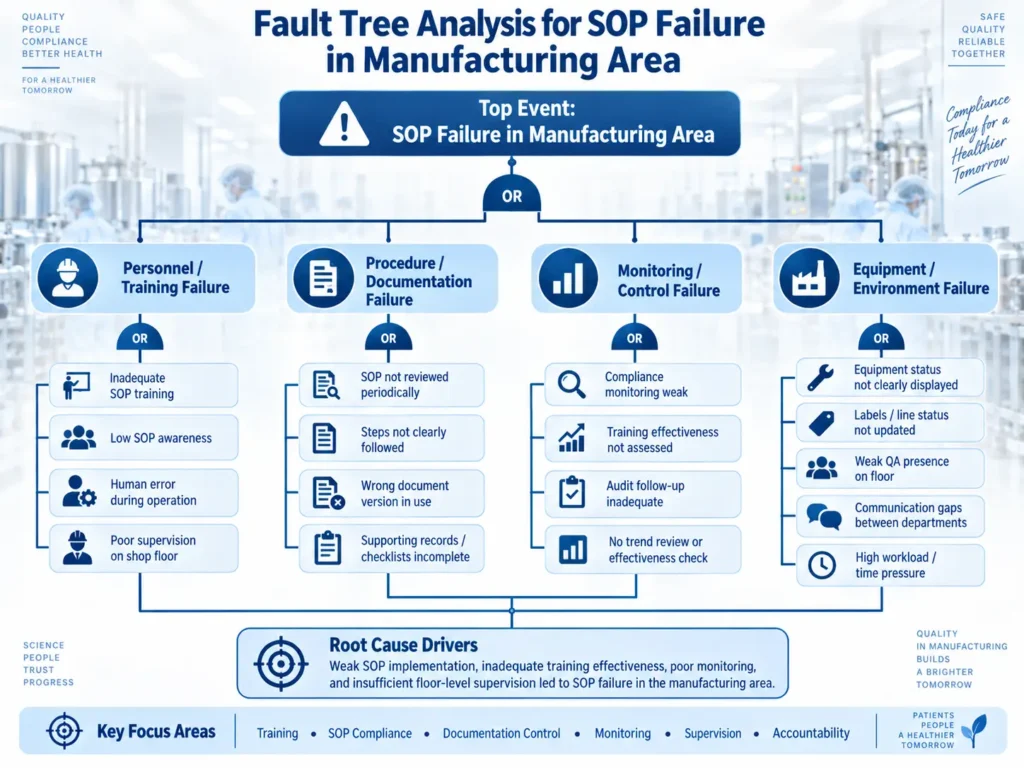
Personnel-related causes include inadequate SOP training, low awareness, human error, and poor supervision. Procedure and documentation failures include outdated SOPs, unclear steps, use of the wrong document version, and incomplete records. Monitoring failures may result from weak compliance checks, lack of training-effectiveness assessment, poor audit follow-up, and absence of trend review. Equipment and environmental causes include unclear equipment status, outdated labels, weak QA presence, communication gaps, and workload pressure.
The analysis indicates that weak SOP implementation, insufficient training effectiveness, poor monitoring, and inadequate shop-floor supervision are important root-cause drivers requiring CAP
1. What is meant by SOP failure in a manufacturing area?
SOP failure means an approved procedure is not followed correctly, completely, or consistently during manufacturing activities.
2. Who is responsible for preparing and approving an SOP?
The user department prepares the SOP, the concerned department head checks it, and Head-QA/Quality Control approves it.
3. Why should an SOP contain clear step-by-step instructions?
Clear instructions help operators understand exactly how an activity must be performed and reduce variation and mistakes. The attached SOP requires detailed stepwise activities written in easy-to-follow language.
4. What information should be included in an SOP where applicable?
It may include equipment, materials, safety requirements, work environment, supporting documents, records, monitoring requirements, completion criteria, environmental controls, deviations/OOS, calibration, and cleaning requirements.
5. Can inadequate training lead to SOP failure?
Yes. If personnel do not properly understand the approved procedure, incorrect execution can occur. The SOP requires a training copy to be issued and training to be conducted before the SOP becomes effective.
6. What should be checked after SOP training?
Training completion and effectiveness should be verified to confirm that personnel understand the procedure and can perform it correctly.
7. Can an uncontrolled or outdated SOP cause a compliance problem?
Yes. Controlled copies should be issued to authorized holders, while superseded controlled copies must be withdrawn when an amended SOP is issued.
8. How frequently should the SOP be reviewed according to the attached procedure?
The SOP states that procedures should be reviewed within 30 working days before completion of two years, or whenever an relevant change is required.
9. How should changes to an SOP be controlled?
Changes should generally be processed through the change-control system by the concerned department, with review and approval as defined in the procedure.
10. What are common causes of SOP failure on the shop floor?
Typical investigation areas include inadequate training, poor supervision, incorrect document version, incomplete records, weak compliance monitoring, communication gaps, and failure to follow defined procedural steps.
11. What should be done when an SOP failure is observed?
The event should be documented, its impact assessed, the root cause investigated, immediate corrections taken where necessary, and suitable CAPA implemented and followed for effectiveness.
12. Why is shop-floor supervision important?
Supervision helps ensure operators follow approved procedures, use the correct documents, complete required records, and immediately report deviations or unusual conditions.
13. What is the likely impact of repeated SOP failures?
Repeated failures can affect product quality, GMP compliance, data reliability, process consistency, and audit readiness.
14. What is the main objective of CAPA after an SOP failure?
CAPA should remove or control the identified root cause and prevent the same failure from recurring.
15. What should be verified during CAPA effectiveness review?
Confirm that personnel are trained, the current SOP is available at the point of use, records are completed correctly, deviations have reduced, and routine monitoring shows sustained compliance.
Reference Guidelines:
- Revised Schedule M – Drugs Rules, 1945, India
Schedule M requires written SOPs and associated records for manufacturing and quality activities, including equipment, cleaning, maintenance, personnel qualification and training, environmental monitoring, complaints, recalls, and other GMP operations. (CDSCO)
CDSCO Schedule M / GMP Requirements - WHO Good Manufacturing Practices for Pharmaceutical Products – Main Principles, TRS 986, Annex 2
WHO GMP emphasizes documented procedures, qualified and trained personnel, defined responsibilities, controlled manufacturing operations, and maintenance of an effective pharmaceutical quality system. (World Health Organization)
WHO GMP Main Principles - PIC/S Guide to GMP – PE 009-17, Part I
Particularly relevant are Chapter 1 – Pharmaceutical Quality System, Chapter 2 – Personnel, Chapter 4 – Documentation, and Chapter 5 – Production. PIC/S requires controlled written procedures and appropriate records for GMP activities. (PIC/S)
PIC/S GMP Guide Publications - EU GMP – EudraLex Volume 4
Key chapters for SOP failure investigations include Chapter 1: Pharmaceutical Quality System; Chapter 2: Personnel; Chapter 4: Documentation; Chapter 5: Production; and Chapter 9: Self-Inspection. (Public Health)
EU GMP EudraLex Volume 4 - US FDA – 21 CFR Parts 210 and 211
Important requirements include 21 CFR 211.22 – Quality Control Unit; 211.25 – Personnel Qualifications; 211.100 – Written Procedures and Deviations; 211.180 – Records; and 211.192 – Production Record Review and Investigations. FDA specifically expects appropriate written production procedures to be established and followed. (U.S. Food and Drug Administration)
FDA Current Good Manufacturing Practice Regulations - ICH Q9(R1) – Quality Risk Management
This is especially relevant to the investigation tools used for SOP failure. It describes risk assessment, risk control, communication and review, and specifically recognizes Fishbone/Ishikawa analysis, FMEA and Fault Tree Analysis (FTA) as quality-risk-management tools. (ICH Database)
ICH Q9(R1) Quality Risk Management - ICH Q10 – Pharmaceutical Quality System
ICH Q10 provides a framework for an effective pharmaceutical quality system, including CAPA, change management, management responsibility, process performance monitoring and continual improvement. (ICH Database)
ICH Q10 Pharmaceutical Quality System