







Brief Description
This SOP describes the proper procedure for entering and exiting the Laminar Air Flow (LAF) room of the Microbiology Laboratory. Its purpose is to maintain cleanliness, control contamination, and ensure that microbiological activities are carried out under suitable hygienic conditions. The Microbiologist is responsible for following the procedure, while the Manager-QC and Head-QA/QC are responsible for its review and effective implementation.Before entry, personnel must check personal hygiene and record the date and time in the logbook. They enter through the airlocks, remove outdoor clothing and slippers as required, sanitize hands with filtered 70% IPA, use an IPA foot pad, and wear pre-sterilized gloves and a sterile gown. Hands and the LAF are sanitized before and after work. During exit, used gloves and gowns are discarded appropriately, personnel pass through the airlocks, wear their laboratory uniform and slippers, and record the exit details.The SOP also requires training of microbiologists and maintains an entry/exit logbook for documentation and traceability.
Skip to PDF content1. Flow Diagram:
The flow diagram explains the entry and exit procedure for the LAF Room of the Microbiology Laboratory in a simple step-by-step manner. Before entry, the person checks personal hygiene and records the date and entry time in the logbook. The person then enters Air Lock-I, removes slippers, apron, cap and personal clothes as applicable, sanitizes hands with filtered 70% IPA, and dips the feet on an IPA pad.After entering Air Lock-II, the person sanitizes the hands again, wears pre-sterilized gloves, a sterile gown, and a second pair of gloves. The LAF is cleaned with filtered 70% IPA before microbiology work starts and again after completion.
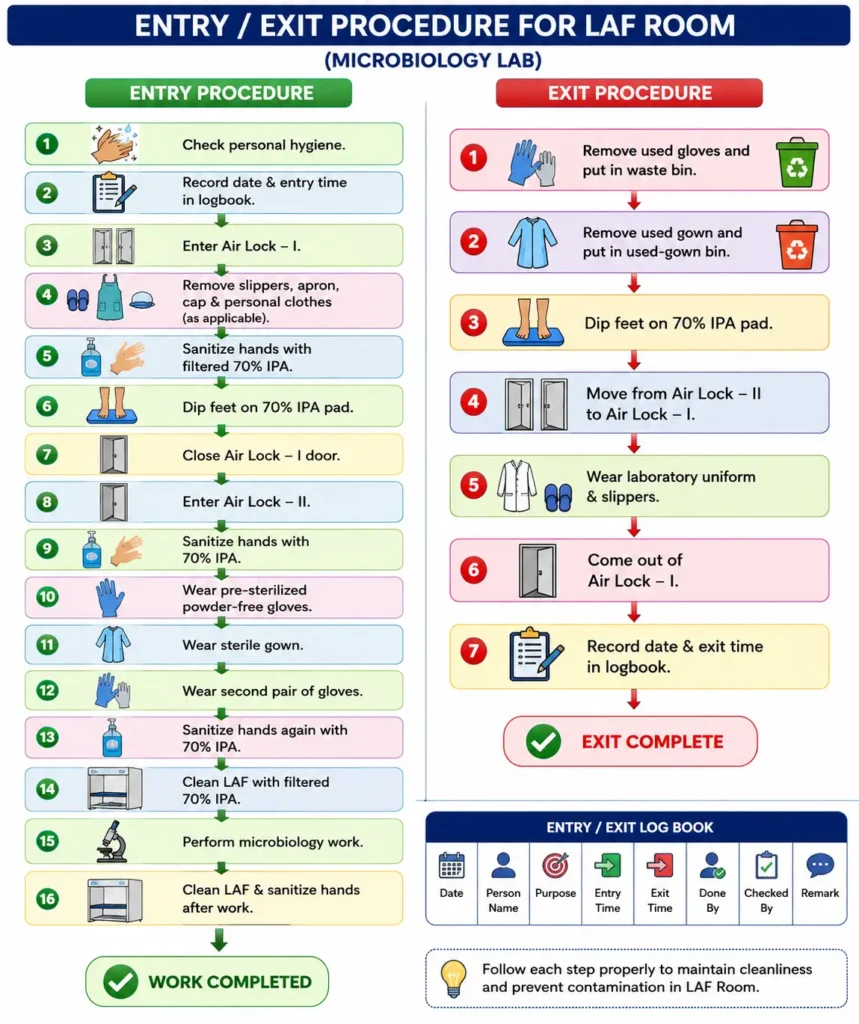
During exit, used gloves and gowns are removed and placed in the proper waste bins. The person passes back through the air locks, wears the laboratory uniform and slippers, comes out, and records the exit time in the logbook. This flow helps maintain cleanliness, discipline, and contamination control in the LAF room.
2. Brainstorming for SOP Failure:
Brainstorming is used to identify the possible reasons why the Entry/Exit SOP for the LAF Room may fail. The SOP requires personnel to follow proper hygiene, air-lock movement, hand sanitization with filtered 70% IPA, gowning, glove use, LAF cleaning, waste disposal, and entry/exit recording.Based on these required steps, the brainstorming diagram highlights possible failure causes such as lack of training, skipping the correct sequence, poor personal hygiene, improper sanitization, incorrect gowning, air-lock misuse, poor LAF cleaning, wrong waste disposal, and incomplete logbook entries.
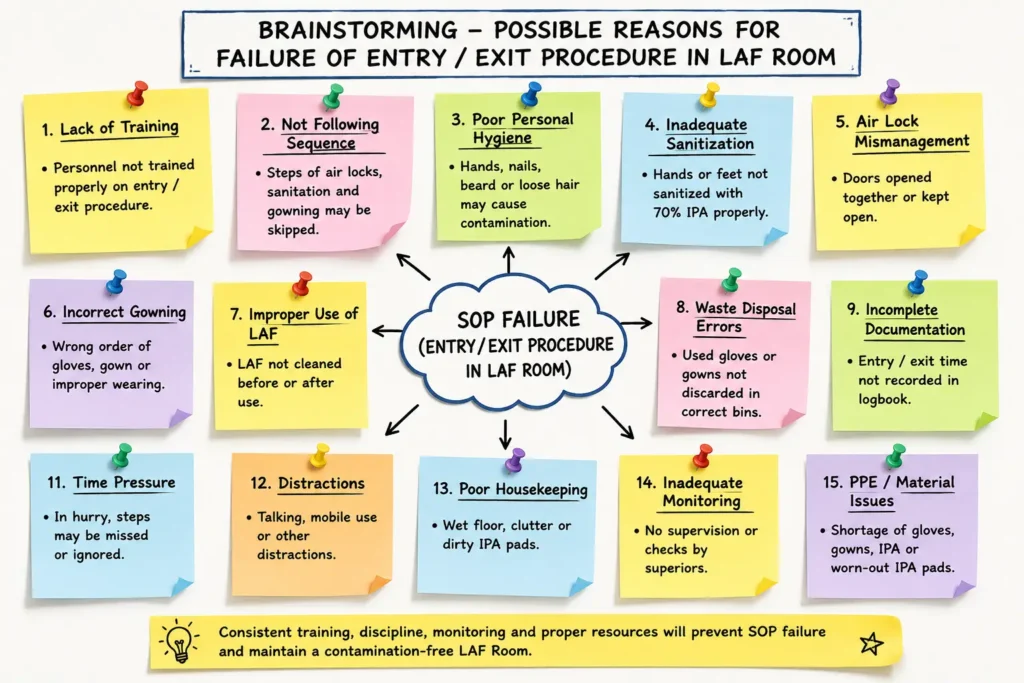
Other possible contributing factors may include time pressure, distraction, poor housekeeping, lack of supervision, or shortage of gloves, gowns, IPA, and other required materials.This brainstorming exercise helps the investigation team collect different ideas before selecting the most likely root cause. It supports further tools such as 5-Why Analysis, Fishbone Analysis, FMEA, or CAPA planning.
3. 5-Why Analysis for SOP Failure:
The 5-Why Analysis is used to find the root cause of failure in the Entry/Exit Procedure for the LAF Room. The SOP requires personnel to follow defined steps for hygiene checking, air-lock movement, hand sanitization with filtered 70% IPA, gowning, glove use, LAF cleaning, waste disposal, and logbook recording.In this analysis, the first “Why” may identify that one or more SOP steps were missed. Further “Whys” can explore why the sequence was not followed, why the operator did not remember or understand the steps, and whether training or supervision was effective. The SOP itself requires training of microbiologists for this activity.
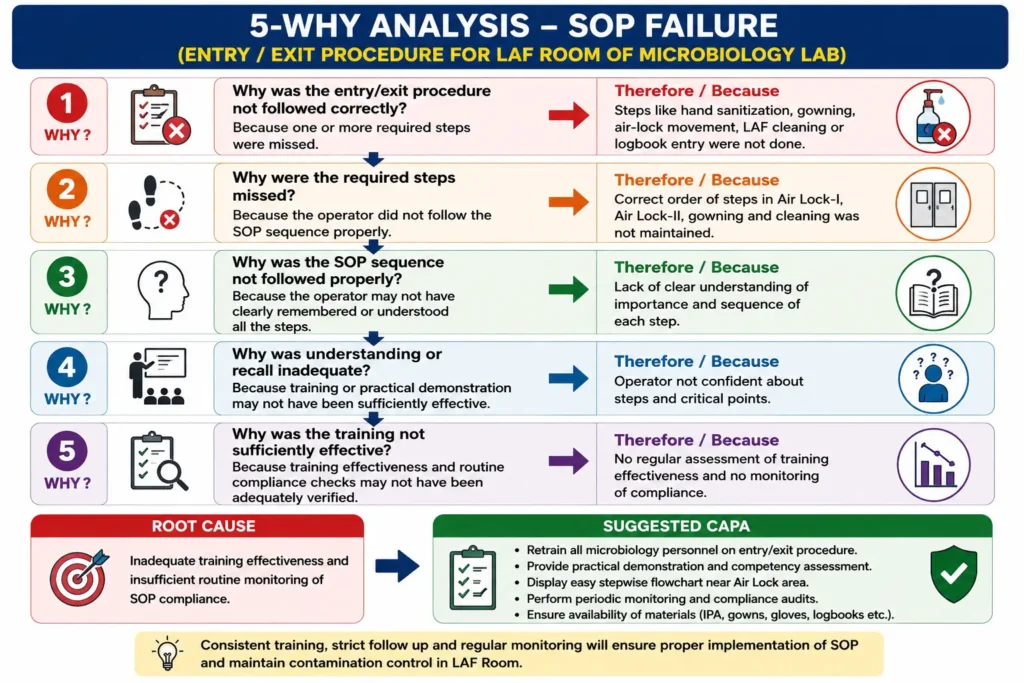
By repeatedly asking “Why?”, the investigation team can move from the visible error to a deeper possible cause, such as ineffective training, poor understanding, or insufficient monitoring. The identified cause can then be addressed through retraining, practical demonstration, compliance checks, and suitable CAPA.
4. Fishbone Analysis for SOP Failure:
The Fishbone Analysis (Ishikawa Diagram) is used to identify possible causes of failure in the Entry/Exit Procedure for the LAF Room of the Microbiology Laboratory. The SOP requires proper personal hygiene, correct air-lock movement, sanitization with filtered 70% IPA, gowning, glove use, LAF cleaning, waste disposal, and entry/exit recording.In the fishbone diagram, possible causes are grouped into major categories such as People, Procedure, Sanitization, Gowning & Air Lock, Documentation, and Material/Environment. Examples may include lack of training, skipped steps, poor hand sanitization, incorrect gowning order, incomplete logbook entries, dirty IPA pads, unavailable gloves or gowns, and poor housekeeping.
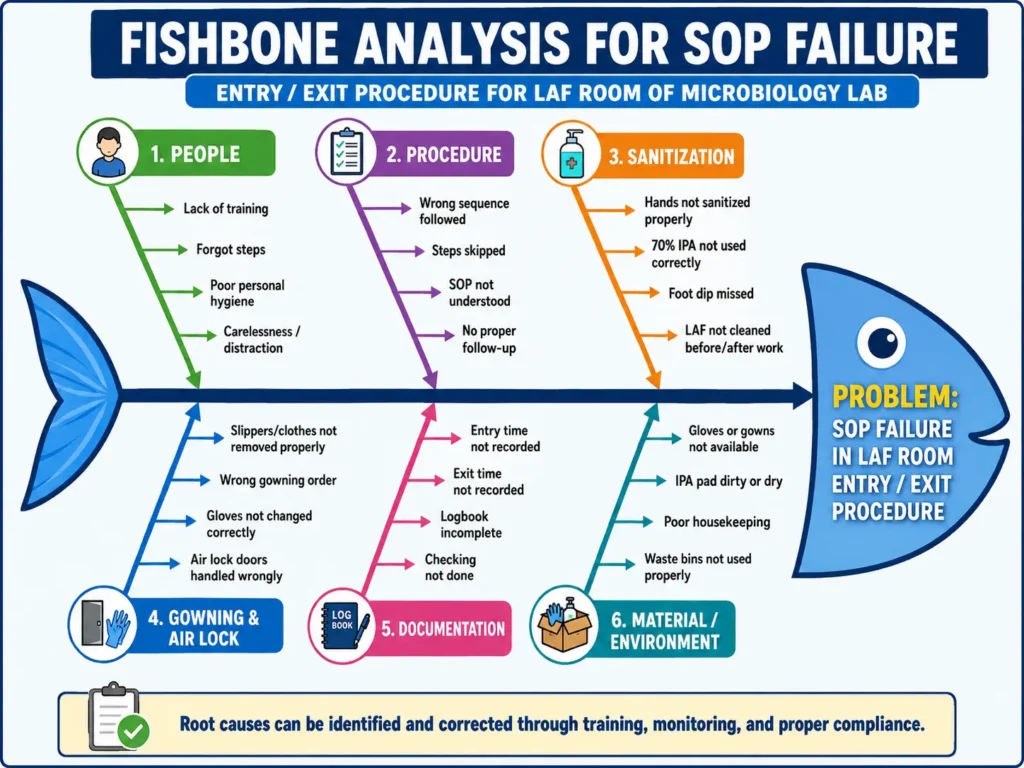
This analysis helps the investigation team organize different possible causes in a simple visual form and identify areas that require further investigation. The confirmed root cause can then be addressed through suitable CAPA, retraining, monitoring, and compliance checks.
5. Fault Tree Analysis (FTA) for SOP Failure:
Fault Tree Analysis (FTA) is used to identify the possible causes that can lead to failure of the Entry/Exit Procedure for the LAF Room of the Microbiology Laboratory. The top event is considered as failure of the entry/exit procedure, which may increase the risk of contamination.The analysis breaks the problem into major failure areas such as personnel/training, sanitization, gowning and air-lock handling, LAF cleaning, exit/waste disposal, and documentation. The SOP requires correct personal hygiene, use of filtered 70% IPA, proper air-lock sequence, sterile gowning and gloves, LAF cleaning before and after work, proper disposal of used gloves and gowns, and recording of entry and exit details.
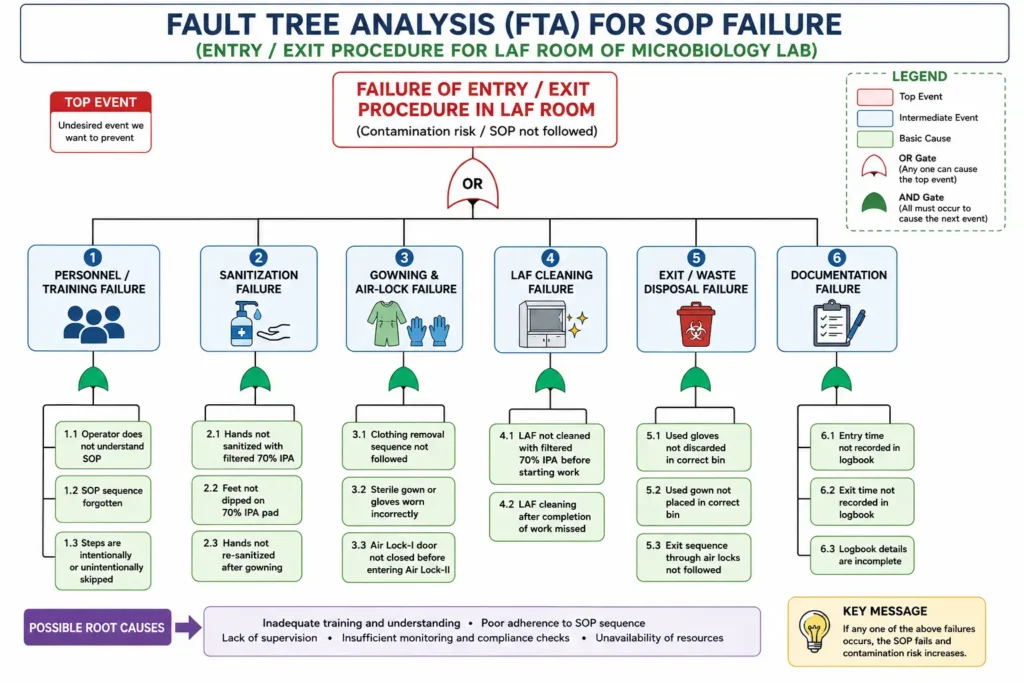
FTA helps the investigation team trace each failure back to its possible basic cause. It supports identification of weak points such as poor training, missed steps, incorrect sanitization, improper gowning, or incomplete records so that suitable CAPA, retraining, monitoring, and compliance checks can be implemented.
Questions & Answers – Entry / Exit Procedure for LAF Room of Microbiology Lab
Q1. What is the purpose of this SOP?
The purpose is to describe the correct procedure for entering and exiting the LAF room of the Microbiology Laboratory.
Q2. Who is responsible for following this SOP?
The Microbiologist is responsible for execution of the SOP.
Q3. What should be checked before entering the LAF room?
Personal hygiene should be checked before entry.
Q4. What details should be recorded before entry?
The date and entry time should be recorded in the logbook.
Q5. What should be removed in Air Lock-I?
Slippers, apron, cap, and personal clothes should be removed as applicable.
Q6. Which sanitizer is used for hand sanitization?
Filtered 70% IPA is used for hand sanitization.
Q7. What is done before entering Air Lock-II?
Hands are sanitized and feet are dipped on a 70% IPA-containing pad.
Q8. Why should the Air Lock-I door be closed?
The Air Lock-I door should remain closed while entering Air Lock-II as required by the SOP.
Q9. What should be worn in Air Lock-II?
Pre-sterilized powder-free gloves, a sterile gown, and secondary gloves should be worn.
Q10. When should the LAF be cleaned?
The LAF should be cleaned with filtered 70% IPA before starting work and again after finishing the work.
Q11. What should be done with used gloves during exit?
Used gloves should be removed and placed in the waste bin.
Q12. What should be done with the used gown?
The used gown should be removed and placed in the designated used-gown waste bin.
Q13. What should be done while moving from Air Lock-II to Air Lock-I during exit?
Feet should again be dipped on the 70% IPA-containing pad.
Q14. What should be recorded after exiting the LAF room?
The exit date and time should be recorded in the logbook.
Q15. What is the training period mentioned in the SOP?
The training period is one hour.
Q16. What does LAF stand for?
LAF stands for Laminar Air Flow.
Q17. What information is maintained in the entry/exit logbook?
The logbook records date, person name, purpose, entry time, exit time, done by, checked by, and remarks.