






Brief Description
This SOP explains the frequency and basic requirements for microbiological testing of non-sterile pharmaceutical products. Its main purpose is to ensure that products meet regulatory and company requirements and that microbiological quality control is performed in a consistent manner. The procedure defines responsibilities of Quality Control, Section Head, Head-QC, Laboratory QA, Unit QA, and Production.
For high-water-activity products such as oral liquids, every batch should be tested. For low-water-activity products such as tablets, the first three batches are tested, and if results are satisfactory, further testing may be performed on one in every ten batches, with at least one batch tested each year. The SOP also covers testing schedules for water systems, laboratory cleanliness, calibrated equipment, use of sterile gloves, proper handling of media and Petri plates, and safe working practices inside microbiology testing areas.
1. Flow Diagram:
The flow diagram gives a simple overview of the microbiological analysis testing frequency for non-sterile pharmaceutical products. It starts with the objective and scope of the SOP, followed by the responsibilities of Quality Control, QA, Section Head, and Production.
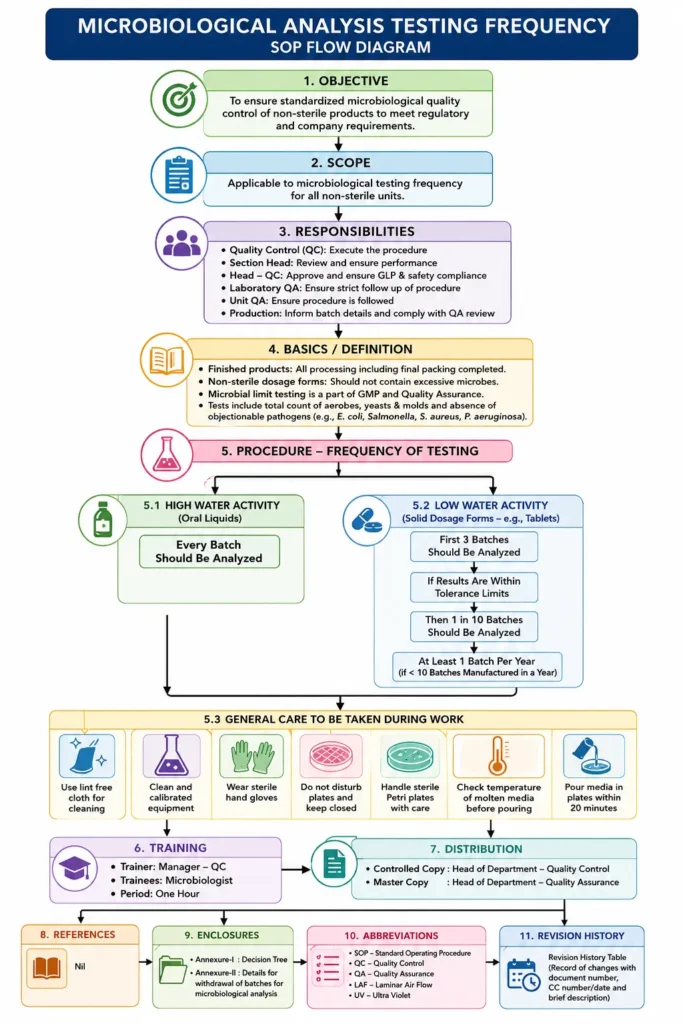
The main part of the flow explains the testing frequency. High-water-activity products such as oral liquids are tested for every batch. For low-water-activity products such as tablets, the first three batches are tested, and if the results are satisfactory, further testing is performed on one in every ten batches, with at least one batch tested each year.
The diagram also highlights important laboratory precautions such as proper cleaning, use of calibrated equipment, sterile gloves, careful handling of Petri plates, and correct media handling. It ends with training, distribution, references, enclosures, abbreviations, and revision history to support proper documentation and SOP compliance.
2. Brainstorming for SOP Failure:
Brainstorming is used to find the possible reasons why the Microbiological Analysis Testing Frequency SOP was not followed correctly. During the discussion, QC, QA, Production, and the Section Head share their ideas and identify where the process may have failed. Possible causes include missed testing schedules, wrong batch selection, lack of communication, incomplete records, inadequate training, uncalibrated equipment, poor laboratory practices, or failure to follow water-testing schedules. These areas are directly connected with the responsibilities, testing frequency, laboratory precautions, and training requirements defined in the SOP.
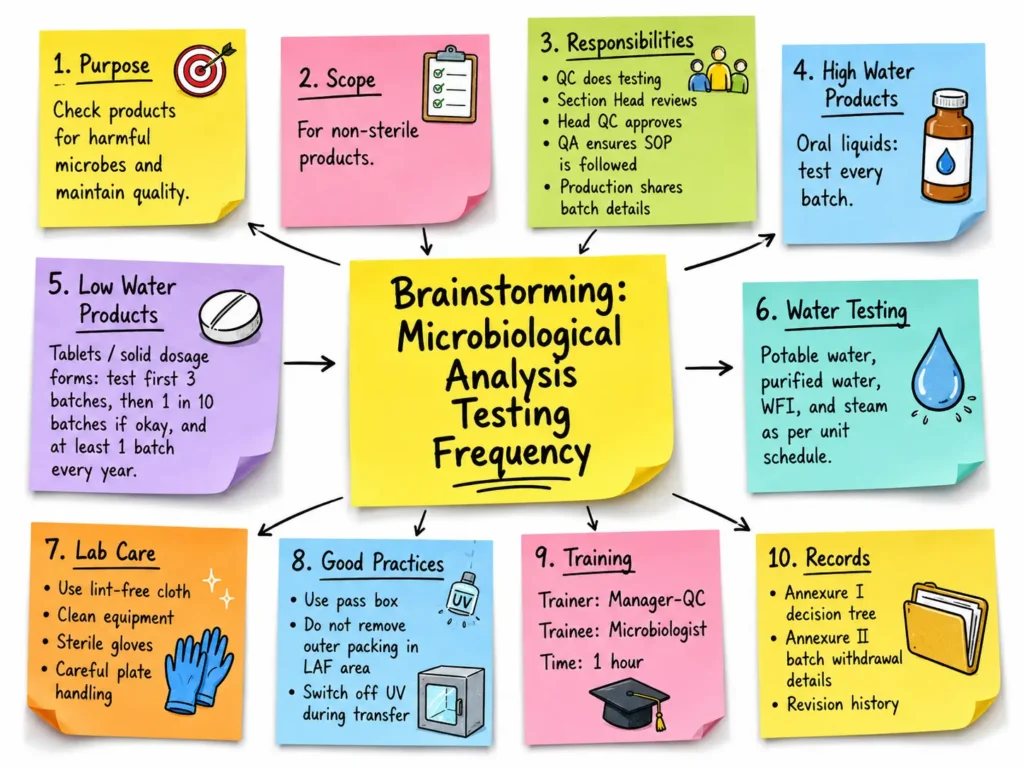
The ideas are written on sticky notes so that the team can easily review and group them. After brainstorming, the most likely causes can be investigated further and suitable corrective and preventive actions can be planned to avoid the same failure in the future.
3. 5-Why Analysis for SOP Failure:
The 5-Why Analysis is used to find the root cause of failure in following the Microbiological Analysis Testing Frequency SOP. The problem starts when microbiological testing is not performed at the required frequency. The first reason may be that the required batches were not selected or tested on time. Further questioning may show that the testing schedule was not properly monitored. This can happen because QC and Production did not communicate batch information clearly or because the SOP requirements were not fully understood. Another reason may be the absence of proper training, reminders, and regular SOP review.
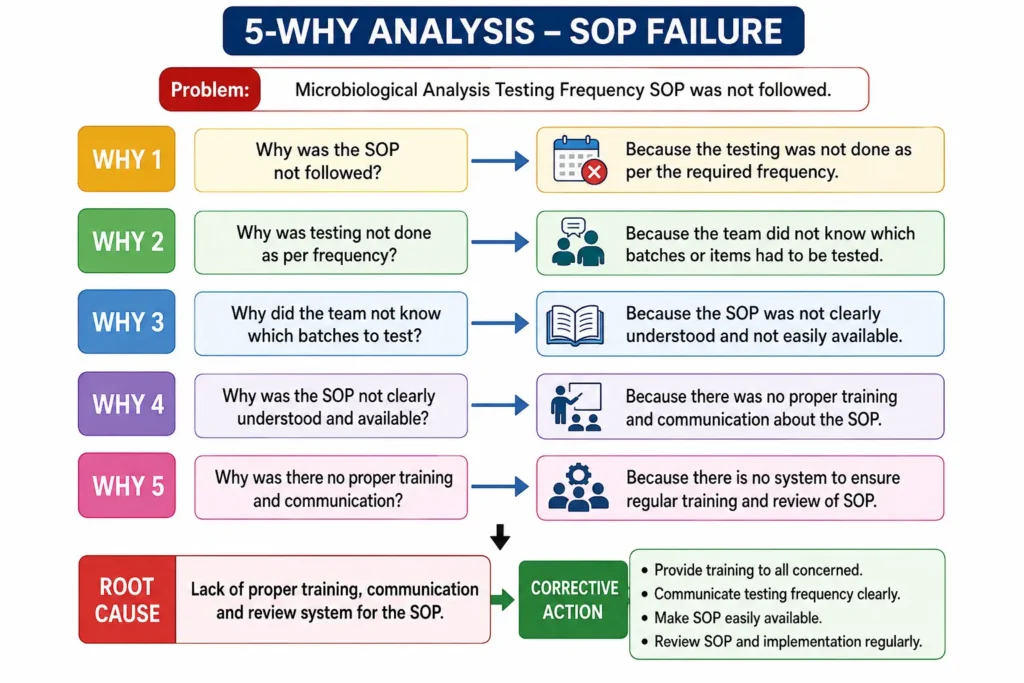
By asking “Why?” step by step, the team can reach the main cause of the failure. The identified root cause may include poor training, weak communication, lack of follow-up, and inadequate monitoring. Corrective actions should include proper training, clear communication, regular review, and effective tracking of testing schedules.
4. Fishbone Analysis for SOP Failure:
The Fishbone Diagram is used to identify the possible causes of failure to follow the Microbiological Analysis Testing Frequency SOP. It groups the causes into six main areas: Man, Method, Machine, Material, Measurement, and Environment.
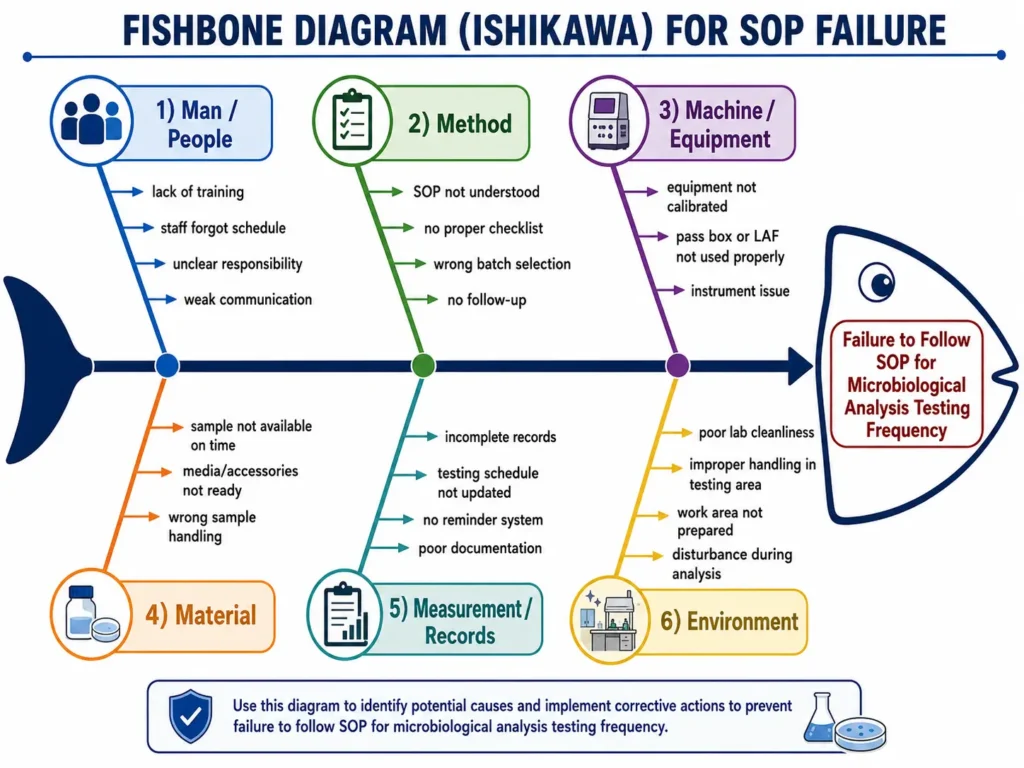
Possible causes include lack of training, unclear responsibilities, weak communication, wrong batch selection, missing checklists, poor follow-up, uncalibrated equipment, sample unavailability, incomplete records, and poor laboratory conditions. The SOP itself requires proper responsibilities, defined testing frequency, calibrated equipment, clean working practices, and correct documentation. By arranging all possible causes in one diagram, the team can easily understand where the failure may have occurred. The most likely causes can then be investigated and suitable corrective actions such as training, better communication, schedule monitoring, proper documentation, and equipment checks can be implemented.
5. Fault Tree Analysis (FTA) for SOP Failure:
Fault Tree Analysis (FTA) is used to find the possible reasons for failure to follow the Microbiological Analysis Testing Frequency SOP. The top event is that the required microbiological testing was not performed as per the SOP.
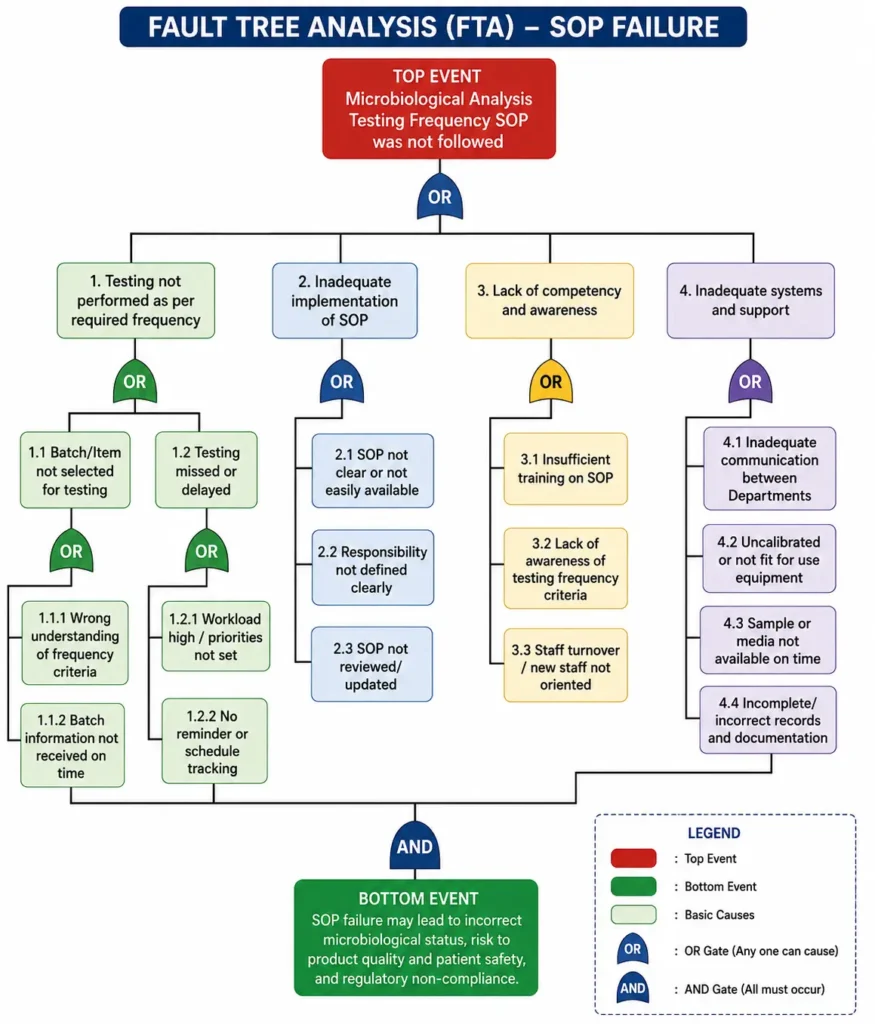
The diagram shows different causes such as wrong batch selection, missed or delayed testing, unclear SOP instructions, poor training, weak communication, uncalibrated equipment, unavailable samples or media, and incomplete records. These causes are connected through OR and AND gates to show how one or more failures can lead to the main problem. FTA helps the team understand the failure in a structured way and identify the most important causes. After finding the causes, suitable actions can be taken, such as improving training, monitoring testing schedules, maintaining equipment, improving communication, and keeping complete records. This helps prevent repeated SOP failures and supports product quality and regulatory compliance.
6. FMEA for SOP Failure:
Failure Mode and Effects Analysis (FMEA) is used to identify where the Microbiological Analysis Testing Frequency SOP may fail and what effect the failure can have. The SOP requires defined testing frequencies, proper responsibilities, calibrated equipment, correct laboratory practices, and proper documentation.
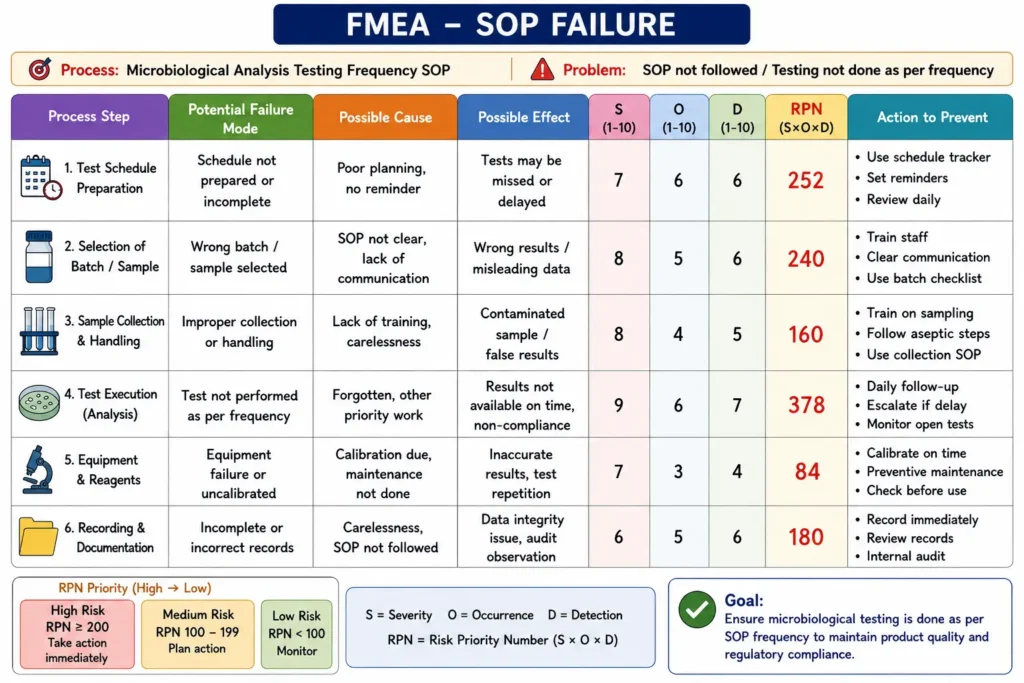
In the FMEA, possible failures include missing the testing schedule, selecting the wrong batch or sample, improper sample handling, delayed testing, use of uncalibrated equipment, and incomplete records. Each failure is given scores for Severity (S), Occurrence (O), and Detection (D). These scores are multiplied to calculate the Risk Priority Number (RPN). Higher-RPN failures need quicker action. Preventive actions may include staff training, schedule tracking, reminders, equipment calibration, better communication, record review, and regular follow-up. This helps ensure microbiological testing is completed on time and supports product quality and SOP compliance.
7. Is/Is-Not Analysis for SOP Failure:
Is/Is-Not Analysis is used to clearly understand what the SOP failure is and what it is not. In this case, the problem is that the Microbiological Analysis Testing Frequency SOP was not followed correctly.
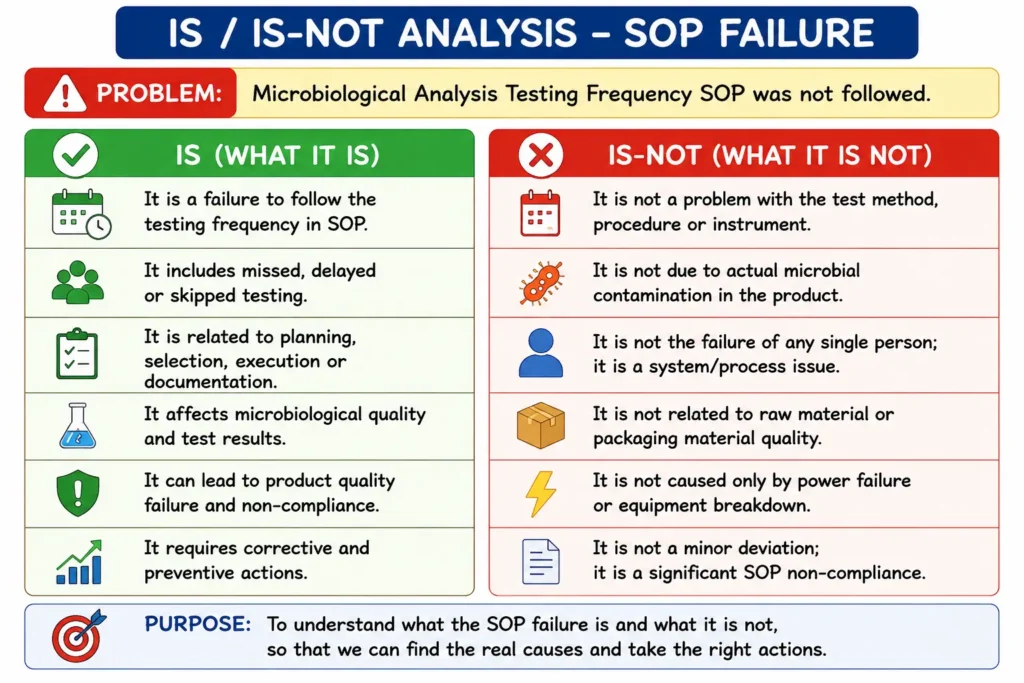
The “Is” side shows that the failure may include missed, delayed, or skipped testing, poor planning, incorrect batch selection, weak execution, and incomplete documentation. It can affect microbiological control, product quality, and regulatory compliance.The “Is-Not” side helps remove unrelated causes. The problem is not necessarily due to the test method, actual microbial contamination, raw material quality, one individual person, or equipment breakdown alone.This analysis helps the team focus on the real problem instead of investigating unrelated areas. After identifying the actual causes, suitable corrective and preventive actions such as better planning, training, communication, monitoring, and documentation can be taken.