







1. Introduction – SOP for New MRP Receiving & Implementation Procedure:
The SOP for New MRP Receiving & Implementation Procedure establishes a documented system for receiving, reviewing, approving, circulating, and implementing newly issued or revised Maximum Retail Price (MRP) information. The procedure defines the responsibilities of Quality Assurance, Production, Planning, and departmental management to ensure that only the current and approved MRP is used during packing operations. Whenever a new MRP is received from a customer or regulatory authority, the information is communicated to QA for review and updating of the master MRP list. Approved controlled copies are then circulated to concerned departments, while superseded copies are collected and made obsolete. Before batch packing and printing of labels or cartons, QA/IPQA and Production personnel verify the applicable MRP to prevent incorrect price printing. The procedure therefore supports controlled implementation, traceability, document control, and consistent use of the approved MRP throughout packaging operations.
Skip to PDF content2. SOP for New MRP Receiving & Implementation Procedure:
The SOP for New MRP Receiving & Implementation Procedure describes the controlled process for receiving, reviewing, approving, circulating, verifying, and implementing a newly issued or revised Maximum Retail Price (MRP). The procedure begins when the Planning Department receives a new MRP from a customer or regulatory authority and immediately communicates it to Quality Assurance. QA then updates the master MRP list and obtains approval from the QA/QC Head.
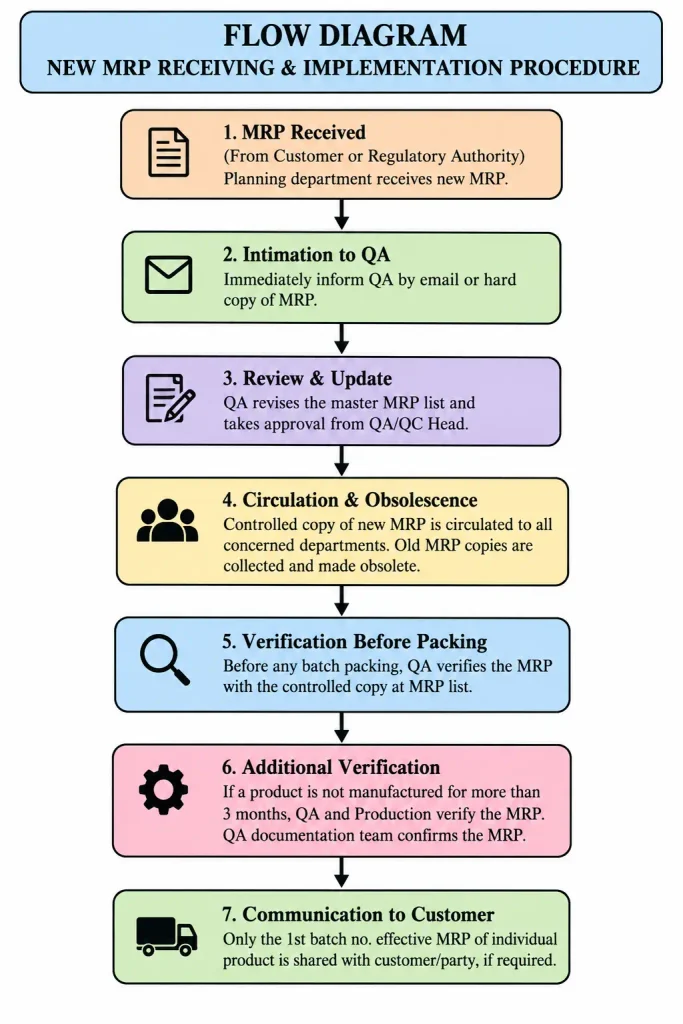
After approval, the controlled copy of the new MRP is circulated to concerned departments, while old copies are collected and made obsolete. Before batch packing, QA verifies the applicable MRP against the controlled MRP list. For products not manufactured for more than three months, QA and Production reconfirm the MRP before packing starts. The effective MRP of the first applicable batch may also be communicated to the concerned customer or party when required.
3. Benefits of Following SOP for New MRP Receiving & Implementation Procedure:
Following the SOP for New MRP Receiving & Implementation Procedure ensures that newly received or revised Maximum Retail Price information is handled through a controlled and documented system. The SOP assigns clear responsibilities to QA and Production personnel for execution and effective implementation of the procedure.
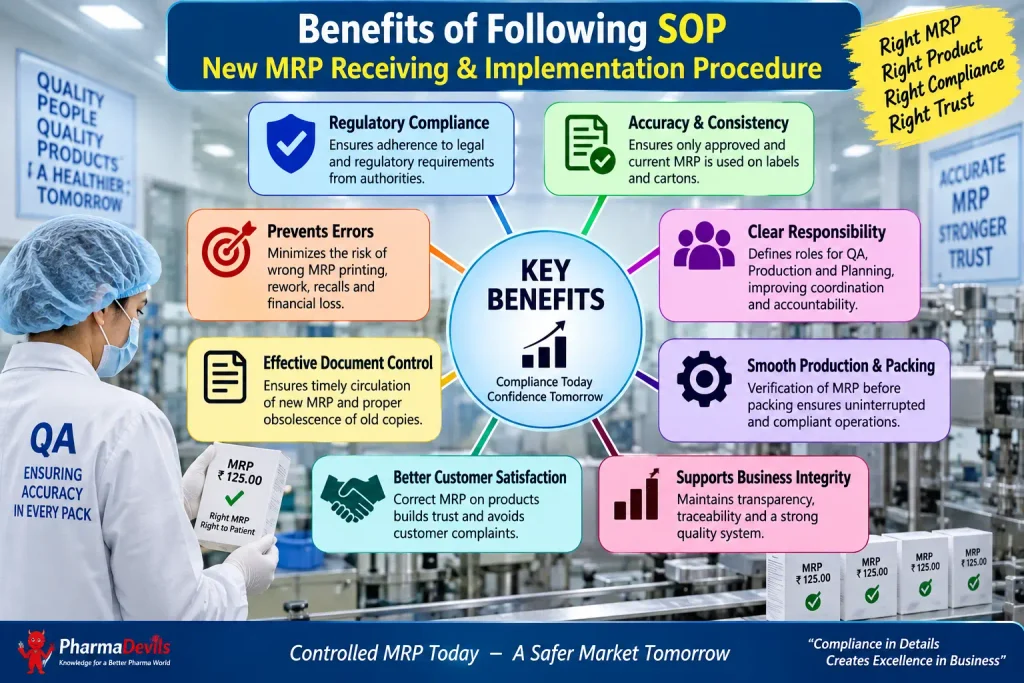
The procedure supports accurate MRP implementation by requiring QA to update the master MRP list, obtain approval, circulate controlled copies to concerned departments, and collect obsolete MRP copies. It also requires verification of the applicable MRP before batch packing and additional confirmation when a product has not been manufactured for more than three months. These controls help maintain MRP accuracy, document control, traceability, departmental coordination, and consistency during packaging operations, thereby reducing the possibility of using an outdated or incorrect MRP.
4. Brainstorming for SOP Failure: New MRP Receiving & Implementation Procedure:
The Brainstorming for SOP Failure – New MRP Receiving & Implementation Procedure identifies possible reasons that can lead to failure in receiving, reviewing, controlling, and implementing a revised Maximum Retail Price. The SOP requires the Planning Department to communicate a new MRP to QA, followed by updating of the master MRP list, approval by QA/QC Head, circulation of controlled copies, withdrawal of obsolete copies, and verification before packing.
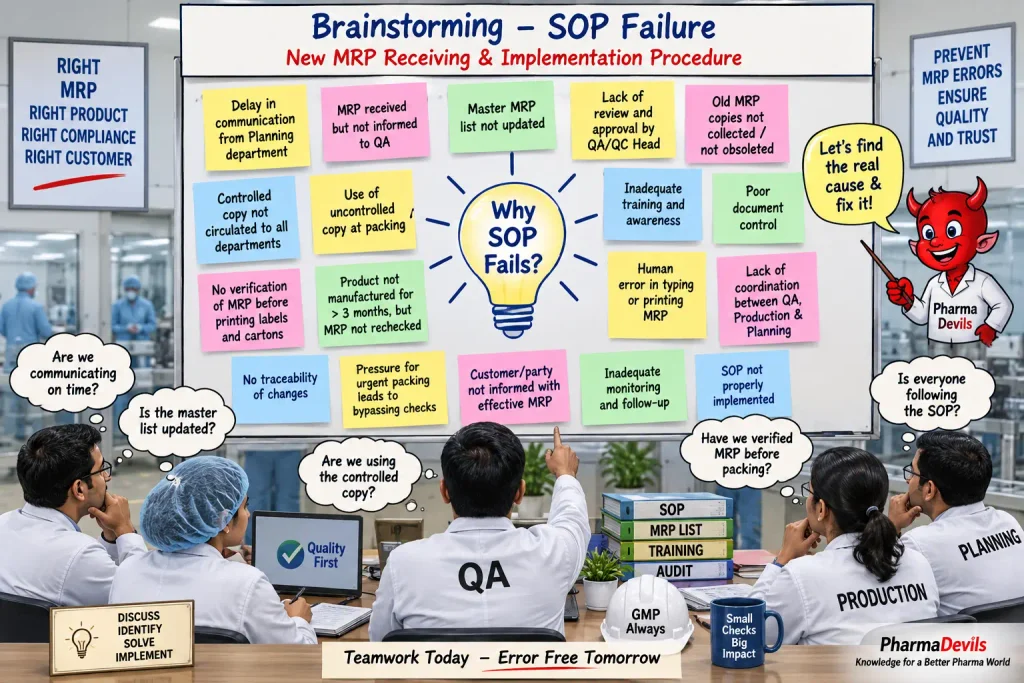
Potential failure causes include delayed communication to QA, non-updating of the master MRP list, lack of timely approval, use of uncontrolled or obsolete MRP copies, inadequate verification before printing or packing, poor coordination between Planning, QA, and Production, and insufficient employee awareness. Brainstorming helps the team collectively identify these weaknesses, evaluate where the process may break down, and define suitable preventive actions to ensure that only the approved and effective MRP is used during packaging operations.
5. Fishbone Analysis for SOP Failure: New MRP Receiving & Implementation Procedure:
The Fishbone Analysis for SOP Failure – New MRP Receiving & Implementation Procedure identifies potential causes that may result in incorrect, delayed, or uncontrolled implementation of a revised Maximum Retail Price. The analysis groups possible causes under major categories such as Manpower, Method, Documents, Verification, Communication, and Management. Key failure causes include inadequate training, lack of SOP awareness, human error in MRP entry, delayed implementation, failure to update the master MRP list, use of uncontrolled or obsolete copies, missing MRP verification before packing, delayed communication from Planning to QA, poor interdepartmental coordination, and inadequate management follow-up.
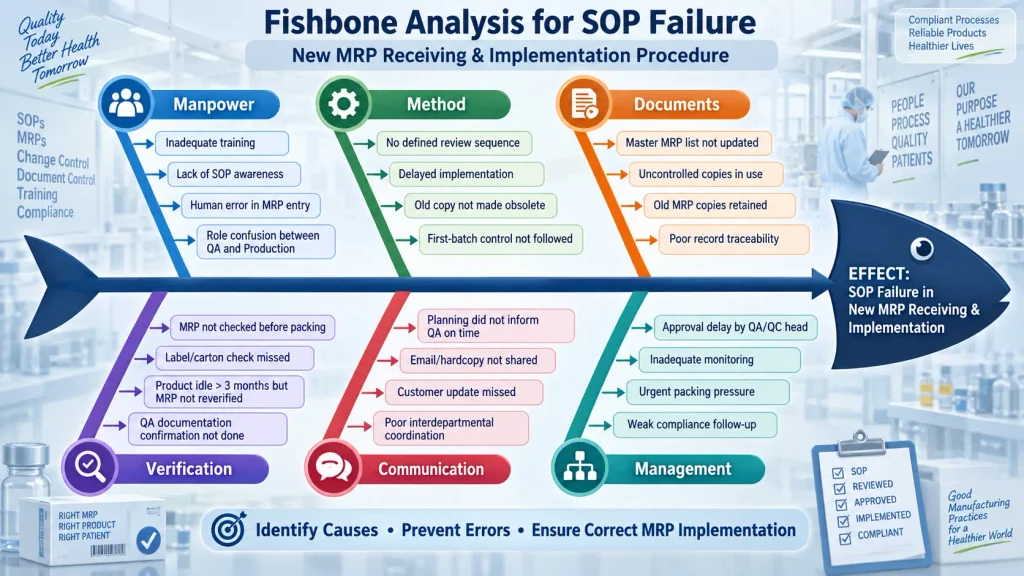
These causes directly relate to the SOP requirements for timely QA intimation, updating and approval of the master MRP list, controlled circulation, withdrawal of obsolete copies, and verification of MRP before packing. Fishbone analysis helps the organization systematically identify contributing causes of SOP failure so that appropriate corrective and preventive actions can be implemented to ensure accurate, controlled, and compliant MRP implementation.
6. 5-Why Analysis for SOP Failure: New MRP Receiving & Implementation Procedure:
The 5-Why Analysis for SOP Failure – New MRP Receiving & Implementation Procedure evaluates the possible sequence of events that can lead to an incorrect or outdated MRP being used during packing. The analysis begins with the problem of incorrect MRP printing and progressively examines why the old MRP was used, why the updated MRP was unavailable, why the master MRP list was not updated and circulated, and why the revised MRP was not communicated to QA on time.
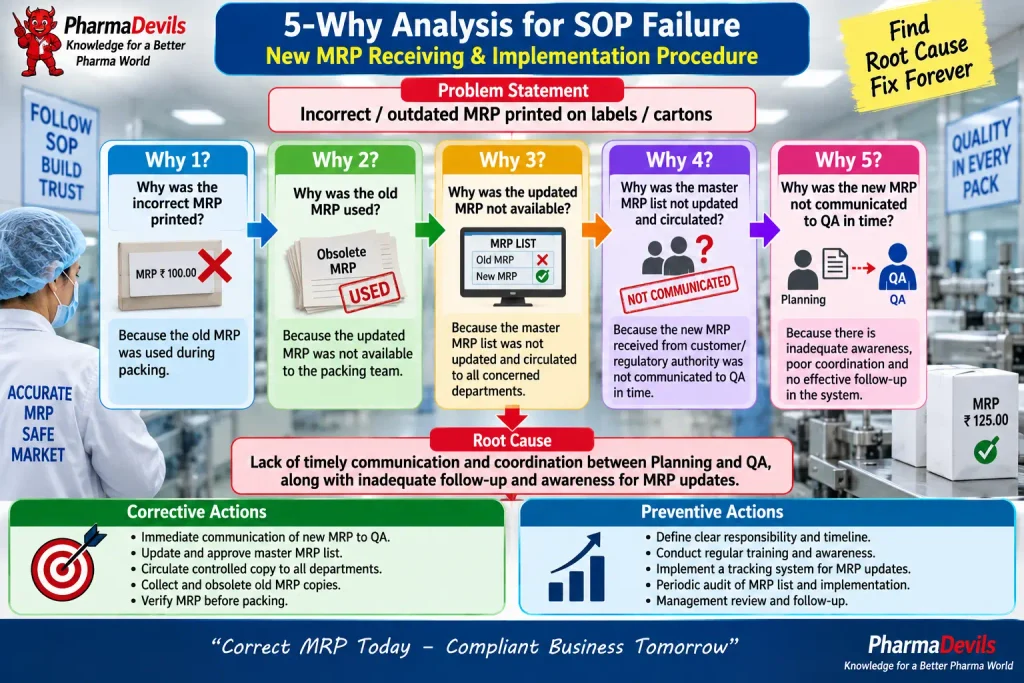
The SOP requires Planning to immediately inform QA when a new MRP is received, after which QA must revise the master MRP list, obtain approval, circulate the controlled copy, collect obsolete copies, and verify the MRP before packing. The 5-Why analysis therefore highlights delayed communication, inadequate coordination, insufficient follow-up, and weak awareness of MRP updates as potential underlying causes. Identifying these causes supports focused corrective and preventive actions such as timely notification, controlled document circulation, staff training, periodic verification, and stronger management follow-up.
Description – Fault Tree Analysis for SOP Failure: New MRP Receiving & Implementation Procedure
The Fault Tree Analysis for SOP Failure – New MRP Receiving & Implementation Procedure illustrates how different process failures can combine to result in an incorrect or outdated MRP being used on labels or cartons. The top event is traced through major contributing branches such as failure to communicate the new MRP to QA, failure to update and approve the master MRP list, and failure to make the updated MRP available at the packing stage. The SOP requires the Planning Department to inform QA immediately after receipt of a new MRP, followed by revision and approval of the master MRP list. It also requires controlled copies of the new MRP to be circulated to concerned departments, old copies to be collected and made obsolete, and the MRP to be verified before batch packing.
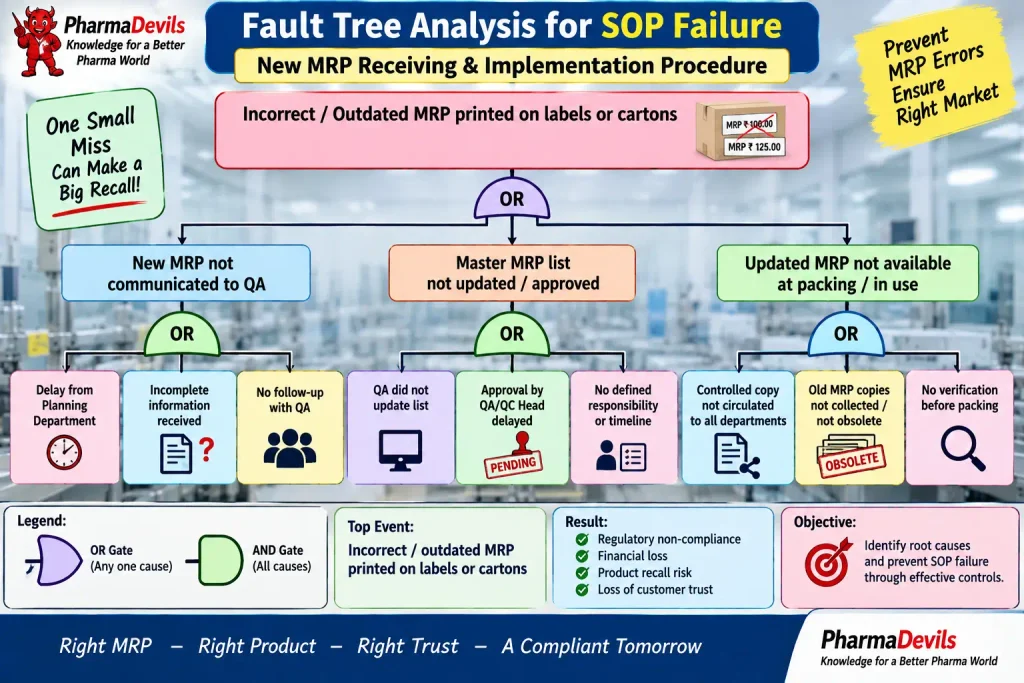
The fault tree therefore helps identify critical breakdown points such as delayed communication, missing updates, delayed approval, uncontrolled document circulation, retention of obsolete copies, and inadequate pre-packing verification. This structured analysis supports identification of root causes and development of suitable controls to strengthen MRP implementation and prevent recurrence of SOP failure.
Description – Impact Assessment for SOP Failure: New MRP Receiving & Implementation Procedure
The Impact Assessment for SOP Failure – New MRP Receiving & Implementation Procedure evaluates the possible consequences when the approved MRP control process is not followed correctly. The SOP requires timely communication of a new MRP to QA, updating and approval of the master MRP list, circulation of controlled copies, withdrawal of obsolete copies, and verification of the applicable MRP before batch packing. Failure at any of these stages may affect QA/QC, Production, Planning, document control, packing operations, customer communication, and overall compliance. Potential consequences include use of an outdated MRP, incorrect printing on labels or cartons, rework, market complaints, product returns, financial loss, audit observations, and loss of customer confidence.
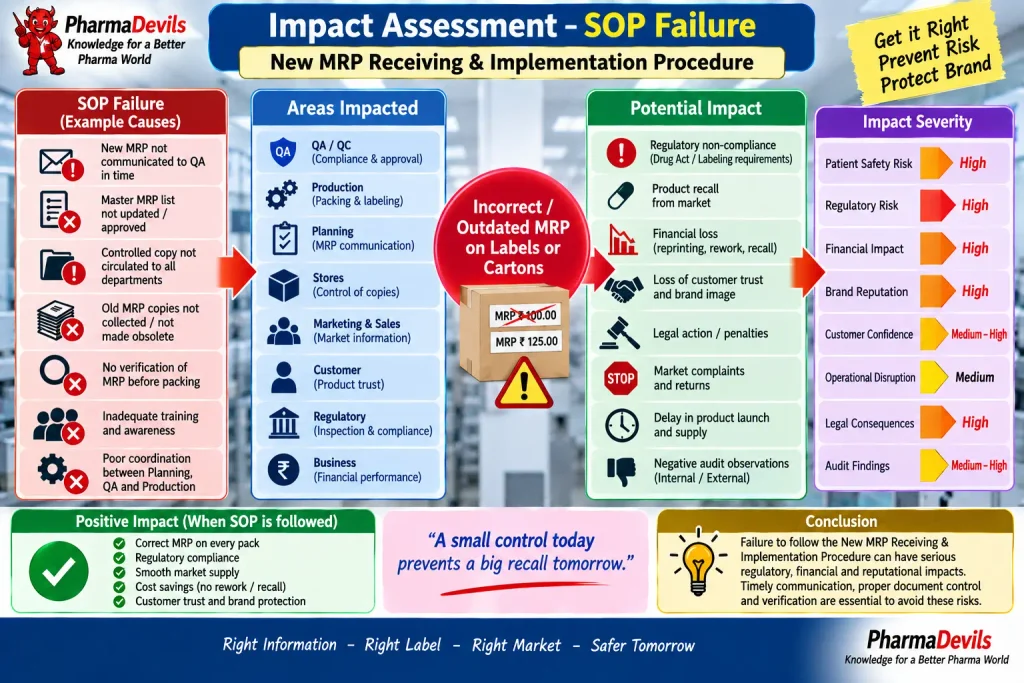
The assessment highlights that effective communication, document control, verification, staff awareness, and coordination between Planning, QA, and Production are essential controls. When the SOP is followed properly, it supports accurate MRP implementation, smooth packing operations, traceability, and consistent control of current and obsolete MRP information.
Question & Answer – SOP for New MRP Receiving & Implementation Procedure
Q1. What is the objective of the SOP for New MRP Receiving & Implementation Procedure?
The objective is to provide a documented procedure for receiving and implementing a new MRP.
Q2. Which departments are mainly responsible for execution of this SOP?
Chemist/Officer-QA and Production Head are responsible for execution of the SOP.
Q3. Who is responsible for effective implementation of the SOP?
The Asst. Manager-QA and Head-QA/QC are responsible for effective implementation.
Q4. From where may a new MRP be received?
A new MRP may be received by the Planning Department from a customer or regulatory authority.
Q5. What should Planning do after receiving a new MRP?
Planning should immediately intimate QA by email or by providing a hard signed copy of the MRP.
Q6. What action should QA take after receiving the new MRP?
QA should revise the master MRP list and obtain approval from the QA/QC Head.
Q7. What happens to the controlled copy of the new MRP?
The controlled copy is circulated to all concerned departments.
Q8. What should be done with the old MRP copy?
The old MRP copy should be collected and made obsolete.
Q9. What verification is required before batch packing?
Before batch packing, QA should verify the applicable MRP against the controlled MRP list.
Q10. What is required if a product has not been manufactured for more than three months?
Before starting packing, QA and Production should verify the MRP, with confirmation from the QA documentation team.
Q11. When may the effective MRP be shared with the customer or party?
The effective MRP for the first applicable batch of an individual product may be shared with the customer or concerned party, if required.
Q12. What is the purpose of the MRP circulation flow?
The flow ensures that the MRP received from the regulatory authority proceeds through QA, Planning/Management, review and updating, circulation, verification before printing, and communication of the effective first-batch MRP to the concerned customer or party.
Q13. What annexure is provided in this SOP?
Annexure-I is provided for the Maximum Retail Price List.
Q14. What information is recorded in the Maximum Retail Price List?
The annexure contains fields for company name, serial number, product, pack size, and current MRP.
Q15. How is the SOP distributed?
Controlled copies are distributed to heads of all departments, while the master copy is retained by the Head of Quality Assurance.