







1. Introduction for SOP for Operation of AHU Unit:
The Operation of AHU Unit SOP explains the standard method for safely starting, operating, monitoring, and stopping Air Handling Units used in pharmaceutical areas. The procedure applies to AHUs serving raw material stores, production areas, sterile sections, and microbiology/QC areas. Engineering personnel are responsible for operating the units and attending breakdowns, while the Engineering Head ensures training and implementation and Quality Assurance oversees compliance. Before starting an AHU, the power supply, supply/return damper positions, and AUTO mode are checked. Chiller, hot-water system, and dehumidifier operation are also included. During operation, pre-filter and fine-filter differential pressure, temperature, relative humidity, and area differential pressure are monitored. Out-of-limit filter pressure readings require investigation, cleaning, repair, or filter replacement. The SOP also specifies the correct shutdown sequence and requires all AHU operating details to be recorded in the AHU logbook.
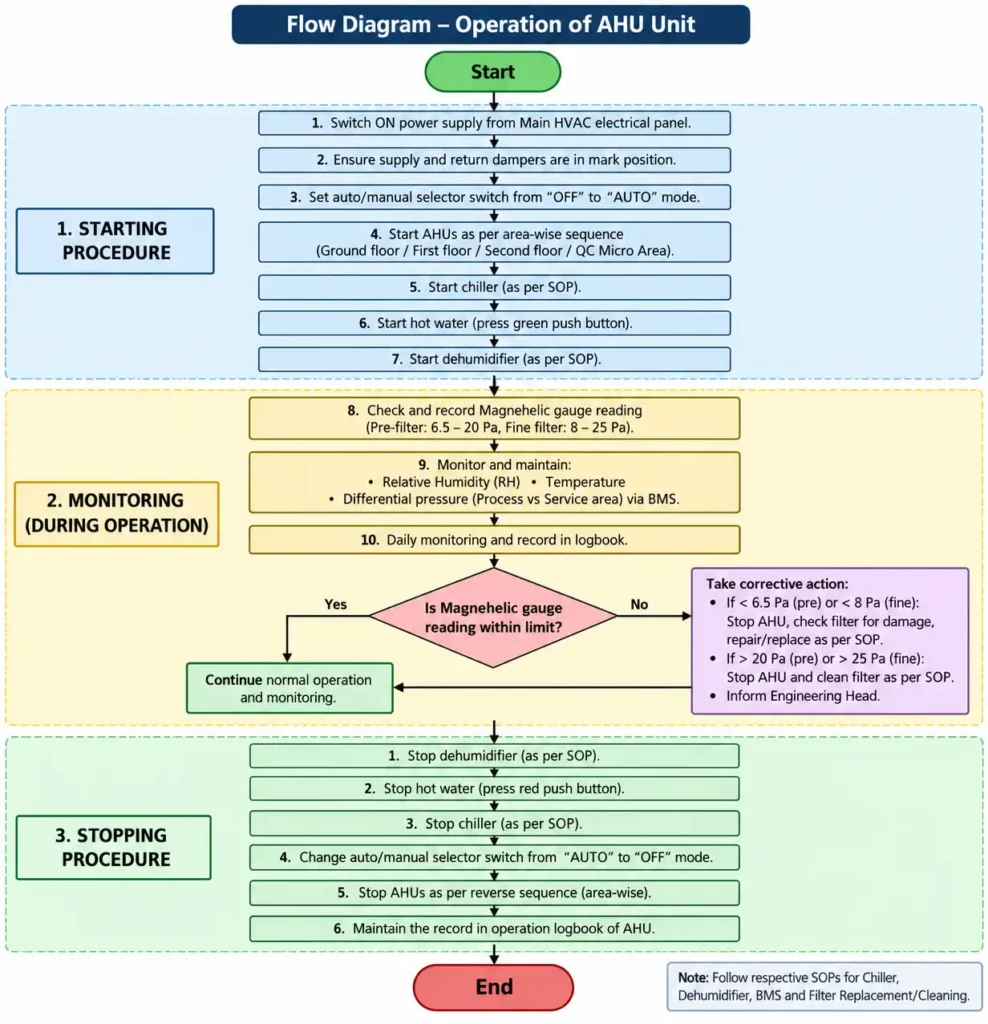
Skip to PDF content2. Flow Diagram for SOP for Operation of Air Handling Unit:
The flow diagram explains the complete operation of the Air Handling Unit (AHU) from start-up to shutdown. The process begins by switching ON the main HVAC power supply, checking supply and return damper positions, and selecting the AUTO mode. AHUs are then started in the defined area-wise sequence, followed by the chiller, hot-water system, and dehumidifier. During operation, the Magnehelic gauge readings are checked for pre-filter and fine-filter pressure limits. The operator also monitors relative humidity, temperature, and differential pressure through the BMS and records observations in the logbook. If pressure readings are outside the specified limits, corrective action is taken by inspecting, cleaning, repairing, or replacing filters and informing the Engineering Head. For shutdown, the dehumidifier, hot-water system, and chiller are stopped first, followed by switching to OFF mode and stopping AHUs in reverse sequence. All activities are documented in the AHU operation logbook.
3. Brainstorming for SOP for Operation of the Air Handling Unit (AHU) is not available:
The brainstorming diagram identifies the possible reasons why the SOP for Operation of the Air Handling Unit (AHU) is not available. Major causes include lack of awareness of regulatory requirements, low management priority, limited technical expertise, inadequate training, and absence of a standard SOP template. Other contributing factors are unclear responsibility for SOP preparation and approval, frequent changes in equipment or operating sequence, outdated BMS settings, and dependence on OEM manuals instead of a controlled procedure.
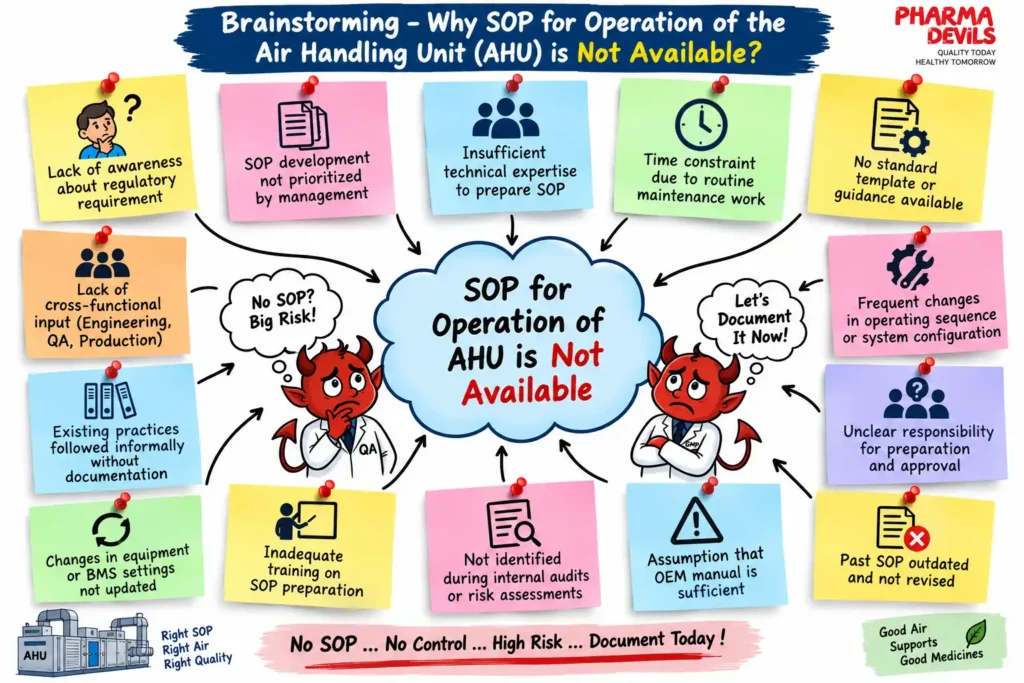
The diagram also highlights weak cross-functional coordination between Engineering, Quality Assurance, and Production, as well as informal working practices without proper documentation. Failure to identify this gap during internal audits or risk assessments can further delay SOP development. The brainstorming exercise helps the organization understand the root causes of missing documentation and supports development of effective corrective and preventive actions to ensure safe, consistent, compliant, and controlled AHU operation.
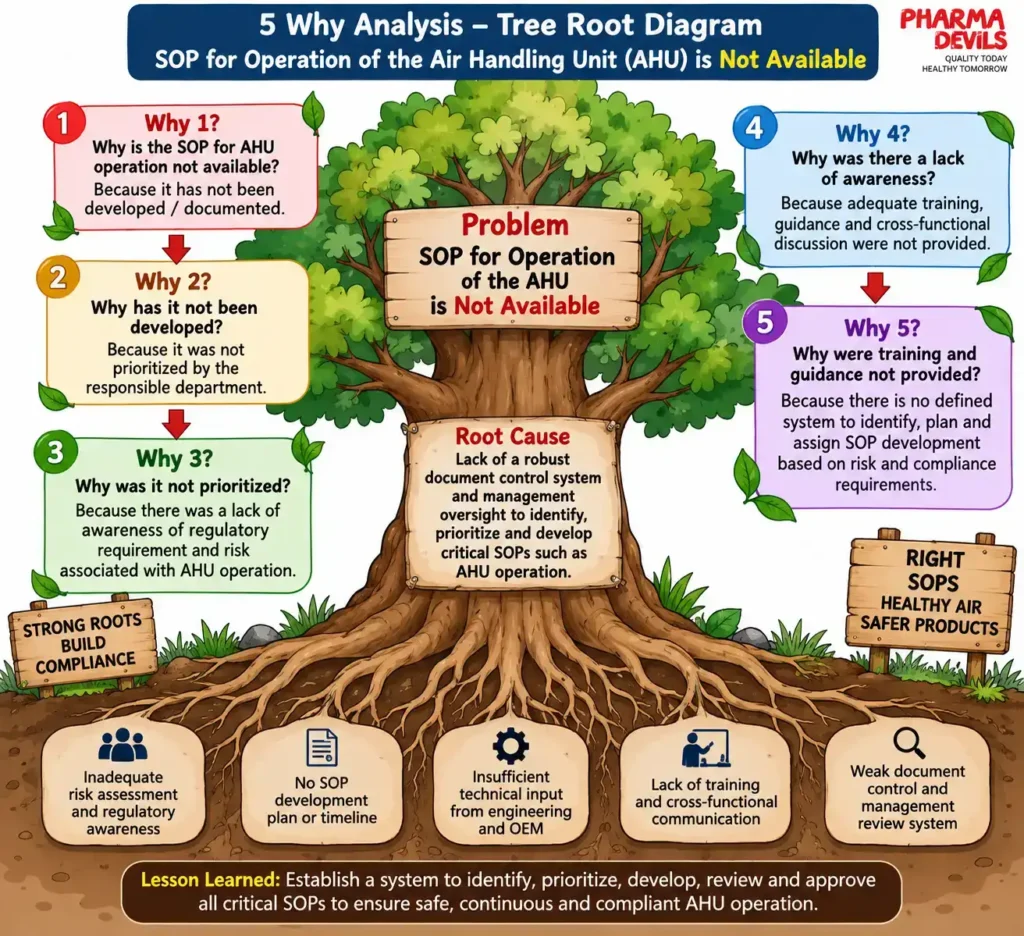
4. 5 Why Analysis for SOP for Operation of the Air Handling Unit (AHU) is not available:
The 5 Why Analysis identifies the underlying reason why the SOP for Operation of the Air Handling Unit (AHU) is not available. The first “Why” shows that the SOP was never formally developed or documented. The second “Why” indicates that preparation of the SOP was not given sufficient priority by the responsible department. The third “Why” points to limited awareness of regulatory expectations and the operational risks associated with AHU systems. The fourth “Why” shows that adequate training, guidance, and cross-functional discussion were not provided. The fifth “Why” identifies the deeper systemic issue: there was no defined process to identify, plan, assign, review, and approve critical SOPs based on risk and compliance requirements.
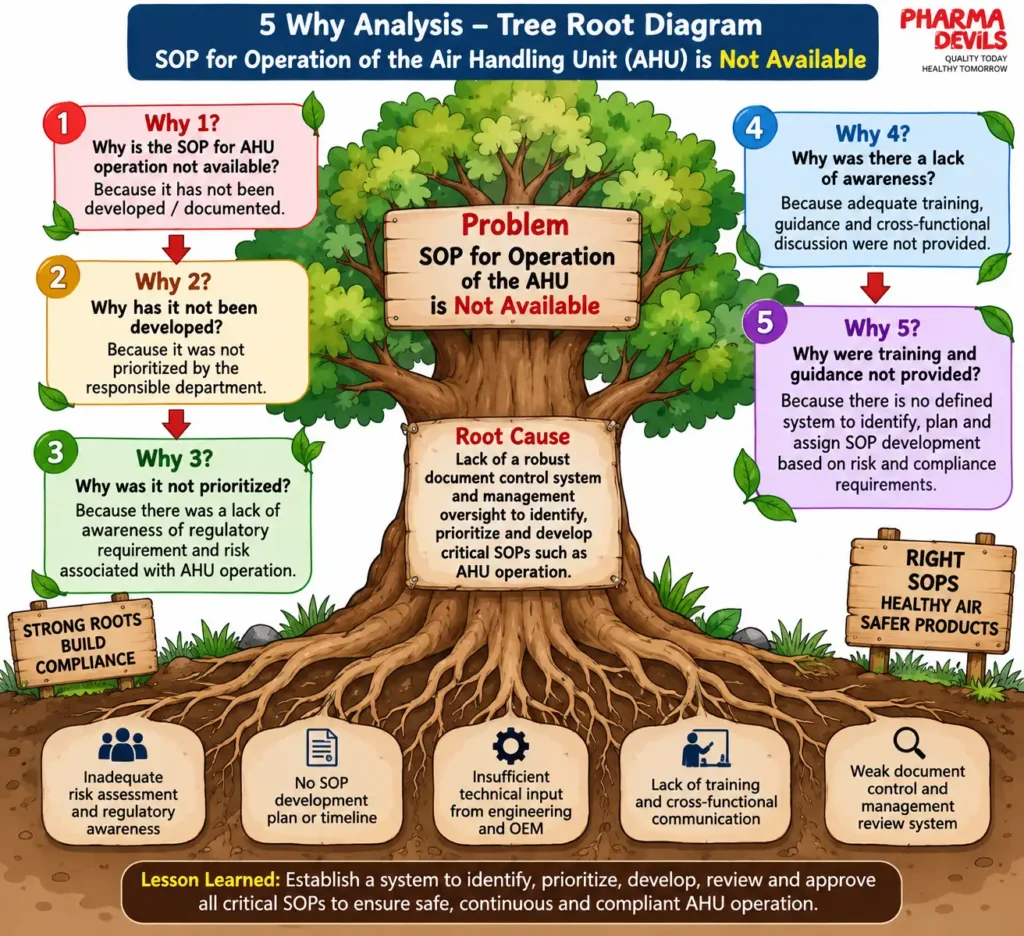
The analysis therefore indicates that the main root cause is weak document-control planning and insufficient management oversight, supported by gaps in risk assessment, technical input, training, responsibility assignment, and periodic review.
5. Heat Map Analysis for SOP for Operation of the Air Handling Unit:
The Heat Map Analysis evaluates the risks associated with the absence of an SOP for Operation of the Air Handling Unit (AHU) based on their likelihood and potential impact. The analysis highlights important risks such as uncontrolled temperature and relative humidity, differential-pressure imbalance, improper AHU start/stop sequence, inadequate filter monitoring, documentation gaps, equipment misuse, cross-contamination, product-quality impact, delayed corrective actions, and regulatory non-compliance.
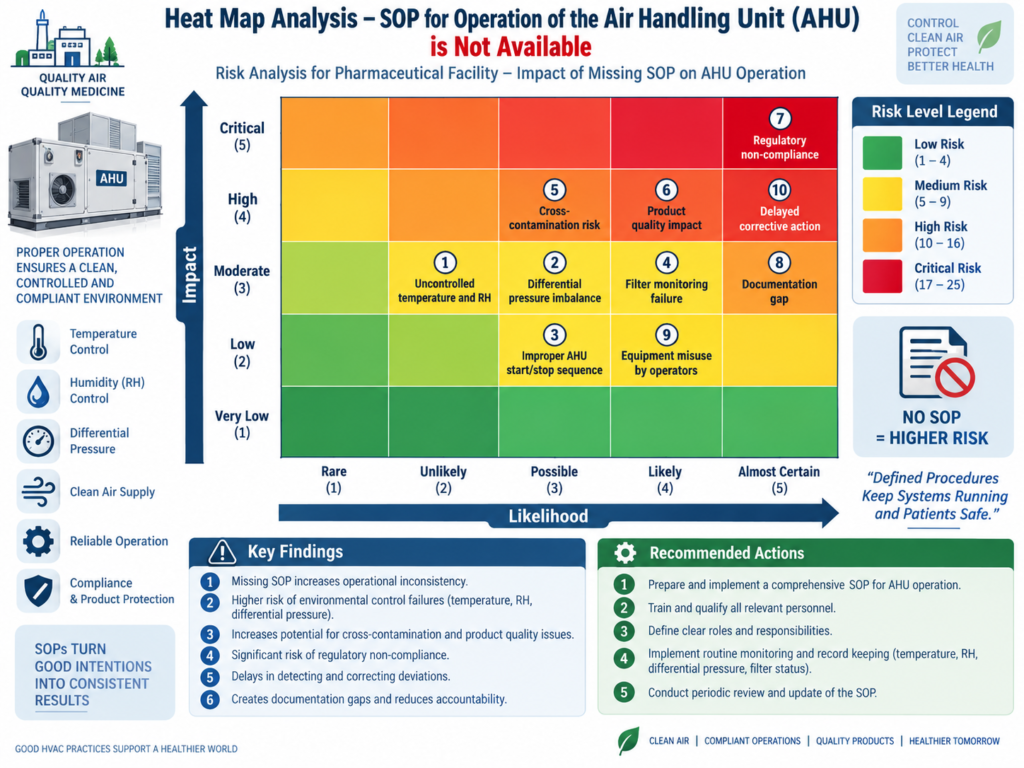
Risks positioned in the red and orange zones require greater attention because they may significantly affect the controlled manufacturing environment, product quality, and GMP compliance. Cross-contamination, product-quality impact, and regulatory non-compliance are particularly important concerns. The assessment demonstrates that operating an AHU without an approved procedure can lead to inconsistent practices and delayed detection of abnormal conditions. Recommended controls include preparing an approved SOP, training personnel, defining responsibilities, routinely monitoring critical HVAC parameters, maintaining proper records, and periodically reviewing the procedure.
6. Fault Tree Analysis for SOP for Operation of the Air Handling Unit not implemented:
The Fault Tree Analysis (FTA) explains the major causes that can lead to failure in implementing the SOP for Operation of the Air Handling Unit (AHU). The top event is identified as “AHU Operation SOP Not Implemented.” This failure is linked to four main areas: people-related, process-related, system/equipment-related, and management-related causes. People-related causes include lack of awareness and inadequate operator training. Process-related causes include absence of SOP development, delayed approval, and poor communication. System-related causes include complex AHU operation, insufficient technical input, and equipment or BMS changes not reflected in documentation. Management-related causes include low priority for documentation and inadequate review or audit systems. These failures can result in uncontrolled temperature and humidity, poor differential pressure control, insufficient filter monitoring, cross-contamination, product-quality impact, documentation gaps, and regulatory non-compliance. FTA helps identify root causes and supports stronger controls, training, documentation, and management oversight.
7. Pareto Chart Analysis for SOP for Operation of the Air Handling Unit not implemented:
The Pareto Chart Analysis highlights the major causes responsible for non-implementation of the SOP for Operation of the Air Handling Unit (AHU). The chart ranks the causes according to their contribution, helping identify the few factors that create most of the problem. The largest contributors are lack of management priority, low regulatory awareness, unclear SOP ownership, inadequate training, and weak document control. Together, these major causes account for approximately 78% of the total impact, showing where corrective actions should be focused first.
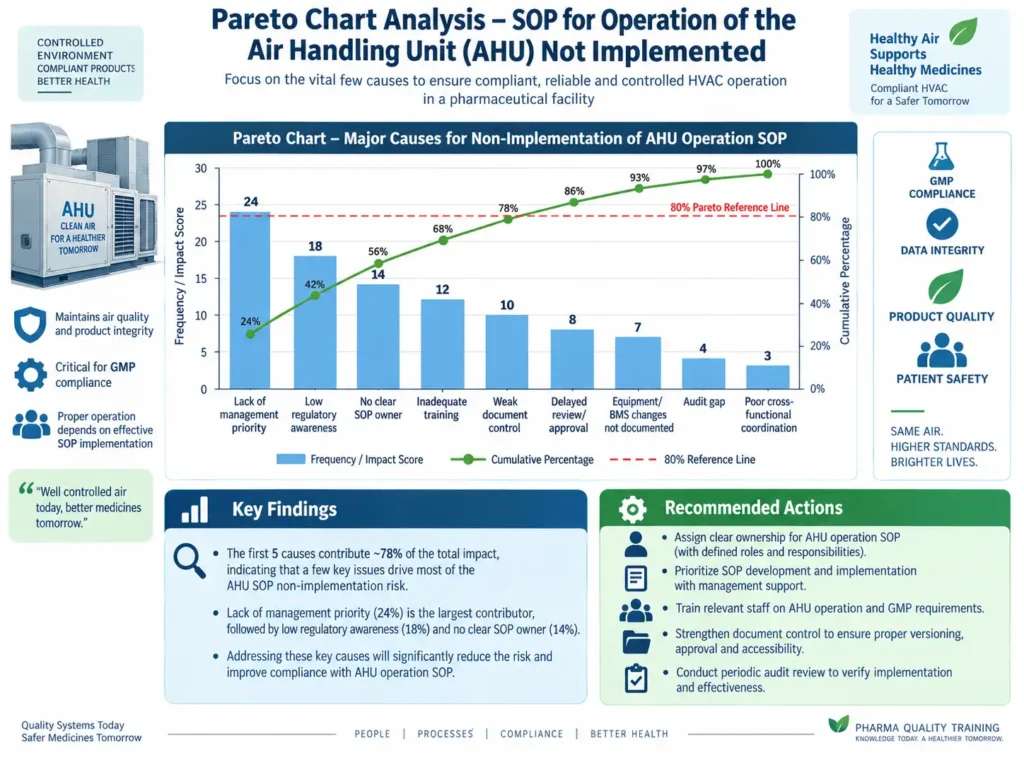
Other contributing factors include delayed review and approval, undocumented equipment or BMS changes, audit gaps, and poor cross-functional coordination. The Pareto approach helps management prioritize resources and address the most significant causes before less critical ones. Recommended actions include assigning clear responsibility, prioritizing SOP development, providing training, strengthening document control, updating technical changes, and periodically verifying SOP implementation through internal audits.
8. Corrective Action and Preventive Action (CAPA):
SOP for Operation of the Air Handling Unit (AHU) Not Implemented
The existing SOP requires defined AHU start/stop sequences, monitoring of pre-filter and fine-filter differential pressure, control of temperature/RH and area differential pressure, and recording of AHU operation in a logbook.
| Type | Action |
|---|---|
| Corrective Action | Immediately inform Engineering and QA regarding non-implementation of the AHU SOP. |
| Corrective Action | Assess all affected AHUs and manufacturing/QC areas for current operating status. |
| Corrective Action | Verify temperature, RH, differential pressure, AHU status and BMS indications. |
| Corrective Action | Check Magnehelic gauge readings and filter condition; investigate any abnormal readings. |
| Corrective Action | Review available AHU logbooks and BMS records for the period during which the SOP was not implemented. |
| Corrective Action | Perform documented impact/risk assessment for possible effect on environmental control, product quality and cross-contamination. |
| Corrective Action | Review and approve the AHU operation SOP through the document-control system. |
| Corrective Action | Train all Engineering operators/technicians and relevant Production, QC and QA personnel before independent AHU operation. |
| Corrective Action | Initiate deviation/CAPA for any identified environmental excursion or documentation gap. |
| Preventive Action | Assign a defined SOP owner from Engineering and responsible reviewer/approver from Engineering and QA. |
| Preventive Action | Establish a master list of all HVAC/AHU SOPs with effective dates, revision dates and training status. |
| Preventive Action | Introduce a checklist covering power supply, damper position, AUTO mode, utility operation, filter DP, temperature, RH and differential pressure. |
| Preventive Action | Ensure area-wise start and stop sequences are displayed or readily available to authorized operators. |
| Preventive Action | Configure routine review of BMS trends and AHU operating logbooks by Engineering. |
| Preventive Action | Include AHU SOP compliance in internal audits and periodic engineering self-inspections. |
| Preventive Action | Provide periodic refresher training and effectiveness assessment to operators. |
| Preventive Action | Revise the SOP whenever AHU configuration, BMS settings, filters, area usage or operating sequence changes. |
| Preventive Action | Conduct periodic CAPA effectiveness checks to confirm sustained SOP implementation and complete documentation. |
CAPA Effectiveness Check
CAPA may be considered effective when 100% relevant personnel are trained, AHU operating records are complete, monitored parameters remain within approved limits, no repeat SOP implementation gaps are observed, and internal audit confirms continued compliance.
9. Questions & Answers – SOP for Operation of Air Handling Unit (AHU):
Q1. What is the objective of the AHU operation SOP?
Answer: The objective is to define a standard procedure for the operation of the Air Handling Unit.
Q2. Who is responsible for AHU operation and breakdown maintenance?
Answer: Engineering operators or technicians are responsible for operating the AHU and attending minor or major breakdown maintenance activities.
Q3. Who ensures implementation of the AHU SOP?
Answer: The Head of Engineering ensures training and implementation, while the Head of Quality Assurance ensures compliance.
Q4. What is the first step before starting the AHU?
Answer: Switch ON the power supply from the main HVAC electrical panel.
Q5. What should be checked before starting the AHU?
Answer: The supply and return dampers should be checked and confirmed in their marked positions.
Q6. Which operating mode should be selected during start-up?
Answer: The auto/manual selector switch should be changed from OFF to AUTO mode.
Q7. Which utilities are started along with the AHU?
Answer: The chiller, hot-water system, and dehumidifier are started as per their respective SOPs.
Q8. What is the specified differential-pressure range for the pre-filter?
Answer: The specified pre-filter differential-pressure range is 6.5 to 20 Pascal.
Q9. What is the specified differential-pressure range for the fine filter?
Answer: The specified fine-filter differential-pressure range is 8 to 25 Pascal.
Q10. What should be done if the pre-filter or fine-filter DP is below the specified limit?
Answer: Stop the AHU, inspect the filter for damage, and rectify or replace the filter if required.
Q11. What should be done if the differential pressure is above the specified limit?
Answer: Stop the AHU and clean the filter according to the applicable AHU filter-cleaning SOP.
Q12. Which parameters are monitored during AHU operation?
Answer: Relative humidity, temperature, filter differential pressure, and process-area differential pressure are monitored.
Q13. How is process-area differential pressure controlled?
Answer: It is controlled through the centralized Building Management System.
Q14. What should be done if a Magnehelic gauge reading is outside the specified limit?
Answer: The Engineering Head should be informed and appropriate corrective action should be taken.
Q15. What is the first step during AHU shutdown?
Answer: The dehumidifier should be stopped as per its SOP.
Q16. Which selector position is used during shutdown?
Answer: The selector switch should be changed from AUTO to OFF mode.
Q17. How should AHUs be stopped?
Answer: AHUs should be stopped one by one according to the defined area-wise stopping sequence.
Q18. Where are AHU operation details recorded?
Answer: AHU operation details are recorded in the AHU operation logbook.
Q19. What information is recorded in the AHU logbook?
Answer: The logbook includes date, start time, stop time, pre-filter DP, fine-filter DP, RH, temperature, remarks, done-by, and checked-by details.
Q20. What does BMS stand for?
Answer: BMS stands for Building Management System.
10. Reference Guidelines – Operation of Air Handling Unit (AHU):
For preparing, reviewing, and implementing an SOP for Operation of the Air Handling Unit (AHU) in a pharmaceutical facility, the following references are appropriate:
- Revised Schedule M, Drugs Rules, 1945 – India, G.S.R. 922(E), 28 December 2023: Provides GMP requirements for pharmaceutical premises, equipment, utilities, documentation, and HVAC systems. CDSCO also identifies Schedule M and WHO GMP as principal references during GMP inspections. CDSCO Revised Schedule M
- WHO Technical Report Series No. 1010, Annex 8 (2018): Guidelines on Heating, Ventilation and Air-Conditioning Systems for Non-Sterile Pharmaceutical Products. It covers HVAC design, management, control, monitoring, qualification, pressure relationships, filtration, temperature, humidity, and contamination control. WHO TRS 1010 Annex 8
- WHO TRS No. 1019, Annex 2 (2019): GMP for HVAC Systems for Non-Sterile Pharmaceutical Products – Part 2. This provides practical interpretation and examples supporting the WHO HVAC requirements.
- WHO TRS No. 1044, Annex 2 (2022): Good Manufacturing Practices for Sterile Pharmaceutical Products. This should be referenced where AHUs serve sterile, aseptic, filling, filtration, sterile passage, or microbiology areas. WHO Sterile GMP Annex 2
- US FDA – Sterile Drug Products Produced by Aseptic Processing: Current Good Manufacturing Practice (2004). Relevant for HVAC filtration, cleanroom environmental control, pressure relationships, contamination control, and aseptic manufacturing areas.
- ICH Q7 – Good Manufacturing Practice for Active Pharmaceutical Ingredients: States that HVAC and other utilities affecting product quality should be qualified, appropriately monitored, and controlled when limits are exceeded; ventilation and filtration systems should minimize contamination and cross-contamination.
- ISO 14644-1 and ISO 14644-2: Useful for cleanroom air cleanliness classification and monitoring. FDA notes that these standards should be used together with applicable GMP regulations and guidance rather than as the sole basis for qualification of sterile facilities.