






1. Introduction for Operation Qualification of HVAC System:
The Operation Qualification (OQ) of the HVAC system verifies that the installed system operates according to approved design specifications, manufacturer requirements, and intended operational parameters. The protocol covers a 1650 CFM HVAC system supplying Sampling Area-I, Material Airlock, and Man Airlock. It includes verification of personnel training, instrument calibration, applicable SOPs, air changes, HEPA filter integrity, particulate count, temperature, relative humidity, pressure differentials, airflow pattern, recovery time, alarms, noise, vibration, valves, dampers, and fresh-air quantity. Successful execution provides documented evidence that the HVAC system functions consistently and is suitable for controlled pharmaceutical area operation during routine use.
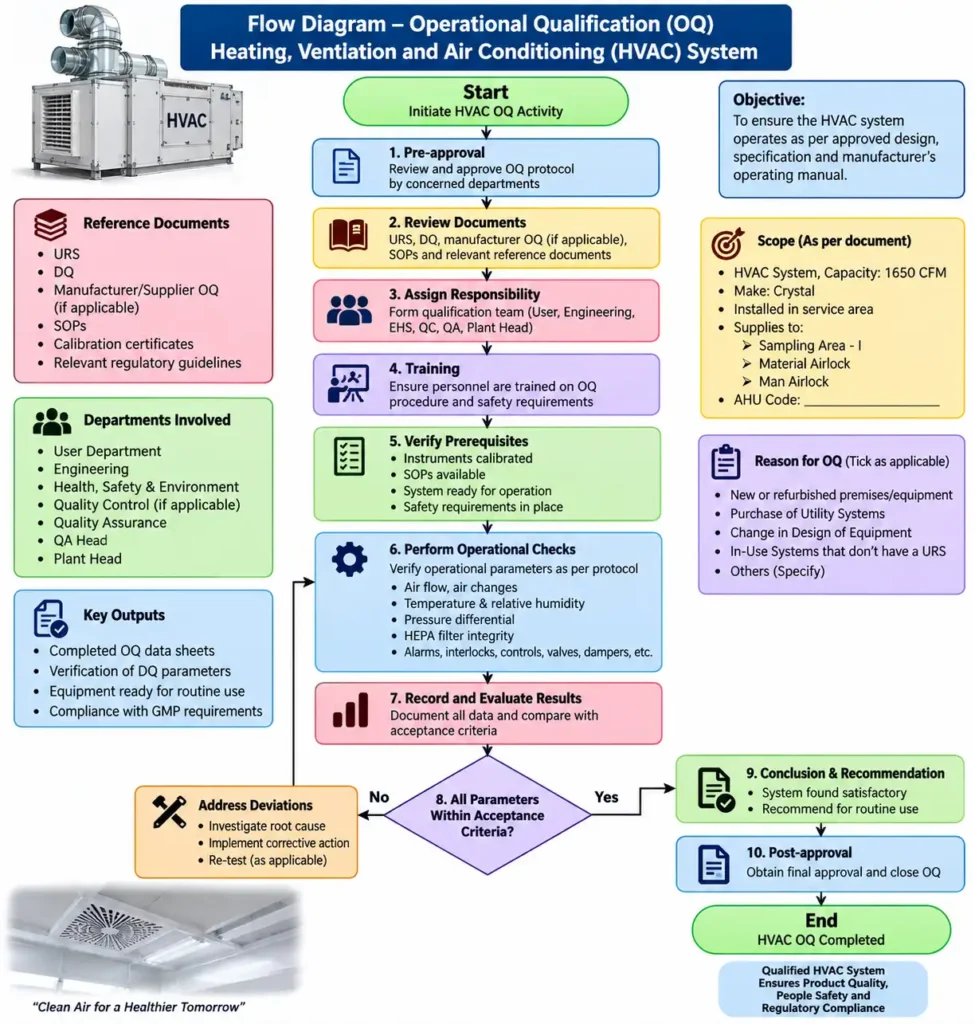
Skip to PDF content2. Flow Diagram – Operational Qualification of HVAC System:
The flow diagram illustrates the systematic execution of Operational Qualification (OQ) for the HVAC system. It begins with protocol initiation and pre-approval, followed by review of URS, DQ, SOPs, manufacturer documents, and applicable references. Responsibilities are assigned to relevant departments, personnel training is confirmed, and prerequisites such as instrument calibration and system readiness are verified. Operational checks are then performed for airflow, air changes, temperature, relative humidity, pressure differential, HEPA integrity, alarms, controls, valves, and dampers. Results are recorded and compared with acceptance criteria. Deviations are investigated and corrected before final conclusion, approval, and OQ closure.
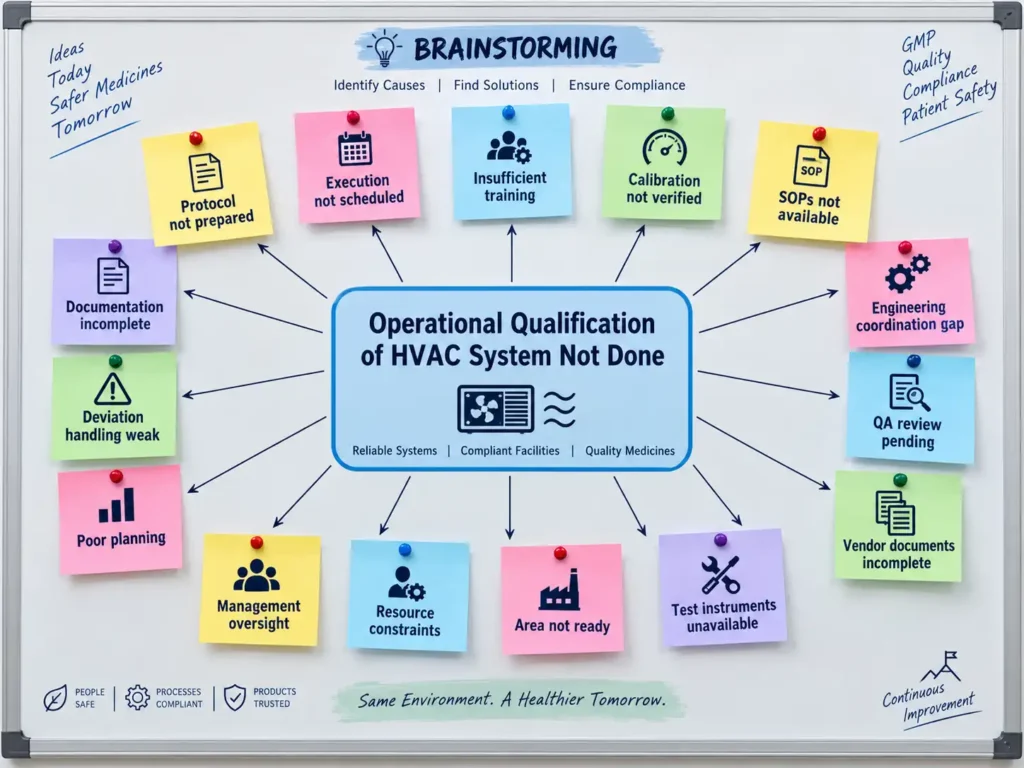
3. Brainstorming Analysis – HVAC Operational Qualification Not Done:
The brainstorming analysis identifies potential causes for the Operational Qualification of the HVAC system not being performed. Major contributing factors include an unprepared qualification protocol, poor execution planning, insufficient personnel training, unverified instrument calibration, unavailable SOPs, incomplete vendor documents, and inadequate engineering coordination. Other possible causes include delayed QA review, unavailable test instruments, area readiness issues, resource constraints, weak deviation handling, incomplete documentation, and insufficient management oversight. The analysis helps the qualification team systematically recognize gaps affecting OQ execution. Addressing these causes through proper planning, documentation, training, coordination, calibration, and timely QA review supports compliant HVAC qualification and reliable system performance.
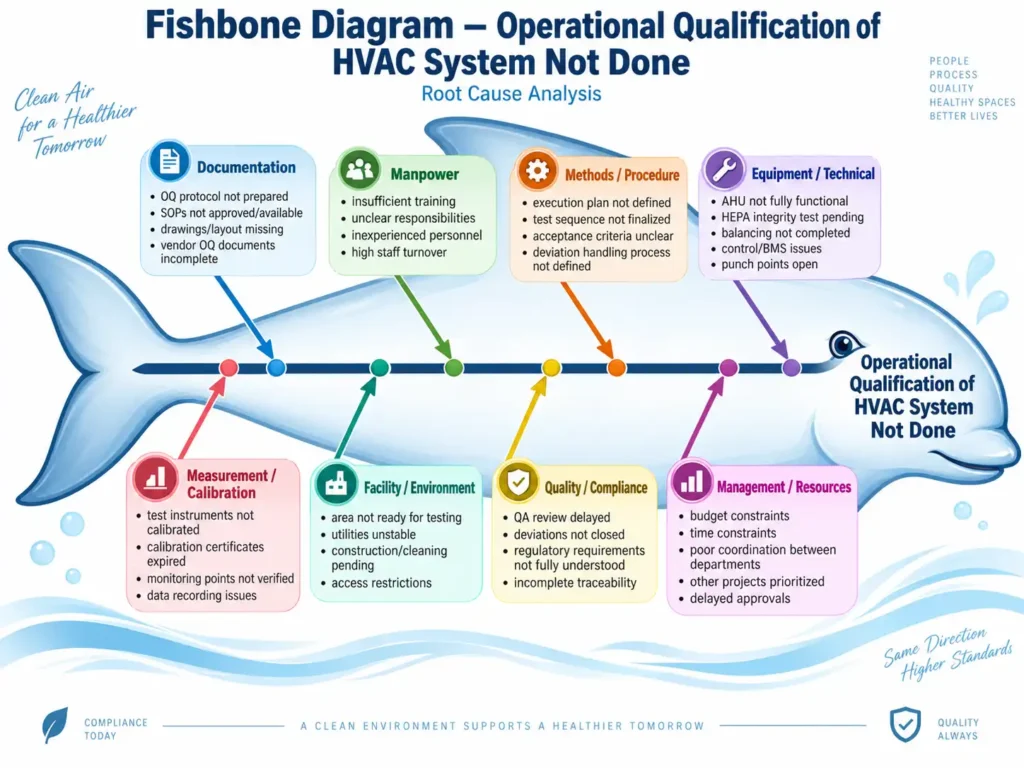
4. Fishbone Analysis – Operational Qualification of HVAC System Not Done
The fishbone diagram identifies potential root causes responsible for the Operational Qualification of the HVAC system not being completed. The causes are grouped into documentation, manpower, methods/procedures, equipment/technical, measurement/calibration, facility/environment, quality/compliance, and management/resources. Key issues include an unprepared OQ protocol, inadequate training, unclear responsibilities, undefined execution plans, pending HEPA integrity testing, incomplete balancing, uncalibrated instruments, unstable utilities, delayed QA review, open deviations, budget limitations, and poor departmental coordination. The dolphin-shaped fishbone visually connects these contributing factors to the main problem and supports systematic investigation, CAPA planning, improved coordination, timely qualification execution, and regulatory compliance.
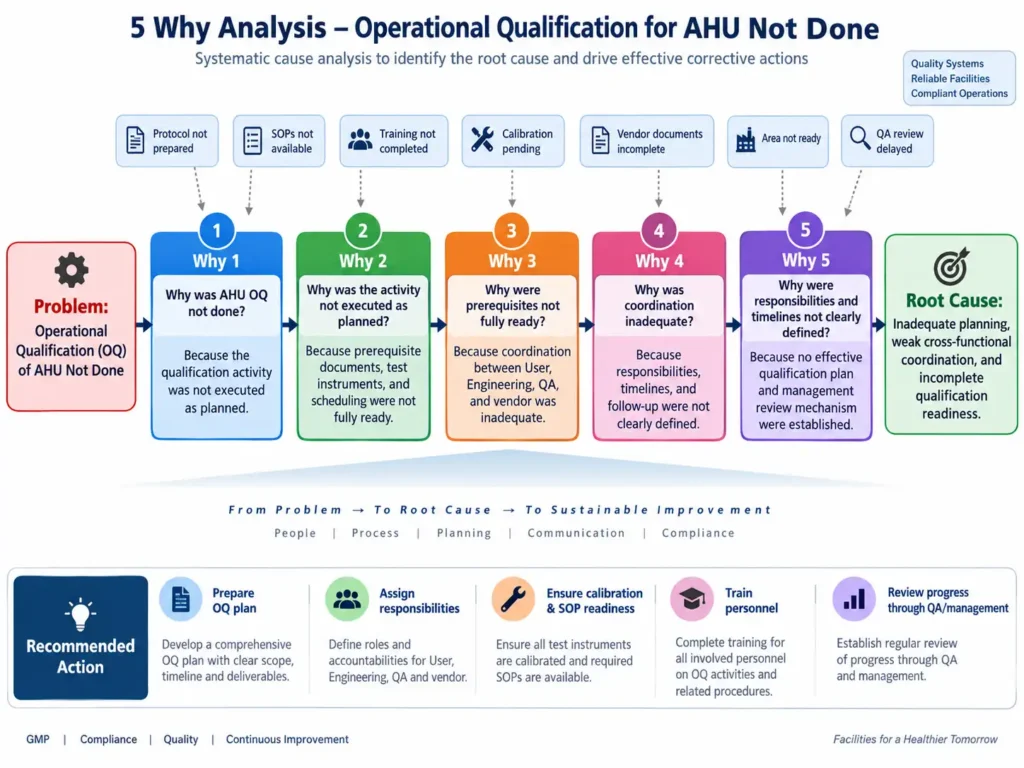
5. 5-Why Analysis – Operational Qualification of AHU Not Done:
The 5-Why analysis identifies the underlying reasons for the Operational Qualification of the AHU not being completed. The analysis begins with failure to execute the planned qualification activity and traces the issue through incomplete prerequisite documents, unavailable or uncalibrated test instruments, inadequate scheduling, and poor coordination among User, Engineering, QA, and vendor teams. Further analysis highlights unclear responsibilities, timelines, and follow-up mechanisms. The root cause is identified as inadequate qualification planning, weak cross-functional coordination, and incomplete readiness of documentation and resources. Recommended actions include preparing a detailed OQ plan, assigning responsibilities, ensuring calibration, completing training, and conducting periodic QA management reviews.
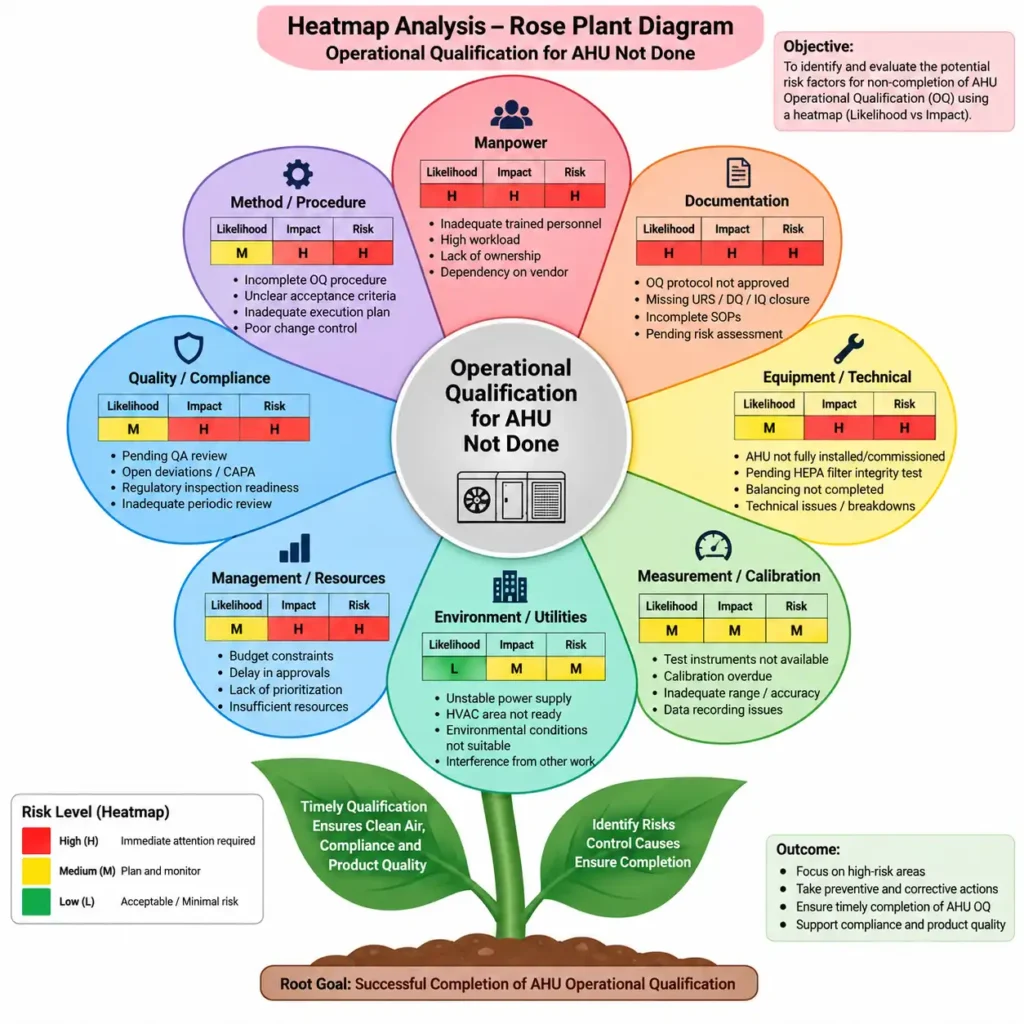
6. Heatmap Analysis – Operational Qualification of AHU Not Done:
The heatmap analysis evaluates potential risks responsible for the Operational Qualification of the AHU not being completed. It considers key categories including manpower, methods/procedures, documentation, equipment/technical issues, measurement/calibration, environment/utilities, management/resources, and quality/compliance. Each category is assessed for likelihood, impact, and overall risk level using high, medium, and low ratings. High-risk areas include inadequate training, incomplete qualification documents, pending HEPA integrity testing, open deviations, and delayed approvals. Medium risks include calibration gaps and unstable utilities. The analysis helps prioritize corrective and preventive actions, allocate resources effectively, and ensure timely completion of AHU Operational Qualification with regulatory compliance and reliable system performance.
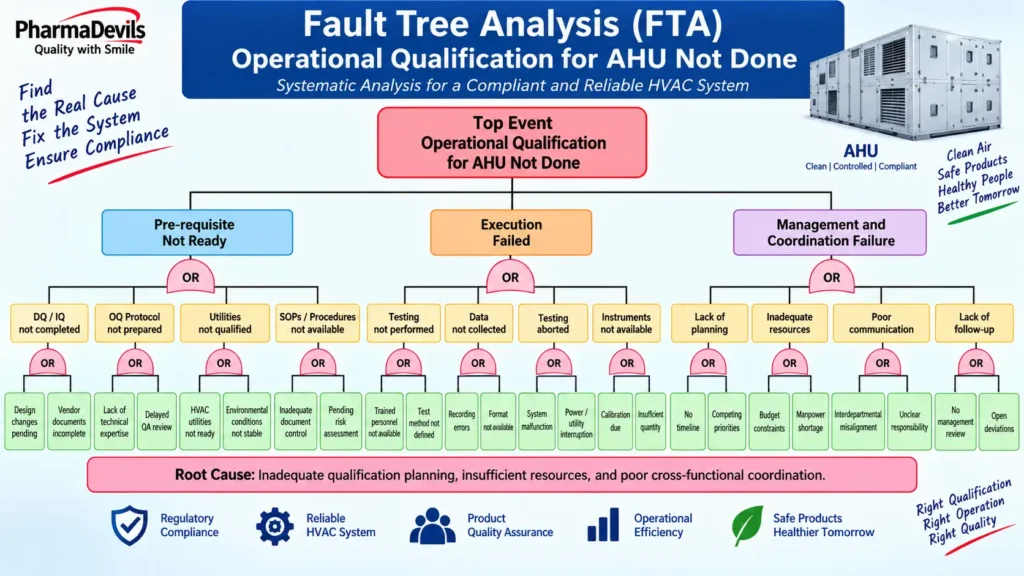
7. Fault Tree Analysis – Operational Qualification for AHU Not Done:
The Fault Tree Analysis identifies the major causes contributing to non-completion of Operational Qualification for the AHU. The top event is linked to three primary failure groups: prerequisite readiness, execution failure, and management/coordination failure. Contributing causes include incomplete DQ/IQ activities, unprepared OQ protocol, unqualified utilities, unavailable SOPs, testing not performed, missing data, unavailable instruments, poor planning, inadequate resources, weak communication, and insufficient follow-up. Lower-level causes further identify vendor delays, calibration gaps, staff shortages, technical issues, and open deviations. This structured analysis helps identify root causes, prioritize corrective actions, and improve timely AHU qualification completion.
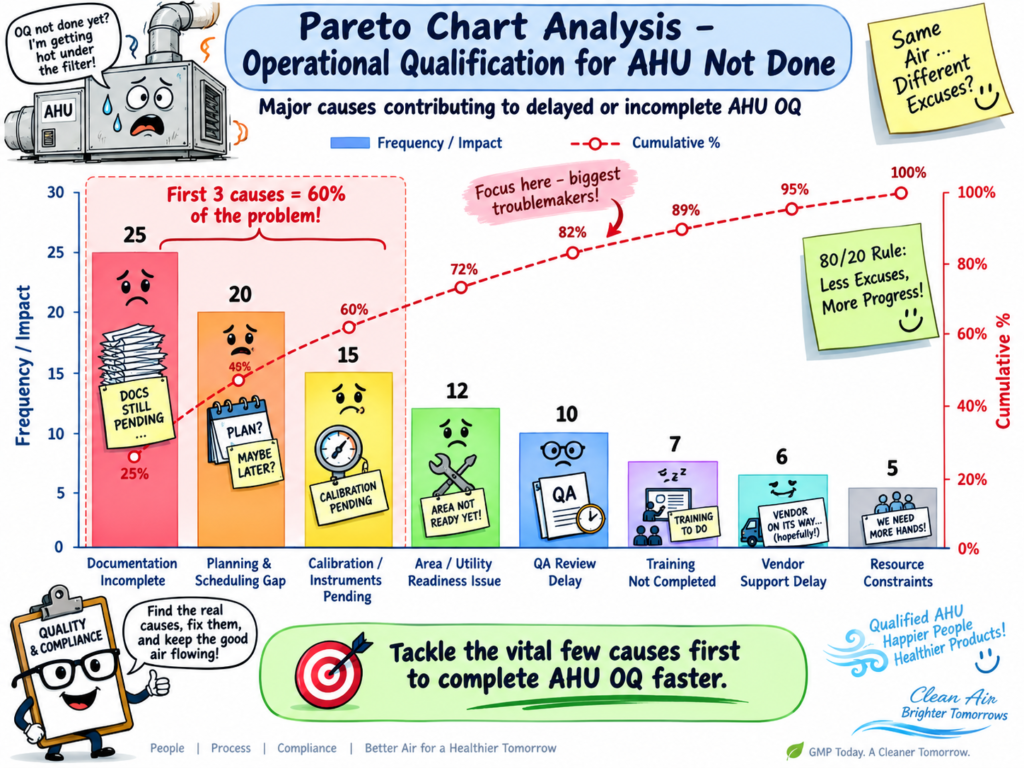
8. Pareto Chart Analysis – Operational Qualification for AHU Not Done:
The Pareto chart highlights the major causes contributing to delayed or incomplete Operational Qualification of the AHU. The highest contributors are incomplete documentation, planning and scheduling gaps, and pending calibration or test instruments, followed by area readiness issues, delayed QA review, incomplete training, vendor support delays, and resource constraints. The cumulative percentage line helps identify the “vital few” causes that contribute most significantly to the problem. By prioritizing these high-impact issues first, the organization can focus corrective actions, improve resource utilization, reduce qualification delays, strengthen coordination, and achieve timely completion of AHU Operational Qualification in a more systematic and compliant manner.
9. Corrective Action and Preventive Action (CAPA) with Effectiveness Review – Operational Qualification of AHU Not Done:
Based on the attached OQ protocol, the qualification activity requires approved documentation, trained personnel, calibrated instruments, verified SOPs, execution of defined HVAC parameters, documentation of deviations, conclusion, and final approval.
| Area / Gap | Corrective Action | Preventive Action | Effectiveness Review |
|---|---|---|---|
| OQ protocol not executed | Prepare/review the AHU OQ protocol, obtain pre-approval, define AHU identification and execute the protocol. | Include OQ execution in the qualification master schedule with responsible persons and target dates. | Verify approved OQ protocol and completed execution records within 30 days. No overdue OQ activities. |
| Personnel training incomplete | Train User, Engineering, QA, EHS/QC personnel involved in OQ before execution. | Maintain a qualification-training matrix and prevent untrained personnel from performing OQ tests. | Review training records and interview selected personnel; target 100% trained personnel. |
| Calibration status not verified | Identify all instruments used for OQ and confirm valid calibration before testing. | Maintain calibration due-date tracking with advance alerts. | Check calibration certificates for all instruments used during OQ; target 100% within calibration validity. The protocol specifically requires verification of calibration status. |
| Required SOPs unavailable/unverified | Review and approve applicable SOPs for AHU operation, filter cleaning, preventive maintenance, temperature/RH, pressure difference, airflow and cleanroom monitoring. | Establish an SOP readiness checklist as an OQ prerequisite. | Confirm all applicable SOP numbers, effective dates and training status before qualification execution. |
| HVAC operational tests pending | Execute specified tests including air changes, HEPA integrity, particulate count, temperature, RH, pressure differential, airflow pattern, recovery and alarm testing. | Introduce a controlled OQ execution checklist covering every approved acceptance criterion. | Review completed data sheets and verify all defined parameters meet approved criteria with no unexplained missing results. |
| Functional checks incomplete | Verify AHU ON/OFF indication, chilled/warm water parameters, blower operation, dampers and fresh-air quantity as applicable. | Include functional verification in commissioning-to-qualification handover. | QA/Engineering independently review completed observations against acceptance criteria. |
| Deviations/open observations | Document deviations identified during OQ, perform investigation, implement corrective action and repeat affected tests where required. | Establish deviation closure as a mandatory requirement before OQ conclusion. | Confirm 100% critical/major deviations closed and affected tests satisfactorily repeated before final approval. |
| Weak coordination and delayed approval | Assign responsibilities and establish regular coordination among User, Engineering, QA, EHS/QC and management. | Use a qualification tracker showing responsibility, planned date, actual date and status. | Weekly tracker review until closure; target no overdue critical qualification activities. |
| OQ closure not completed | Compile results, attachments, deviations and recommendation/conclusion and obtain post-approval. | Use a standardized OQ closure checklist reviewed by QA. | QA verifies complete records and signatures from required functions before the system is considered qualified. The protocol requires recommendation/conclusion followed by post-approval. |
Effectiveness Review Conclusion
CAPA may be considered effective when the AHU OQ protocol has been completely executed and approved, all personnel are trained, instruments are within calibration validity, required SOPs are effective, operational and functional tests meet their predefined acceptance criteria, and all deviations are satisfactorily closed. QA should perform a documented effectiveness review approximately 30–60 days after CAPA completion and confirm that no qualification activity remains overdue and no repeat gap related to AHU OQ execution has occurred.
10. Questions and Answers – Operational Qualification of AHU:
- Q: What is the purpose of Operational Qualification of the AHU/HVAC system?
A: The purpose is to verify that the installed HVAC system operates according to the approved design, specifications, and manufacturer’s operating manual and to document relevant operating data. - Q: What HVAC system is covered in the attached OQ protocol?
A: The protocol covers an HVAC system of 1650 CFM capacity, Make: Crystal, installed in the service area and supplying Sampling Area-I, Material Airlock, and Man Airlock. - Q: Why may an OQ protocol be prepared?
A: Reasons listed include new or refurbished premises/equipment, purchase of utility systems, change in equipment design, in-use systems without a URS, or other specified reasons. - Q: Which departments are responsible for AHU Operational Qualification?
A: Responsibilities are assigned to the User Department, Engineering, Health Safety and Environment, Quality Assurance, QA Head, and Plant Head. - Q: Why must personnel training be completed before OQ execution?
A: The protocol requires personnel involved in qualification activities to have documented training status and training-report availability before performing qualification work. - Q: Why is calibration verification important during OQ?
A: Instruments used for qualification must have their instrument identification, calibration date, calibration due date, and verification status documented before use. - Q: Which SOPs should be available for HVAC OQ?
A: The protocol identifies SOPs related to AHU operation, filter cleaning, preventive maintenance, measuring instruments, filter handling, temperature/RH recording, pressure-difference recording, microbiological monitoring, duct leakage testing, and pressure balancing. - Q: What air-change acceptance criterion is stated in the protocol?
A: For the ISO 8 area at rest, the protocol states NLT 20 air changes per hour. - Q: What is the HEPA filter integrity acceptance criterion?
A: The protocol specifies leakage of not more than 0.01% of the upstream challenge aerosol concentration. - Q: What temperature and relative-humidity limits are stated?
A: Temperature is specified as NMT 25°C, while relative humidity is specified as NMT 60% during the defined at-rest monitoring period. - Q: What is checked during the airflow-pattern test?
A: Smoke should diffuse uniformly through the supply location and move toward the return location. It should also move from an area under positive pressure toward an area under negative pressure. - Q: What is the acceptance criterion for the area recovery test?
A: The protocol states that recovery or clean-up should be achieved within 15 minutes. - Q: What should happen during the AHU failure and alarm test?
A: An annunciation or alarm should be generated when the AHU failure condition is tested. - Q: What is the acceptable noise level mentioned in the protocol?
A: Noise should be not more than 80 dB at a distance of 1 metre, and no abnormal vibration should be observed. - Q: What functional checks are performed on the AHU?
A: Checks include ON/OFF indication, chilled-water inlet/outlet valves, chilled- and warm-water pressure and temperature, process-air blower operation, damper operation, and fresh-air quantity. - Q: What fresh-air quantity is specified?
A: Fresh-air quantity should be 10% to 20% of the total CFM. - Q: What should be done if deviations occur during OQ?
A: Deviations or changes should be documented in the designated section of the qualification record and addressed before recommendation, conclusion, and final approval. - Q: When can the AHU OQ be considered complete?
A: Completion requires execution of the qualification activities, recording of observations, handling of deviations, preparation of recommendation/conclusion, and post-approval by the designated functions including QA Head and Plant Head.
11. Reference Guidelines – Operational Qualification of AHU/HVAC System:
- WHO Technical Report Series No. 1010, Annex 8 (2018) – Guidelines on Heating, Ventilation and Air-Conditioning Systems for Non-Sterile Pharmaceutical Products. This is a primary reference for pharmaceutical HVAC design, control, operation, qualification, and lifecycle management.
- WHO Technical Report Series No. 1019, Annex 2 (2019) – WHO GMP for HVAC Systems for Non-Sterile Pharmaceutical Products – Part 2: Interpretation of Guidelines.
- WHO TRS 1019, Annex 3 (2019) – Good Manufacturing Practices: Guidelines on Validation. It specifically addresses qualification, including operational qualification, protocols, reports, calibration, deviation management, and HVAC validation.
- ISO 14644-1:2015 – Cleanrooms and Associated Controlled Environments — Part 1: Classification of Air Cleanliness by Particle Concentration. Applicable for cleanroom particle classification such as ISO Class 8.
- ISO 14644-2:2015 – Cleanrooms and Associated Controlled Environments — Part 2: Monitoring to Provide Evidence of Cleanroom Performance Related to Air Cleanliness by Particle Concentration. Covers monitoring plans, pressure differential, airflow and particle monitoring.
- ISO 14644-3:2019 – Cleanrooms and Associated Controlled Environments — Part 3: Test Methods. Relevant for airflow, recovery, filter integrity and other cleanroom performance testing during qualification.
- EU GMP, EudraLex Volume 4, Annex 15 – Qualification and Validation – General GMP expectations for lifecycle qualification and validation of facilities, utilities, systems and equipment. The European Commission identifies Annex 15 as the applicable qualification and validation annex.
- 21 CFR Part 211.46 – Ventilation, Air Filtration, Air Heating and Cooling – Requires appropriate control of ventilation, air pressure, microorganisms, dust, humidity, temperature and air filtration in pharmaceutical manufacturing areas.
For sterile/aseptic areas, additionally reference EU GMP Annex 1 – Manufacture of Sterile Medicinal Products and FDA’s Sterile Drug Products Produced by Aseptic Processing — Current Good Manufacturing Practice.