







1. Introduction for Performance Qualification of HVAC System:
The Performance Qualification (PQ) of the HVAC System verifies that the installed 1650 CFM HVAC system consistently performs as intended under operational conditions and adequately serves the Sampling Area-I, Material Airlock, and Man Airlock. The qualification includes verification of personnel training, calibration status of measuring instruments, and defined departmental responsibilities. Performance testing covers temperature, relative humidity, pressure differential, particulate matter, and microbial counts over three consecutive working days. Particulate levels must comply with ISO Class 8, while microbiological monitoring is performed using settle plates and air sampling. Results, deviations, attachments, conclusions, and final approvals are documented to demonstrate satisfactory HVAC performance.
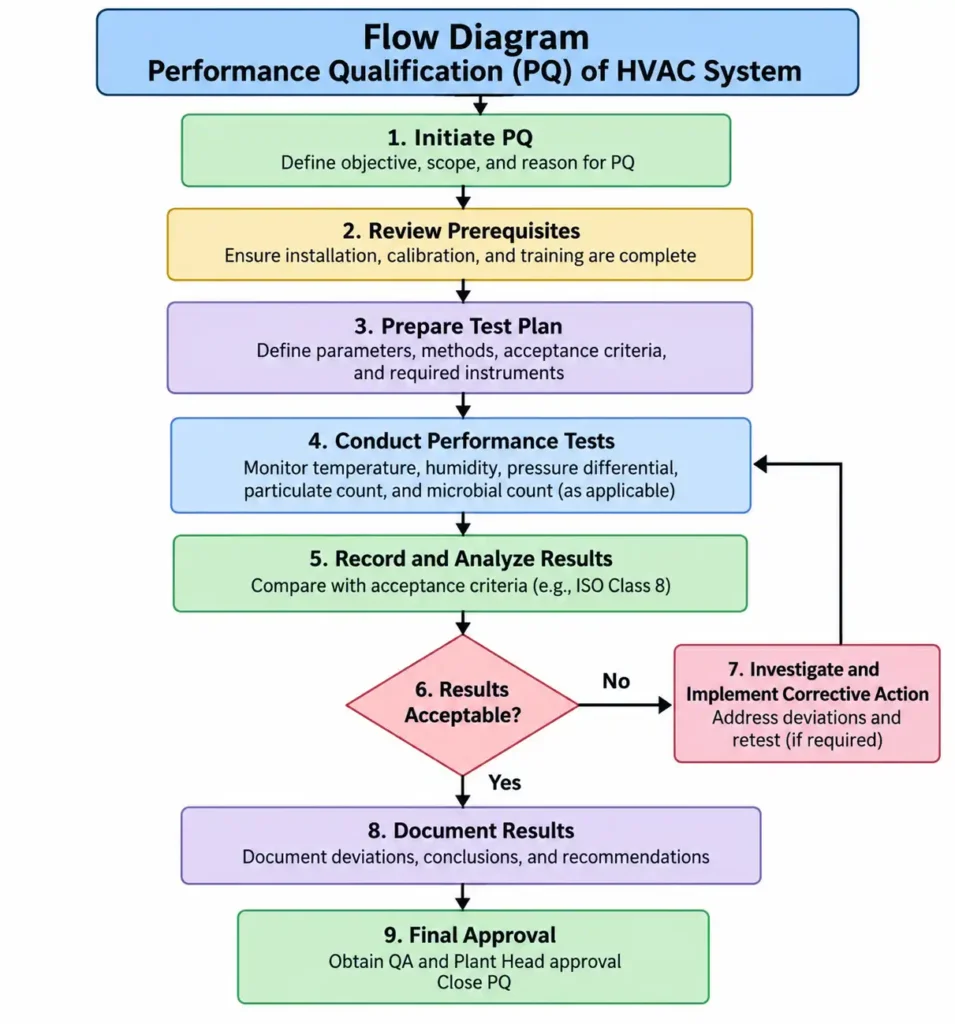
Skip to PDF content2. Flow Diagram – Performance Qualification of HVAC System:
The flow diagram illustrates the systematic process for conducting Performance Qualification (PQ) of the HVAC System. It begins with defining the objective, scope, and reason for qualification, followed by verification of prerequisites such as installation status, instrument calibration, and personnel training. The qualification team then prepares the test plan and evaluates critical parameters including temperature, relative humidity, pressure differential, particulate count, and microbial count. Results are compared with predefined acceptance criteria, including ISO Class 8 requirements where applicable. Any unacceptable result is investigated and corrected before retesting. Finally, observations, deviations, conclusions, recommendations, and approvals are documented to formally close the PQ activity.
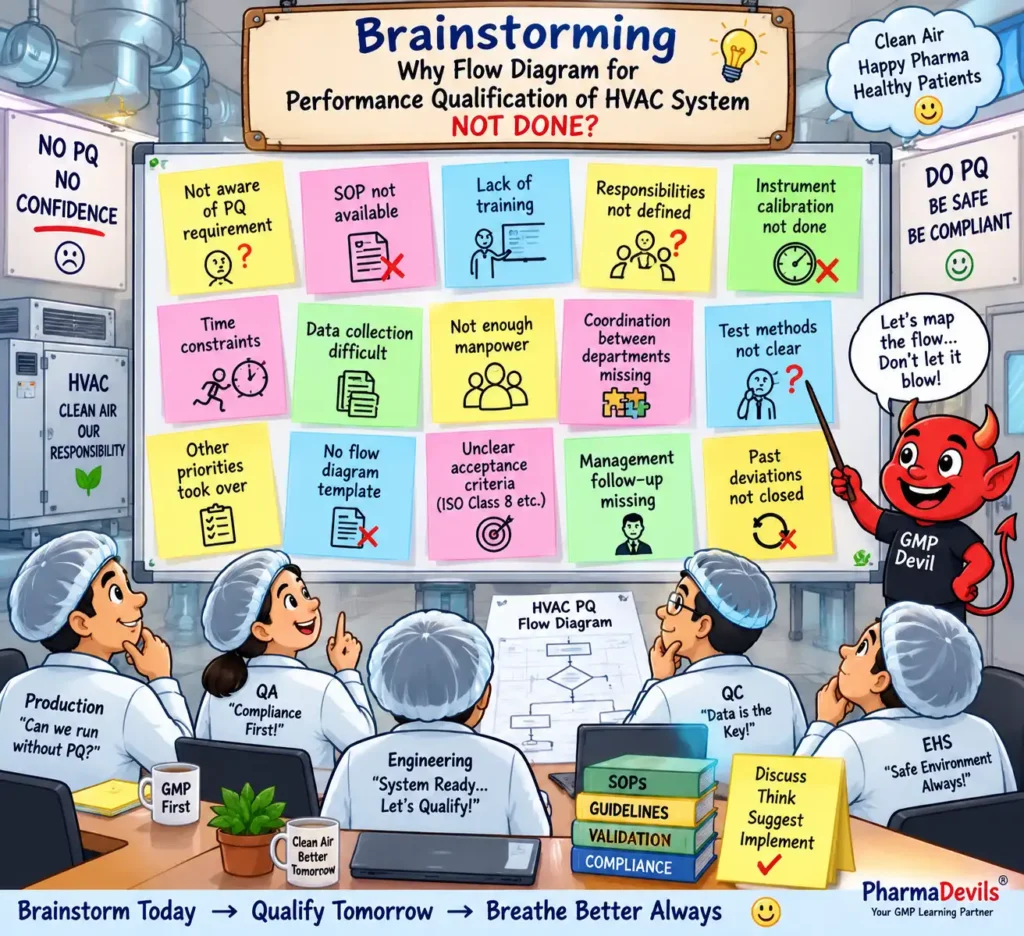
3. Brainstorming – HVAC Performance Qualification Not Done:
The brainstorming diagram highlights potential reasons why the HVAC Performance Qualification flow diagram was not prepared or completed. Key causes include lack of awareness of PQ requirements, unavailable SOPs, inadequate training, unclear responsibilities, uncalibrated instruments, time constraints, insufficient manpower, poor data collection, weak departmental coordination, unclear test methods, missing templates, undefined acceptance criteria, unresolved deviations, and inadequate management follow-up. The funny GMP-themed setting encourages Production, QA, Engineering, QC, and EHS teams to discuss problems collaboratively. The diagram emphasizes structured brainstorming, proper documentation, defined responsibilities, calibrated instruments, and timely management review to ensure successful HVAC performance qualification and sustained GMP compliance.
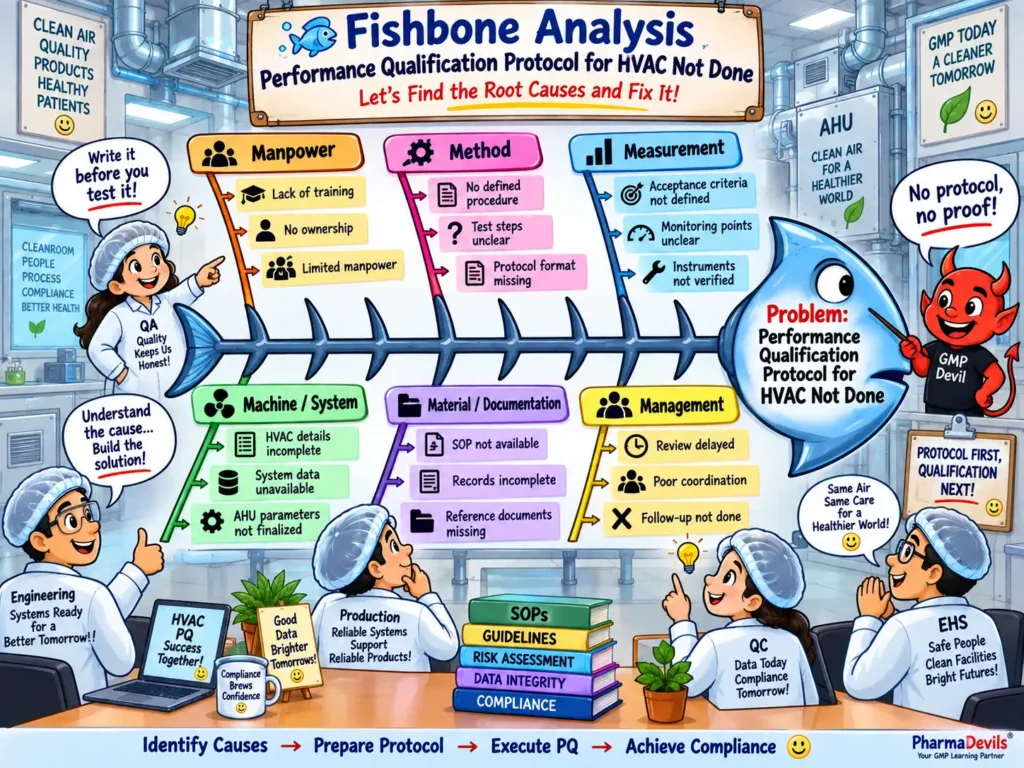
4. Fishbone Analysis – HVAC Performance Qualification Protocol Not Done:
The fishbone analysis identifies major causes responsible for the Performance Qualification Protocol for the HVAC system not being prepared or executed. The causes are grouped under Manpower, Method, Measurement, Machine/System, Material/Documentation, and Management. Key issues include inadequate training, unclear ownership, limited manpower, undefined procedures, unclear test steps, missing protocol formats, undefined acceptance criteria, unverified instruments, incomplete HVAC data, unavailable SOPs, missing reference documents, delayed review, poor coordination, and lack of follow-up. This analysis helps the qualification team systematically identify root causes, assign responsibilities, strengthen documentation, improve coordination, and establish corrective actions before execution of HVAC Performance Qualification.
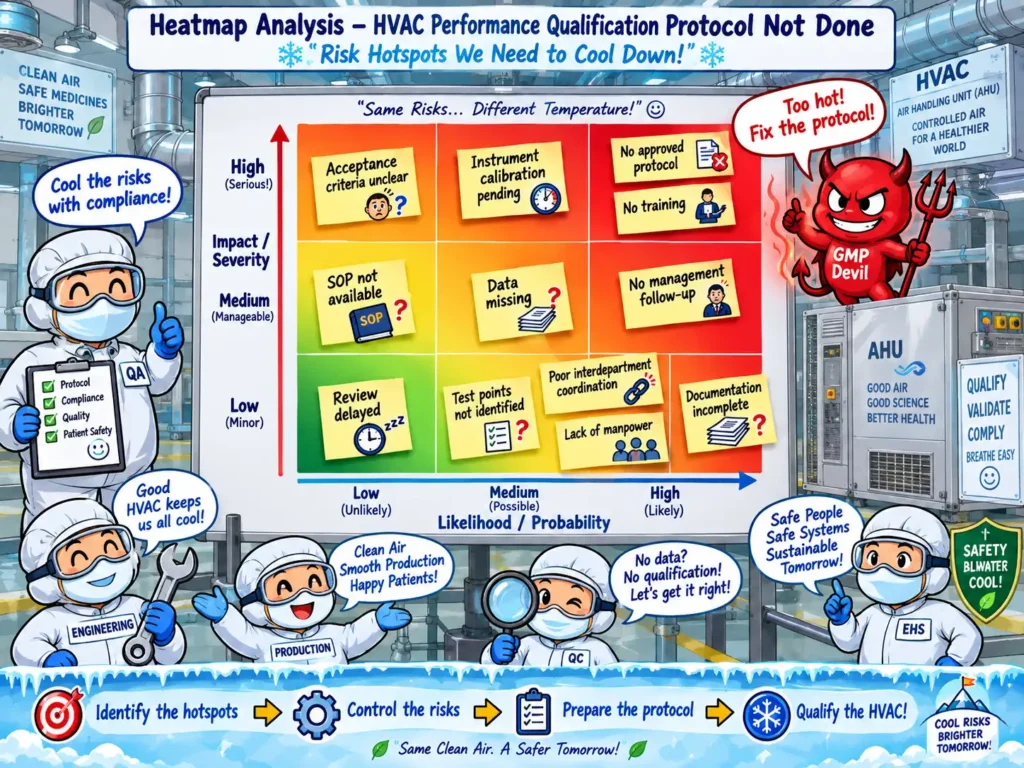
5. Heatmap Analysis – HVAC Performance Qualification Protocol Not Done:
The heatmap analysis evaluates risks associated with HVAC Performance Qualification Protocol not being completed by considering likelihood and severity. High-risk areas include absence of an approved protocol, inadequate training, pending instrument calibration, and unclear acceptance criteria. Medium-risk factors include unavailable SOPs, missing data, insufficient management follow-up, poor interdepartmental coordination, and incomplete documentation. Lower-risk issues include delayed review and unidentified test points. The heatmap helps prioritize corrective actions by focusing first on high-severity and high-probability failures. It supports systematic risk control, timely protocol preparation, proper training, calibration verification, defined responsibilities, and successful execution of HVAC Performance Qualification.
6. 5-Why Analysis – HVAC Performance Qualification Protocol Not Done:
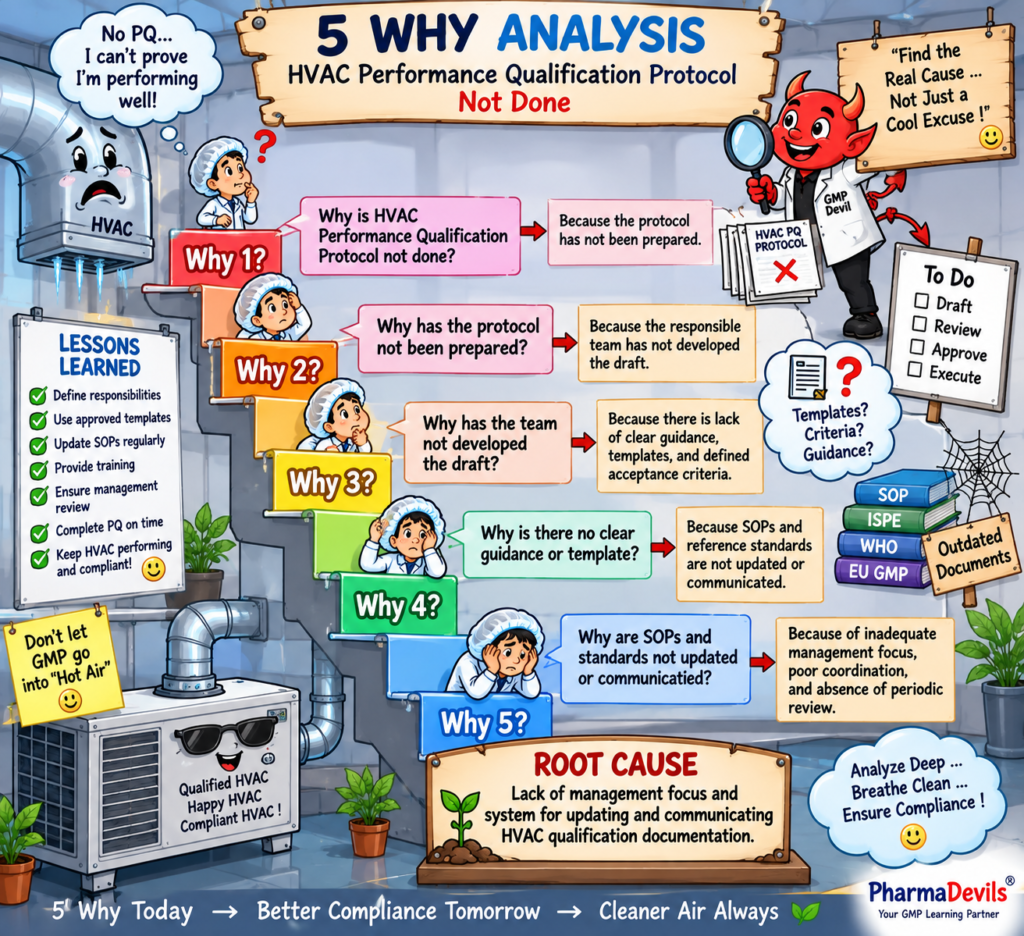
The 5-Why analysis identifies the underlying causes behind the HVAC Performance Qualification Protocol not being completed. The analysis begins with the missing protocol and traces the issue through lack of draft preparation, unclear responsibilities, absence of approved templates and acceptance criteria, outdated SOPs, and poor communication of qualification requirements. The final root cause points to inadequate management focus, weak coordination, and absence of a structured system for periodically reviewing and updating HVAC qualification documents. The analysis highlights the need for defined ownership, current procedures, trained personnel, approved templates, periodic management review, and timely follow-up to ensure HVAC Performance Qualification is completed and documented effectively.
7. Fault Tree Analysis – HVAC Performance Qualification Protocol Not Done:
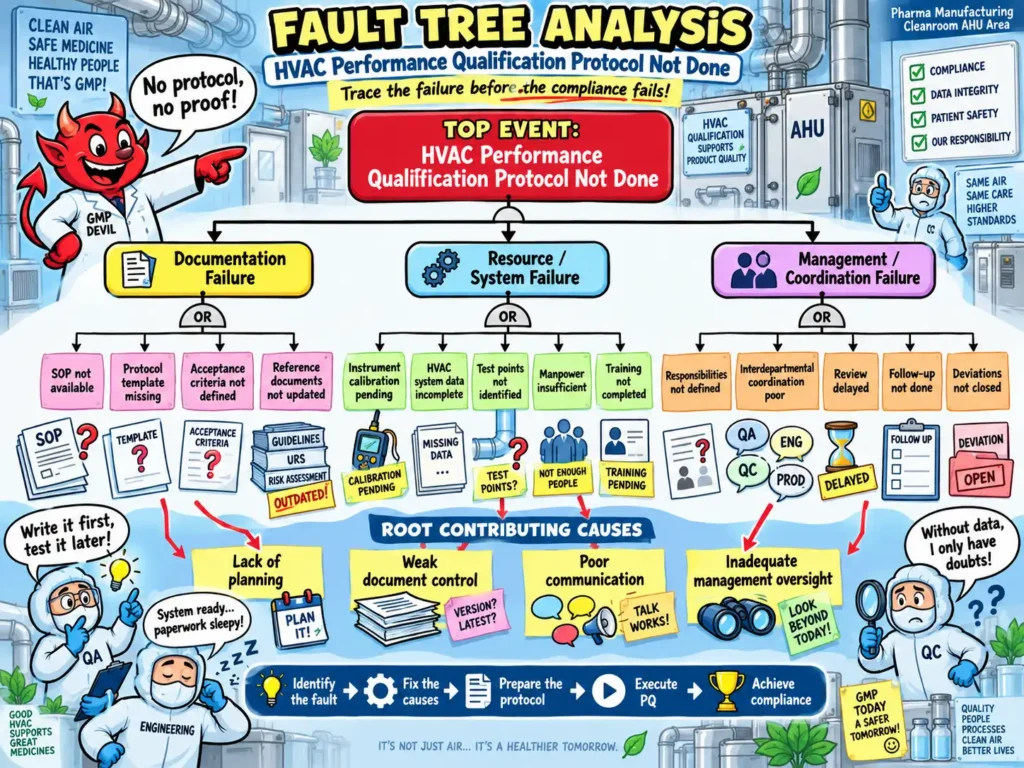
The fault tree analysis identifies the major failures contributing to the HVAC Performance Qualification Protocol not being completed. The top event is linked to three main categories: documentation failure, resource/system failure, and management/coordination failure. Contributing causes include unavailable SOPs, missing protocol templates, undefined acceptance criteria, outdated reference documents, pending instrument calibration, incomplete HVAC system data, unidentified test points, insufficient manpower, incomplete training, unclear responsibilities, poor interdepartmental coordination, delayed review, inadequate follow-up, and open deviations. The analysis helps trace multiple contributing causes systematically so corrective actions can target planning, documentation control, communication, training, calibration, and management oversight.
8. Pareto Chart Analysis – HVAC Performance Qualification Protocol Not Done:
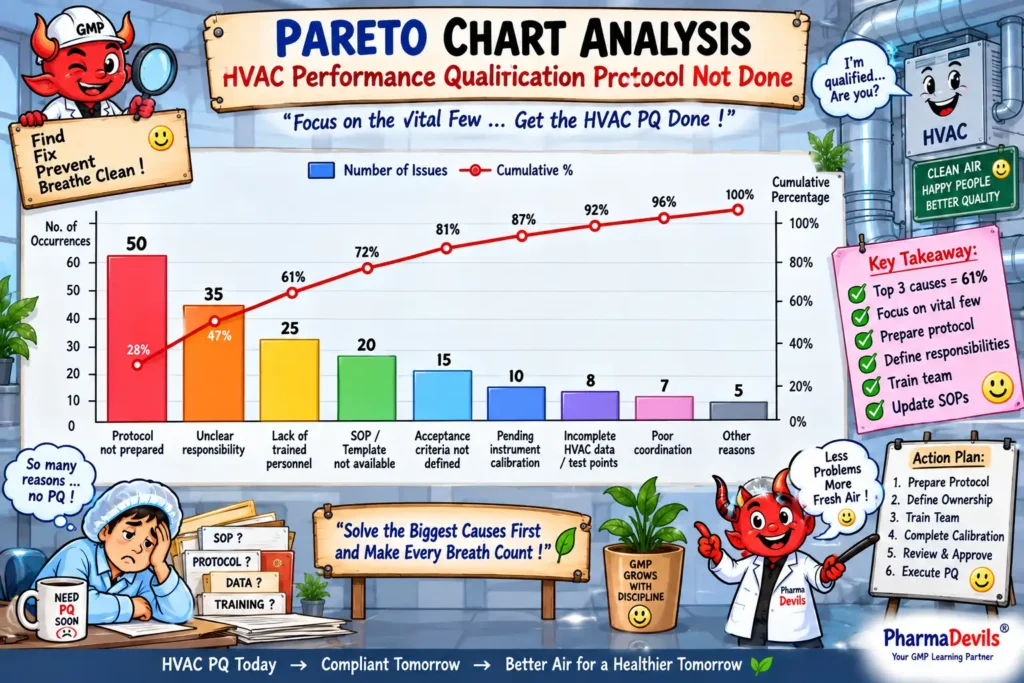
The Pareto chart analysis identifies and prioritizes the major causes responsible for the HVAC Performance Qualification Protocol not being completed. The highest contributors include protocol not prepared, unclear responsibility, lack of trained personnel, unavailable SOP/template, and undefined acceptance criteria. Additional causes include pending instrument calibration, incomplete HVAC data, poor coordination, and other minor issues. The cumulative percentage line helps highlight the vital few causes creating most of the problem. The analysis supports focused corrective action by prioritizing protocol preparation, responsibility assignment, personnel training, SOP availability, calibration completion, and management follow-up before executing HVAC Performance Qualification successfully.
9. Corrective Action and Preventive Action – HVAC Performance Qualification Protocol Not Done:
The HVAC Performance Qualification protocol should be prepared, reviewed, approved, and executed before the system is formally considered performance qualified. The attached protocol assigns preparation and execution responsibilities to User, Engineering, QC, QA, QA Head, and Plant Head, and also requires personnel training and verification of instrument calibration.
| Type | Action |
|---|---|
| Correction | Prepare the pending HVAC Performance Qualification protocol using the approved qualification format. |
| Corrective Action | Define objective, scope, responsibilities, test methodology, acceptance criteria, sampling requirements, and documentation requirements before execution. |
| Corrective Action | Review and approve the protocol by User Department, Engineering, QA, QA Head, and Plant Head before testing. |
| Corrective Action | Verify that all personnel involved in PQ are trained and training records are available. |
| Corrective Action | Verify calibration status of all instruments used during HVAC performance testing before execution. |
| Corrective Action | Perform HVAC PQ tests for temperature, relative humidity, pressure differential, particulate count, and microbial monitoring as applicable. The protocol specifically includes these performance checks. |
| Corrective Action | Document observations, results, deviations, incidents, OOS/OOT, conclusions, and recommendations after completion. |
| Preventive Action | Establish a qualification master schedule identifying due dates and responsible departments for HVAC DQ/IQ/OQ/PQ activities. |
| Preventive Action | Maintain an approved standard template/checklist for HVAC Performance Qualification protocols. |
| Preventive Action | Introduce periodic QA review of pending qualification documents and overdue activities. |
| Preventive Action | Define ownership and timelines for preparation, review, approval, execution, and closure of qualification documents. |
| Preventive Action | Include HVAC qualification requirements in periodic GMP and validation training programs. |
| Preventive Action | Maintain a calibration tracking system to ensure instruments required for PQ remain within calibration validity. |
| Preventive Action | Conduct periodic management review of qualification status, open deviations, and pending CAPA to prevent recurrence. |
Expected outcome: HVAC Performance Qualification activities are planned, approved, executed, documented, and periodically monitored so that protocol preparation is not missed in future qualification cycles.
10. Questions & Answers – Performance Qualification of HVAC System:
Q1. What is the objective of HVAC Performance Qualification?
Answer: To verify that the installed HVAC system consistently performs as intended under operational conditions and that relevant operating parameters are recorded and evaluated.
Q2. What HVAC capacity is covered in this protocol?
Answer: The protocol covers an HVAC system with a capacity of 1650 CFM.
Q3. Which areas are supplied by the HVAC system?
Answer: Sampling Area-I, Material Airlock, and Man Airlock.
Q4. Why is Performance Qualification required?
Answer: The protocol identifies new/refurbished premises or equipment and purchase of utility systems as reasons for performing PQ.
Q5. Which departments participate in HVAC PQ?
Answer: User Department, Engineering, Health Safety and Environment, Quality Control, Quality Assurance, QA Head, and Plant Head.
Q6. What should be verified before starting PQ testing?
Answer: Personnel training status and calibration status of instruments used during qualification should be verified.
Q7. Which major parameters are evaluated during HVAC PQ?
Answer: Temperature, relative humidity, pressure differential, particulate matter count, and microbial count are evaluated.
Q8. What is the temperature acceptance limit?
Answer: The protocol specifies a temperature limit of NMT 25°C.
Q9. What is the relative humidity acceptance limit?
Answer: The protocol specifies relative humidity of NMT 60%.
Q10. How long are temperature and humidity monitored?
Answer: They are recorded every two hours for a total of eight hours over three consecutive working days under operating conditions.
Q11. What is the particulate matter acceptance requirement?
Answer: The area should meet the requirements of ISO Class 8.
Q12. What is the microbial limit by settle plate method?
Answer: The protocol specifies a total viable count of NMT 100 CFU/plate.
Q13. What is the microbial limit by air sampling method?
Answer: The protocol specifies a total viable count of NMT 200 CFU/m³.
Q14. What should be done if deviations, incidents, OOS, OOT, or changes occur during PQ?
Answer: They should be documented in the designated deviation/incident/change/OOS/OOT section of the qualification protocol and addressed before final closure.
Q15. Who provides final approval of the HVAC PQ document?
Answer: The post-approval section requires approval by the QA Head and Plant Head after review by the responsible departments.
11. Reference Guidelines – Performance Qualification of HVAC System:
The attached HVAC PQ protocol itself states “Reference Documents: Nil.” For a more complete and audit-ready HVAC Performance Qualification protocol, the following external references are appropriate:
- WHO Technical Report Series No. 1010, Annex 8 (2018) – Guidelines on heating, ventilation and air-conditioning systems for non-sterile pharmaceutical products. It addresses HVAC design, control, management, and qualification throughout the system life cycle.
- WHO TRS No. 1019, Annex 2 (2019) – GMP for HVAC systems for non-sterile pharmaceutical products, Part 2: Interpretation of Guidelines. It provides explanatory examples and technical interpretation supporting WHO HVAC requirements.
- WHO TRS No. 1019, Annex 3 (2019) – Good Manufacturing Practices: Guidelines on Validation. This supports risk-based, lifecycle qualification and validation practices.
- ISO 14644-1:2015 – Cleanrooms and associated controlled environments — Part 1: Classification of air cleanliness by particle concentration. Relevant for airborne particle classification, including ISO cleanroom classes.
- ISO 14644-2:2015 – Cleanrooms and associated controlled environments — Part 2: Monitoring to provide evidence of cleanroom performance related to air cleanliness by particle concentration. It covers monitoring plans, calibration, pressure differential, airflow, particle monitoring, and response to deviations.
- EU GMP, EudraLex Volume 4, Annex 15 – Qualification and Validation – Applicable to qualification of facilities, equipment, utilities, and systems using a lifecycle and risk-based approach.
- EU GMP, EudraLex Volume 4, Annex 1 – Manufacture of Sterile Medicinal Products – Relevant where the HVAC serves sterile or classified cleanroom areas, particularly for cleanroom and clean-air equipment qualification.
- Revised Schedule M, Drugs Rules, 1945 – India – Relevant Indian GMP requirements include qualification and monitoring of utilities such as HVAC and control of contamination/cross-contamination.