







1. Introduction:
The Period of Destruction of Document SOP establishes a controlled system for the retention, review, authorization, and destruction of pharmaceutical documents and records. Proper document retention is an important part of the pharmaceutical quality system because records provide evidence of manufacturing activities, testing, equipment operation, training, validation, qualification, investigations, and regulatory compliance. The SOP applies to records generated by departments such as Quality Assurance, Quality Control, Personnel, Engineering, Warehouse, Production, and Process Development. The procedure specifies different retention periods depending on the importance and type of record. For example, calibration records are retained for five years, batch manufacturing and packing records are retained until one year after product expiry, while important documents such as change controls, qualification records, validation records, and certain audit records are retained permanently and are not destroyed. Documents that have completed their approved retention period are generally destroyed by shredding, preventing obsolete, confidential, or controlled information from being accidentally reused or accessed. However, destruction cannot be carried out without proper authorization. The SOP requires approval before destruction and requires the activity to be documented using the prescribed destruction record. Original obsolete master manufacturing formulae, SOPs, and specifications are preserved as historical copies rather than destroyed. The SOP also defines responsibilities for QA personnel, document checking, destruction authorization, and maintenance of destruction records. A formal Controlled Document Destruction Authorization is provided to ensure that documents are reviewed and approved before disposal. Overall, this SOP helps maintain document traceability, data integrity, confidentiality, regulatory readiness, and effective control of obsolete records throughout their lifecycle.
Skip to PDF content2. Flow Diagram:
The flow diagram explains the controlled process for retention and destruction of pharmaceutical documents. The process starts by identifying the document, such as an SOP, record, report, calibration document, batch record, training record, or other controlled document. The applicable retention period is then checked according to the SOP. If the retention period has not been completed, the document continues to be stored safely. If the retention period is complete, it is checked whether the document is permitted to be destroyed. Some important documents, such as change controls, qualification records, validation records, and historical master documents, are retained and are not destroyed.
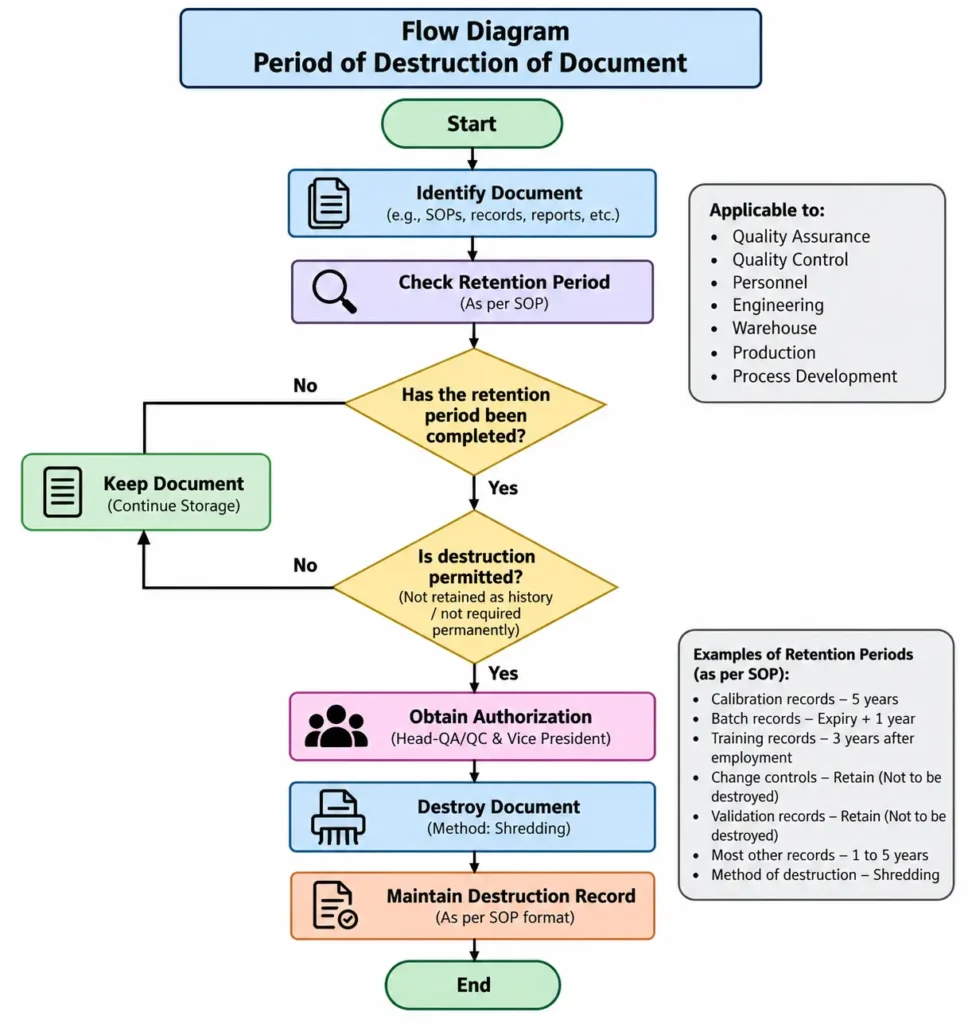
For documents eligible for destruction, prior authorization is obtained from the responsible management personnel. The approved document is then destroyed, generally by shredding, and the destruction activity is recorded in the prescribed format. The SOP specifically requires approval before destruction and maintenance of a destruction record. This systematic process helps ensure document traceability, controlled disposal, confidentiality, and compliance with the established document-retention system.
3. Benefits of Following the SOP:
The image explains the major benefits of following the SOP for the Period of Destruction of Documents in a pharmaceutical organization. Proper implementation of this SOP ensures that documents are retained for the required period and destroyed only after appropriate review and authorization. Following the SOP supports GMP compliance, better document control, confidentiality, audit readiness, and organized record management. It prevents obsolete documents from being accidentally used and ensures that important historical documents are preserved when required. The SOP also helps departments such as QA, QC, Production, Engineering, Warehouse, and Personnel maintain systematic control over their records.
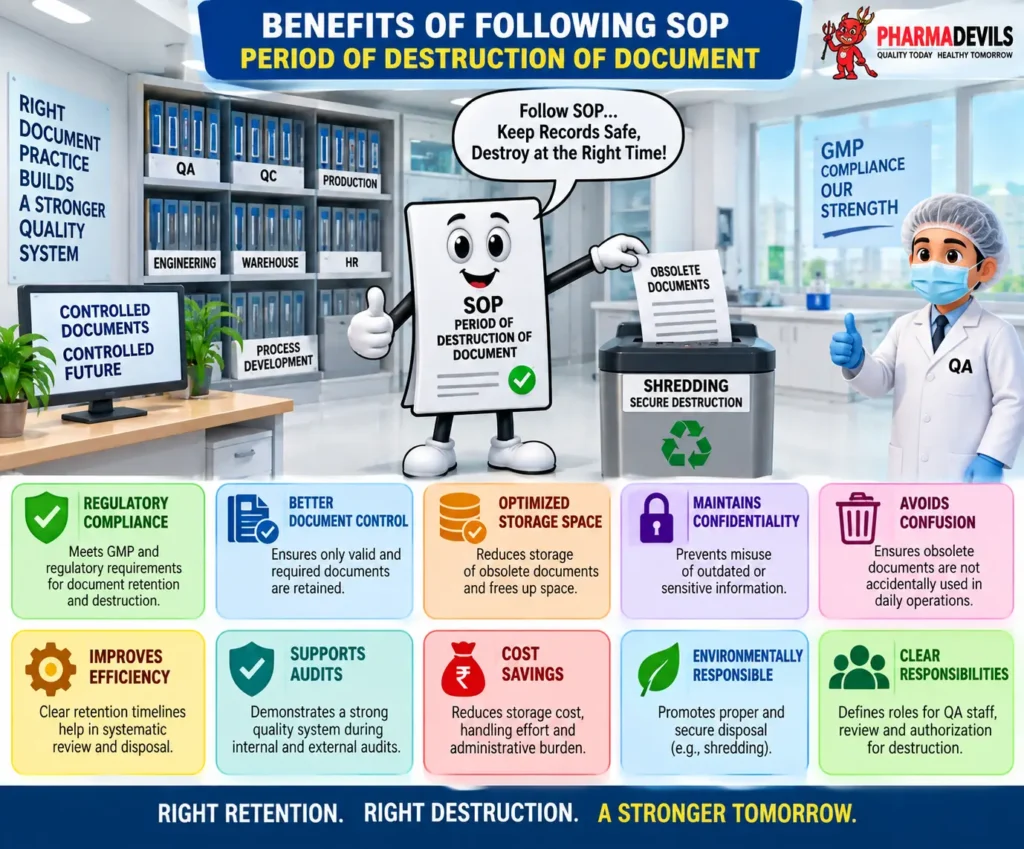
Timely destruction of eligible records reduces unnecessary storage, lowers administrative burden, and improves efficiency. Secure methods such as shredding help protect confidential or sensitive information. The SOP also establishes clear responsibilities for checking, authorizing, performing, and documenting destruction activities. Overall, following this SOP creates a controlled, traceable, secure, and inspection-ready document-management system.
4. Brainstorming for SOP Failure:
The brainstorming image presents possible reasons why the SOP for Period of Destruction of Document may not be properly followed in a pharmaceutical organization. At the center, the main problem is identified as “SOP for Period of Destruction of Document Not Followed.” Different colored sticky notes represent potential contributing factors identified during the brainstorming exercise. Major possible causes include lack of training, poor awareness of document-retention timelines, absence of destruction authorization, inadequate document review, improper record tracking, weak retention-schedule monitoring, poor archival practices, manual errors, excessive workload, weak supervision, lack of accountability, and mixing obsolete documents with current documents.
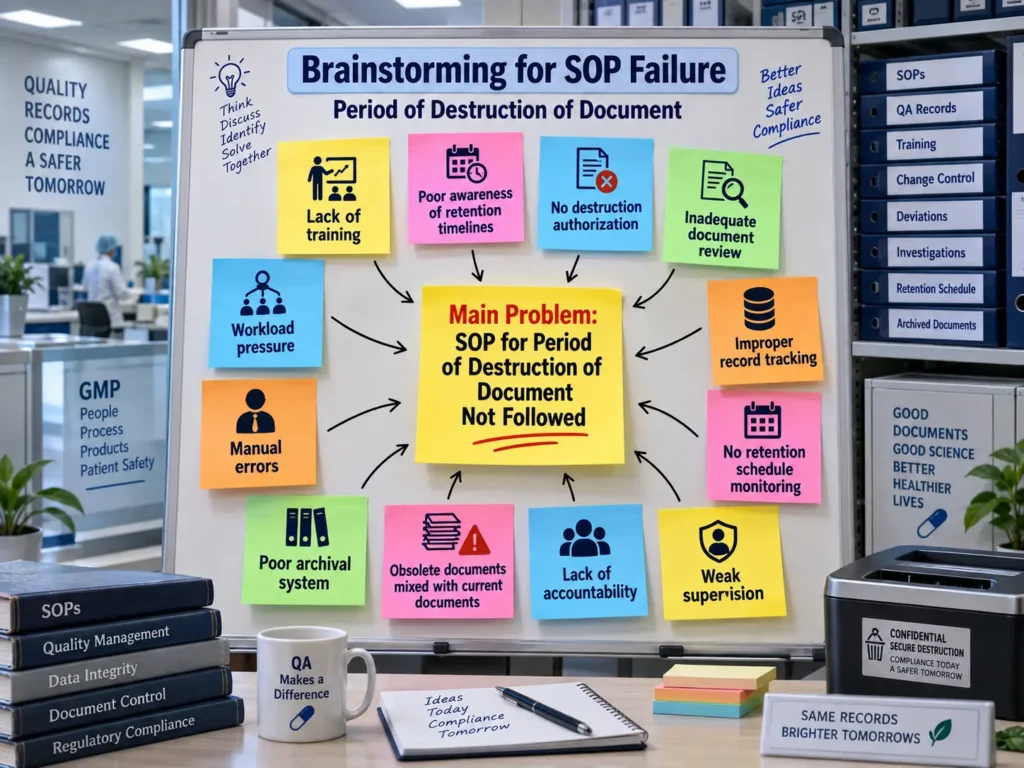
These possible causes are especially important because the SOP assigns specific responsibilities for execution, checking, authorization, and controlled destruction of documents. It also requires approval before destruction and recording of the destruction activity in the prescribed format. The brainstorming exercise helps the investigation team identify probable weaknesses before performing detailed root-cause analysis. It supports better CAPA planning, improved training, stronger document control, and prevention of recurrence.
5. 5-Why Analysis for SOP Failure:
The 5-Why Analysis image explains the possible root cause behind failure to follow the SOP for Period of Destruction of Document. The analysis begins with the main problem that documents are not being destroyed according to the defined retention requirements.
Why 1: The SOP is not followed because documents are not destroyed after completion of their retention period.
Why 2: Documents are not destroyed on time because there is inadequate tracking and review of document retention periods.
Why 3: Tracking and review are weak because responsibilities for monitoring document retention and destruction are not clearly or effectively implemented.
Why 4: Responsibilities are not properly monitored because personnel have insufficient training, awareness, and communication regarding the SOP requirements.
Why 5: Training and awareness remain inadequate because management has not ensured regular refresher training, periodic review, and effectiveness monitoring.
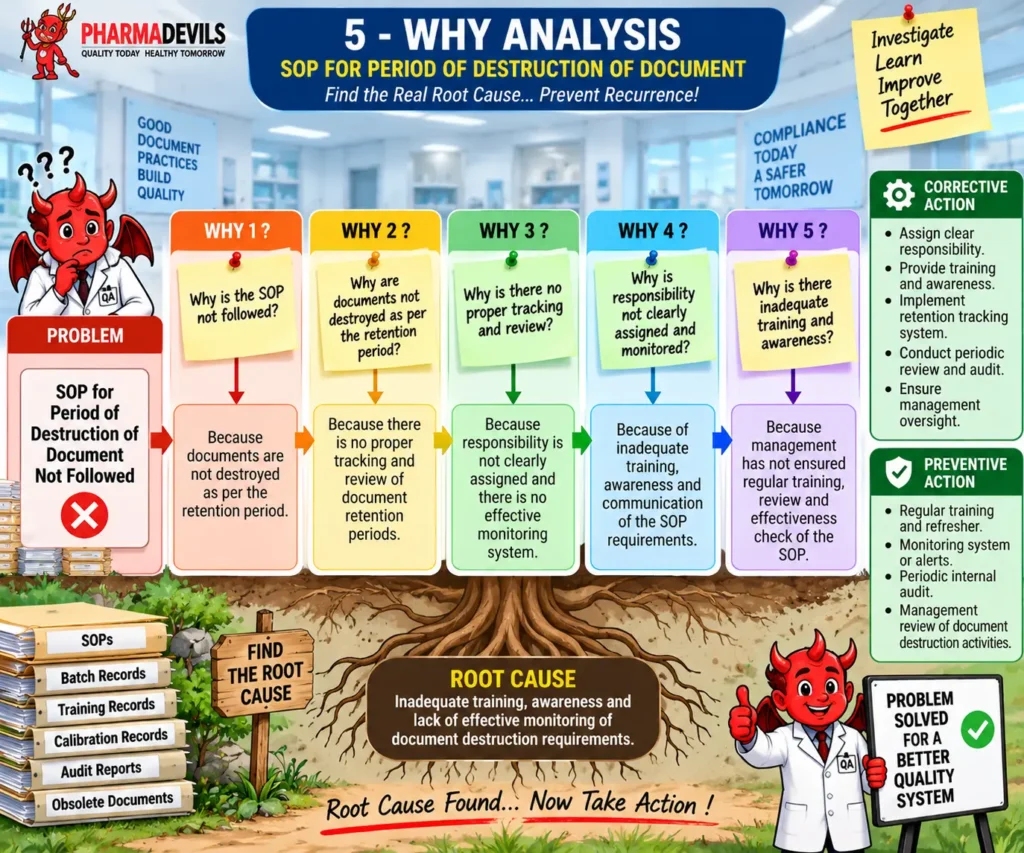
The analysis therefore identifies the probable root cause as inadequate training and awareness combined with weak monitoring of document-destruction requirements. This is relevant to the SOP because it specifically assigns responsibility to QA for execution, checking, and authorization of document destruction. The SOP also requires approval before destruction and recording of the destruction activity. The 5-Why approach helps convert a visible compliance failure into actionable CAPA such as improved training, defined responsibilities, retention tracking, periodic review, and management oversight.
6. Fishbone Analysis for SOP Failure:
The Fishbone Analysis image identifies possible causes for failure to follow the SOP for Period of Destruction of Document. The main problem shown at the head of the fish is “SOP for Period of Destruction of Document Not Followed.” Potential causes are grouped into six major categories: Man, Machine, Method, Material, Measurement, and Environment. Under Man, possible causes include inadequate training, poor awareness of retention periods, high workload, weak accountability, and staff turnover. Machine/System factors include absence of electronic tracking, inadequate document-management systems, missing alerts, and system or hardware failures. Method factors include unclear instructions, inadequate review and approval, improper authorization, or deviation from the defined destruction method.
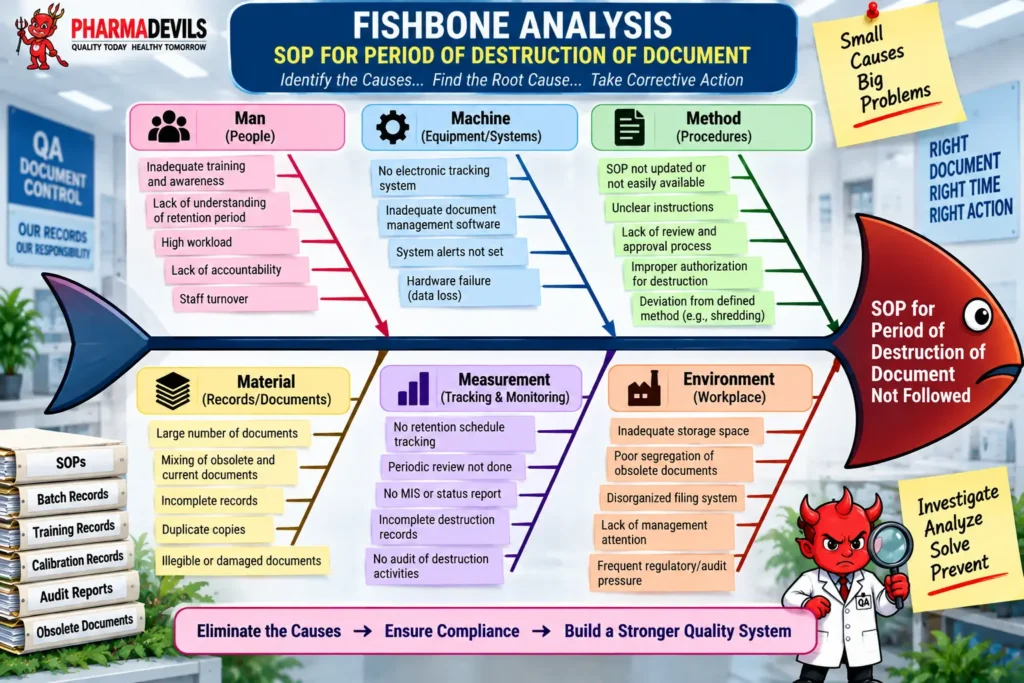
Material/Records factors cover large document volumes, mixing of obsolete and current documents, incomplete records, duplicate copies, and damaged records. Measurement/Monitoring causes include lack of retention tracking, missed periodic review, incomplete destruction records, and inadequate audit monitoring. Environment factors include poor storage space, weak segregation, disorganized filing, and insufficient management attention. These causes are relevant because the SOP requires defined responsibilities for execution, checking, authorization, and controlled destruction of documents. It also requires destruction approval and maintenance of destruction records. Overall, the fishbone analysis helps systematically identify contributing factors so that appropriate corrective and preventive actions can be implemented.
7. Fault Tree Analysis for SOP Failure:
The Fault Tree Analysis image explains how failure to follow the SOP for Period of Destruction of Document can result from several connected system weaknesses. The top event is identified as “SOP for Period of Destruction of Document Not Followed.” The analysis breaks this failure into major contributing events such as documents not being destroyed after completion of the retention period, obsolete documents not being properly identified or segregated, destruction activities not being performed according to the SOP, and lack of trained or aware personnel.
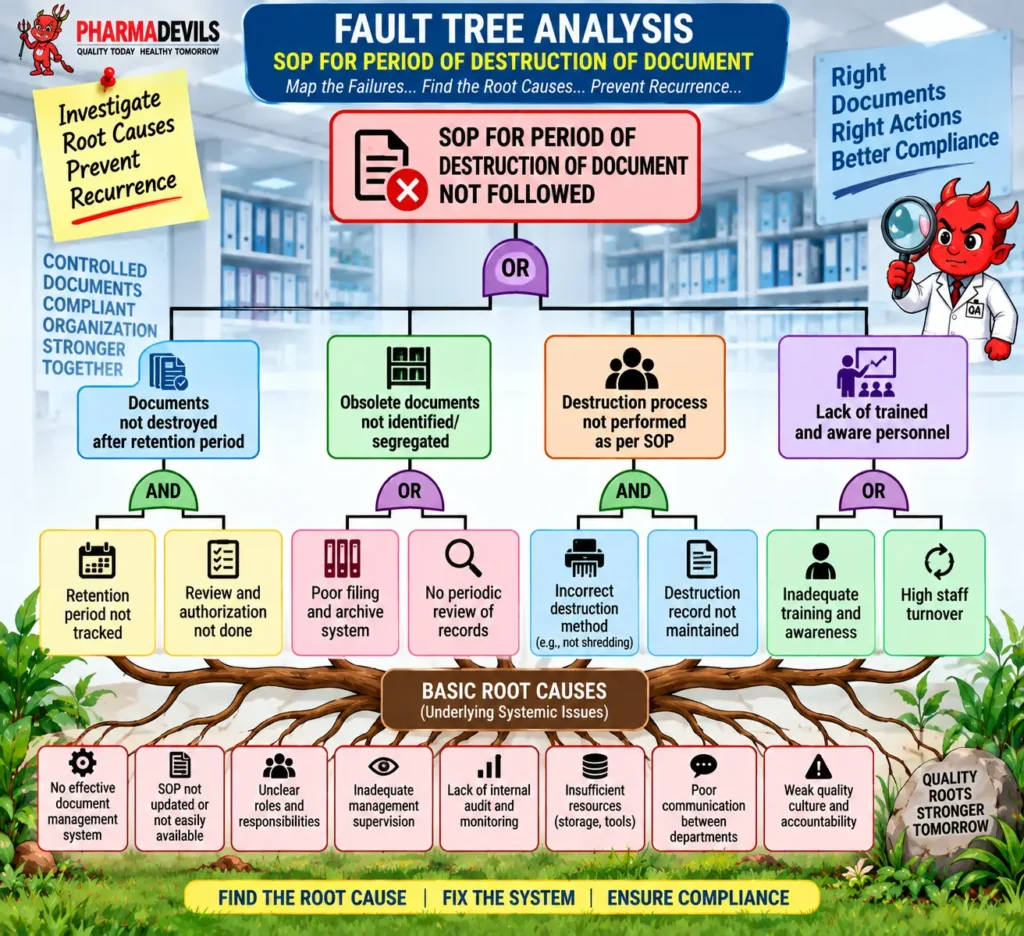
These failures are further linked to basic causes including retention periods not being tracked, review and authorization not being completed, poor filing and archival systems, lack of periodic record review, use of an incorrect destruction method, incomplete destruction records, inadequate training, and high staff turnover. At the lowest level, the image highlights systemic root causes such as weak document-management systems, outdated or inaccessible SOPs, unclear responsibilities, insufficient management supervision, poor internal auditing, inadequate resources, weak interdepartmental communication, and poor accountability. This analysis aligns with the SOP, which assigns responsibility for execution, checking, and authorization of document destruction. It also requires destruction approval and recording of the activity before documents are destroyed. Overall, the fault tree helps identify where the document-destruction control system can fail and supports selection of appropriate CAPA to prevent recurrence.
8. Impact Assessment:
The impact assessment image explains the possible consequences when the SOP for Period of Destruction of Document is not followed. The main concern is that obsolete, confidential, or unnecessary records may remain uncontrolled, while documents due for destruction may continue to be stored without proper review and authorization.The image highlights several important impact areas. Regulatory impact may include non-compliance observations during inspections. Quality impact can arise if obsolete or incorrect documents are accidentally used. Data integrity impact includes loss of traceability and uncertainty about the authenticity or status of records. Confidentiality and security impact may occur when sensitive records are not destroyed securely.
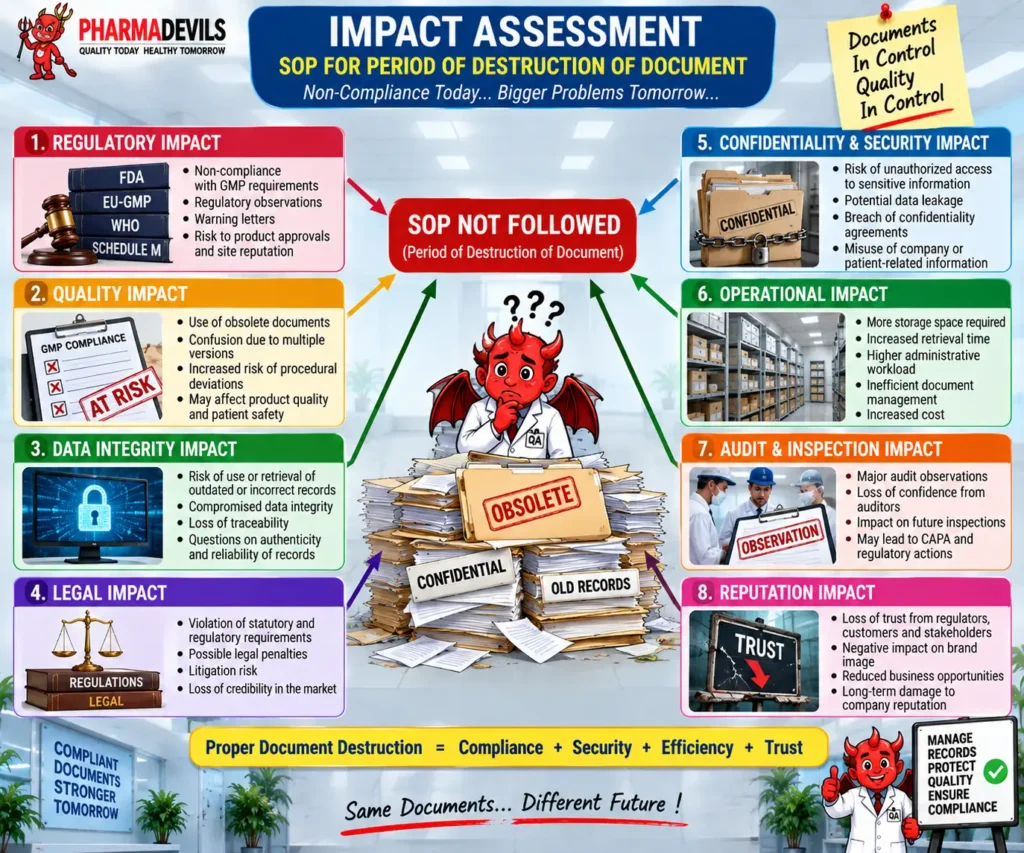
There may also be operational impacts, such as excessive storage requirements, difficult document retrieval, increased administrative workload, and poor document organization. In addition, ineffective document destruction can create audit and inspection concerns, especially where authorization or destruction records are incomplete. The SOP itself requires approval before destruction and recording of the destruction activity in the prescribed format. It also specifies that certain important records must be retained and not destroyed, making proper classification essential. Overall, effective implementation of the SOP supports compliance, traceability, confidentiality, controlled storage, and reliable document management.
Questions & Answers:
- What is the objective of the SOP for Period of Destruction of Document?
The objective is to provide guidelines for maintaining documents generated by Quality Assurance, Quality Control, Personnel, Engineering, Warehouse, Production, and Process Development departments. - What is the scope of this SOP?
The SOP applies to the defined storage period and method of destruction of various pharmaceutical documents and records. - Who is responsible for executing this SOP?
The QA Chemist is responsible for execution of the SOP. - Who checks the documents proposed for destruction?
The Assistant Manager is responsible for checking documents that are due for destruction. - Who authorizes document destruction?
The Head-QA/QC and Vice President are responsible for authorizing destruction. - What is the common method used for document destruction?
The SOP specifies shredding for many records after completion of their approved retention period. - How long are instrument/equipment calibration records retained?
They are retained for 5 years and then destroyed by shredding. - Are Change Control records destroyed?
No. Change Control records are required to be retained and are not to be destroyed. - Are Facility/Equipment Qualification records destroyed?
No. These records are to be retained and not destroyed. - What is the retention requirement for Validation records?
Validation records are to be retained and are not destroyed. - How long are Batch Manufacturing/Packing Records retained?
Batch Manufacturing/Packing Records, Quality Control Reports, and Batch Record Review Sheets are retained until one year after product expiry and are then destroyed by shredding. - How long are training records retained?
Training records are retained for 3 years after the end of employment of the employee and then destroyed by shredding. - How long are Product Annual Reports retained?
Product Annual Reports are retained for 4 years before destruction by shredding. - How long are product complaint records retained?
Product complaint records are retained for 5 years and then destroyed by shredding. - Are internal and external audit reports destroyed?
No. Internal and external audit reports are to be retained and are not destroyed. - How long are deviation reports retained?
Deviation reports are retained for 5 years before destruction. - What happens to obsolete original master manufacturing formulae, SOPs, and specifications?
Obsolete original copies are preserved as history copies rather than being destroyed. - Is approval required before destruction of documents?
Yes. Approval must be obtained before destruction, and the destruction activity must be recorded in the prescribed format. - Which annexure is used for destruction authorization?
Annexure-I – Destruction Authorization is used for obtaining authorization. - Which annexure is used for recording document and material destruction?
Annexure-II – Document & Material Destruction Record is used to document the destruction activity. - What information is recorded in the destruction record?
The record includes material/product/document name, batch number where applicable, manufacturing/expiry details, rejection date, traceability reference number, OOS number where applicable, stage of rejection, quantity destroyed, reason for destruction, and mode of destruction. - Who finally witnesses and approves destruction activities?
The format identifies the Head-QA/QC for approval, the concerned department for performing destruction, and IPQA as the destruction witness.
Reference Guidelines:
- Revised Schedule M, Drugs Rules, 1945 – G.S.R. 922(E), Government of India, 28 December 2023
Schedule M requires controlled pharmaceutical documentation, prevention of unintended use of superseded documents, defined retention periods, and availability of records throughout the retention period. (Drugs Control)
CDSCO Gazette Notifications – Revised Schedule M - EU GMP – EudraLex Volume 4, Part I, Chapter 4: Documentation
Sections 4.10–4.12 address retention of GMP documents and records. Batch documentation generally must be retained for the required period, while critical records such as validation or stability data may require longer retention depending on their regulatory relevance. (Public Health)
European Commission – EudraLex Volume 4 - PIC/S GMP Guide PE 009-17, Part I, Chapter 4 – Documentation
Sections 4.10–4.12 require secure record retention, defined retention periods, and protection of record integrity. PIC/S specifies that batch documentation should generally be kept for one year after batch expiry or at least five years after certification, whichever is longer, subject to applicable requirements. (PIC Scheme)
PIC/S GMP Guide PE 009-17 Part I - US FDA – 21 CFR Part 211, Section 211.180: General Requirements
FDA requires production, control, and distribution records associated with a drug-product batch to generally be retained for at least one year after the batch expiry date. Records must remain accessible for inspection during the required retention period. (U.S. Food and Drug Administration)
FDA – CGMP Records and Reports Q&A - WHO Good Manufacturing Practices for Pharmaceutical Products – Main Principles / WHO GMP Compendium
WHO GMP emphasizes controlled creation, maintenance, storage, retrieval, and retention of pharmaceutical documentation as part of the pharmaceutical quality system. (World Health Organization)
WHO GMP Compendium, Volume 2 – 10th Edition - WHO Good Practices for Pharmaceutical Quality Control Laboratories
WHO states that quality and technical records should be legible, readily retrievable, appropriately stored, and protected against modification, deterioration, damage, or loss throughout their retention period. (World Health Organization)