






1. SOP FOR PROCESSING OF PLACEBO BATCH – INTRODUCTION:
The SOP for Processing of Placebo Batch establishes a controlled procedure for the preparation, authorization, manufacture, handling, reconciliation, storage, issuance, and final disposition of placebo batches within the Production Department. The procedure is intended to ensure that placebo batches are processed under defined controls and with appropriate involvement of Production, Quality Control, and Quality Assurance personnel. Placebo batches may be required for purposes such as analytical method development, equipment or machine change-part trials, process development trials, process improvements, and demonstration activities. Before manufacture, an approval for the placebo batch is raised by Production, approved by the Head of Quality Assurance, and authorized by the Plant Head. The SOP also defines the placebo batch numbering system, preparation and authorization of the BMR/BPR, manufacturing controls, in-process checks, reconciliation, proper labeling and secure storage, issuance for the intended purpose, return of excess material, and authorized destruction after completion of the activity.
Skip to PDF content2. SOP for Processing of Placebo Batch – Flow Diagram:
The flow diagram for SOP for Processing of Placebo Batch illustrates the complete sequence for controlled planning, approval, manufacture, use, reconciliation, and disposal of a placebo batch. The process begins when a placebo batch is required for analytical method development, equipment or change-part trials, process development, improvement activities, or demonstration purposes. Production then raises an approval request, which is approved by the Head of Quality Assurance and authorized by the Plant Head.
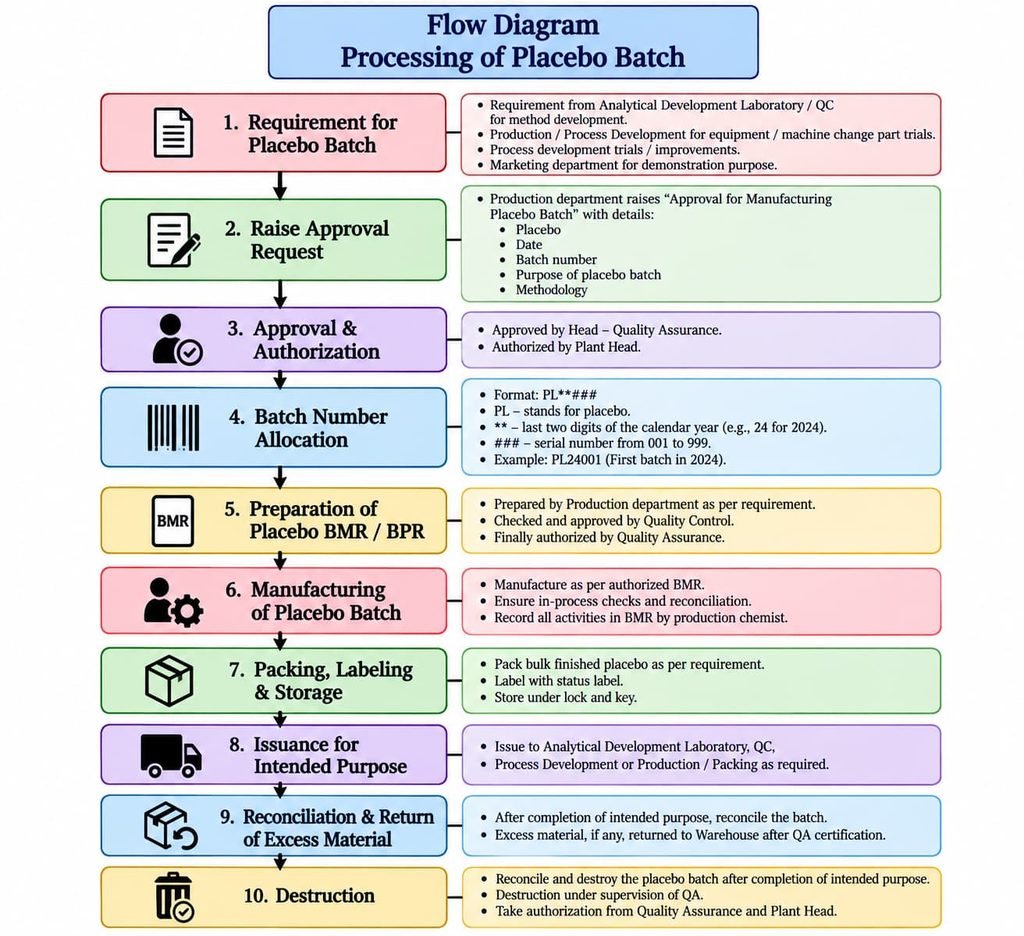
After authorization, a unique placebo batch number is allocated, followed by preparation and approval of the BMR/BPR. The batch is then manufactured according to the authorized record with required in-process checks and reconciliation. After manufacture, the placebo is packed, labeled, stored under lock and key, and issued for its intended purpose. On completion, the batch is reconciled, excess material is handled appropriately, and remaining placebo is destroyed after authorization under Quality Assurance supervision.
3. SOP for Processing of Placebo Batch – Benefits of Following SOP:
Following the SOP for Processing of Placebo Batch ensures that placebo batches are manufactured and handled through a controlled, documented, and authorized process. The SOP clearly defines the responsibilities of Production, Quality Control, and Quality Assurance, helping maintain accountability throughout the activity. It supports consistent processing by requiring proper approval, authorization, batch numbering, preparation of the BMR/BPR, in-process checks, and reconciliation. These controls improve traceability and reduce the possibility of mix-ups, undocumented use, or improper handling of placebo material.
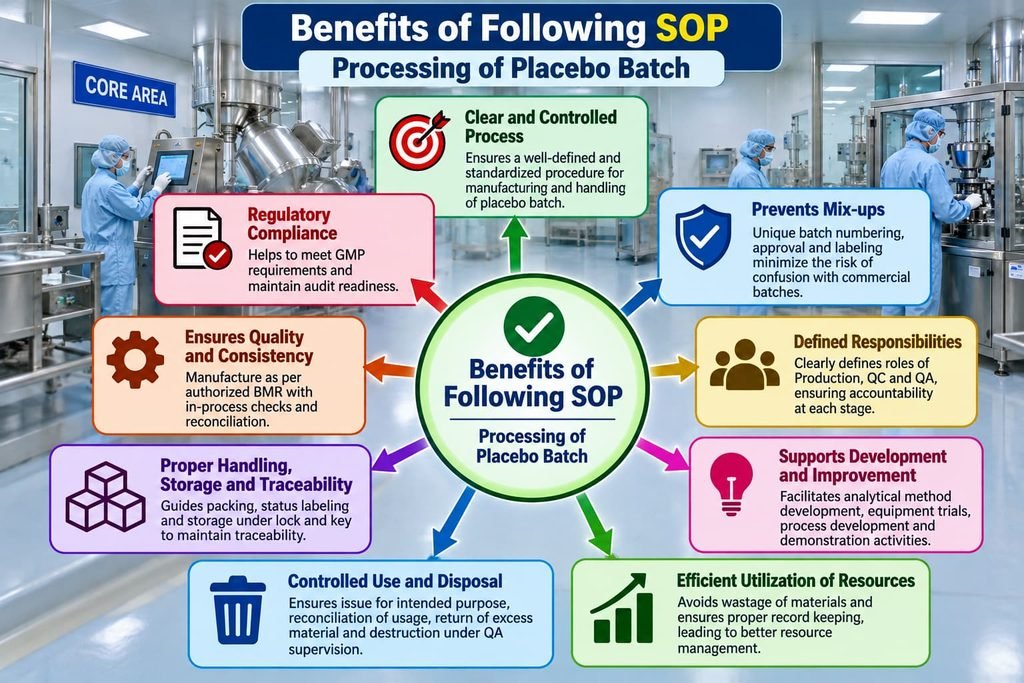
The SOP also ensures that finished placebo material is properly packed, status-labeled, stored under lock and key, issued only for its intended purpose, and appropriately reconciled after use. Excess material is returned under QA certification, while remaining placebo is destroyed only after authorization from Quality Assurance and the Plant Head. Overall, the SOP strengthens control, traceability, consistency, accountability, and proper disposition of placebo batches.
4. SOP for Processing of Placebo Batch – Brainstorming for SOP Failure:
The brainstorming analysis for SOP for Processing of Placebo Batch identifies possible causes that may lead to failure or non-compliance during placebo batch processing in the core manufacturing area. Key concerns include inadequate personnel training, incomplete approval or authorization, incorrect batch numbering, poor documentation, improper BMR/BPR preparation, deviation from authorized manufacturing instructions, and failure to perform required in-process checks and reconciliation. The SOP requires involvement of Production, Quality Control, and Quality Assurance, with approval by QA Head and authorization by the Plant Head.
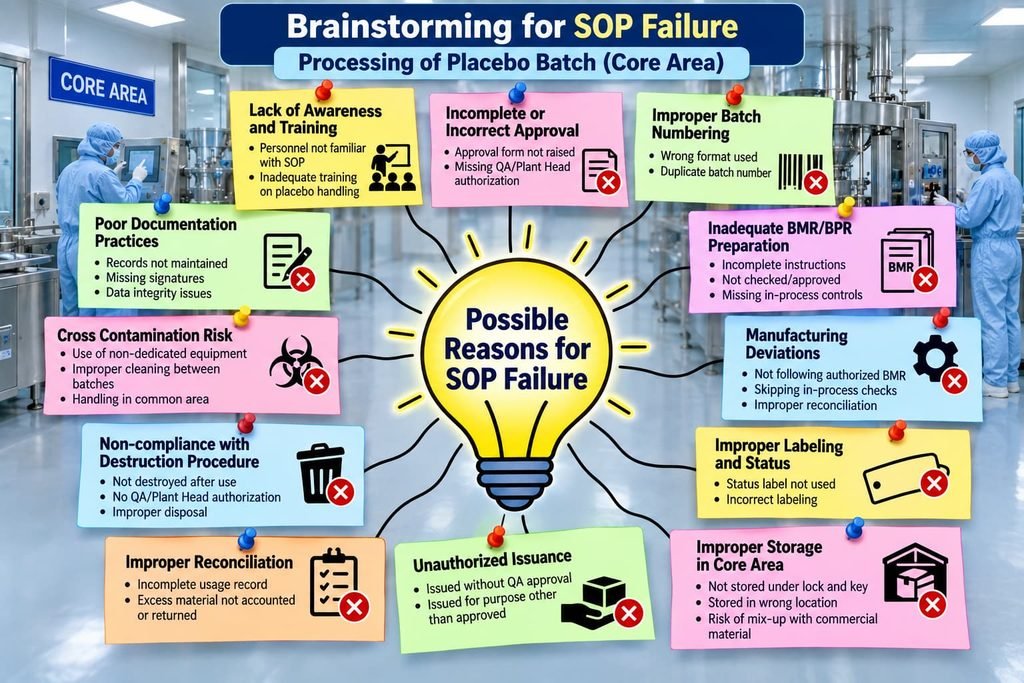
Other potential failure points include incorrect labeling, improper storage, unauthorized issuance, incomplete reconciliation of excess material, and improper destruction after completion of the intended purpose. The SOP specifies that placebo material should be properly labeled, stored under lock and key, issued only for its intended purpose, reconciled, and destroyed only after appropriate authorization. This brainstorming exercise helps identify process weaknesses so that suitable training, documentation controls, supervision, and preventive measures can be strengthened.
5. SOP for Processing of Placebo Batch – 5-Why Analysis for SOP Failure:
The 5-Why Analysis for SOP for Processing of Placebo Batch is used to trace repeated processing failures back to their underlying causes. The diagram highlights failures such as placebo manufacture without proper authorization, incorrect batch numbering, incomplete BMR/BPR preparation, missed in-process checks and reconciliation, improper labeling or storage, and failure to properly reconcile or destroy placebo material after use. These are critical because the SOP requires formal approval, defined batch numbering, authorized manufacturing records, documented in-process checks, proper labeling and storage, controlled issuance, reconciliation, and authorized destruction.
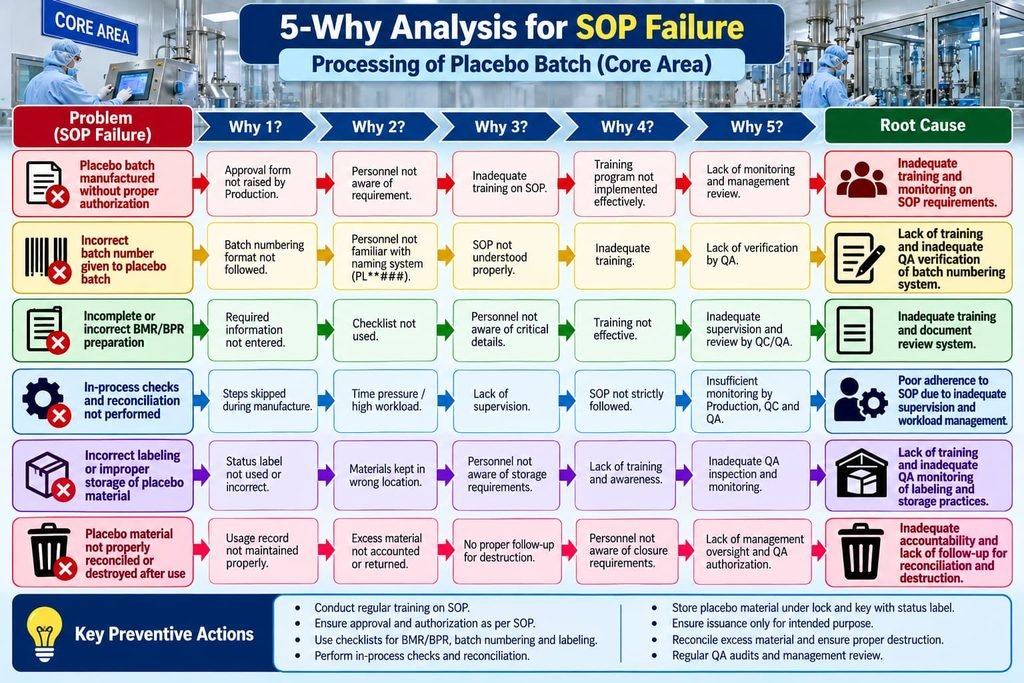
The analysis indicates that these failures may progress through causes such as lack of awareness, insufficient SOP training, inadequate supervision, weak QA/QC review, poor use of checklists, workload pressure, and inadequate management monitoring. The probable root causes therefore center on training gaps, insufficient verification, weak document review, inadequate supervision, and poor follow-up. The 5-Why approach helps identify the real cause behind recurring SOP deviations so that targeted preventive actions can be implemented, including effective training, stronger approval controls, better QA review, use of checklists, improved reconciliation, and periodic management oversight.
6. SOP for Processing of Placebo Batch – Fishbone Analysis for SOP Failure:
The Fishbone Analysis for SOP for Processing of Placebo Batch identifies the major categories that may contribute to failure during placebo batch processing in the pharmaceutical core area. The analysis groups potential causes under Manpower, Method, Documentation, Process Control, Material/Storage, and Management/QA Oversight. Manpower-related causes include inadequate SOP training, lack of awareness, poor supervision, and failure to follow instructions. Method-related failures may involve missing approval, improper authorization, incorrect batch numbering, or deviation from the defined procedure. The SOP requires the placebo batch approval to be raised by Production, approved by the Quality Assurance Head, and authorized by the Plant Head.
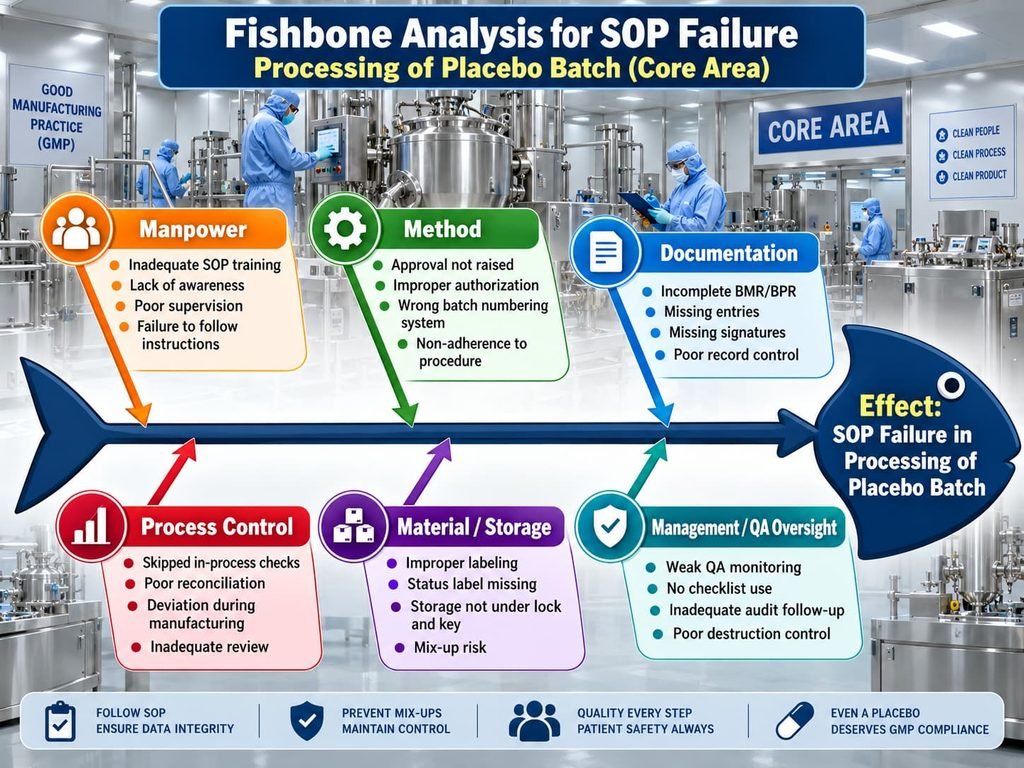
Documentation and process-control failures may include incomplete BMR/BPR entries, missing signatures, skipped in-process checks, and poor reconciliation. The SOP specifies that the BMR/BPR must be appropriately prepared and authorized and that manufacturing stages require reconciliation and in-process checks. Material and storage-related causes include improper labeling, missing status labels, incorrect storage, and weak control of excess material. Management and QA-related failures may involve insufficient monitoring and inadequate control over reconciliation or destruction. The SOP requires proper labeling, storage under lock and key, controlled issuance, reconciliation, and authorized destruction under QA supervision. Overall, the Fishbone Analysis helps systematically identify potential contributing factors so that appropriate corrective and preventive actions can be developed.
7. SOP for Processing of Placebo Batch – Fault Tree Analysis for SOP Failure:
The Fault Tree Analysis (FTA) for SOP for Processing of Placebo Batch illustrates how different failures can combine to result in the top event: non-compliance or failure in processing of a placebo batch. The analysis identifies major intermediate events such as inadequate personnel performance, failure in approval and authorization, deviation from the defined procedure, inadequate BMR/BPR documentation, improper handling and storage, and failure in reconciliation or disposal.
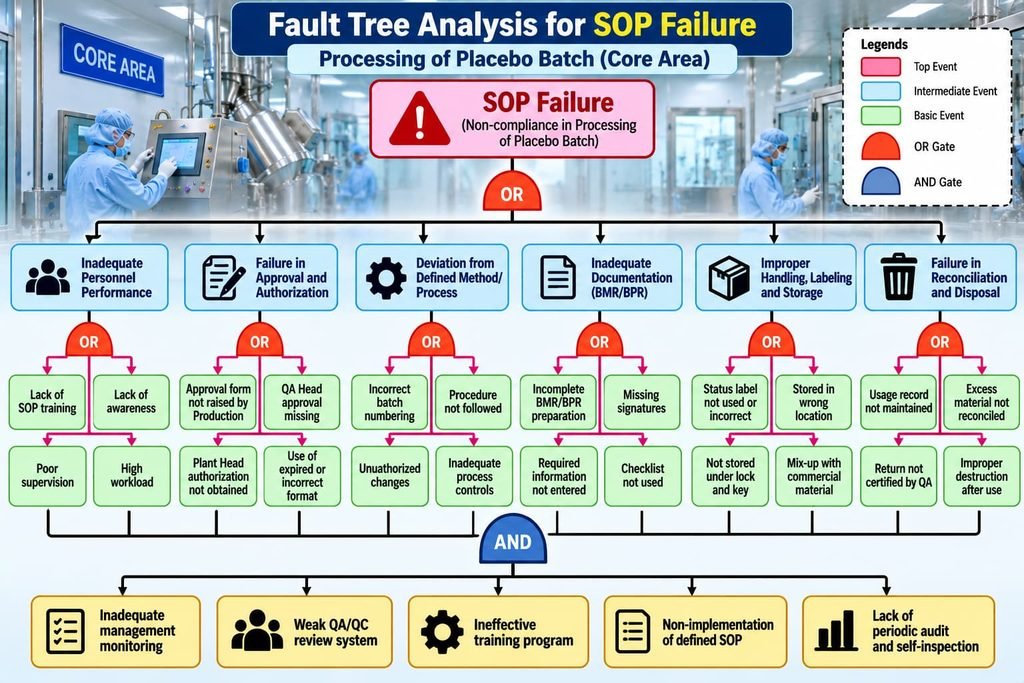
The SOP requires Production to raise the placebo batch approval, with approval by the Head of Quality Assurance and authorization by the Plant Head. It also defines a specific batch numbering system and requires preparation, checking, approval, and QA authorization of the placebo BMR/BPR. Basic failure events shown in the fault tree include lack of SOP training, poor supervision, incorrect batch numbering, incomplete records, missing signatures, failure to follow authorized manufacturing instructions, skipped process checks, incorrect status labeling, improper storage, incomplete usage records, and failure to account for excess material. The SOP further requires in-process checks and reconciliation during manufacture, proper status labeling, storage under lock and key, controlled issuance for the intended purpose, return of excess material after QA certification, and authorized destruction after completion of use. Overall, the FTA helps visualize how individual control failures can escalate into overall SOP failure and highlights the importance of training, QA/QC review, management monitoring, documentation control, and strict adherence to the approved procedure.
8. SOP for Processing of Placebo Batch – Impact Assessment:
The Impact Assessment for SOP for Processing of Placebo Batch evaluates the possible consequences if the approved procedure is not followed during placebo batch processing. Failure of the SOP can affect product quality, documentation, operations, compliance, traceability, and controlled material handling. The SOP requires placebo batches to be manufactured only after proper approval and authorization, with defined batch numbering, approved BMR/BPR, in-process checks, reconciliation, labeling, storage, controlled issuance, and authorized destruction.
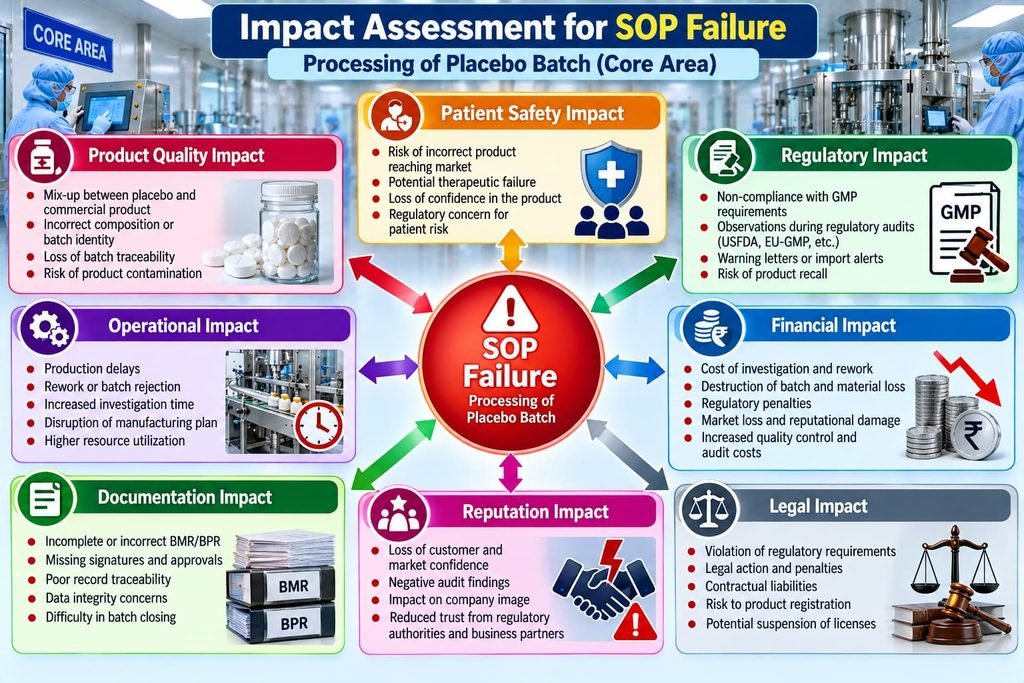
Non-compliance may lead to incorrect batch identification, incomplete documentation, missing approvals, poor traceability, mix-up risk, improper storage, uncontrolled issuance, or failure to reconcile excess material. Operationally, such failures may result in investigation, rework, delays, and additional QA oversight. The assessment also highlights potential compliance and business impacts, including audit observations, increased investigation costs, loss of material, and damage to organizational credibility. Overall, the impact assessment demonstrates why strict adherence to the SOP is necessary to maintain GMP control, documentation accuracy, accountability, traceability, and proper disposition of placebo batches.
9. SOP for Processing of Placebo Batch – CAPA:
The Corrective and Preventive Action (CAPA) for SOP for Processing of Placebo Batch is intended to address failures identified during placebo batch processing and prevent their recurrence. Typical failures may include processing without proper approval or authorization, incorrect batch numbering, incomplete BMR/BPR, missed in-process checks, improper labeling or storage, and inadequate reconciliation or destruction of excess placebo material. The SOP requires formal approval before processing, defined batch numbering, preparation and authorization of BMR/BPR, in-process checks, reconciliation, proper labeling, controlled storage, intended-use issuance, and authorized destruction.
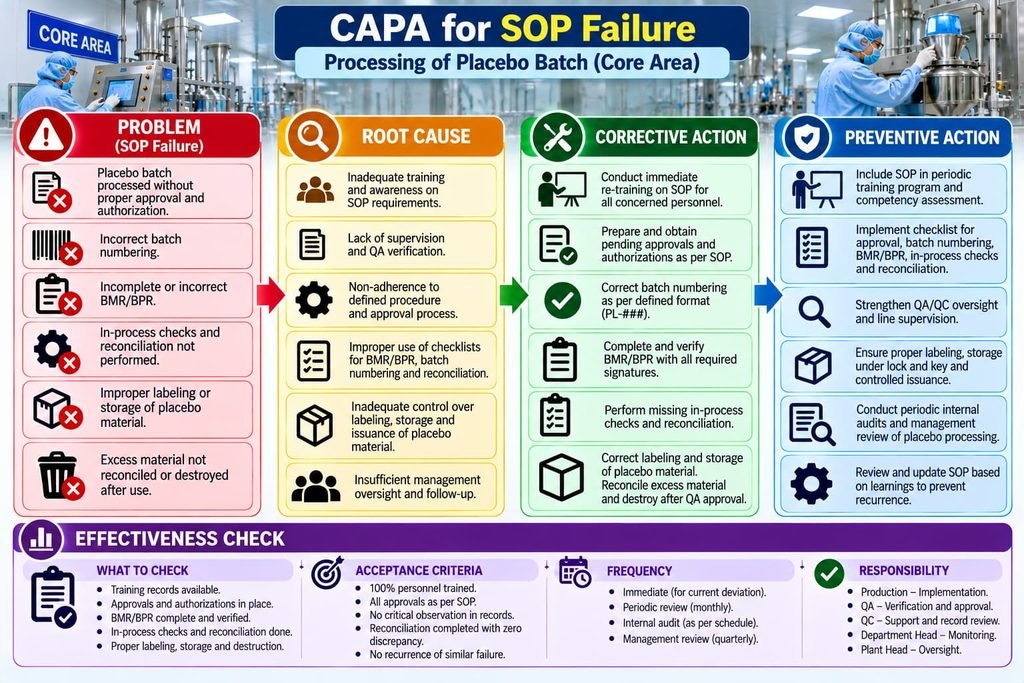
Corrective actions should therefore focus on immediate retraining, completion of missing documentation or approvals, correction of batch identification, completion of pending checks and reconciliation, and correction of labeling or storage deficiencies. Preventive actions should include periodic SOP training, use of checklists, strengthened QA/QC review, improved supervision, periodic internal audits, and management review. Effectiveness should be verified by confirming complete training records, proper approvals, complete BMR/BPR documentation, successful reconciliation, correct labeling and storage, and absence of recurrence of similar SOP failures.
SOP for Processing of Placebo Batch – Questions & Answers:
- Q: What is the objective of the SOP for Processing of Placebo Batch?
A: The objective is to define the procedure for processing placebo batches and the controls that must be followed during their manufacture and handling. - Q: Where is this SOP applicable?
A: The SOP is applicable to the processing of placebo batches in the Production Department. - Q: Who is responsible for execution of this SOP?
A: Personnel from Production, Quality Control, and Quality Assurance are responsible for execution of the SOP. - Q: Who is responsible for effective implementation of the SOP?
A: Manager-Production, Manager-QC, and Head-QA/QC are responsible for its effective implementation. - Q: For what purposes may a placebo batch be manufactured?
A: A placebo batch may be required for analytical method development, equipment or machine change-part trials, process development trials, process improvements, and demonstration purposes. - Q: Who raises the approval for manufacturing a placebo batch?
A: The Production Department raises the “Approval for Manufacturing Placebo Batch.” - Q: What information is included in the placebo batch approval?
A: The approval includes placebo details, date, batch number, purpose for which the placebo batch is required, and methodology. - Q: Who approves and authorizes the placebo batch manufacturing request?
A: The request is approved by the Quality Assurance Head and authorized by the Plant Head. - Q: What is the batch numbering format for a placebo batch?
A: The defined format is PL followed by the last two digits of the calendar year and a serial number from 001 to 999. For example, the first placebo batch manufactured in 2024 is PL24001. - Q: Who prepares and authorizes the placebo BMR/BPR?
A: The Production Department prepares the BMR/BPR as required. It is checked and approved by Quality Control and finally authorized by Quality Assurance. - Q: How should the placebo batch be manufactured?
A: It should be manufactured according to the instructions in the authorized Batch Manufacturing Record, with reconciliation and in-process checks recorded at each stage. - Q: How should the finished placebo material be stored?
A: The bulk finished placebo should be packed as required, properly identified with a status label, and stored under lock and key. - Q: What happens to non-recoverable and excess placebo material?
A: Non-recoverable material is destroyed by Production under QA supervision. Excess material, if any, is returned to the Warehouse after QA certification. - Q: To whom can a placebo batch be issued?
A: It may be issued for its intended purpose to the Analytical Development Laboratory, Quality Control, Process Development, Production, or Packing as applicable. - Q: What should be done after completion of the intended purpose?
A: The placebo batch should be reconciled and destroyed after obtaining authorization from Quality Assurance and the Plant Head. - Q: What are the main controls required for placebo batch processing?
A: Major controls include documented approval, proper authorization, unique batch numbering, authorized BMR/BPR, in-process checks, reconciliation, status labeling, secure storage, controlled issuance, and authorized destruction.
Reference Guidelines – SOP for Processing of Placebo Batch:
- In-House Procedure / Company Quality Management System (QMS) – The SOP specifically identifies its reference as “In House.”