







1. Introduction to Batch Packing Record (BPR) of Terbutaline Sulphate, Bromhexine Hydrochloride & Guaiphenesin Syrup:
The Batch Packing Record (BPR) of Terbutaline Sulphate, Bromhexine Hydrochloride & Guaiphenesin Syrup is a comprehensive pharmaceutical documentation system designed to ensure the systematic execution, monitoring, and verification of packing operations in accordance with Good Manufacturing Practices (GMP). It provides documented evidence of each packing activity, ensuring product quality, traceability, consistency, and compliance with established procedures.The syrup contains Terbutaline Sulphate IP 1.25 mg, Bromhexine Hydrochloride IP 4 mg, and Guaiphenesin IP 50 mg per 5 mL in a mentholated flavoured syrup base. The formulation combines a bronchodilator, a mucolytic agent, and an expectorant, commonly used in the management of respiratory conditions associated with bronchospasm and mucus accumulation. The BPR covers essential packing activities, including packaging material dispensing, line clearance, bottle washing, filling, sealing, labelling, overprinting, inspection, and final packing. It also incorporates critical in-process quality checks such as fill volume verification, sealing integrity, leakage testing, PP cap perfo
Skip to PDF content2. Flow Diagram – Terbutaline Sulphate, Bromhexine Hydrochloride & Guaiphenesin Syrup (BPR):
The Flow Diagram of the Batch Packing Record (BPR) for Terbutaline Sulphate, Bromhexine Hydrochloride & Guaiphenesin Syrup illustrates the sequential packing operations involved in ensuring product quality, safety, traceability, and compliance with Good Manufacturing Practices (GMP). The packing process begins with packaging material dispensing and verification, including PET bottles, PP caps, labels, measuring cups, cartons, trays, and shrink-wrapping materials. This is followed by line clearance to confirm the cleanliness and readiness of the packing area and equipment.
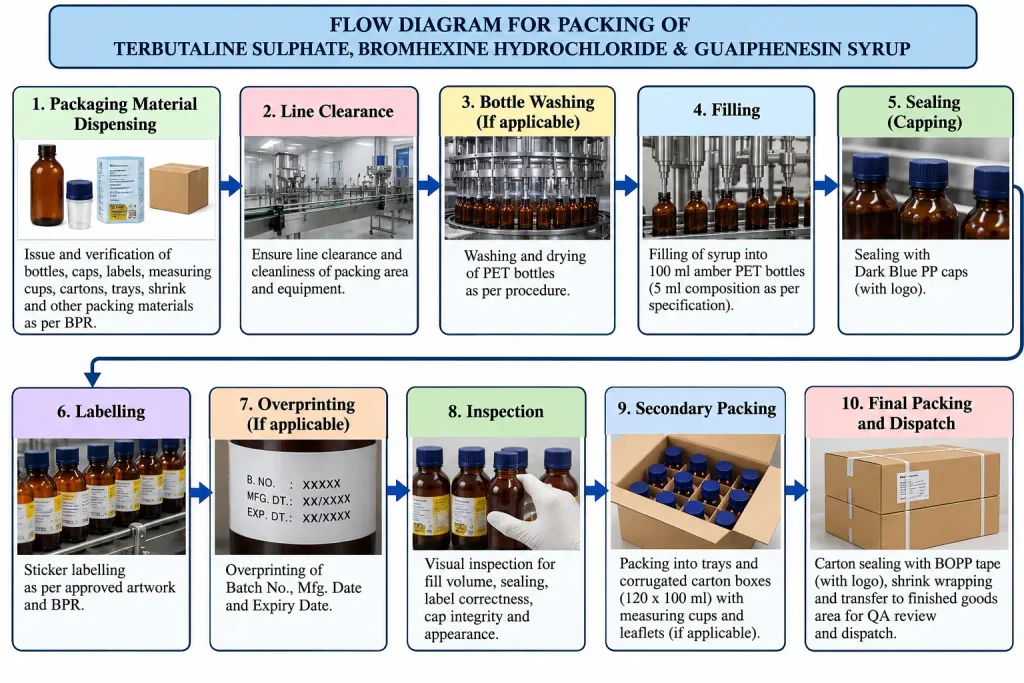
The subsequent stages include bottle washing, syrup filling, sealing, labelling, overprinting, and visual inspection. Critical in-process quality checks cover fill volume accuracy, sealing integrity, leakage testing, cap perforation, label correctness, and overall container appearance. After satisfactory inspection, filled bottles undergo secondary packing, including the arrangement of bottles in cartons and shippers. The process concludes with final packing, reconciliation of packaging materials, calculation of packing yield, and documented verification by Production and Quality Assurance personnel. The primary objective of this flow diagram is to provide a clear visual representation of the packing sequence, helping pharmaceutical personnel understand operational responsibilities, identify critical control points, minimize packaging errors, and maintain complete batch documentation. This flow diagram also serves as a useful reference for GMP training, standard operating procedures, internal audits, process monitoring, and regulatory inspections.
3. Critical Process Parameters (CPP) and Critical Quality Attributes (CQA) of Terbutaline Sulphate, Bromhexine Hydrochloride & Guaiphenesin Syrup (BPR):
The Critical Process Parameters (CPP) and Critical Quality Attributes (CQA) of Terbutaline Sulphate, Bromhexine Hydrochloride & Guaiphenesin Syrup are essential elements of pharmaceutical quality assurance, ensuring consistent packing operations, product safety, and compliance with Good Manufacturing Practices (GMP). Critical Process Parameters (CPP) represent the process variables and operational controls that must be monitored during packaging material dispensing, line clearance, bottle washing, filling, sealing, labelling, overprinting, and secondary packing. Important parameters include washing water temperature, filling volume, filling machine settings, sealing conditions, cap perforation, label alignment, and printing accuracy. Critical Quality Attributes (CQA) are the measurable physical, chemical, microbiological, and packaging characteristics that must comply with approved specifications to ensure product quality. Packaging-related quality attributes include correct fill volume, container closure integrity, absence of leakage, acceptable syrup appearance, accurate labelling, tamper-evident cap integrity, and proper pack presentation.
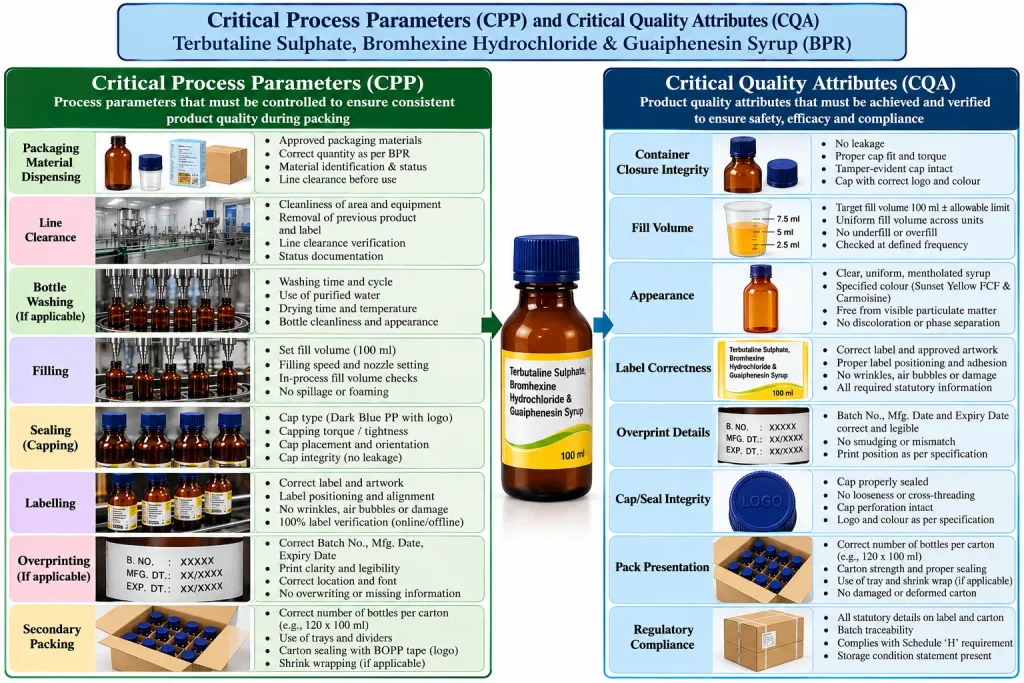
The Batch Packing Record provides documented controls for hourly fill volume verification, sealing and labelling inspections, leakage testing, rejection analysis, packaging material reconciliation, and final batch yield evaluation. These activities help identify potential quality defects and prevent the release of incorrectly packed products. The primary objective of CPP and CQA monitoring is to maintain consistent packaging performance, minimize operational deviations, prevent product mix-ups, and ensure that finished products meet established quality and regulatory requirements.
Note: The illustrated CPPs are proposed packing-process control parameters. Their criticality and acceptable limits should be established through documented risk assessment, qualification, and validation. The supplied BPR primarily documents packaging controls rather than a complete product CQA specification.