







1. Introduction – SOP for Transfer and Storage of Semi-Finished Product to In-Process Quarantine Area:
The Standard Operating Procedure for Transfer and Storage of Semi-Finished Product to In-Process Quarantine Area defines a controlled system for the identification, transfer, segregation, storage, and movement of semi-finished pharmaceutical products during different stages of manufacturing. The procedure covers materials such as dispensed raw materials, semi-processed materials, tablet/capsule blends, core tablets, coated tablets, filled capsules, empty gelatin capsules, and recoverable or non-recoverable rejections generated during manufacturing and packing operations.The SOP requires semi-finished materials to be transferred to designated quarantine areas with appropriate In-Process Stage, Container Status, Recoverable, or Non-Recoverable labels, as applicable. Materials are stored batch-wise with proper physical segregation until Quality Control release or further processing. Quarantine areas are maintained under restricted and locked access, while every inward and outward material movement is documented through the prescribed quarantine log. This system supports material traceability, prevents mix-ups and unauthorized use, and helps maintain GMP control throughout the manufacturing process.
Skip to PDF content2. Flow Diagram – Transfer and Storage of Semi-Finished Product to In-Process Quarantine Area:
The SOP for Transfer and Storage of Semi-Finished Product to In-Process Quarantine Area describes the controlled handling of semi-finished materials generated during pharmaceutical manufacturing. These materials may include dispensed materials, semi-processed materials, tablet or capsule blends, core tablets, coated tablets, filled capsules, empty gelatin capsules, and recoverable or non-recoverable rejections.
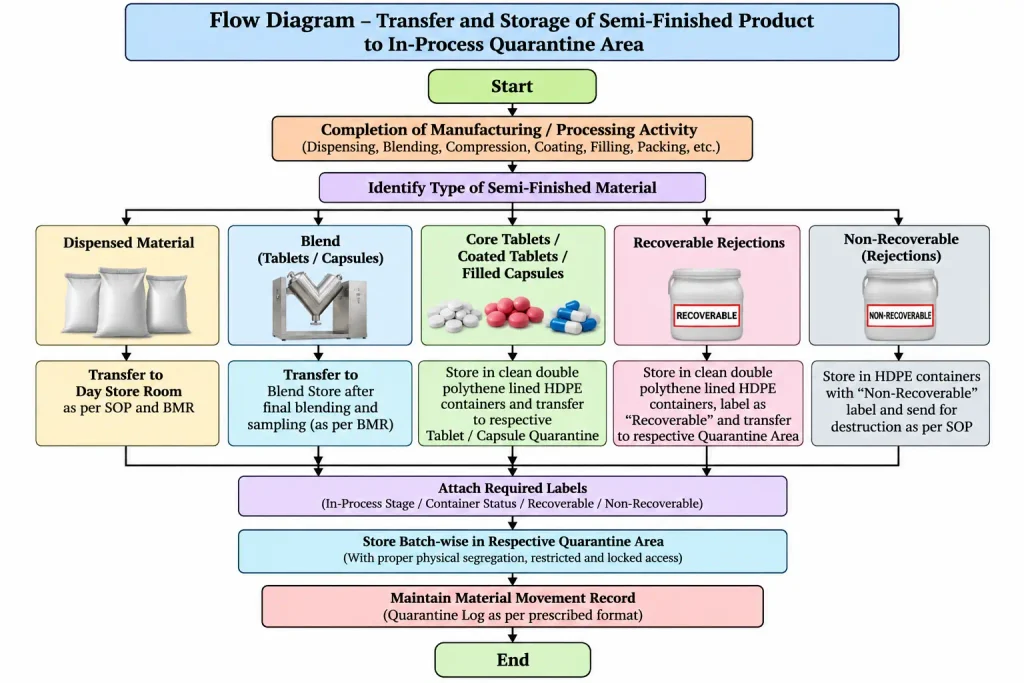
After completion of the relevant manufacturing stage, materials are transferred to designated storage or quarantine areas such as the Day Store, Blend Store, or Tablet/Capsule Quarantine. Appropriate status labels are applied, containers are properly closed, and batches are physically segregated to prevent mix-ups. The SOP also requires quarantine areas to remain restricted and locked, while all inward and outward material movements are documented in the quarantine log. This ensures proper identification, traceability, controlled storage, and accountability of semi-finished products until QC release, further processing, or disposal.
3. Benefits of Following SOP for Transfer and Storage of Semi-Finished Product to In-Process Quarantine Area:
Following the SOP for Transfer and Storage of Semi-Finished Product to In-Process Quarantine Area ensures that semi-finished materials are properly identified, labelled, segregated, transferred, and stored in designated quarantine locations. The SOP requires batch-wise storage, appropriate status labels, controlled containers, and physical segregation of good materials and recoverable rejections, helping reduce the possibility of mix-ups and unauthorized use.
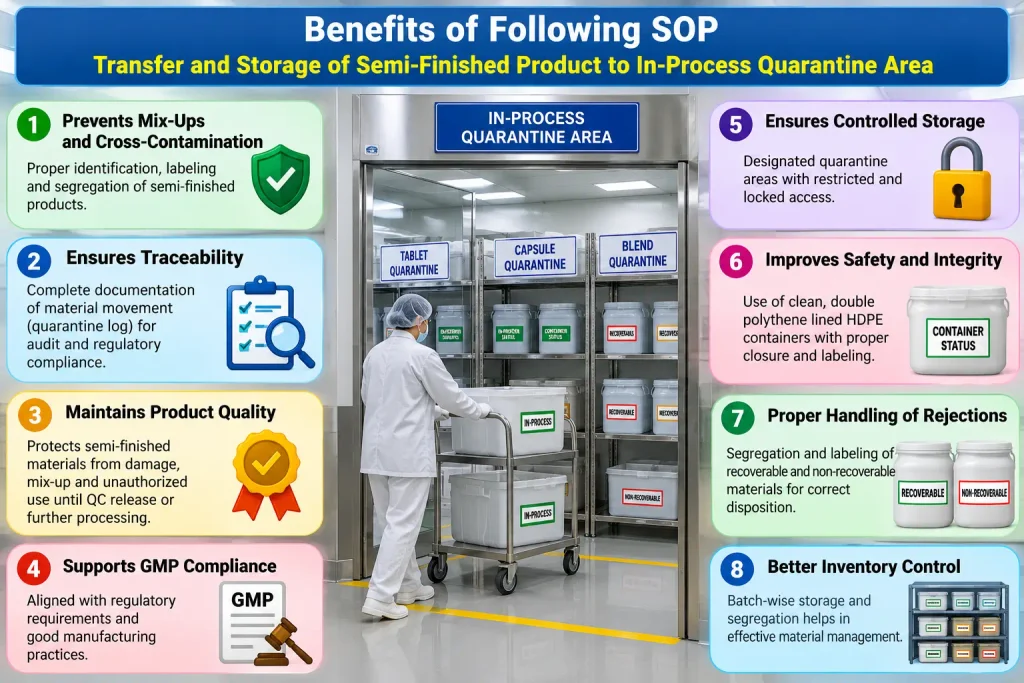
It also requires quarantine areas to remain restricted and locked, which supports controlled access and material security. All material movements into and out of quarantine are documented through the prescribed quarantine log, improving traceability and accountability. By following these controls consistently, the organization can maintain better product status control, ensure proper handling of recoverable and non-recoverable materials, support GMP compliance, and protect the identity and integrity of semi-finished products until further processing, release, or destruction.
4. Brainstorming for SOP Failure – Transfer and Storage of Semi-Finished Product to In-Process Quarantine Area:
Brainstorming for failure of the SOP for Transfer and Storage of Semi-Finished Product to In-Process Quarantine Area helps identify possible weaknesses that may affect material identity, segregation, storage, and traceability. Potential failures include incorrect identification of semi-finished material, missing or incorrect status labels, transfer to the wrong storage or quarantine area, inadequate segregation of batches, and improper handling of recoverable or non-recoverable rejections.
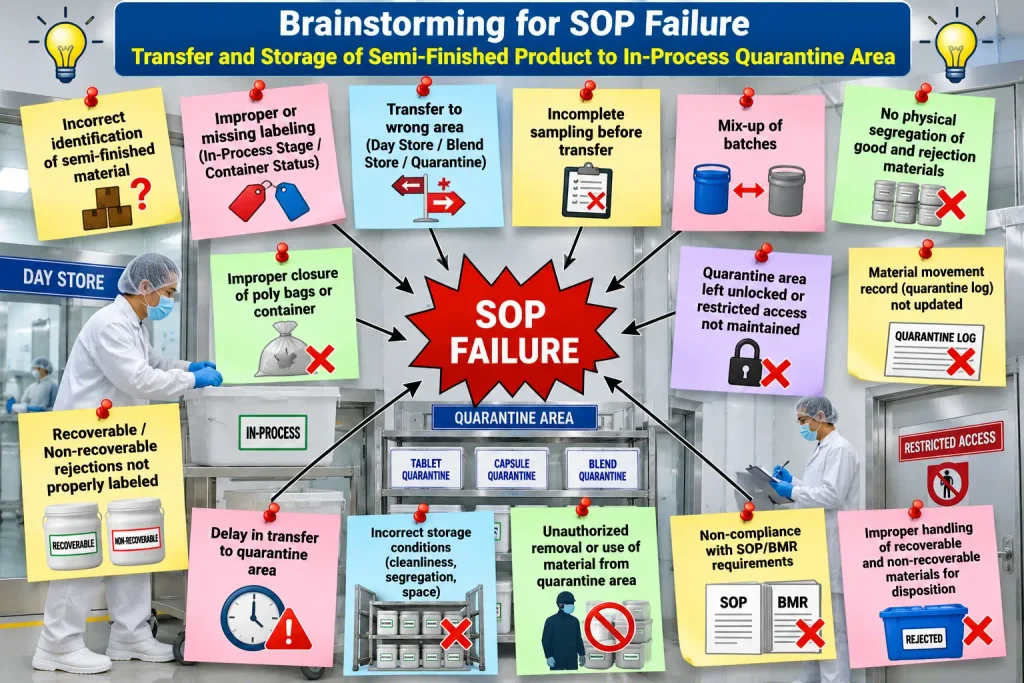
The SOP specifically requires appropriate In-Process Stage, Container Status, Recoverable, and Non-Recoverable labeling, together with batch-wise segregation and transfer to the designated quarantine area. Other possible failure points include unlocked quarantine areas, unauthorized material removal, incorrect storage practices, delayed transfer, and failure to update the material movement record. The SOP requires quarantine areas to remain restricted and locked and requires inward and outward material movement to be recorded in the quarantine log.
5. 5-Why Analysis for SOP Failure – Transfer and Storage of Semi-Finished Product to In-Process Quarantine Area:
The 5-Why Analysis for failure of the SOP for Transfer and Storage of Semi-Finished Product to In-Process Quarantine Area is used to identify the underlying reason behind incorrect transfer, improper labeling, inadequate segregation, or unauthorized handling of semi-finished materials. The analysis starts with the observed failure, such as material being transferred to the wrong area, and repeatedly asks “Why?” until the fundamental cause is identified.
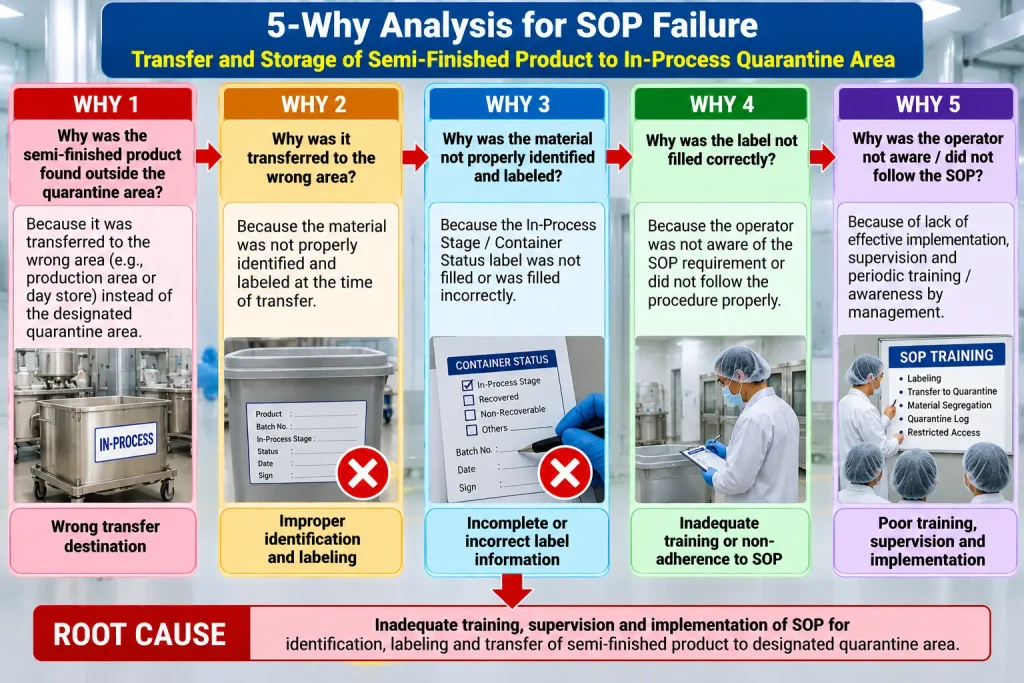
The SOP requires semi-finished materials such as blends, core tablets, coated tablets, and filled capsules to be transferred to their designated quarantine areas with appropriate In-Process Stage and Container Status labels. A typical 5-Why sequence may identify improper material identification, incomplete labeling, lack of operator awareness, inadequate training, and insufficient supervision or SOP implementation as contributing causes. The analysis helps establish a logical root cause and supports development of targeted CAPA such as retraining, improved verification, stronger supervisory checks, and periodic compliance review.
6. Fishbone Analysis for SOP Failure – Transfer and Storage of Semi-Finished Product to In-Process Quarantine Area:
The Fishbone Analysis for failure of the SOP for Transfer and Storage of Semi-Finished Product to In-Process Quarantine Area is used to systematically identify potential causes that may lead to incorrect transfer, storage, labeling, segregation, or documentation of semi-finished products. The analysis groups possible causes under major categories such as Man, Machine, Material, Method, Environment, and Measurement. Potential causes may include inadequate operator training, incorrect material identification, damaged or missing labels, improper container closure, non-adherence to the SOP, poor segregation, restricted-access failures, and incomplete quarantine-log entries. These issues are directly relevant because the SOP requires properly labeled containers, batch-wise segregation, controlled quarantine storage, restricted access, and recording of inward and outward material movement.
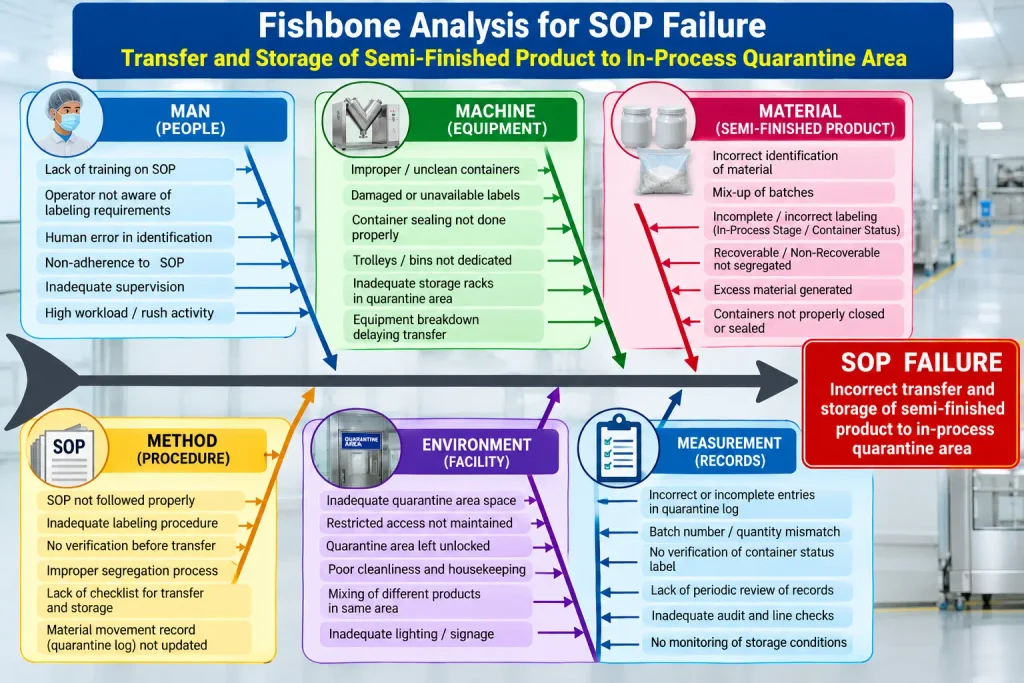
Fishbone analysis helps the investigation team visualize all probable contributing factors before selecting the most likely root cause. It provides a structured basis for further investigation, risk assessment, and development of suitable corrective and preventive actions to strengthen compliance with the SOP.
7. FMEA Analysis for SOP Failure – Transfer and Storage of Semi-Finished Product to In-Process Quarantine Area:
The FMEA Analysis for failure of the SOP for Transfer and Storage of Semi-Finished Product to In-Process Quarantine Area evaluates potential failure modes that may occur during identification, labeling, transfer, segregation, container closure, quarantine storage, and material movement recording. The analysis ranks each failure based on Severity (S), Occurrence (O), and Detection (D) to calculate the Risk Priority Number (RPN = S × O × D) and prioritize corrective actions.
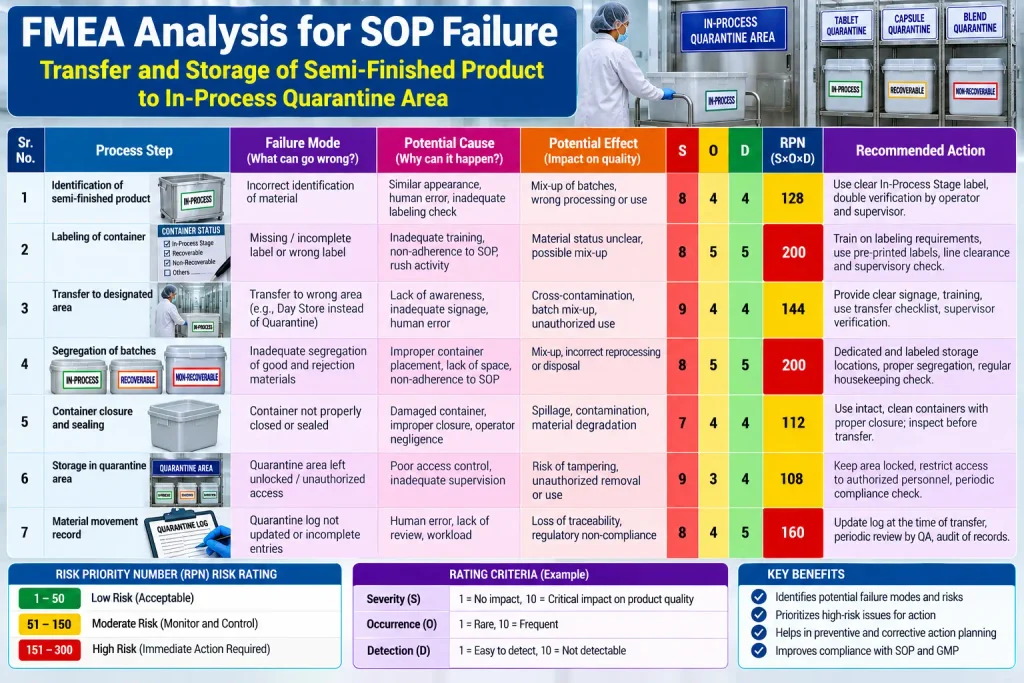
Potential failures include incorrect identification of semi-finished material, missing or incorrect status labels, transfer to the wrong quarantine area, improper segregation of good and rejected materials, inadequate container closure, unauthorized access, and incomplete quarantine-log entries. These risks are relevant because the SOP requires appropriate labeling, batch-wise segregation, secure storage in designated quarantine areas, and controlled material movement. The SOP also requires quarantine areas to remain restricted and locked and mandates documentation of inward and outward movement through the quarantine log. FMEA helps identify higher-risk failure modes so that actions such as operator training, supervisory verification, improved labeling controls, access restriction, transfer checklists, and periodic record review can be prioritized to strengthen GMP compliance and material traceability.
8. CAPA for SOP Failure – Transfer and Storage of Semi-Finished Product to In-Process Quarantine Area:
The CAPA for failure of the SOP for Transfer and Storage of Semi-Finished Product to In-Process Quarantine Area is intended to correct identified deficiencies and prevent recurrence of failures related to material identification, labeling, transfer, segregation, quarantine storage, and documentation. The SOP requires semi-finished materials to be transferred to their designated storage or quarantine areas with appropriate status labeling and physical segregation.
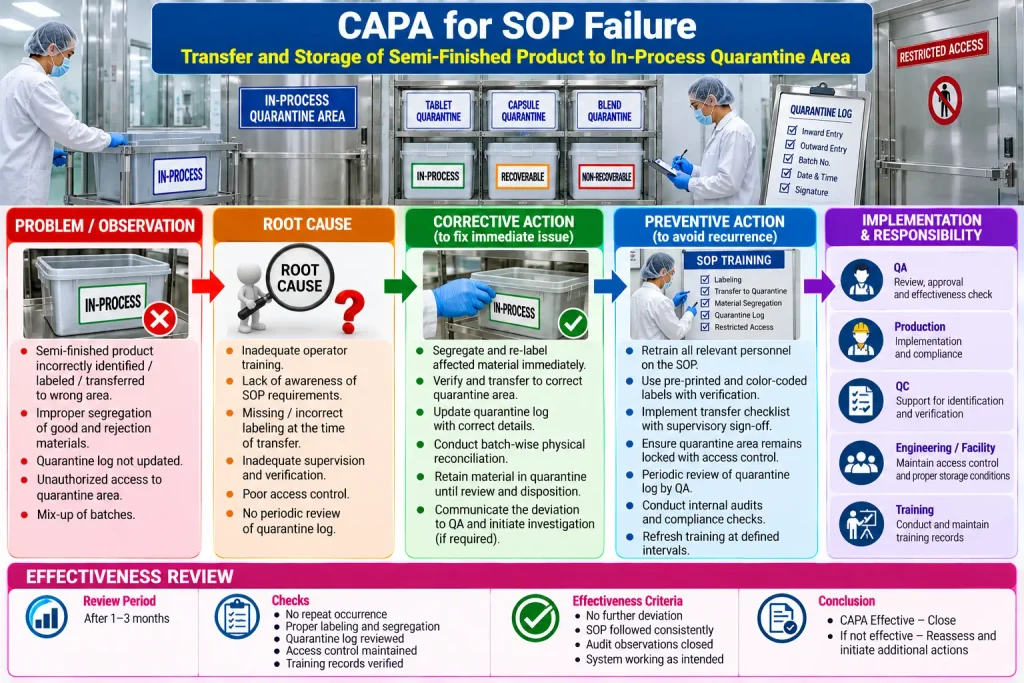
Corrective actions may include immediate segregation and re-labeling of affected material, verification of the correct quarantine location, updating the material movement record, physical reconciliation, and investigation of any deviation. Preventive actions may include refresher SOP training, supervisory verification, standardized labels, transfer checklists, restricted access, and periodic review of quarantine records. The SOP specifically requires quarantine areas to remain restricted and locked and requires all inward and outward material movement to be documented in the quarantine log. CAPA effectiveness should be verified through follow-up review of labeling, segregation, access control, training records, quarantine logs, and recurrence of similar incidents to confirm that the implemented actions are working as intended.
Questions & Answers – Transfer and Storage of Semi-Finished Product to In-Process Quarantine Area:
- What is the objective of this SOP?
The objective is to define the procedure for transfer and storage of semi-finished products in the In-Process Quarantine Area. - Who is responsible for execution of this SOP?
Concerned Production personnel and Production Chemists are responsible for execution, while the Manager-Production and Head-QA/QC are responsible for effective implementation. - What materials are considered semi-finished materials under this SOP?
They include dispensed material, semi-processed material, tablet/capsule blends, core tablets, coated tablets, filled capsules, empty gelatin capsules, and rejections generated during compression, filling, or packing. - Where should dispensed material be transferred after dispensing?
It should be transferred to the Day Store Room after completion of dispensing as per the applicable SOP and Batch Manufacturing Record. - Where should tablet or capsule blend be stored after final blending and sampling?
It should be transferred to the Blend Store and kept in appropriately labeled Intermediate Product Containers or bins. - How should blend material be stored in quarantine?
Blend should be stored batch-wise in the respective quarantine area until Quality Control releases it and until it is further processed. - How should compressed tablets, coated tablets, and filled capsules be stored?
They should be stored in clean, double-polythene-lined HDPE containers with appropriate container status labeling and secure closure. - Where are core tablets, coated tablets, and filled capsules transferred?
Core tablets and coated tablets are transferred to Tablet Quarantine, while filled capsules are transferred to the respective quarantine area. - How should recoverable rejections be handled?
Recoverable rejections should be stored in clean double-polythene-lined HDPE containers, labeled as “Recoverable,” - Should recoverable rejections and good tablets/capsules be stored together?
They may be stored in the respective quarantine area, but physical segregation must be maintained, and good material should be stored batch-wise.