







1. Introduction – SOP for Weighing of Packed Blister:
The Standard Operating Procedure for Weighing of Packed Blister establishes a controlled and systematic method for verifying the weight of filled blister or strip packs during pharmaceutical production. The procedure is intended to ensure that each blister or strip contains the required number of tablets and that any abnormality, such as a missing tablet or improper filling, can be identified through weight verification. The SOP is applicable to all filled blister and strip packs handled in the production area. As part of the procedure, the blister or strip is first checked for proper tablet filling. A standard filled-blister weight is then calculated using the average weight of the empty blister and the average tablet weight. An acceptable lower and upper weight range is established using half of one tablet weight as the tolerance. If any packed blister is found outside the established weight limits, Production and QA personnel are informed and the pack is physically checked and verified. This control helps strengthen pack integrity, reconciliation, detection of missing tablets, GMP compliance, and overall product quality assurance.
Skip to PDF content2. Flow Diagram – SOP for Weighing of Packed Blister:
The SOP for Weighing of Packed Blister describes the procedure for checking the weight of filled blister or strip packs during pharmaceutical production. The process begins with verification of the blister or strip to confirm proper tablet filling. The standard weight of one filled blister is calculated using the average weight of the empty blister together with the average weight of the tablets contained in the pack.
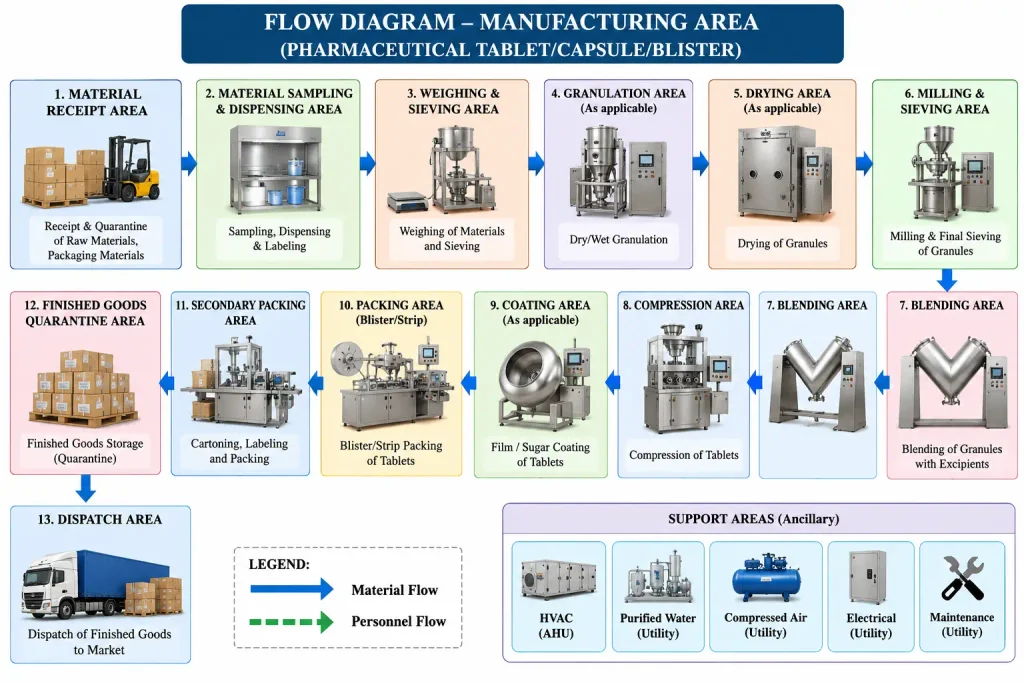
An acceptable weight range is then established by subtracting and adding half the weight of one tablet from the standard filled-blister weight. This range is used as a control to identify possible missing tablets, improper filling, or abnormal pack weight. If any blister or strip is found outside the specified weight limit, the Production and QA personnel are informed, and the pack is physically checked and verified. This procedure supports effective in-process control and helps maintain consistency of packed pharmaceutical products.
3. Benefits of Following SOP for Weighing of Packed Blister:
Following the SOP for Weighing of Packed Blister helps ensure consistent and controlled verification of filled blister or strip packs during production. The procedure requires checking the blister for proper tablet filling, calculating the standard filled-blister weight, and establishing an acceptable weight range for verification. Proper implementation of this SOP supports early identification of under-filled or improperly filled blister packs. It also strengthens in-process control by requiring Production and QA personnel to investigate and physically verify any pack found outside the established weight limit.
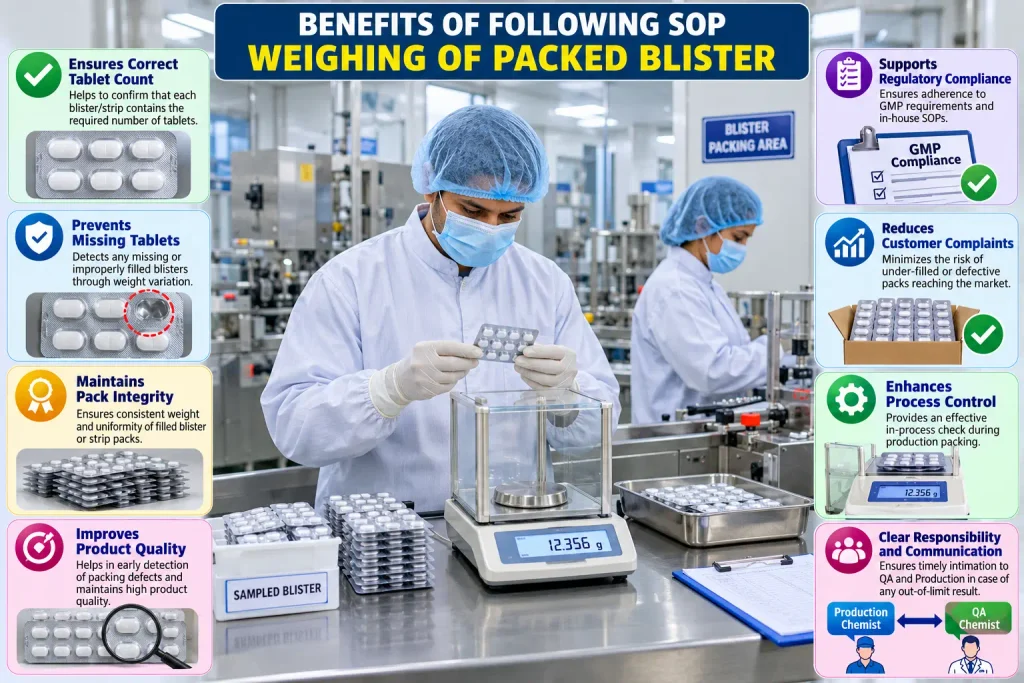
The major benefits include improved packing accuracy, better control of tablet count, reduced risk of missing tablets, consistent pack quality, timely detection of abnormalities, defined responsibility between Production and QA, improved documentation, and stronger compliance with the approved manufacturing procedure. Overall, the SOP helps maintain the reliability and quality of packed pharmaceutical products.
4. Brainstorming for SOP Failure: Weighing of Packed Blister:
The Brainstorming for SOP Failure – Weighing of Packed Blister is used to identify possible reasons that may lead to failure of the blister-weight verification process. Since the SOP requires checking proper tablet filling, calculating the standard filled-blister weight, establishing an acceptable lower and upper range, and physically verifying any out-of-limit pack, failures can occur when these activities are not performed correctly.
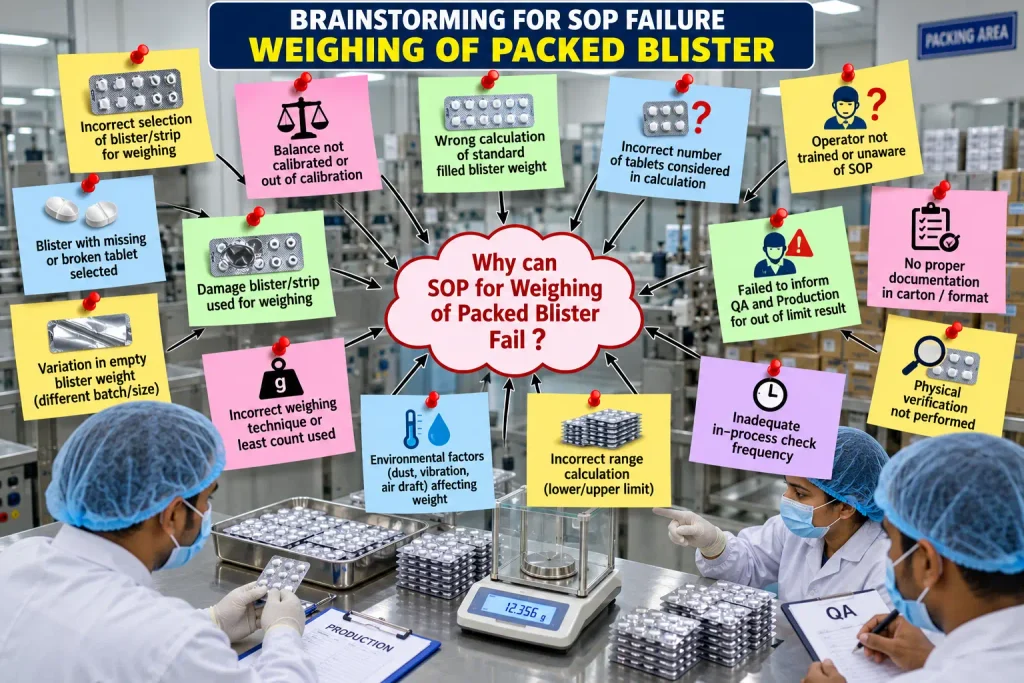
Potential causes considered during brainstorming include incorrect blister selection, use of a damaged or incompletely filled blister, incorrect average weight calculation, wrong number of tablets considered in the calculation, improper lower or upper limit determination, use of an unsuitable balance, poor operator understanding, and incomplete documentation. The exercise also highlights the importance of timely communication between Production and QA whenever an out-of-limit result is observed. The SOP specifically requires Production and QA personnel to physically check and verify such cases.brainstorming helps identify human, equipment, calculation, material, and procedural weaknesses before they result in incorrect acceptance or rejection of packed blister strips.
5. 5-Why Analysis for SOP Failure: Weighing of Packed Blister:
The 5-Why Analysis for SOP Failure – Weighing of Packed Blister is used to systematically investigate the underlying reasons for an out-of-limit blister weight or improper blister filling. The SOP requires the blister or strip to be checked for proper tablet filling, followed by calculation of the standard filled-blister weight and its acceptable lower and upper limits.
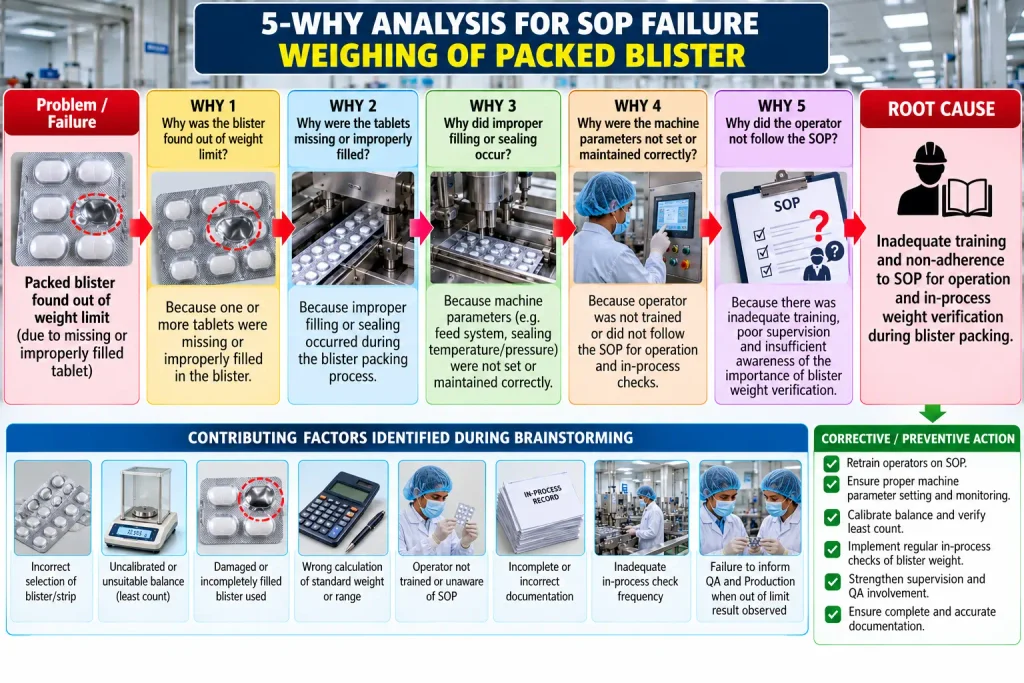
In a typical failure scenario, the first question identifies why the blister was outside the established weight range. Further “Why” questions may then examine whether tablets were missing or improperly filled, whether the packing operation was adequately controlled, whether operators correctly followed the approved procedure, and whether training or supervision was sufficient.The analysis helps move from the visible problem to the underlying root cause instead of stopping at the immediate error. The SOP also requires Production and QA personnel to physically check and verify any out-of-limit result, making investigation and timely action an important part of the control process.
6. Fishbone Analysis for SOP Failure: Weighing of Packed Blister:
The Fishbone Analysis for SOP Failure – Weighing of Packed Blister is used to systematically identify and organize potential causes that may lead to an out-of-limit blister weight or improper filling condition. The SOP requires checking the blister or strip for proper tablet filling, calculating the standard filled-blister weight, and establishing acceptable lower and upper weight limits.
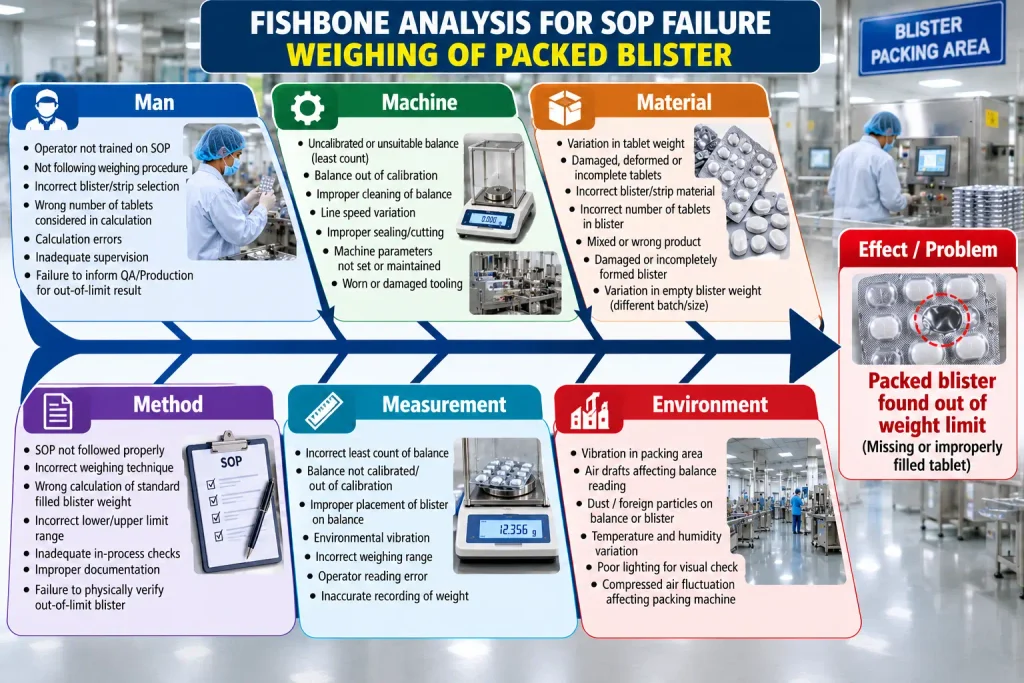
The fishbone diagram groups possible failure causes under major categories such as Man, Machine, Material, Method, Measurement, and Environment. These may include operator training gaps, incorrect blister selection, unsuitable or uncalibrated weighing equipment, variation in blister or tablet weight, calculation errors, improper weighing technique, incomplete documentation, vibration, air drafts, and other conditions affecting accurate weighing. The analysis helps the investigation team evaluate all probable contributing factors instead of focusing only on the immediate defect. Where an out-of-limit result is observed, the SOP requires Production and QA personnel to physically check and verify the condition.
7. FMEA for SOP Failure: Weighing of Packed Blister:
The Failure Mode and Effects Analysis (FMEA) for SOP Failure – Weighing of Packed Blister is used to identify, evaluate, and prioritize potential risks associated with blister-weight verification activities. The SOP requires proper checking of filled blisters or strips, calculation of the standard filled-blister weight, determination of the acceptable weight range, and verification of any out-of-limit result.
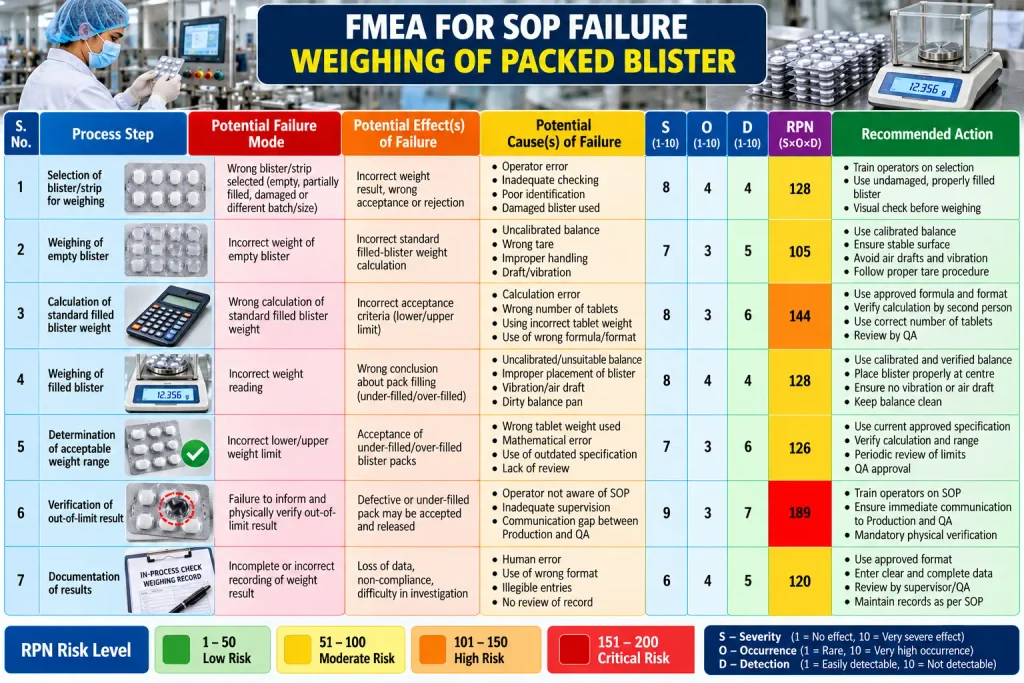
The FMEA considers possible failure modes such as incorrect blister selection, inaccurate weighing of empty or filled blisters, wrong calculation of standard blister weight, incorrect lower and upper limits, failure to verify abnormal results, and incomplete documentation. Each failure mode is assessed using Severity (S), Occurrence (O), and Detection (D) ratings, and the Risk Priority Number (RPN) is calculated as S × O × D. Higher-risk failures require stronger controls, such as use of calibrated balances, verification of calculations, operator training, proper documentation, routine in-process checks, and timely communication between Production and QA. This systematic approach helps prioritize CAPA, strengthen process controls, and reduce the risk of accepting defective or improperly filled blister packs.
8. Heat Map Analysis for SOP Failure: Weighing of Packed Blister:
The Heat Map Analysis for SOP Failure – Weighing of Packed Blister is used to visually classify and prioritize risks associated with failures in the blister-weight verification process. The SOP requires proper inspection of the filled blister or strip, calculation of the standard filled-blister weight, establishment of acceptable lower and upper weight limits, and verification of any result found outside the specified range. The heat map evaluates each identified failure based on Severity and Occurrence and places the risk into categories such as Low, Moderate, High, or Critical. Potential high-risk failures may include incorrect calculation of the standard blister weight, use of an unsuitable or uncalibrated balance, wrong blister or strip selection, incorrect weight limits, and failure to physically verify an out-of-limit blister.
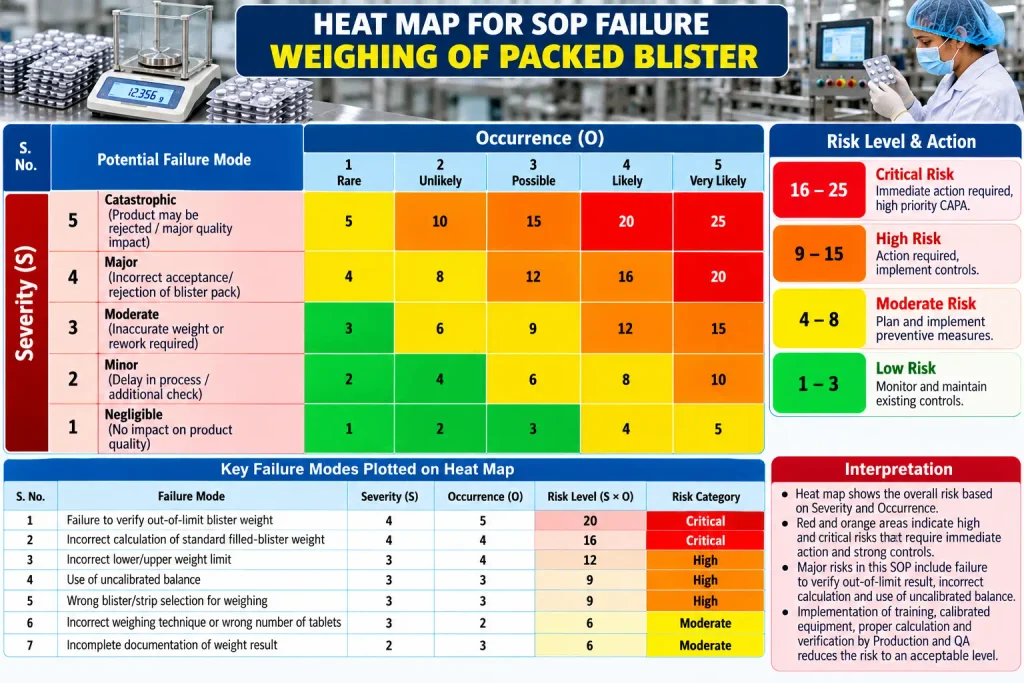
Red and orange zones indicate risks requiring prompt corrective or preventive action, whereas yellow and green zones represent comparatively lower risks that can be controlled through routine monitoring. The analysis helps Production and QA prioritize controls such as operator training, calibrated weighing equipment, calculation verification, proper documentation, and timely investigation of abnormal blister weights.
9. CAPA for SOP Failure: Weighing of Packed Blister:
The CAPA for SOP Failure – Weighing of Packed Blister is designed to correct identified failures and prevent their recurrence during blister-weight verification. Typical issues include out-of-limit blister weight due to missing or under-filled tablets, incorrect readings from an unsuitable or uncalibrated balance, wrong calculation of standard filled-blister weight or acceptance range, inadequate in-process verification, and incomplete documentation. Corrective actions include stopping and segregating affected packs, rechecking weights using a calibrated balance, recalculating the approved range, physically verifying abnormal blister packs, reviewing records, and retraining concerned personnel.
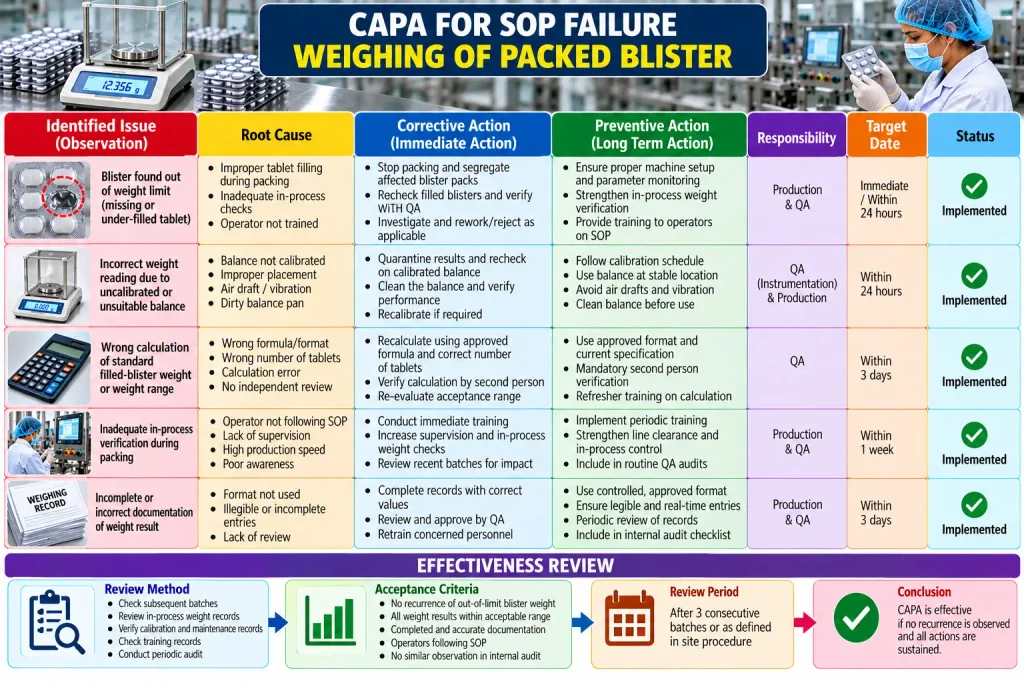
Preventive actions focus on scheduled calibration, proper machine setup, stronger in-process checks, periodic SOP training, independent calculation verification, controlled documentation, and routine QA oversight. Responsibilities are generally shared between Production and QA. CAPA effectiveness should be reviewed through subsequent batches, calibration and training records, internal audits, and confirmation that no similar failure recurs.
Questions & Answers – SOP for Weighing of Packed Blister:
1. What is the objective of the SOP for Weighing of Packed Blister?
The objective is to define a controlled procedure for weighing filled blister or strip packs in the production area.
2. Where is this SOP applicable?
It is applicable to all filled blister and strip packs handled in the production area.
3. Who is responsible for execution of this SOP?
The Chemist/Officer–Production is responsible for execution of the SOP.
4. Who is responsible for effective implementation of this SOP?
Deputy Manager–Production and AGM–Production are responsible for effective implementation.
5. What should be checked before weighing a blister or strip?
The blister or strip should first be checked to ensure proper tablet filling.
6. Why are empty blisters weighed?
Empty blisters are weighed to determine the standard weight of one empty blister, which is required for calculating the expected filled-blister weight.
7. Why is the weight of tablets required?
The average tablet weight is used along with the empty blister weight to calculate the standard weight of the filled blister.
8. How is the standard filled-blister weight calculated?
The SOP uses the standard empty-blister weight plus the average tablet weight multiplied by the number of tablets in one blister.
9. How is the acceptable lower weight limit calculated?
Lower limit = Standard filled-bl