







1. Introduction – Weighing Procedure for Packed Finished Goods:
The Weighing Procedure for Packed Finished Goods is established to ensure that packed pharmaceutical products are weighed systematically before final transfer or release from the production/packing area. The SOP applies to filled shippers and defines responsibilities for Production personnel and QA/QC management to ensure proper execution and effective implementation of the procedure. The procedure requires verification of the correct packed units, proper shipper packing and sealing, weighing of each completed shipper, and recording of the observed weight in the designated BPR weighing sheet. It also establishes standard average weights and acceptable weighing ranges for different products and packaging configurations. Specific calculations are provided for tablets, oral liquids, and ointments, including inner cartons, outer cartons, shrink packs, and shippers. These controls help identify missing, excess, loose, or incorrectly packed components before finished goods are transferred for further handling. Any shipper found outside the established weight range is required to be checked by Production and QA personnel.
Skip to PDF content2. Flow Diagram – Weighing Procedure for Packed Finished Goods:
The Flow Diagram for Weighing Procedure for Packed Finished Goods represents the sequence of activities followed in the manufacturing/packing area to ensure that each packed shipper is correctly packed, sealed, weighed, recorded, and verified before further handling. As defined in the SOP, the shipper is first checked for correctness of the filled units and for proper carton arrangement. H-type BOPP tape is then applied according to the applicable packing instruction.
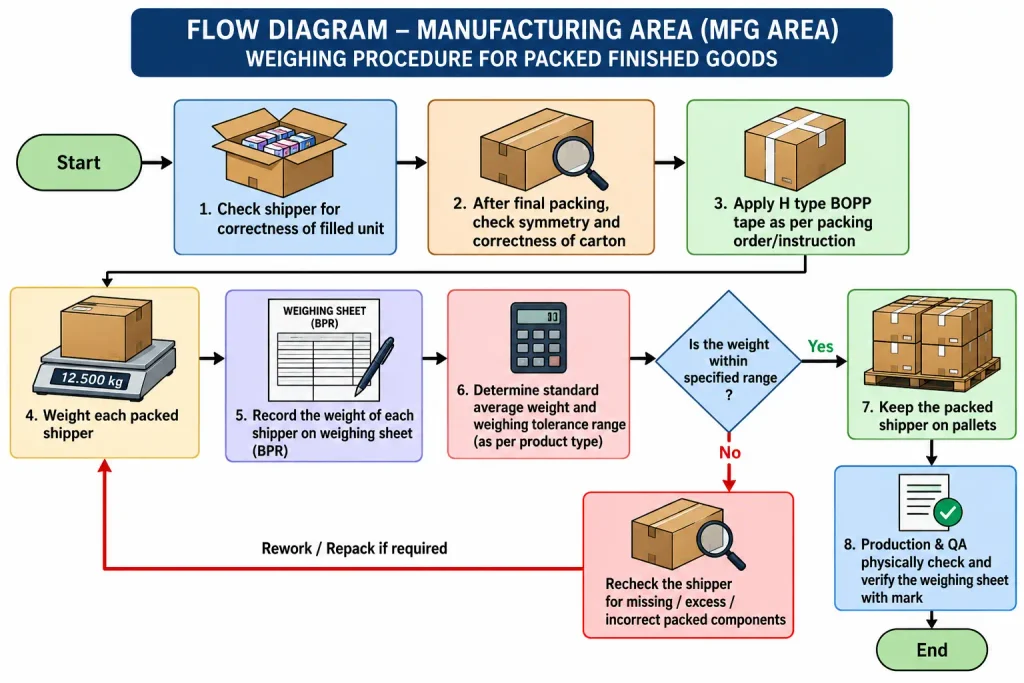
Each packed shipper is weighed on the designated balance, and the observed weight is recorded on the weighing sheet in the BPR. The standard average weight and acceptable weighing range are established according to the applicable product and pack configuration. If the observed shipper weight is outside the specified range, Production and QA personnel are informed for physical verification and rechecking. The SOP requires every shipper to be weighed and the observed value documented, with out-of-limit cases checked by Production and QA before acceptance.
3. Benefits of Following SOP – Weighing Procedure for Packed Finished Goods:
Following the Weighing Procedure for Packed Finished Goods helps ensure that every packed shipper contains the correct quantity of product and packaging components before it is transferred for further handling. The SOP requires checking the filled units, verifying the packed carton, applying H-type BOPP tape, weighing each shipper, and recording the observed weight in the designated BPR weighing sheet.
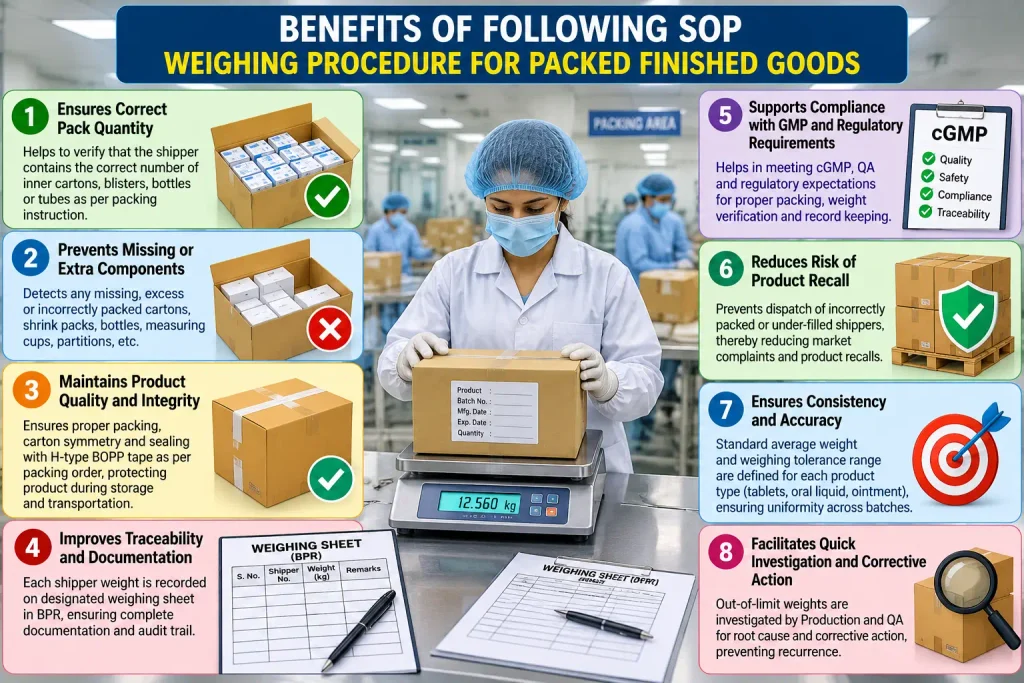
The procedure improves packing accuracy, documentation, traceability, and consistency by establishing a standard average weight and an acceptable weighing range for different product categories such as tablets, oral liquids, and ointments. It also helps detect missing, excess, or incorrectly packed components because each shipper is checked against the specified weighing range. If any weight is found outside the limit, Production and QA personnel are informed for physical verification and appropriate action.
4. Brainstorming for SOP Failure – Weighing Procedure for Packed Finished Goods:
The Brainstorming for SOP Failure – Weighing Procedure for Packed Finished Goods is used to identify possible causes that may lead to incorrect weighing, improper packing, documentation errors, or failure to detect out-of-range packed shippers. The SOP requires verification of filled units, correct carton packing, proper sealing with H-type BOPP tape, weighing of every packed shipper, and recording of the observed weight in the BPR weighing sheet. Potential failure causes may include use of an incorrect or uncalibrated balance, wrong zero setting, incorrect packing configuration, missing or extra cartons, damaged shippers, improper sealing, wrong calculation of the acceptable weight range, use of incorrect documents, incomplete weight entries, inadequate training, rushed packing activities, and insufficient Production/QA verification.
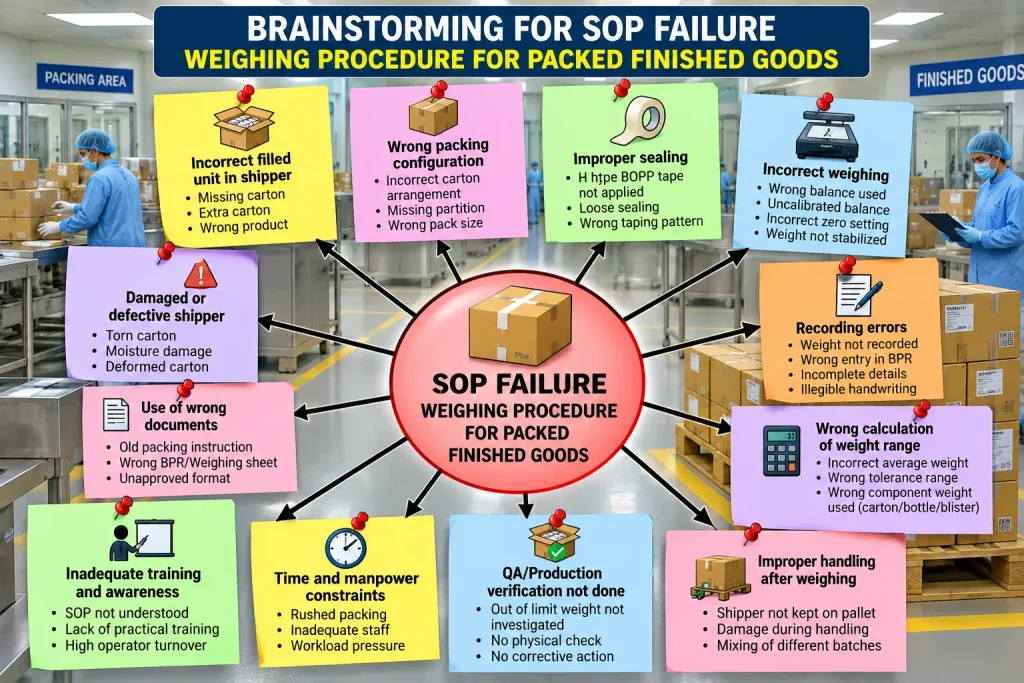
The SOP specifically requires that each shipper remain within the established weighing range and that any out-of-limit weight be reported to Production and QA for physical verification. These brainstorming points can therefore be used as inputs for subsequent 5-Why Analysis, Fishbone Analysis, FMEA, and CAPA to identify root causes and strengthen control of finished-goods packing operations.
5. 5-Why Analysis for SOP Failure – Weighing Procedure for Packed Finished Goods:
The 5-Why Analysis for SOP Failure – Weighing Procedure for Packed Finished Goods is used to systematically identify the underlying cause of a weighing or packing failure in the manufacturing area. A typical problem may be that the shipper weight is found outside the specified weighing range. The immediate cause may be an incorrect number of cartons, bottles, blisters, or other packed components inside the shipper.
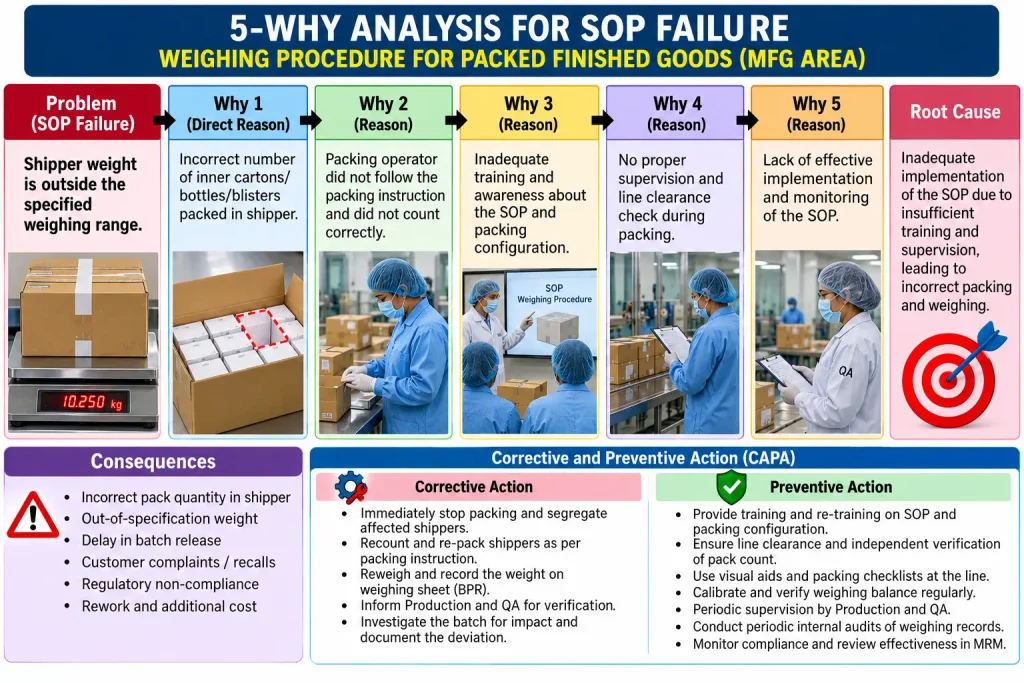
Further questioning may identify that the packing operator did not follow the approved packing instruction or failed to count the components correctly. This can be linked to inadequate training and insufficient understanding of the applicable SOP and packing configuration. Additional causes may include inadequate supervision, ineffective verification, and weak monitoring of SOP implementation.The SOP requires every shipper to be weighed, the observed weight to be documented, and any out-of-limit result to be reported to Production and QA for physical verification.Production and QA are also required to physically check and verify such cases.
6. Fishbone Analysis for SOP Failure – Weighing Procedure for Packed Finished Goods:
The Fishbone Analysis for SOP Failure – Weighing Procedure for Packed Finished Goods helps identify and categorize the possible causes responsible for an out-of-range shipper weight or incorrect finished-goods packing. The analysis groups potential causes under Man, Machine, Material, Method, Measurement, and Environment, making it easier to investigate the problem systematically.
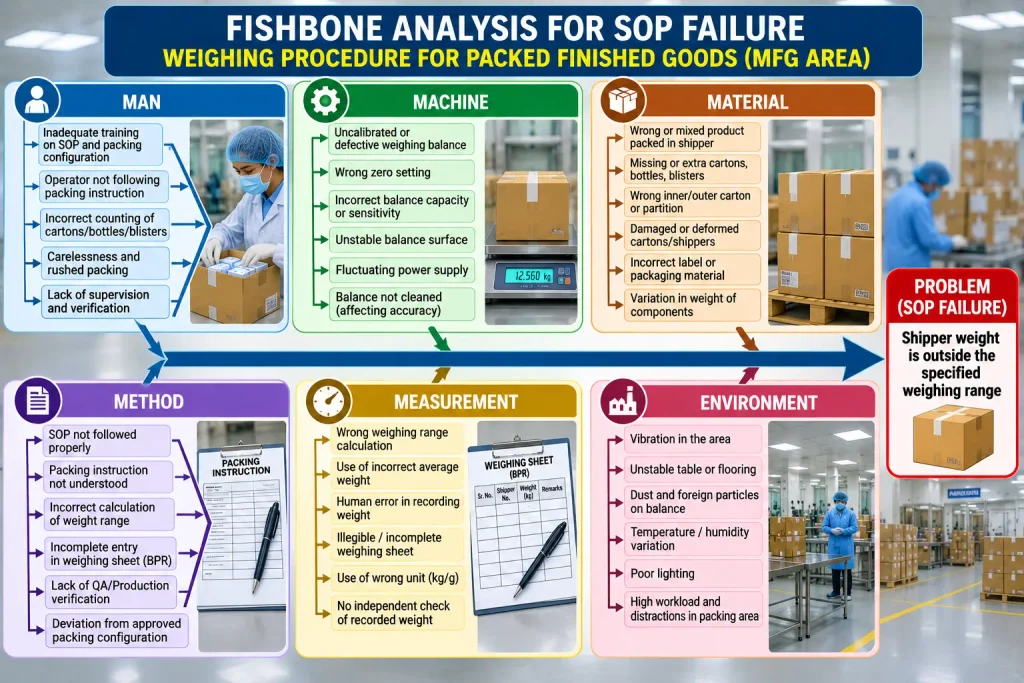
Under Man, possible causes include inadequate training, incorrect counting, carelessness, or insufficient supervision. Machine-related causes may include an uncalibrated or defective balance, incorrect zero setting, unsuitable balance capacity, or unstable weighing conditions. Material-related causes may involve missing or extra cartons, bottles, blisters, incorrect packaging components, or damaged shippers. Method and Measurement failures may include deviation from the approved packing instruction, incorrect calculation of the weighing range, incomplete entries in the BPR, incorrect units, or lack of independent verification. Environmental factors such as vibration, unstable flooring, dust, and work-area distractions may also influence weighing accuracy.
7. FMEA Analysis – Weighing Procedure for Packed Finished Goods:
The Failure Mode and Effects Analysis (FMEA) for Weighing Procedure for Packed Finished Goods is used to identify potential failures in the weighing and packing process, assess their impact, and prioritize the risks requiring corrective or preventive action. The SOP requires packed shippers to be checked for correct filled units, properly sealed, weighed, and documented in the designated BPR weighing sheet. Typical failure modes may include incorrect pack quantity, improper sealing, use of an unsuitable or inaccurate weighing balance, incomplete weight recording, incorrect calculation of the allowable weighing range, damaged shippers, or failure to report an out-of-limit weight. Each failure is assessed using Severity (S), Occurrence (O), and Detection (D), and the Risk Priority Number (RPN = S × O × D) is calculated to determine the priority of controls.
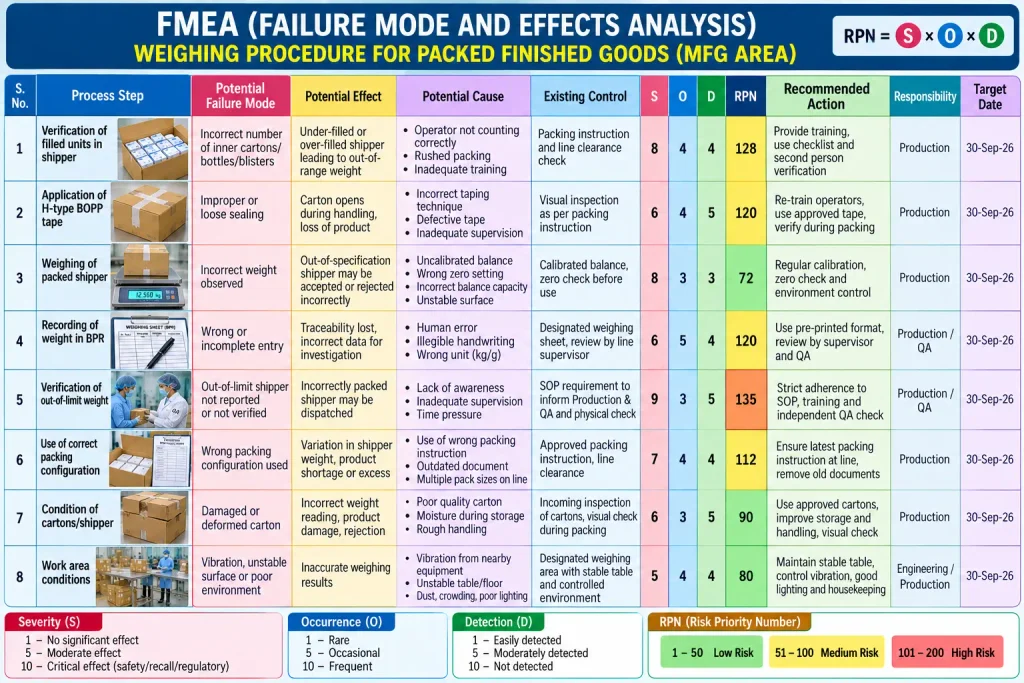
The SOP specifically requires each shipper to remain within the established weighing range, and any out-of-limit observation must be informed to Production and QA for physical verification. FMEA therefore supports a proactive approach to reducing packing errors, strengthening verification controls, improving documentation, and ensuring consistent implementation of the weighing procedure.
Questions & Answers – Weighing Procedure for Packed Finished Goods:
- What is the objective of this SOP?
The objective is to establish a weighing procedure for final shipper packing in the production area. - What is the scope of this SOP?
The SOP applies to the weighing of all filled shippers in the production area. - Who is responsible for execution of the SOP?
The Officer/Chemist–Production is responsible for execution of the SOP. - Who is responsible for effective implementation of the SOP?
Manager–Production, AGM–Production, and Head–QA/QC are responsible for effective implementation. - What should be checked before weighing the shipper?
The shipper should be checked for correctness of the filled units and proper carton arrangement. - How should the final shipper be sealed?
H-type BOPP tape should be applied according to the individual packing order or packing instruction. - Is every packed shipper required to be weighed?
Yes. Each packed shipper is required to be weighed and then kept on pallets. - Where should the shipper weight be recorded?
The weight of each shipper should be recorded on the provided weighing sheet in the BPR.