






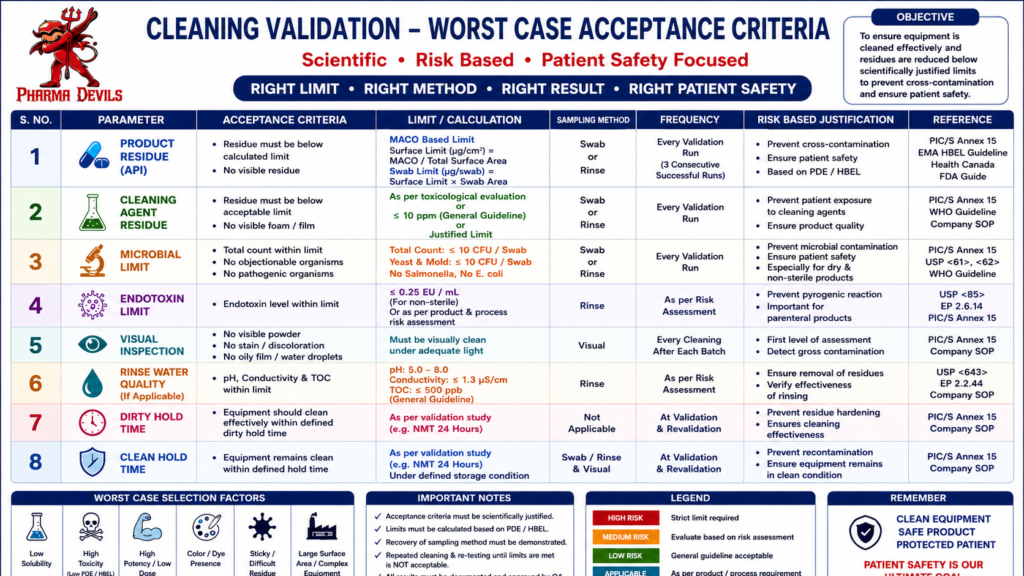
Cleaning validation worst-case acceptance criteria are scientifically defined limits used to prove that equipment cleaning is effective and safe for the next product. The purpose is to ensure that residues from the previous product, cleaning agents, microorganisms, endotoxins, and visible contamination are reduced below justified limits. These criteria are especially important when multiple products are manufactured on shared equipment, because cross-contamination may directly affect patient safety and product quality.
The most important criterion is previous product residue, usually API residue. Its limit is calculated using MACO, PDE, HBEL, batch size, maximum daily dose, and total product contact surface area. The residue result must be below the calculated swab or rinse limit. Visual cleanliness is also required, but visual inspection alone is not sufficient for complete cleaning validation.
Cleaning agent residue must also be controlled. Detergent or disinfectant residues should be below the toxicologically acceptable limit or justified company limit. There should be no visible foam, film, or chemical smell after final rinsing.