





Worst-Case Location Selection for Cleaning Validation of an Octagonal Blender
Worst-case location selection for cleaning validation of an octagonal blender should be performed using a scientific and risk-based approach. The purpose is to identify product-contact surfaces where residue is most likely to accumulate, remain after cleaning, or produce a failure during swab sampling.
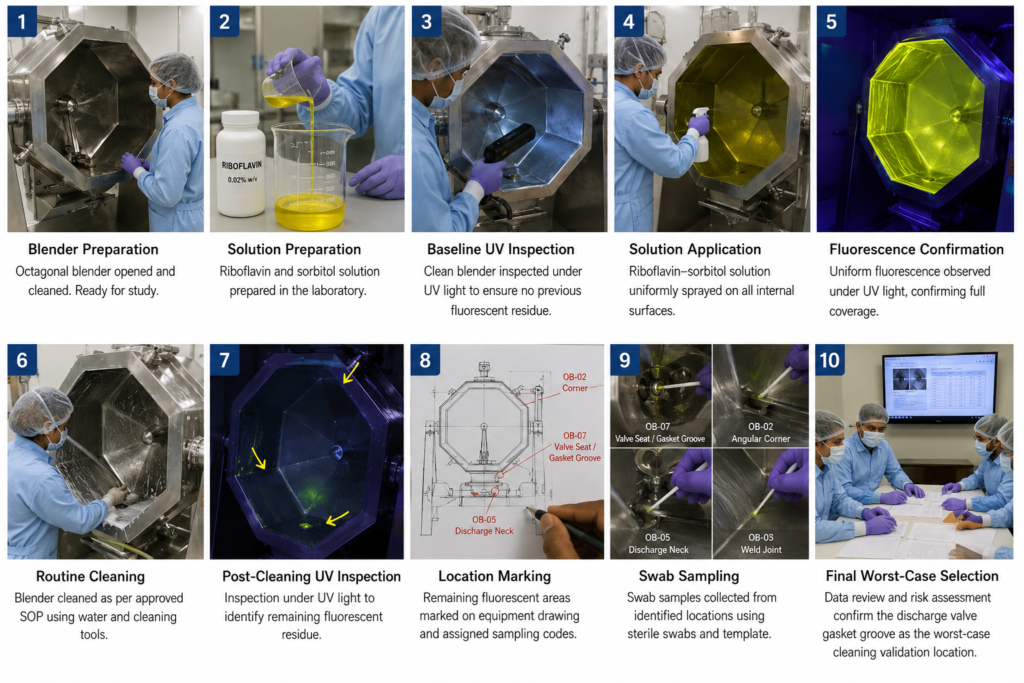
The process begins with a review of the equipment drawing, product-contact parts, cleaning SOP, dismantling procedure, material of construction, and previous cleaning-validation results. The blender is then cleaned, dried, and opened. A baseline inspection is performed using a 365 nm UV lamp to confirm that no previous fluorescent residue is present on the equipment surfaces.
A riboflavin–sorbitol solution is then prepared and applied uniformly to all internal product-contact surfaces. These surfaces include the internal shell, angular corners, weld joints, charging-port gasket, discharge neck, butterfly valve, valve seat, and gasket groove. Uniform fluorescence is checked under UV light to confirm that the tracer solution has reached all required surfaces.
The equipment is then cleaned according to the approved routine cleaning SOP. After cleaning, the blender is inspected again under UV light. Locations where yellow-green fluorescence remains are considered difficult-to-clean areas and potential worst-case sampling locations.
Typical worst-case locations in an octagonal blender may include the discharge butterfly-valve gasket groove, valve seat, blade edge, discharge neck, internal angular corners, charging-port gasket area, weld joints, and the lowest internal point.
Before these areas are finalized as swab sampling locations, they should be evaluated using actual product-residue behaviour, cleaning difficulty, accessibility, surface complexity, swab-recovery study data, and historical cleaning results. The riboflavin–sorbitol study should be treated as a supporting tool only. Final worst-case location selection must be scientifically justified through documented risk assessment and confirmed by product-specific swab sampling results.