







Cleaning validation WORST CASE SELECTION CRITERIA (POTENCY/ SOLUBILITY/TOXICITY) approach used to identify the product that presents the highest risk of carryover on shared equipment. The purpose is to validate the cleaning procedure against the most difficult challenge, so that other lower-risk products can be covered with proper justification. Three major criteria commonly used for worst-case selection are potency, solubility, and toxicity.
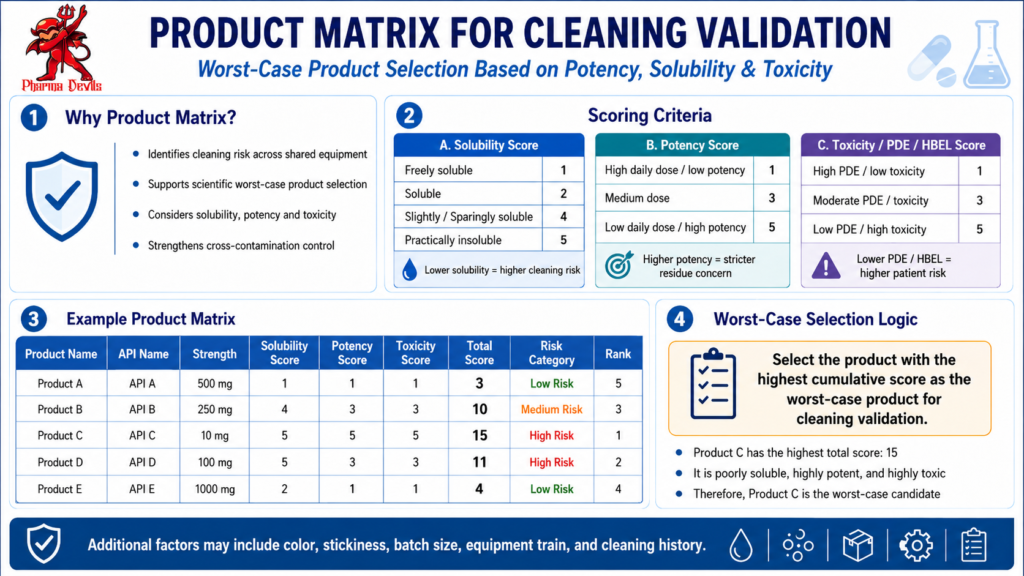
Potency refers to the amount of drug required to produce a therapeutic effect. Highly potent products, especially those effective at low doses, are considered high risk because even trace residues may impact the next product and patient safety. Therefore, lower therapeutic dose generally means higher cleaning concern.
Solubility indicates how easily the API dissolves in the cleaning medium, usually water or a cleaning agent solution. Poorly soluble or practically insoluble products are difficult to remove from equipment surfaces and may remain trapped in corners, gaskets, dead legs, and hard-to-clean parts. Low solubility therefore increases the probability of residue retention and makes the product a stronger worst-case candidate.
Toxicity is evaluated through toxicological data such as PDE or HBEL. Products with low PDE/HBEL values are more hazardous because very small amounts of residue may be unacceptable. Lower allowable exposure means stricter residue limits and greater cleaning validation risk.
A practical risk matrix assigns numerical scores to each factor. For example, high potency may score 5, poor solubility 5, and high toxicity 5. The total score helps rank products and identify the highest-risk item for validation. If two products have similar scores, additional factors such as stickiness, color, batch size, equipment train, and cleaning history should also be reviewed.
Thus, worst-case selection based on potency, solubility, and toxicity ensures a risk-based, scientifically justified, and patient-focused cleaning validation program. This approach improves cross-contamination control, supports regulatory expectations, and provides a rationale for selecting the most challenging product during protocol preparation, limit calculation, sampling strategy, and monitoring of cleaning effectiveness across shared manufacturing equipment.