Chemical SOP
Microbiology SOP
Warehouse SOP
Manufacturing SOP
Information technology SOP
admin

admin

DRY POWDER INJECTION TESTS & CHECKS IN PHARMA

DRY POWDER INJECTION TESTS & CHECKS IN PHARMA

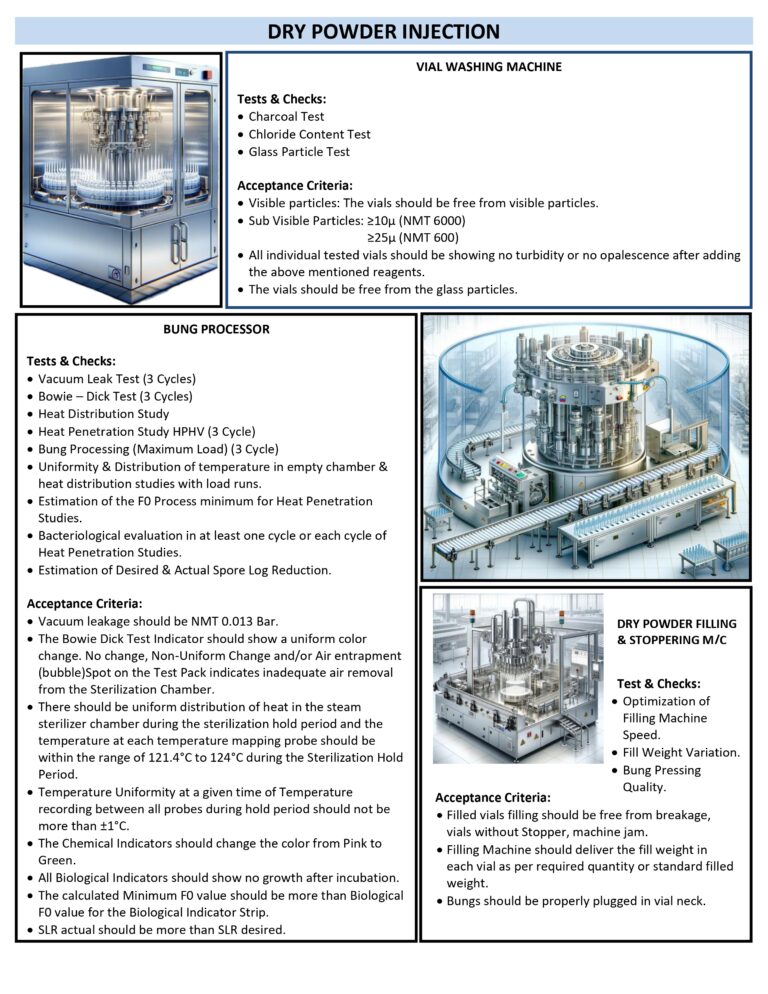
Dry Powder Injection (DPI) products (e.g., sterile powders in vials for reconstitution) require controls for sterility assurance, dose accuracy, powder performance, and container–closure integrity. Typical tests & checks span raw materials, in-process controls, and finished product testing. Incoming / raw…

Cleaning Validation (Chapter 4)

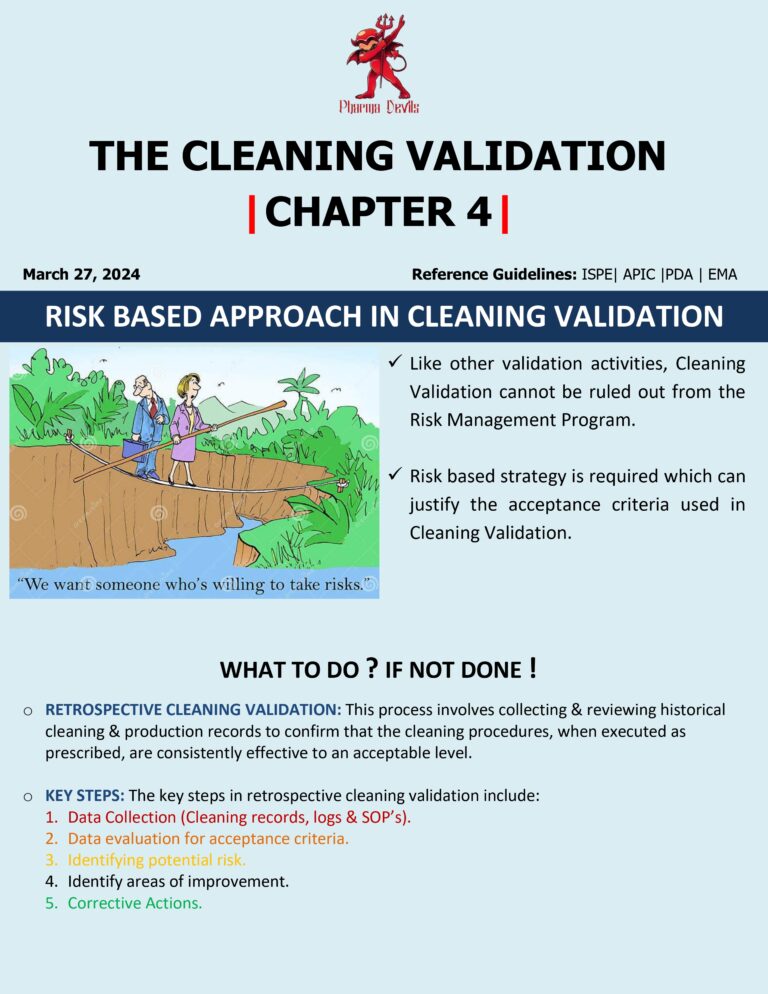
Risk Based Approach in Cleaning Validation

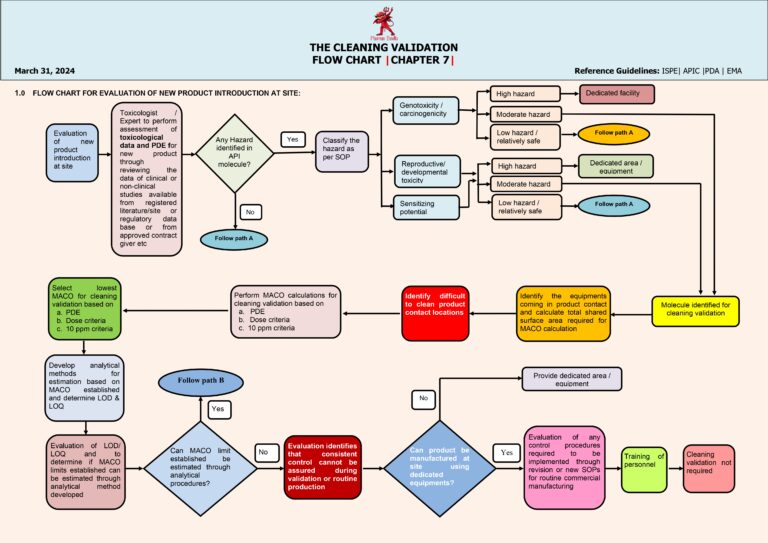
A risk-based approach (RBA) in cleaning validation applies Quality Risk Management principles to focus validation effort on what most impacts patient safety and product quality. Instead of validating “everything the same way,” you rank risks and design your strategy (worst-case…

Cleaning Validation (Chapter 3)

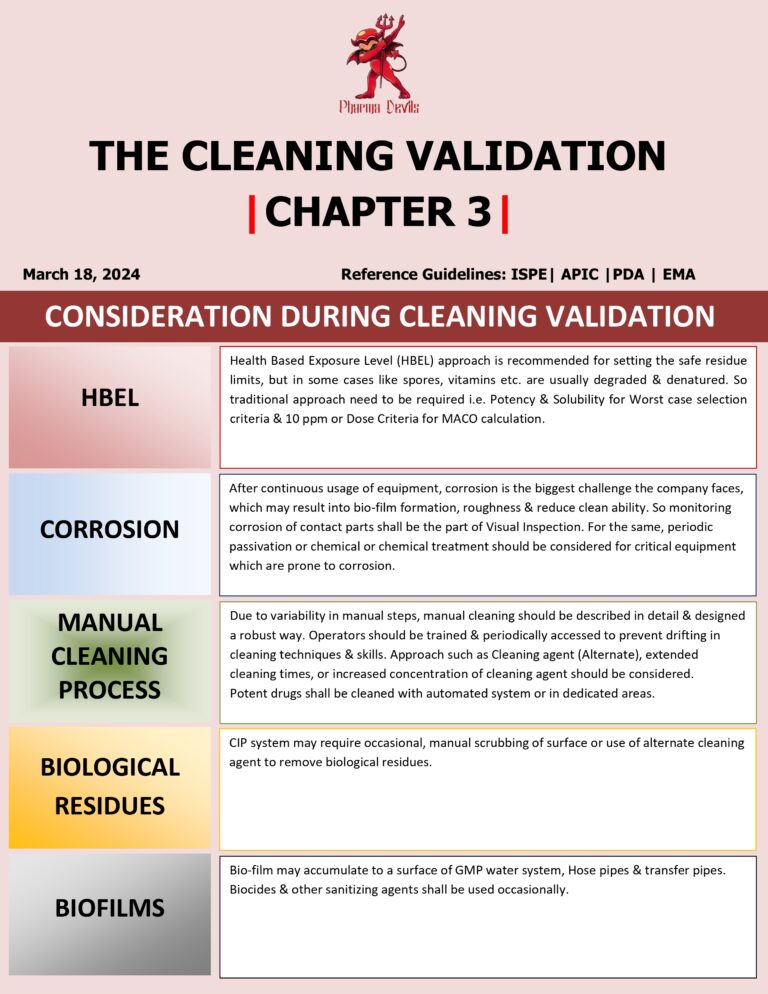
Consideration during Cleaning Validation

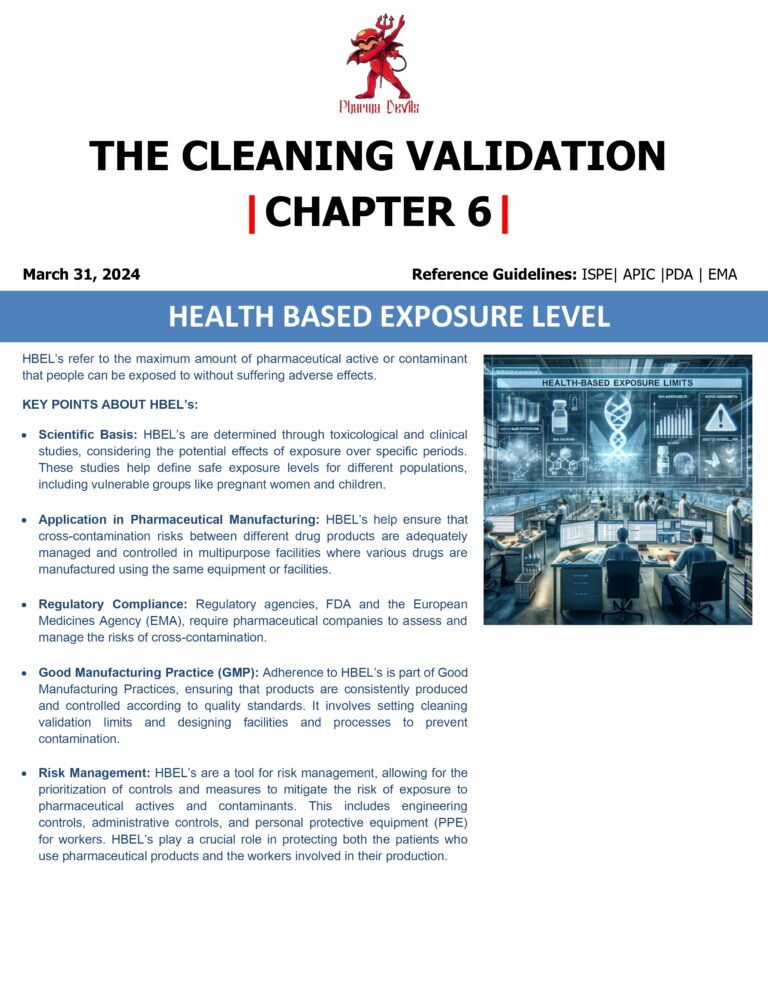
Cleaning validation demonstrates that approved cleaning procedures consistently remove product residues, cleaning agents, and bioburden (where applicable) to predefined acceptance limits. Key considerations should be planned upfront and justified in a risk-based manner. Start with a well-defined scope: equipment train…

Cleaning Validation (Chapter 2)

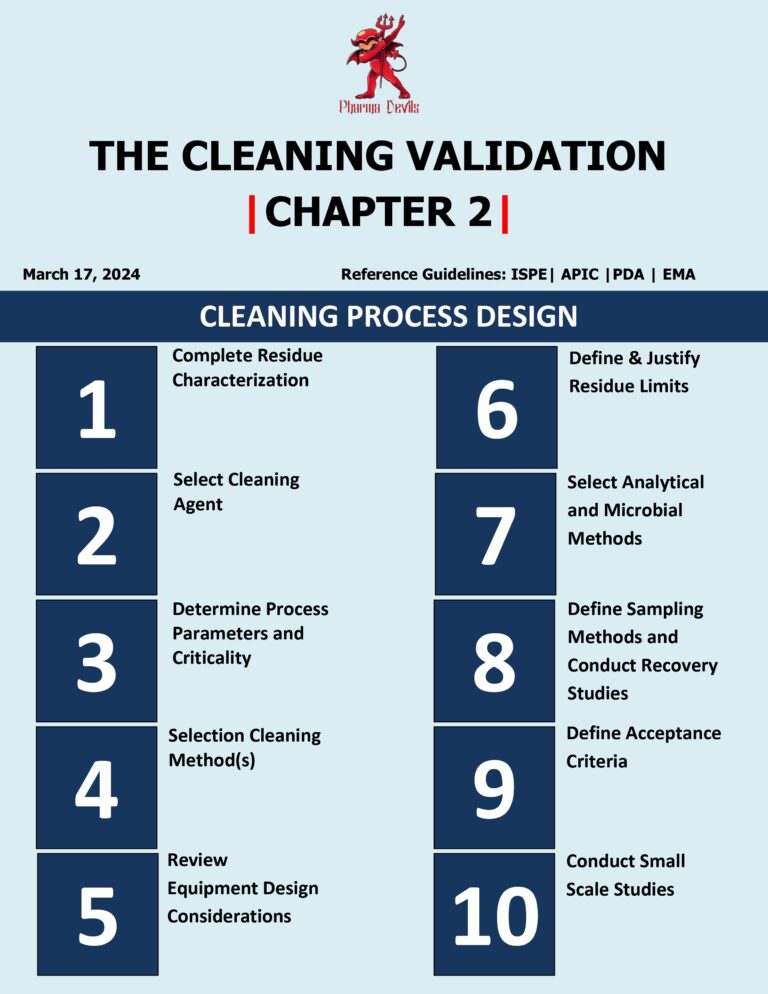
Cleaning Validation (Chapter 2)

A lifecycle approach to Cleaning Validation treats cleaning as a controlled process from design through routine operation, not a one-time study. It aligns with GMP expectations for science- and risk-based validation and supports sustained compliance. 1) Process and product understanding…

Cleaning Validation (Chapter 1)

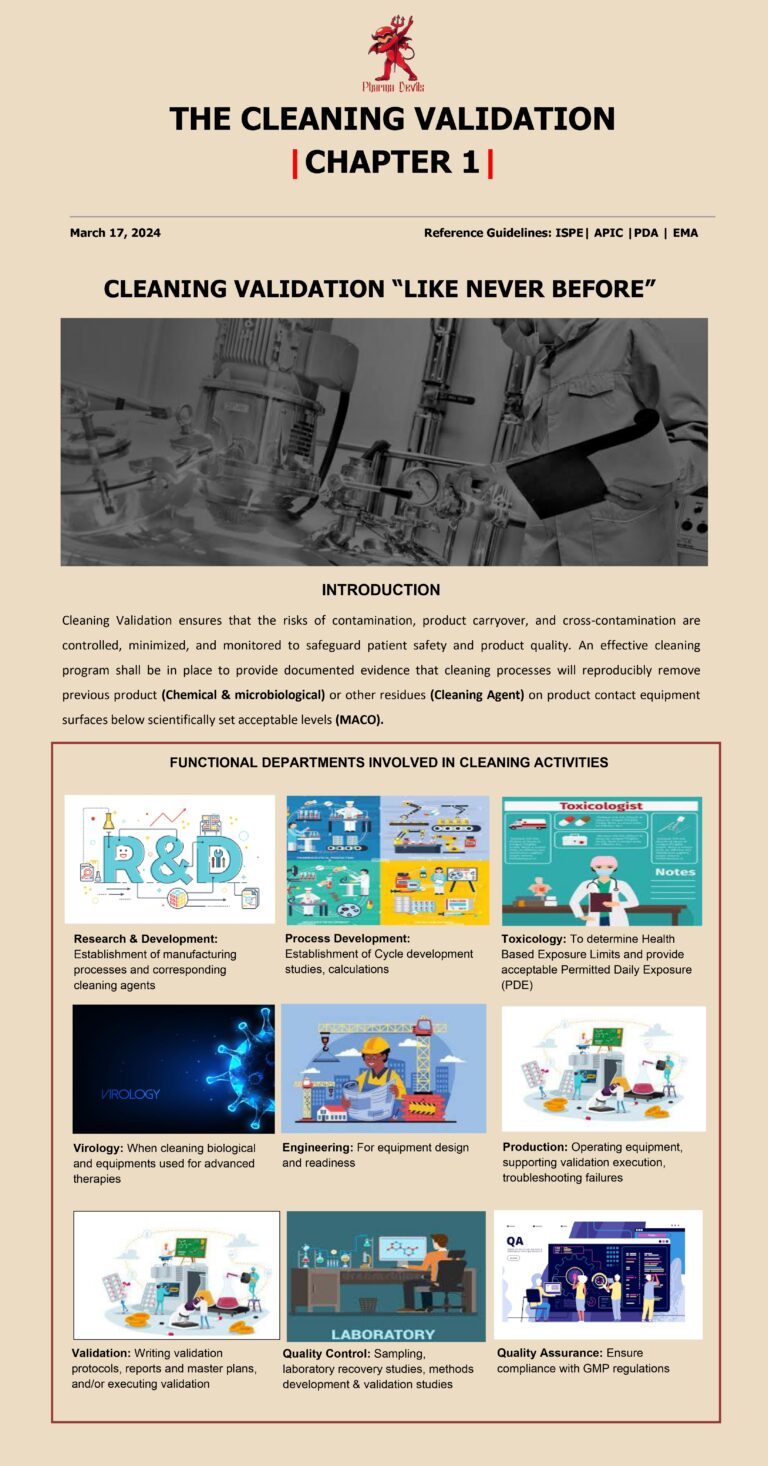
Cleaning Validation

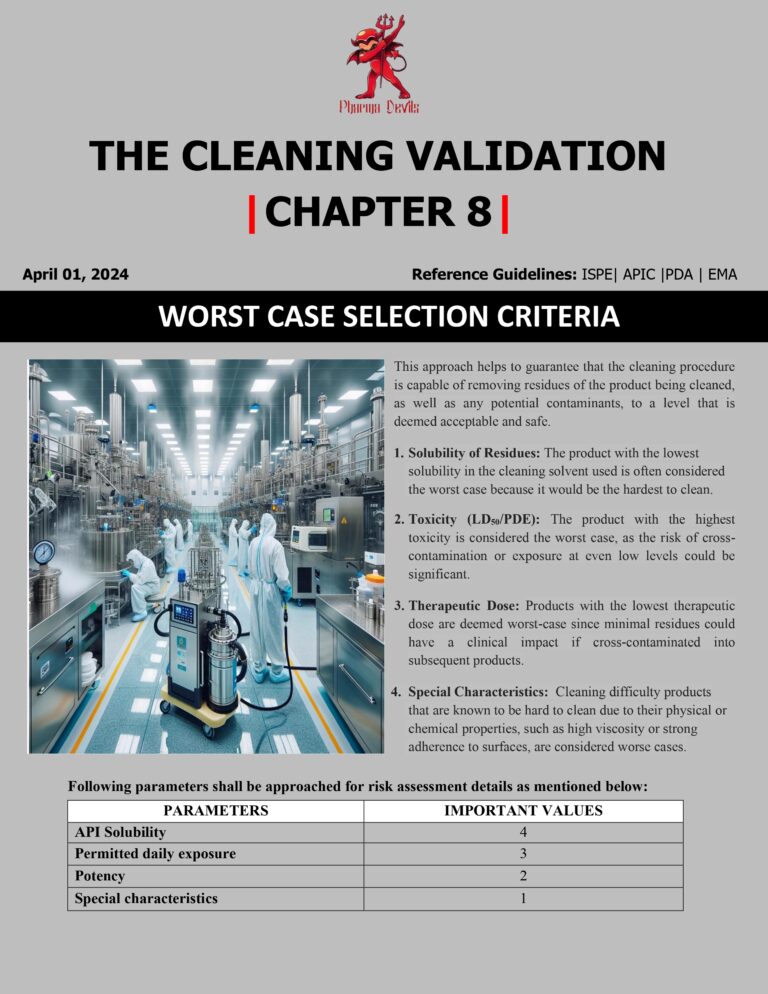
Cleaning Validation in Pharmaceutical Industry Cleaning validation in pharma is a documented, scientific approach that demonstrates cleaning procedures consistently remove product residues, cleaning agents and microorganisms to pre-defined acceptable levels. It is a core GMP requirement and a critical element…

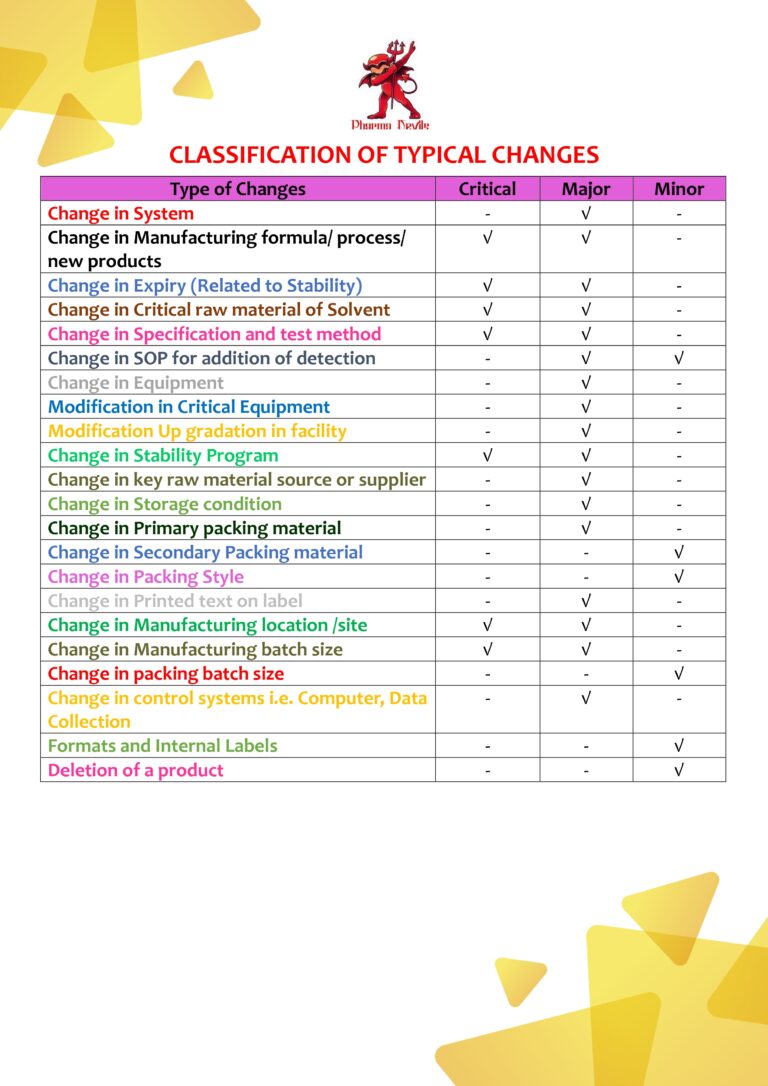
CLASSIFICATION OF TYPICAL CHANGES IN PHARMA

Change control ensures that any modification to facilities, processes or documents is assessed before implementation. Typical changes are classified as major, moderate and minor based on potential impact on product quality, patient safety and regulatory compliance. Major changes are those…

KNOW YOUR FORM FILLING SEALING IN PHARMA

KNOW YOUR FORM FILLING SEALING IN PHARMA

Form-Fill-Seal (FFS) in pharma is an automated packaging process where a container is formed, then filled with product, and immediately sealed—all in one continuous, controlled operation. It is widely used for sterile liquids (BFS) and some non-sterile products because it…

KNOW YOUR OPTHALMICS IN PHARMA

KNOW YOUR OPTHALMICS IN PHARMA

Opthalmics in pharma are dosage forms intended for the eye (topical or intraocular) and therefore demand strict control of sterility, comfort, and safety. Because the eye is highly sensitive, even small deviations in pH, tonicity, particles, or microbial contamination can…

KNOW ABOUT TEMPERATURE MAPPING IN PHARMA

Temperature Mapping

Temperature mapping in pharma is a documented study used to demonstrate that storage areas such as warehouses, cold rooms and stability chambers maintain uniform, controlled temperatures under normal operating conditions. It is a critical GMP requirement, as temperature excursions can…

OINTMENT TESTS & CHECKS IN PHARMA

OINTMENT TESTS & CHECKS IN PHARMA

OINTMENT TESTS & CHECKS IN PHARMA Ointments are semi-solid preparations applied to skin, eye, or mucosa. In pharma, each batch undergoes specific quality control tests to ensure safety, efficacy and patient acceptability. 1. Appearance & Identification 2. Assay & Content…

error: Content is protected !!