






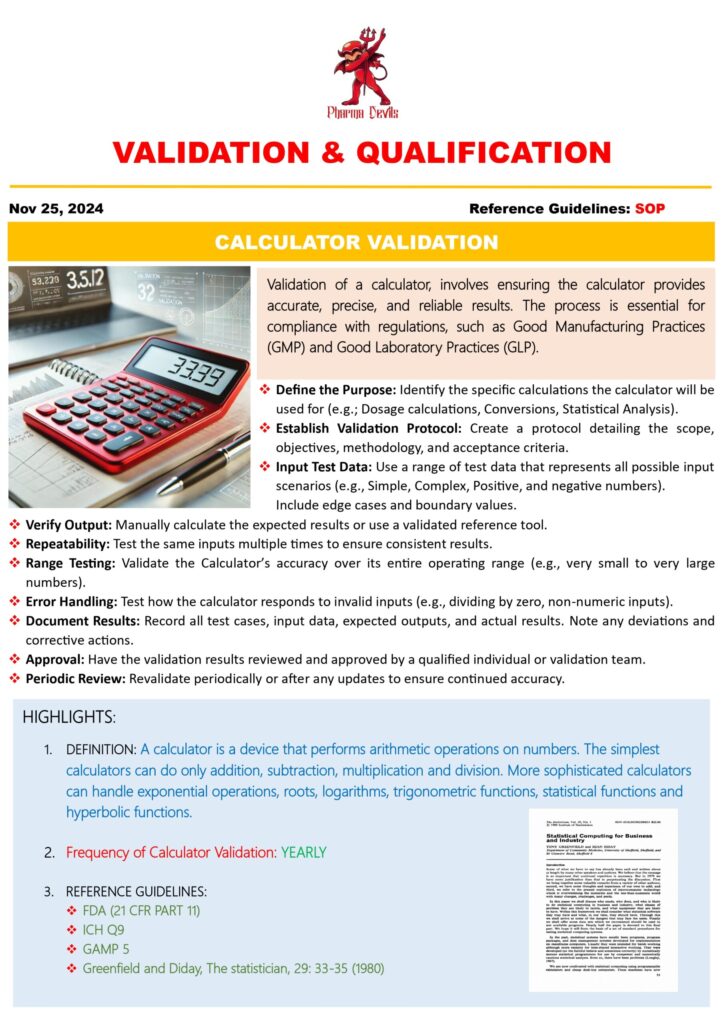
- SOP for Validation of Calculator
- SOP for Procedure for Numbering and Verification of the Calculators
- SOP for Performance Verification of Calculator and Excel Sheet
- SOP for Performance Verification and General Calculations by using Calculator
- SOP for Operation and Qualification of Calculator
- SOP for Calculator Validation
Calculator validation in pharma ensures that any calculator used for GMP decisions produces accurate, consistent, and traceable results. It applies to calculators used for critical calculations in manufacturing, QC, QA, engineering, and validation—such as assay calculations, dilution factors, yields, label claim adjustments, OOS evaluations, and stability trending. The approach depends on the calculator type and GMP impact.
1) Define scope and risk
Identify where calculators are used and classify them:
- Non-programmable basic calculators (handheld): usually low complexity, but may be GMP-critical if used for release decisions.
- Programmable calculators (stored formulas): higher risk; treat like a simple computerized system.
- Spreadsheet/app/web calculators: highest risk; should be validated as computerized systems (CSV) with access control and versioning.
Use risk assessment (e.g., GAMP 5 thinking) to decide the depth of testing based on severity (impact on product quality), frequency of use, and detectability (ability to catch errors by second-person verification).
2) User requirements (URS)
Document intended use:
- Type/model or application name/version
- Functions required (addition, subtraction, multiplication, division, %, square root, scientific notation, parentheses)
- Required precision/rounding rules (e.g., 2–4 decimals, significant figures)
- Display format (fixed/scientific), memory functions, error indicators
- Data integrity expectations (if electronic records are stored)
3) Installation/identification (as applicable)
- Assign unique ID to each calculator (sticker/asset tag)
- Record make, model, serial number, location, department, and SOP reference
- For software calculators: installation record, version, checksum/build, authorized source
4) Operational Qualification (OQ) – accuracy testing
Test critical functions with pre-approved test cases:
- Basic arithmetic with positive/negative numbers
- Decimals and rounding behavior
- Percent calculations
- Order of operations (BODMAS/parentheses)
- Scientific notation (if used)
- Large/small number handling; divide-by-zero error behavior
Compare results to an independent reference (validated spreadsheet, certified reference values, or manual verified calculations). Record expected vs actual, pass/fail, tester signature, date.
5) Performance & control
- Define revalidation/calibration frequency (commonly annual, or per risk)
- Define routine checks (e.g., monthly check using 2–3 standard calculations)
- Require second-person verification for critical batch-release calculations
- Change control for replacement calculators or app updates
6) Documentation
Maintain protocol, executed test sheets, deviation handling, summary report, and approval. This ensures calculators remain reliable tools under GMP and data integrity expectations.