








1. Introduction – Chlorpheniramine Maleate, Ammonium Chloride and Sodium Citrate Expectorant:
The Batch Packing Record (BPR) of Chlorpheniramine Maleate, Ammonium Chloride and Sodium Citrate Expectorant is an essential pharmaceutical documentation system designed to ensure the systematic execution, monitoring, and verification of packing operations in accordance with Good Manufacturing Practices (GMP). It provides comprehensive traceability, quality assurance, and regulatory compliance throughout the packaging process. The expectorant formulation contains Chlorpheniramine Maleate IP 2.5 mg, Ammonium Chloride IP 125 mg, and Sodium Citrate IP 55 mg per 5 mL. Chlorpheniramine Maleate acts as an antihistamine, Ammonium Chloride functions as an expectorant, and Sodium Citrate contributes to the formulation’s expectorant properties. The BPR includes detailed documentation of packing material dispensing, line clearance, bottle washing, filling, sealing, labeling, overprinting, visual inspection, and final packaging operations. Critical in-process quality checks include fill volume verification, sealing integrity, leakage testing, cap perforation inspection, labeling accuracy, and rejection analysis. Additionally, the document establishes procedures for batch yield calculation, printed packaging material reconciliation, sample collection, finished product transfer, and destruction of rejected packaging materials. Production and Quality Assurance personnel are responsible for verifying operational activities and maintaining accurate records. Effective implementation of this BPR helps prevent packaging mix-ups, minimize operational errors, maintain product identification and traceability, and ensure consistent packaging quality. It also supports batch review, deviation investigation, regulatory inspections, and the controlled release of finished pharmaceutical products.
Skip to PDF content2. Flow Diagram of Chlorpheniramine Maleate, Ammonium Chloride and Sodium Citrate Expectorant:
The Flow Diagram of Chlorpheniramine Maleate, Ammonium Chloride and Sodium Citrate Expectorant (BPR) illustrates the systematic sequence of pharmaceutical packaging operations performed in accordance with Good Manufacturing Practices (GMP). It provides a structured overview of each processing stage, ensuring product quality, packaging integrity, traceability, and regulatory compliance. The packaging process begins with the receipt of approved bulk product, followed by packing schedule preparation, material dispensing, and verification of packaging components. Line clearance is performed to confirm that the packaging area and equipment are clean and free from materials belonging to previous batches.
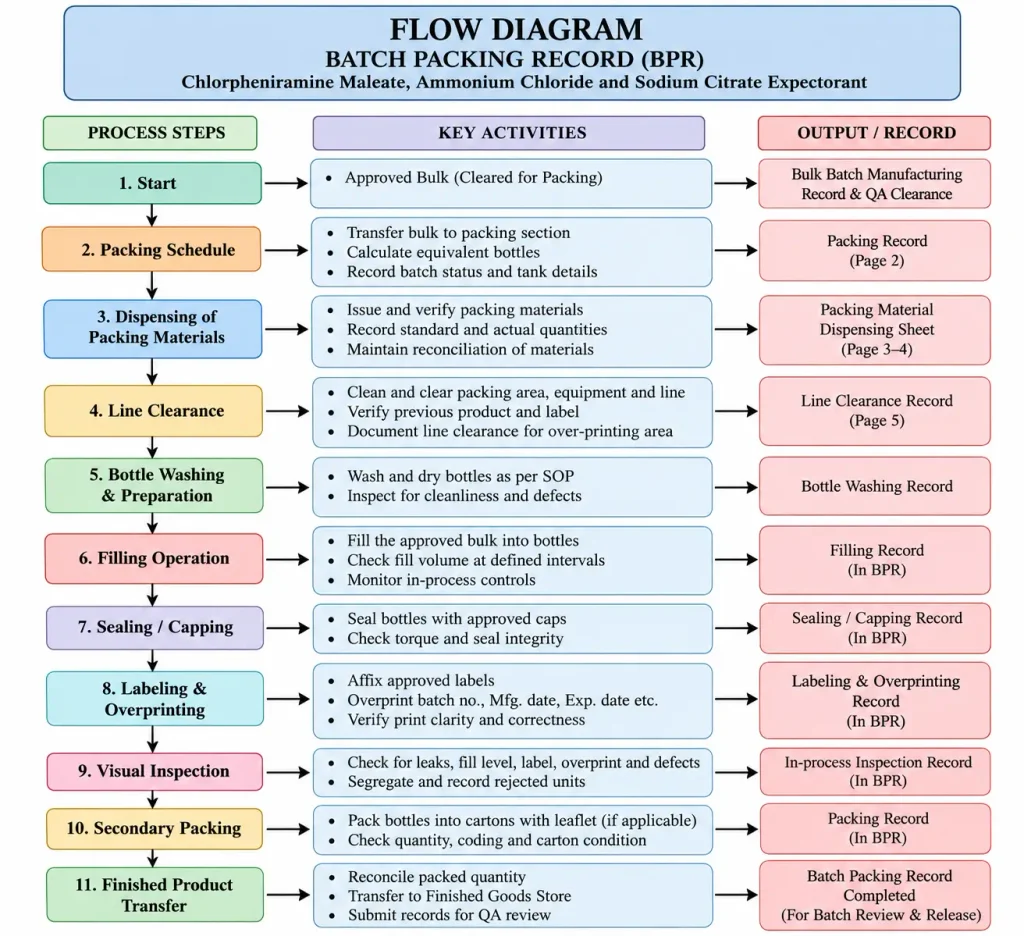
The next stages include bottle washing, filling, sealing, capping, labeling, and overprinting. During these operations, critical in-process checks are conducted to verify bottle cleanliness, filling volume, sealing integrity, leakage, cap perforation, and accuracy of printed information. After filling and sealing, bottles undergo inspection to identify defective or nonconforming units. Accepted bottles proceed to secondary packaging, including carton packing and shipper preparation. Finally, batch yield calculation, rejection analysis, reconciliation of printed packaging materials, and finished product transfer are documented in the BPR. Production and Quality Assurance personnel review the completed records to ensure compliance with approved procedures.This flow diagram serves as a valuable reference for pharmaceutical operators, production supervisors, Quality Assurance professionals, GMP training, batch documentation, and regulatory audit preparation.
3. Critical Process Parameters (CPP) and Critical Quality Attributes (CQA) of Chlorpheniramine Maleate, Ammonium Chloride and Sodium Citrate Expectorant:
The Critical Process Parameters (CPP) and Critical Quality Attributes (CQA) of Chlorpheniramine Maleate, Ammonium Chloride and Sodium Citrate Expectorant play an essential role in ensuring consistent packaging quality, product safety, and compliance with Good Manufacturing Practices (GMP). The CPP and CQA diagram illustrates the relationship between pharmaceutical packaging operations, process controls, quality requirements, and monitoring activities throughout the Batch Packing Record (BPR).
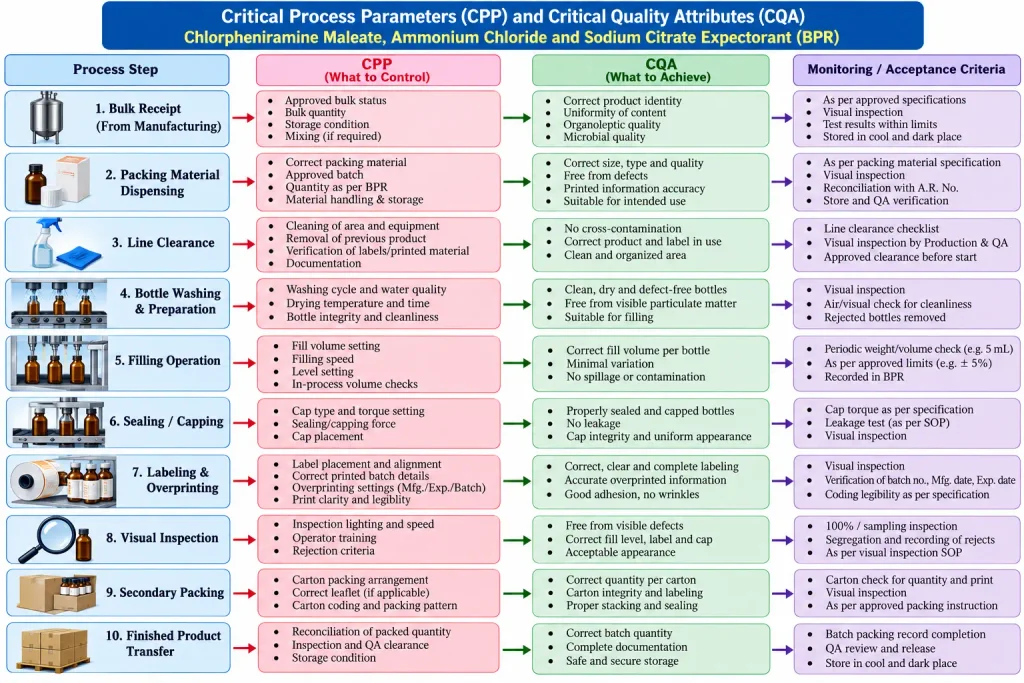
Critical Process Parameters (CPP) include approved bulk material status, packing material verification, line clearance, bottle washing conditions, filling volume settings, sealing and capping conditions, labeling accuracy, overprinting controls, and packaging line operations. These parameters must be appropriately monitored to minimize process variability, prevent packaging defects, and maintain operational consistency.
Critical Quality Attributes (CQA) include correct product identification, bottle cleanliness, accurate filling volume, container closure integrity, absence of leakage, proper cap perforation, accurate labeling, legible batch coding, packaging integrity, and correct finished product quantity. The BPR incorporates essential in-process quality checks, including fill volume verification, leak testing, sealing quality assessment, visual inspection, rejection analysis, and printed packaging material reconciliation. Production and Quality Assurance personnel document and verify these activities according to approved procedures and established acceptance criteria. Effective monitoring of CPPs helps maintain the required CQAs and reduces the risk of product mix-ups, contamination, incorrect labeling, and packaging failures. This CPP and CQA diagram serves as a valuable reference for pharmaceutical production personnel, Quality Assurance professionals, GMP training, process monitoring, batch documentation, quality risk management, and regulatory audit preparation.
Note: The parameters shown are potential critical controls. Their final CPP/CQA classification and acceptance limits must be justified through documented quality risk assessment, process knowledge, and approved product specifications.