




1. Brief Detail:
The Cleaning Validation Master Plan provides a structured framework for planning, executing, documenting, and maintaining cleaning validation activities across oral solid, injectable, ophthalmic, and topical manufacturing areas. It is intended to ensure that shared manufacturing equipment is cleaned effectively so residues of previous products, cleaning agents, and microorganisms are reduced to predetermined acceptable levels, thereby preventing cross-contamination and protecting product quality, safety, identity, strength, and purity. The plan defines departmental responsibilities, cleaning validation workflow, product and equipment matrixing, worst-case product selection, equipment grouping, cleaning verification, sampling methods, analytical method requirements, and hold-time studies. It also establishes acceptance criteria using visual inspection, swab and rinse sampling, residue limits, microbial criteria, and cleaning-agent limits. The document further addresses protocol preparation, analytical method validation, revalidation, change control, and investigation of failures, providing an overall lifecycle approach for consistent and scientifically justified cleaning validation for routine pharmaceutical manufacturing operations and continued compliance with procedures.
Skip to PDF content2. Flow Diagram:
The Cleaning Validation Process Flow Diagram presents a systematic approach for demonstrating that pharmaceutical equipment cleaning procedures are effective and reproducible. The process begins with initiation of cleaning validation, followed by risk assessment, product/equipment grouping, and selection of the worst-case product and equipment. Acceptance criteria are then established for product residues, cleaning agents, microbial contamination, and visual cleanliness. Appropriate cleaning procedures are developed or reviewed, personnel are trained, and an approved Cleaning Validation Protocol defines sampling locations, swab/rinse methods, analytical techniques, and acceptance limits. During execution, equipment is cleaned, visually inspected, sampled, and analyzed using validated methods. Results are compared against predefined criteria.
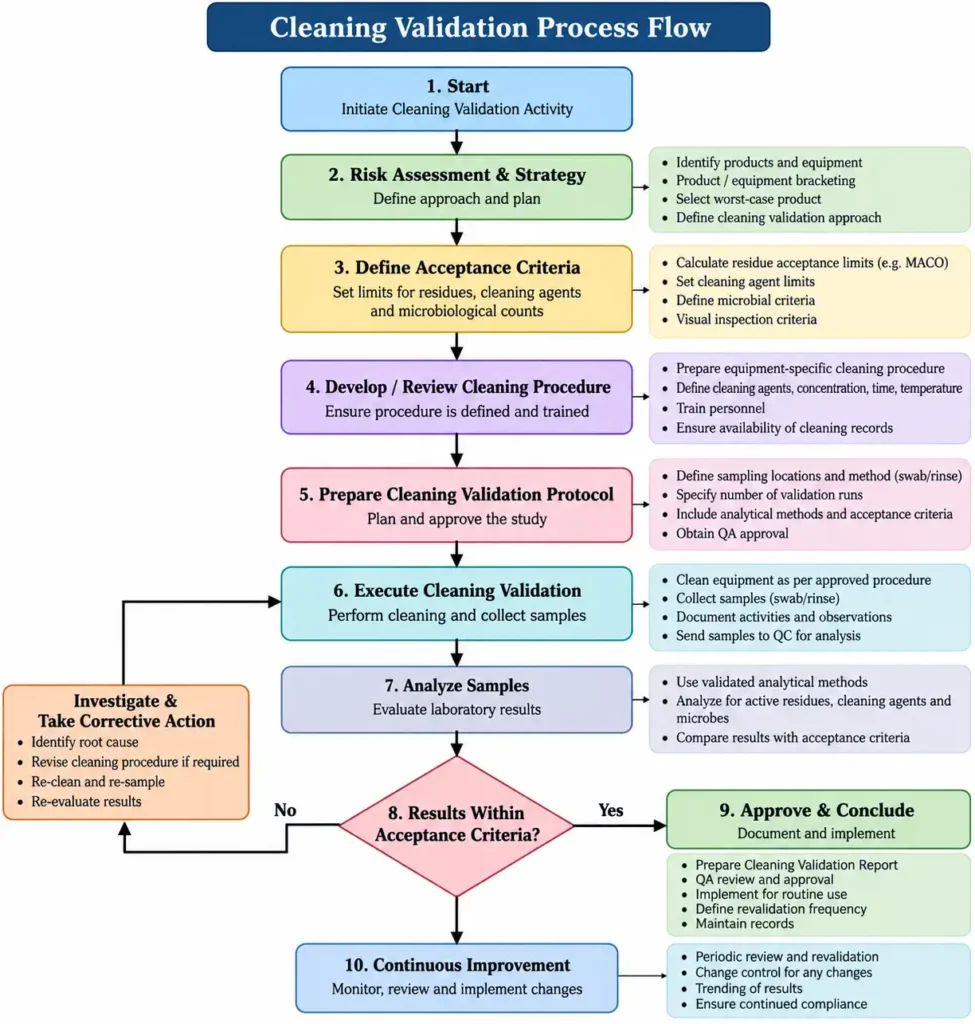
If results fail, an investigation, corrective action, re-cleaning, and re-evaluation are performed. If satisfactory, the validation report is approved and the cleaning procedure is implemented for routine use. Periodic review, change control, and revalidation support continued compliance and effectiveness.
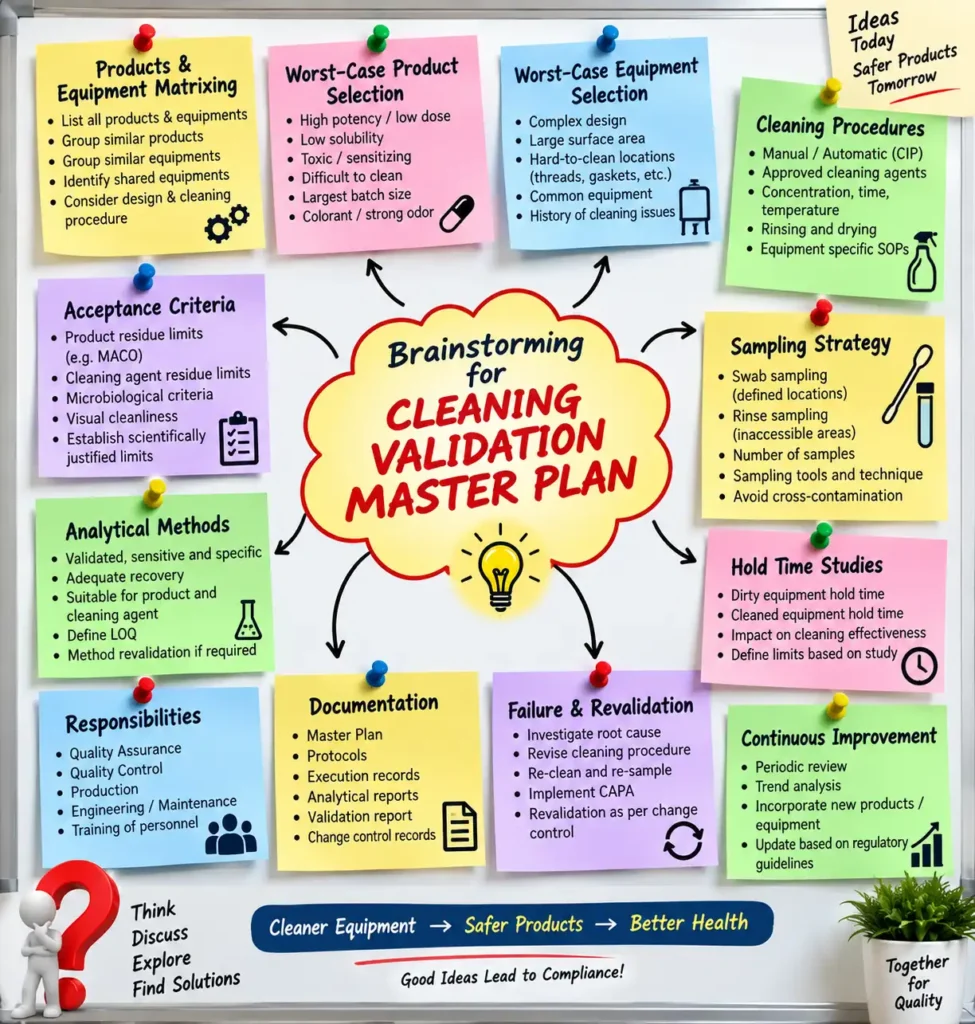
3. Brainstorming:
The Brainstorming Diagram for the Cleaning Validation Master Plan organizes the major elements required to establish a scientifically justified and effective pharmaceutical cleaning validation program. The central concept focuses on preventing cross-contamination and ensuring equipment is consistently cleaned to acceptable levels. Key brainstorming areas include product and equipment matrixing, worst-case product selection, worst-case equipment identification, cleaning procedures, sampling strategy, analytical methods, acceptance criteria, hold-time studies, documentation, departmental responsibilities, failure investigation, revalidation, and continuous improvement. The master plan uses factors such as solubility, potency, toxicity, equipment surface area, design, and hard-to-clean locations when defining the validation strategy. Sampling may include swab and rinse methods, supported by validated analytical procedures and predefined acceptance criteria. QA, QC, Production, and Engineering have defined responsibilities for execution and oversight. Overall, brainstorming helps identify risks, strengthen validation planning, improve compliance, and maintain reliable cleaning performance.
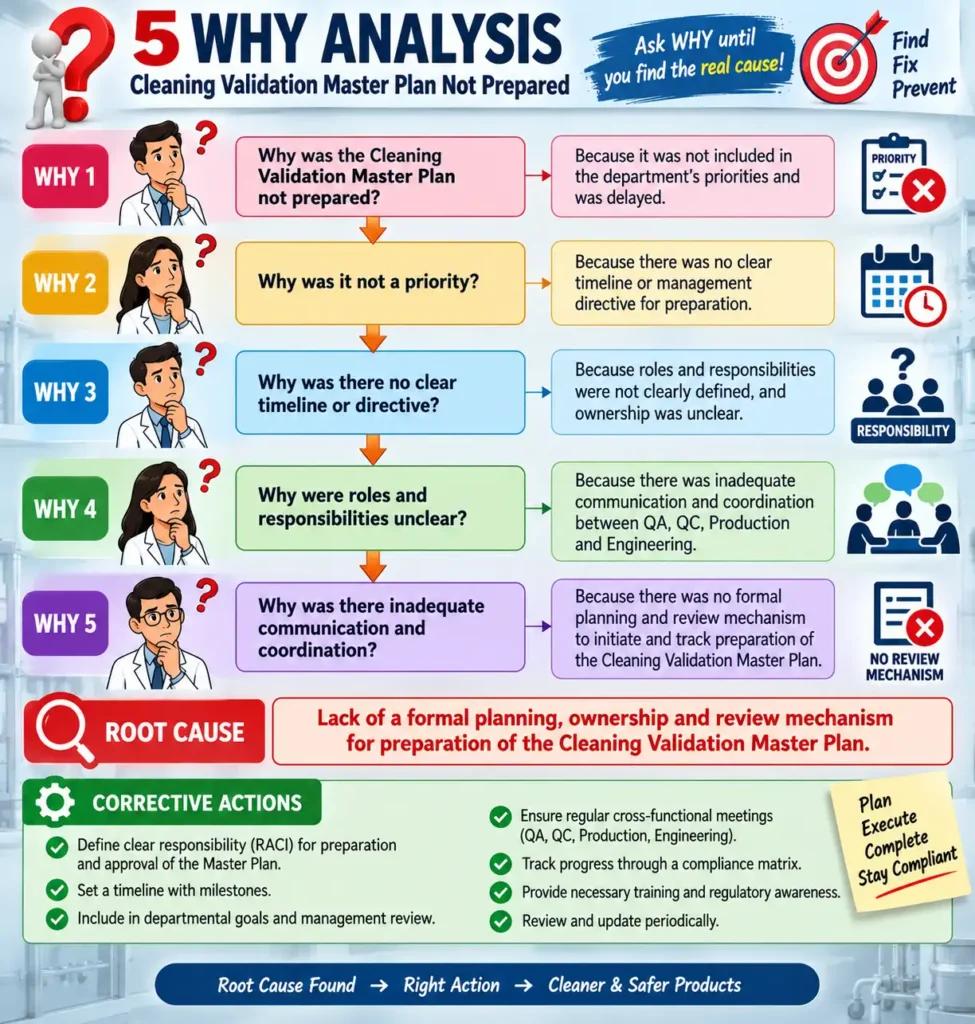
4. 5 Why Analysis:
The 5 Why Analysis for “Cleaning Validation Master Plan Not Prepared” is used to identify the underlying reason for failure to prepare the required master plan. The analysis begins with the immediate problem and progressively asks “Why?” to move from surface-level causes toward the root cause. The sequence identifies delayed prioritization, absence of a defined preparation timeline, unclear ownership and responsibilities, insufficient coordination between QA, QC, Production, and Engineering, and lack of a formal planning and review mechanism. The final root cause is identified as absence of a structured system for planning, ownership, monitoring, and periodic review of the Cleaning Validation Master Plan. Corrective actions include assigning clear responsibilities, establishing timelines and milestones, conducting cross-functional review meetings, tracking completion status, providing appropriate training, and periodically reviewing and updating the master plan. This approach supports systematic CAPA implementation and helps prevent recurrence of similar documentation and compliance failures.
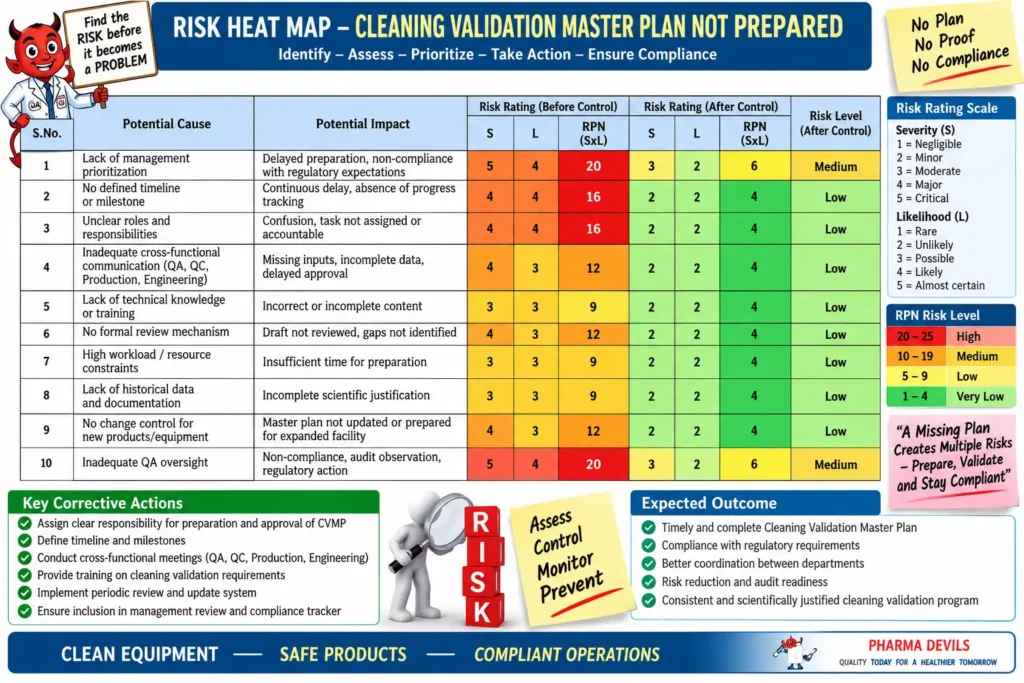
5. Heat Map (FMEA):
The Heat Map for “Cleaning Validation Master Plan Not Prepared” provides a visual risk assessment of the major causes and potential impacts associated with the absence of a documented CVMP. It evaluates risks using Severity (S), Likelihood (L), and Risk Priority Number (RPN) before and after implementation of controls. Major risk factors include lack of management prioritization, undefined timelines, unclear responsibilities, inadequate cross-functional communication, insufficient training, absence of formal review, resource constraints, weak historical documentation, poor change control, and inadequate QA oversight. The heat map highlights higher-risk issues requiring immediate attention and demonstrates how corrective actions can reduce risks to acceptable levels. Recommended controls include assigning clear ownership, establishing milestones, conducting cross-functional reviews, providing training, strengthening change control, and monitoring progress through management review. Overall, the heat map supports prioritization of CAPA, improves accountability, reduces compliance risk, and helps ensure timely preparation and maintenance of the Cleaning Validation Master Plan.
Questions & Answers
- Q: What is a Cleaning Validation Master Plan (CVMP)?
A: A CVMP is an umbrella document that defines the overall strategy, responsibilities, methodology, acceptance criteria, sampling approach, documentation, and lifecycle requirements for cleaning validation activities. - Q: What is the main purpose of cleaning validation?
A: Its purpose is to demonstrate that cleaning procedures consistently remove product residues, cleaning-agent residues, and microorganisms to predetermined acceptable levels, thereby preventing cross-contamination. - Q: Which departments are involved in cleaning validation?
A: Quality Assurance, Quality Control, Production, and Engineering are primarily responsible for preparation, execution, sampling, analysis, training, equipment information, review, and approval activities. - Q: What is the worst-case approach in cleaning validation?
A: It involves selecting a representative product that provides the greatest cleaning challenge based on parameters such as solubility, potency, toxicity, cleaning difficulty, batch size, and acceptance limits. - Q: Why is a matrix approach used?
A: The matrix approach reduces the need to validate every product individually by selecting a scientifically justified worst-case product and representative equipment. - Q: How is worst-case equipment selected?
A: Equipment may be grouped based on similar design and operating principles, while equipment with larger product-contact surface area and difficult-to-clean locations is considered more challenging. - Q: What are the main stages of cleaning validation methodology?
A: They include worst-case product selection, calculation of acceptance limits, selection of sampling method, analytical method development, and establishment of hold times. - Q: What sampling methods are used in cleaning validation?
A: The main methods are swab sampling for accessible surfaces and rinse sampling for inaccessible or difficult-to-disassemble equipment surfaces. - Q: Why is swab sampling generally preferred?
A: Swab sampling allows direct evaluation of specific product-contact surfaces, particularly difficult-to-clean locations, and can physically recover insoluble residues. - Q: What recovery is specified for swab sampling in the CVMP?
A: The document specifies that recovery of the target residue should not be less than 70%, with the recovery factor considered in residue-limit calculations. - Q: What area is generally sampled during swabbing?
A: The CVMP specifies a sampling area of 5 cm × 5 cm, where feasible. - Q: What are the main acceptance criteria for cleaning validation?
A: Acceptance criteria include visual cleanliness, product residue limits, cleaning-agent residue limits, and microbiological criteria. - Q: What is the visual cleanliness requirement?
A: Equipment should be visually clean internally and externally, with no visible residue remaining after completion of cleaning. - Q: What is the 10-ppm criterion?
A: The CVMP states that not more than 10 ppm of one product should appear in the subsequent product as a carryover criterion. - Q: What happens if visual, swab, or rinse results fail?
A: The failure must be investigated, the cleaning procedure may require revision, the equipment should be re-cleaned, and the revised procedure may require validation. - Q: What is cleaning verification?
A: Cleaning verification is used under specific conditions, such as introduction of a new product or equipment that does not fit an established product/equipment matrix, until the cleaning procedure is validated. - Q: What is a dirty equipment hold-time study?
A: It evaluates whether equipment can still be effectively cleaned after remaining dirty for a defined period, considering effects such as residue drying or microbial proliferation. - Q: What is a cleaned equipment hold-time study?
A: It determines how long cleaned equipment can remain idle while continuing to meet microbiological cleanliness requirements before reuse. - Q: When may cleaning revalidation be required?
A: Revalidation may be required when significant changes occur, such as a change in cleaning agent or introduction of equipment that does not fit the established equipment train. - Q: Why is the Cleaning Validation Master Plan important?
A: It provides a controlled and scientifically justified framework for preventing cross-contamination, ensuring consistent cleaning effectiveness, protecting product quality, and maintaining pharmaceutical manufacturing compliance.