


1. Brief Description:
The Cleaning Validation Master Plan provides a structured approach for validating the cleaning procedures used for production equipment in the Tablet Manufacturing Department. Its main purpose is to ensure that cleaning effectively removes product residues, cleaning agents, and microbial contamination to levels that do not create patient-safety concerns. The plan defines responsibilities of Quality Assurance, Production, Engineering, Quality Control, R&D/Technology Transfer, and the Toxicologist. It covers selection of the worst-case product and equipment, establishment of acceptance limits, selection of swab and rinse sampling methods, analytical method validation, and residue recovery studies. Acceptance criteria consider visual cleanliness, therapeutic dose, 10-ppm limits, and PDE-based limits. The plan also includes dirty and clean equipment hold-time studies, product-contact surface-area calculations, and documentation requirements. Cleaning validation is performed on three consecutive runs using the worst-case product, followed by continuous monitoring, periodic verification, change control, and revalidation when required.
Skip to PDF content2. Flow Diagram:
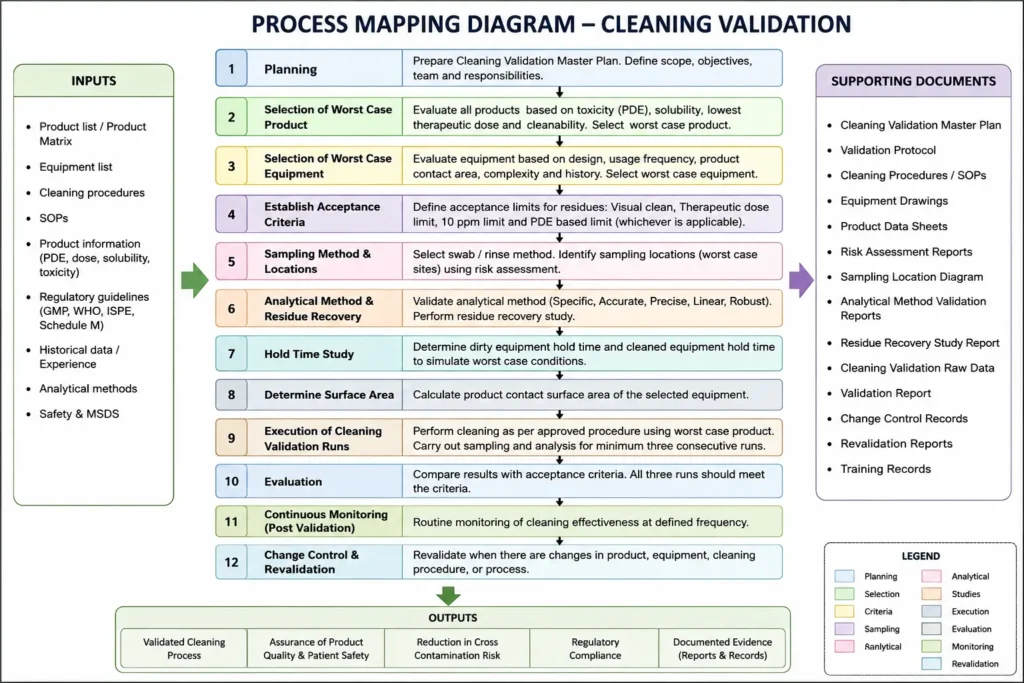
The Process Mapping Diagram for Cleaning Validation shows the complete sequence of activities required to establish and maintain an effective cleaning validation program. The process begins with preparation of the Cleaning Validation Master Plan and selection of the worst-case product and equipment. Acceptance criteria are then established based on visual cleanliness, therapeutic dose, 10 ppm, and PDE limits. Appropriate swab and rinse sampling methods and locations are selected, followed by analytical method validation and residue recovery studies. Dirty and cleaned equipment hold times and product-contact surface areas are also evaluated. Cleaning validation is then executed for three consecutive runs using the worst-case product. Results are compared with established limits, documented, and reviewed. After successful validation, routine monitoring is continued, while significant changes to products, equipment, or cleaning procedures may require revalidation.
3. Critical Process Parameters (CPP) & Critical Quality Attributes (CQA):
The uploaded Cleaning Validation Master Plan does not explicitly classify parameters as CPPs or CQAs. The following table is a practical classification based on the cleaning steps, sampling requirements, analytical controls, and acceptance criteria defined in the document.
| Critical Process Parameters (CPP) | Purpose / Control |
|---|---|
| Equipment qualification status | Ensure CIP, utilities and instruments are qualified/calibrated before validation. |
| Cleaning water quality | Potable water is used for initial cleaning/scrubbing and purified water for final rinsing. |
| Scrubbing / cleaning procedure | Follow approved equipment cleaning SOP to remove product residues effectively. |
| Final rinse | Purified-water rinse helps remove remaining residues and cleaning materials. |
| Drying conditions | Equipment is dried using a dryer or compressed air after cleaning. |
| Dirty Equipment Hold Time | Maximum time equipment may remain uncleaned before cleaning. |
| Cleaned Equipment Hold Time | Time from completion of cleaning until equipment is reused. |
| Sampling method | Appropriate swab and/or rinse sampling must be selected. |
| Swab sampling area | Normally 10 × 10 cm (100 cm²), with smaller areas where necessary. |
| Desorption solvent & volume | Must be suitable for the API and allow detection by the analytical method. |
| Analytical method performance | Specificity, LOD, LOQ, linearity, accuracy and precision must be validated. |
| Residue recovery | Sampling recovery should generally be >75%; up to 50% may be accepted for certain surfaces such as rubber where defined. |
| Number of validation runs | Cleaning validation is performed on three consecutive runs with the worst-case product. |
Critical Quality Attributes (CQA)
| CQA | Expected Quality Requirement |
|---|---|
| Visual cleanliness | No visible residue after cleaning and drying. |
| API residue level | Must comply with the established MACO acceptance limit. |
| Chemical contamination | Must meet limits based on dose, 10 ppm and/or PDE criteria. |
| Microbial contamination | Not more than 30 CFU/100 cm² as specified in the plan. |
| Cleaning-agent / solvent residue | Residual cleaning or desorption solvent must remain within established acceptance limits. |
| Cross-contamination control | Cleaning must prevent carryover of the previous product into the next product. |
| Equipment cleanliness | Product-contact surfaces should be chemically, physically and microbiologically clean. |
In simple terms: CPPs control how the equipment is cleaned and tested, while CQAs confirm whether the cleaned equipment is acceptable for safe reuse.
4. Impact Assessment:
The Cleaning Validation Master Plan has a direct impact on product quality, patient safety, equipment cleanliness, and prevention of cross-contamination. The plan requires cleaning procedures to effectively remove product residues, cleaning agents, and microbial contamination from manufacturing equipment to acceptable levels. Proper selection of the worst-case product and equipment helps ensure that cleaning is challenged under difficult conditions. The use of defined acceptance criteria, including visual cleanliness, dose-based limits, 10 ppm, and PDE-based limits, helps control carryover of residues into the next product. Swab and rinse sampling, validated analytical methods, and residue recovery studies provide documented evidence of cleaning effectiveness. Regular monitoring, periodic review, change control, and revalidation further help maintain the validated cleaning status. Overall, effective cleaning validation reduces contamination risks, supports GMP compliance, and ensures that equipment is safe and suitable for reuse in pharmaceutical manufacturing.
5. Questions & Answers:
Q1. What is the purpose of the Cleaning Validation Master Plan?
Answer: It defines the requirements for validating cleaning procedures so that product residues, cleaning agents, and contamination are reduced to safe and acceptable levels.
Q2. What is the scope of this Cleaning Validation Master Plan?
Answer: It covers cleaning validation activities for the Tablet Manufacturing Department.
Q3. What is cleaning validation?
Answer: Cleaning validation provides documented assurance that the cleaning process effectively removes API residues, cleaning aids, and microbial contamination from equipment.
Q4. Which departments are involved in cleaning validation?
Answer: Quality Assurance, Production, Engineering, Quality Control, R&D/Technology Transfer, and the Toxicologist are involved.
Q5. How is the worst-case product selected?
Answer: It is selected based on toxicological assessment, API solubility, lowest therapeutic dose, and product cleanability.
Q6. What is PDE in cleaning validation?
Answer: PDE means Permitted Daily Exposure. It is calculated using toxicological data such as NOAEL, NOEL, or LOEL with appropriate modifying factors.
Q7. How is the worst-case equipment selected?
Answer: Equipment is grouped in an Equipment Matrix, and representative critical equipment is selected based on similarity in capacity, shape, and product-contact characteristics.
Q8. What acceptance criteria are used for API residues?
Answer: The plan considers visual cleanliness, therapeutic dose-based MACO, 10 ppm criteria, and PDE-based MACO.
Q9. What is the visual-clean acceptance criterion?
Answer: No residue should be visible on the cleaned and dried equipment surface with the unaided eye.
Q10. What sampling methods are used during cleaning validation?
Answer: The main sampling methods are swab sampling and rinse sampling.
Q11. When is swab sampling preferred?
Answer: Swab sampling is preferred for accessible, hard-to-clean, and dried-out surfaces because it directly measures residue on a defined surface area.
Q12. When is rinse sampling used?
Answer: Rinse sampling is used for inaccessible surfaces, equipment parts that are not normally dismantled, and difficult-to-reach locations.
Q13. What is the standard swab sampling area?
Answer: Normally, a 10 × 10 cm area, equal to 100 cm², is sampled. Smaller areas may be used depending on equipment design.
Q14. What is the microbiological acceptance criterion?
Answer: The plan specifies a microbiological acceptance criterion of not more than 30 CFU/100 cm².
Q15. What is a residue recovery study?
Answer: It checks how effectively the selected sampling method can recover known residues from equipment-contact surfaces.
Q16. What recovery percentage is considered acceptable?
Answer: Recovery should generally be more than 75%. For certain surfaces such as rubber, recovery down to 50% may be accepted if scientifically defined.
Q17. How many cleaning validation runs are required?
Answer: Cleaning validation is performed on three consecutive runs using the identified worst-case product.
Q18. What is Dirty Equipment Hold Time?
Answer: It is the time equipment remains uncleaned after manufacturing before the cleaning process begins.
Q19. What is Cleaned Equipment Hold Time?
Answer: It is the time between completion of equipment cleaning and the start of its next use.
Q20. When is revalidation required?
Answer: Revalidation may be required when there are changes in products, formulation, equipment, manufacturing area, product-contact parts, or cleaning procedures.