







1. Introduction to Batch Manufacturing Record (BMR) of Diclofenac Diethylamine, Linseed Oil, Methyl Salicylate and Menthol Gel
Diclofenac Diethylamine, Linseed Oil, Methyl Salicylate and Menthol Gel is a topical pharmaceutical formulation designed to provide localized relief from muscular pain, joint discomfort, inflammation, sprains, and strains. This combination contains Diclofenac Diethylamine, a non-steroidal anti-inflammatory drug (NSAID), along with Linseed Oil, Methyl Salicylate, and Menthol, which contribute to its analgesic, counterirritant, and soothing properties. The formulation contains Diclofenac equivalent to 1% w/w Diclofenac Sodium, Linseed Oil 3% w/w, Methyl Salicylate 10% w/w, and Menthol 5% w/w in a water-washable gel base. These ingredients work through complementary mechanisms to provide symptomatic relief from musculoskeletal discomfort. The Batch Manufacturing Record (BMR) provides a comprehensive documentation framework for manufacturing this topical gel in accordance with Good Manufacturing Practices (GMP). It includes raw material dispensing, equipment verification, manufacturing operations, mixing, homogenization, in-process quality checks, filling, sealing, and packaging activities. Critical quality parameters such as appearance, homogeneity, pH, viscosity, assay, and microbial quality should be monitored according to approved specifications. Proper documentation, line clearance, equipment cleanliness, and quality assurance verification help maintain batch-to-batch consistency, product safety, regulatory compliance, and traceability throughout the manufacturing process. This ensures reliable manufacturing control and supports consistent finished-product quality.
Skip to PDF content2. Manufacturing Process Flow Diagram of Diclofenac Diethylamine, Linseed Oil, Methyl Salicylate and Menthol Gel
The manufacturing process of Diclofenac Diethylamine, Linseed Oil, Methyl Salicylate and Menthol Gel involves a series of controlled operations designed to ensure product uniformity, quality, safety, and compliance with Good Manufacturing Practices (GMP).

The process begins with the receipt, quality control testing, and release of raw materials, followed by accurate dispensing and verification of ingredients. Manufacturing area clearance and equipment cleanliness are verified before initiating production to prevent contamination and cross-contamination. The gel base is prepared using approved ingredients under controlled processing conditions. Diclofenac Diethylamine, Linseed Oil, Methyl Salicylate, and Menthol are incorporated according to the approved manufacturing instructions. Mixing and homogenization are performed to achieve uniform distribution of ingredients and the desired gel consistency. In-process quality checks may include appearance, homogeneity, pH, viscosity, and other parameters specified in the approved manufacturing documents. Following satisfactory bulk testing and approval, the gel is transferred for tube filling and sealing under controlled conditions. Filled tubes undergo inspection, labeling, and secondary packaging. Finally, finished product quality control testing, batch manufacturing record review, and Quality Assurance approval are completed before product release. This systematic manufacturing approach ensures batch-to-batch consistency, product traceability, regulatory compliance, and reliable finished-product quality, in accordance with approved specifications and GMP requirements.
3. Critical Process Parameters (CPPs) and Critical Quality Attributes (CQAs) of Diclofenac Diethylamine, Linseed Oil, Methyl Salicylate and Menthol Gel
The manufacturing of Diclofenac Diethylamine, Linseed Oil, Methyl Salicylate and Menthol Gel requires effective monitoring and control of Critical Process Parameters (CPPs) and Critical Quality Attributes (CQAs) to ensure consistent product quality, safety, and efficacy in accordance with Good Manufacturing Practices (GMP).
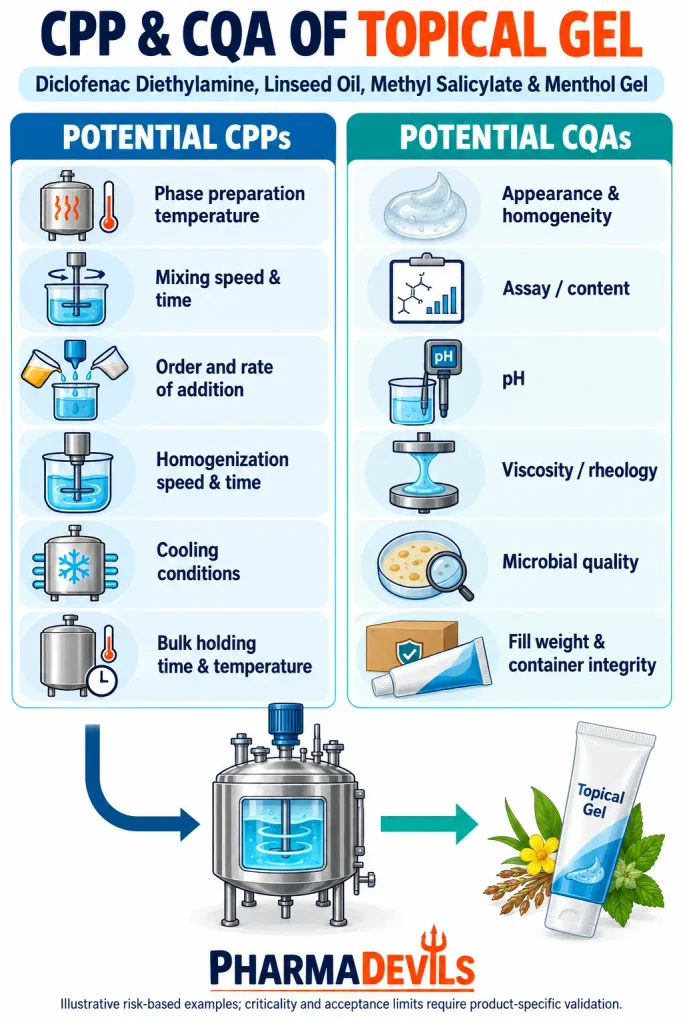
Critical Process Parameters (CPPs) are process variables whose variability can affect Critical Quality Attributes and therefore require appropriate monitoring and control. Potential CPPs include phase preparation temperature, mixing speed, mixing duration, ingredient addition sequence, homogenization conditions, cooling rate, and bulk holding time. Proper control of these parameters supports uniform ingredient distribution, desired gel consistency, and formulation stability. Critical Quality Attributes (CQAs) are physical, chemical, biological, or microbiological properties that must remain within established acceptance limits to ensure product quality. Potential CQAs include appearance, homogeneity, active ingredient assay, pH, viscosity, microbial quality, fill weight, and container closure integrity. Effective monitoring through in-process testing, equipment qualification, validated manufacturing procedures, and quality control testing helps minimize variability and manufacturing deviations. A systematic, risk-based approach to CPP and CQA evaluation strengthens process robustness, batch-to-batch consistency, product stability, regulatory compliance, and patient safety throughout the pharmaceutical manufacturing lifecycle.
Note: Actual CPPs and CQAs must be established through product-specific risk assessment, development studies, and process validation.