







1. Introduction to Batch Manufacturing Record (BMR) of Diclofenac Diethylamine, Linseed Oil, Methyl Salicylate, Menthol & Capsaicin Gel:
The Batch Manufacturing Record (BMR) for Diclofenac Diethylamine, Linseed Oil, Methyl Salicylate, Menthol & Capsaicin Gel is an essential pharmaceutical document that provides comprehensive instructions and records for manufacturing a topical analgesic and anti-inflammatory formulation in compliance with Good Manufacturing Practices (GMP). This gel contains Diclofenac Diethylamine (1.16% w/w), Linseed Oil (3% w/w), Methyl Salicylate (10% w/w), Menthol (5% w/w), and Capsaicin (0.025% w/w). These ingredients work through different mechanisms to provide localized relief from muscular pain, joint discomfort, inflammation, and stiffness. The BMR systematically documents all manufacturing activities, including raw material dispensing, equipment cleaning, line clearance, material verification, gel preparation, mixing, homogenization, in-process quality checks, filling, sealing, and packaging. Critical manufacturing parameters, including mixing time, temperature, pH, viscosity, and product uniformity, must be controlled according to approved specifications to maintain consistent product quality. The document also establishes responsibilities for Production, Quality Control, and Quality Assurance personnel, ensuring proper verification, traceability, and accountability throughout manufacturing. Accurate documentation of batch activities, deviations, equipment usage, and quality control results supports regulatory compliance, batch-to-batch consistency, product safety, and effective batch release decisions. Overall, the BMR serves as a vital tool for ensuring controlled, reproducible, and GMP-compliant pharmaceutical gel manufacturing.
Skip to PDF content2. Manufacturing Flow Diagram for Diclofenac Diethylamine, Linseed Oil, Methyl Salicylate, Menthol & Capsaicin Gel:
The manufacturing flow diagram of Diclofenac Diethylamine, Linseed Oil, Methyl Salicylate, Menthol & Capsaicin Gel illustrates the sequential manufacturing operations required to produce a topical analgesic and anti-inflammatory gel under Good Manufacturing Practices (GMP). The manufacturing process begins with raw material dispensing and verification, followed by equipment cleaning and line clearance to prevent contamination and mix-ups. During the water phase preparation, purified water is heated to 75–80°C. Disodium Edetate and Propylene Glycol are dissolved, followed by the controlled addition of Carbomer 934 to form a uniform gel base.
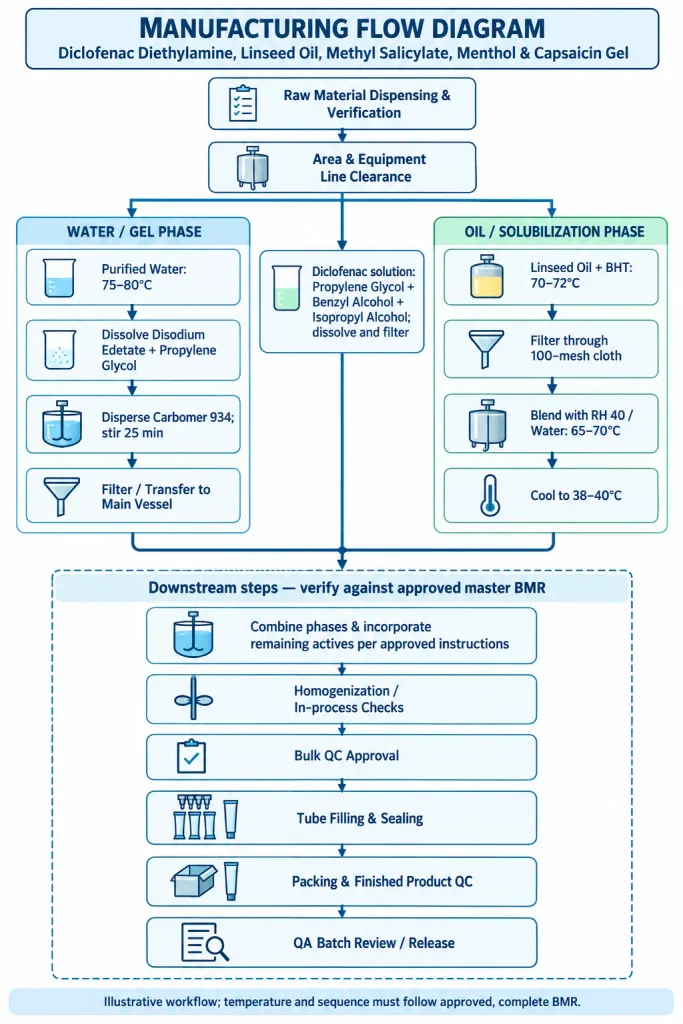
In the oil phase preparation, Linseed Oil and Butylated Hydroxytoluene (BHT) are heated to 70–72°C and filtered. The oil phase is subsequently incorporated into the prepared solubilizing medium under controlled conditions. Diclofenac Diethylamine is separately dissolved in a suitable solvent mixture containing Propylene Glycol, Benzyl Alcohol, and Isopropyl Alcohol. The subsequent manufacturing stages involve combining the prepared phases, incorporating the remaining ingredients, mixing, homogenization, and performing in-process quality checks according to the approved Master BMR. Following bulk quality approval, the gel undergoes tube filling, sealing, inspection, packaging, and finished product testing. Finally, Quality Assurance reviews the completed manufacturing documentation to ensure product quality, traceability, and GMP compliance.
Note: The downstream processing sequence is illustrative because the supplied BMR does not contain complete instructions for these stages.
3. Critical Process Parameters (CPPs) and Critical Quality Attributes (CQAs) of Diclofenac Diethylamine, Linseed Oil, Methyl Salicylate, Menthol & Capsaicin Gel:
Critical Process Parameters (CPPs) and Critical Quality Attributes (CQAs) play an essential role in ensuring the consistent quality, safety, and effectiveness of Diclofenac Diethylamine, Linseed Oil, Methyl Salicylate, Menthol & Capsaicin Gel during pharmaceutical manufacturing.
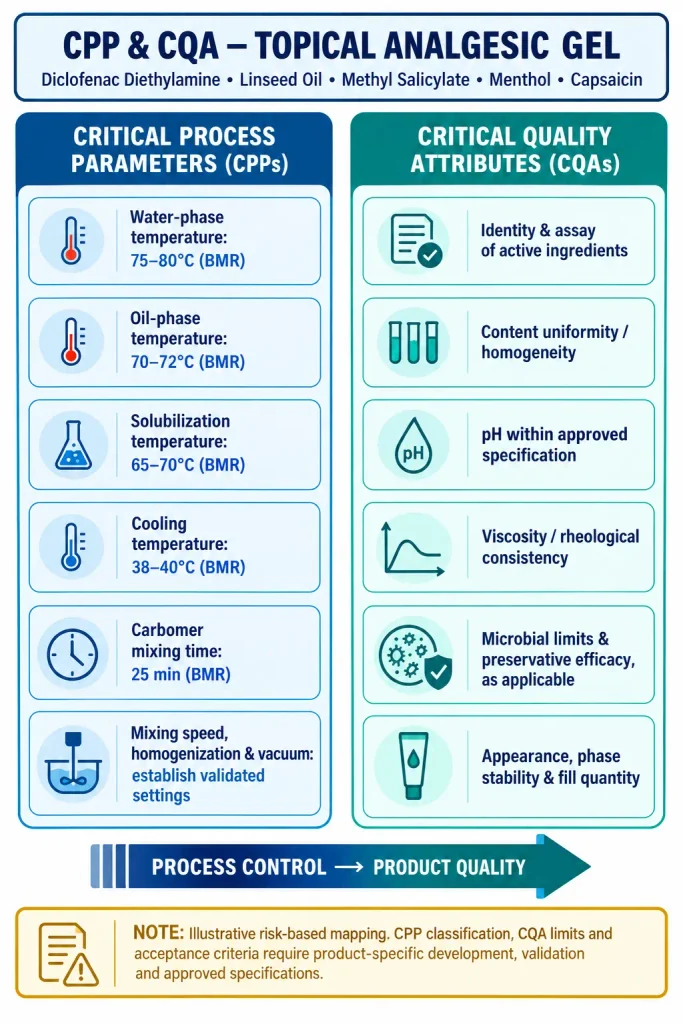
Critical Process Parameters (CPPs)
CPPs are manufacturing parameters whose variability can significantly affect product quality. Important process parameters requiring evaluation and control include:
- Water Phase Temperature: Maintain 75–80°C during gel base preparation.
- Oil Phase Temperature: Maintain 70–72°C for proper oil phase preparation.
- Solubilization Temperature: Control at 65–70°C during the specified processing stage.
- Cooling Temperature: Maintain 38–40°C before subsequent processing.
- Mixing Time: Stir Carbomer 934 for 25 minutes to achieve uniform dispersion.
- Homogenization: Control mixing speed, time, and vacuum according to validated parameters.
Critical Quality Attributes (CQAs)
CQAs are physical, chemical, biological, or microbiological characteristics that must remain within established limits to ensure product quality.
- Assay: Ensures active ingredients meet approved potency specifications.
- Content Uniformity: Confirms homogeneous distribution of active ingredients throughout the gel.
- pH: Maintains formulation stability and suitability for topical application.
- Viscosity: Ensures appropriate consistency, spreadability, and application characteristics.
- Microbial Quality: Confirms compliance with applicable microbiological specifications.
- Physical Appearance: Evaluates color, texture, homogeneity, and absence of phase separation.
Conclusion
Effective monitoring of CPPs and CQAs helps minimize manufacturing variability, prevent quality defects, and maintain batch-to-batch consistency.
Note: The listed processing temperatures and mixing time originate from the BMR. Their formal classification as CPPs and the applicable CQA limits must be justified through product-specific quality risk assessment, development studies, and process validation.