







Diclofenac Sodium Assay Method 4 is based on the formation of an ion-pair complex between diclofenac sodium and methylene blue under alkaline phosphate buffer conditions. Diclofenac sodium is an acidic drug and exists mainly in ionized form in phosphate buffer at pH 8.0. Methylene blue acts as a cationic dye and reacts with the anionic diclofenac species to form a colored ion-pair complex.
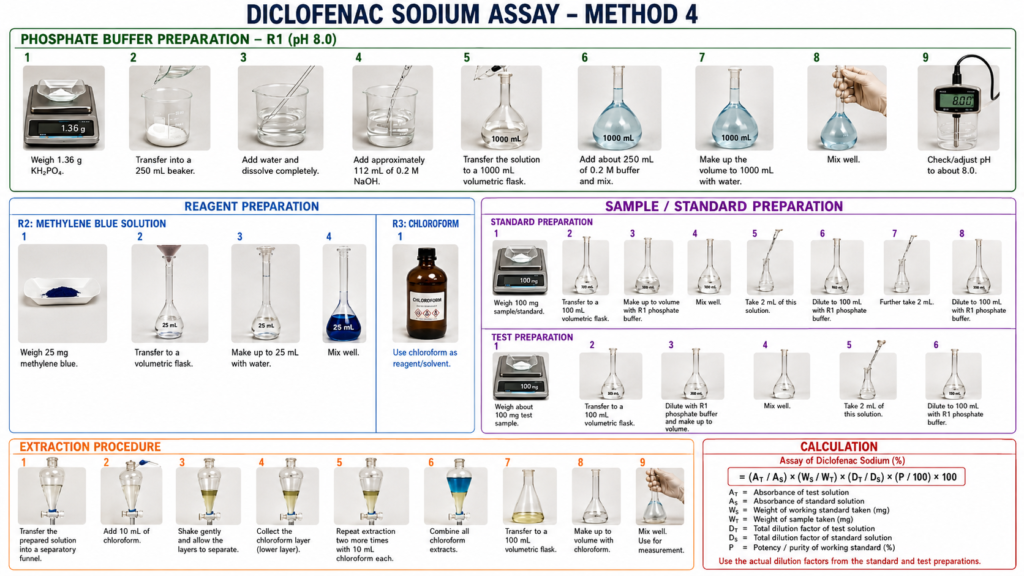
In this method, phosphate buffer pH 8.0 is prepared using potassium dihydrogen phosphate and sodium hydroxide. The buffer maintains the required alkaline pH, which is important for complete ionization of diclofenac sodium and stable complex formation. A methylene blue solution is prepared separately and used as the color-forming reagent. Chloroform is used as the extracting solvent because the formed ion-pair complex is more soluble in chloroform than in the aqueous phase.
Standard and test solutions are prepared by accurately weighing diclofenac sodium standard and sample, dissolving them in phosphate buffer, and making suitable dilutions. A measured volume of the prepared solution is transferred into a separating funnel. Methylene blue reagent is added, followed by chloroform extraction. During shaking, diclofenac sodium forms an ion-pair complex with methylene blue, which transfers into the chloroform layer. Repeated extraction ensures maximum recovery of the colored complex.
The chloroform extracts are combined and diluted to a fixed volume with chloroform. The absorbance of the final chloroform solution is then measured using a spectrophotometer at the specified wavelength against a suitable blank. The absorbance of the test solution is compared with that of the standard solution.
The percentage assay of diclofenac sodium is calculated using the absorbance ratio, standard weight, sample weight, dilution factors, and potency of the working standard. This method is useful for quantitative estimation because it is simple, selective, and based on measurable color intensity. Proper pH control, accurate dilution, complete phase separation, and careful extraction are essential for reliable and reproducible assay results.