







1. Introduction – Diphenhydramine HCl, Ammonium Chloride and Sodium Citrate Syrup:
The Batch Packing Record (BPR) of Diphenhydramine HCl, Ammonium Chloride and Sodium Citrate Syrup is an essential pharmaceutical documentation system designed to ensure accurate, controlled, and traceable packing operations in accordance with Good Manufacturing Practices (GMP). This syrup formulation contains Diphenhydramine Hydrochloride IP (14.08 mg), Ammonium Chloride IP (138 mg), and Sodium Citrate IP (57.03 mg) per 5 ml in a mentholated syrup base. The formulation combines antihistaminic and expectorant ingredients commonly used in cough preparations. The BPR provides comprehensive documentation of packing activities, including packing material dispensing, line clearance, bottle washing, filling, sealing, labeling, inspection, and final packaging. It establishes systematic procedures for monitoring critical packing parameters such as fill volume, sealing integrity, cap perforation, labeling accuracy, and leak testing. Additionally, the record includes in-process quality checks, rejection analysis, packing material reconciliation, batch yield calculations, and destruction records for rejected materials. Proper implementation of the BPR ensures product identification, packaging integrity, batch traceability, and regulatory compliance. It also establishes accountability among Production, Quality Control, and Quality Assurance personnel. This document serves as an important reference for pharmaceutical professionals involved in syrup packaging, quality assurance, batch documentation, and GMP compliance, supporting consistent product quality and patient safety.
Skip to PDF content2. Flow Diagram – Batch Packing Process of Diphenhydramine HCl, Ammonium Chloride and Sodium Citrate Syrup:
The flow diagram illustrates the systematic Batch Packing Record (BPR) process for Diphenhydramine HCl, Ammonium Chloride and Sodium Citrate Syrup, highlighting the essential packing operations and in-process quality control checks required to maintain product quality, safety, and compliance with Good Manufacturing Practices (GMP).
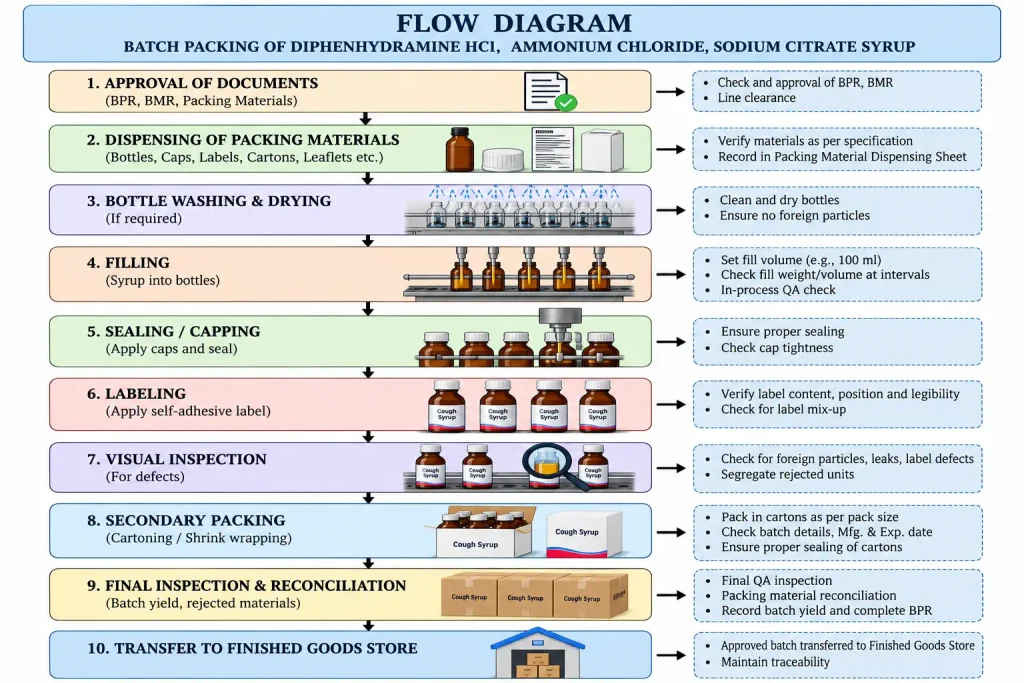
The process begins with verification of approved batch documents, packing material dispensing, and line clearance to prevent contamination and product mix-ups. Subsequently, bottles undergo washing and inspection before being transferred to the filling section, where the prescribed quantity of syrup is filled under controlled operating conditions. Following filling, bottles undergo sealing and capping operations, including checks for sealing integrity, leakage, and cap perforation. The bottles are then labeled and visually inspected for defects, foreign particles, and incorrect labeling. Secondary packaging involves placing accepted bottles into cartons and shippers with verification of batch numbers, manufacturing dates, expiry dates, and other printed information. Finally, batch yield calculation, packing material reconciliation, rejection analysis, and QA verification are performed before the finished product is released and transferred to the designated storage area. This structured workflow ensures traceability, documentation accuracy, packaging integrity, and consistent pharmaceutical quality throughout the packing process.
3. Critical Process Parameters (CPP) and Critical Quality Attributes (CQA) of Diphenhydramine HCl, Ammonium Chloride and Sodium Citrate Syrup (BPR):
The Critical Process Parameters (CPP) and Critical Quality Attributes (CQA) of Diphenhydramine HCl, Ammonium Chloride and Sodium Citrate Syrup are essential elements for maintaining product quality, packaging integrity, and regulatory compliance throughout the pharmaceutical packing process. Critical Process Parameters (CPP) include packing material verification, bottle washing conditions, filling volume, filling machine speed, sealing integrity, cap perforation, labeling accuracy, and visual inspection. These parameters require monitoring and control according to approved Batch Packing Records (BPR), Standard Operating Procedures (SOPs), and established specifications. During filling operations, maintaining the specified fill volume is important to ensure accurate product quantity. Sealing and capping operations require checks for leakage, closure integrity, and proper cap application. Labeling controls help prevent product identification errors and packaging mix-ups.
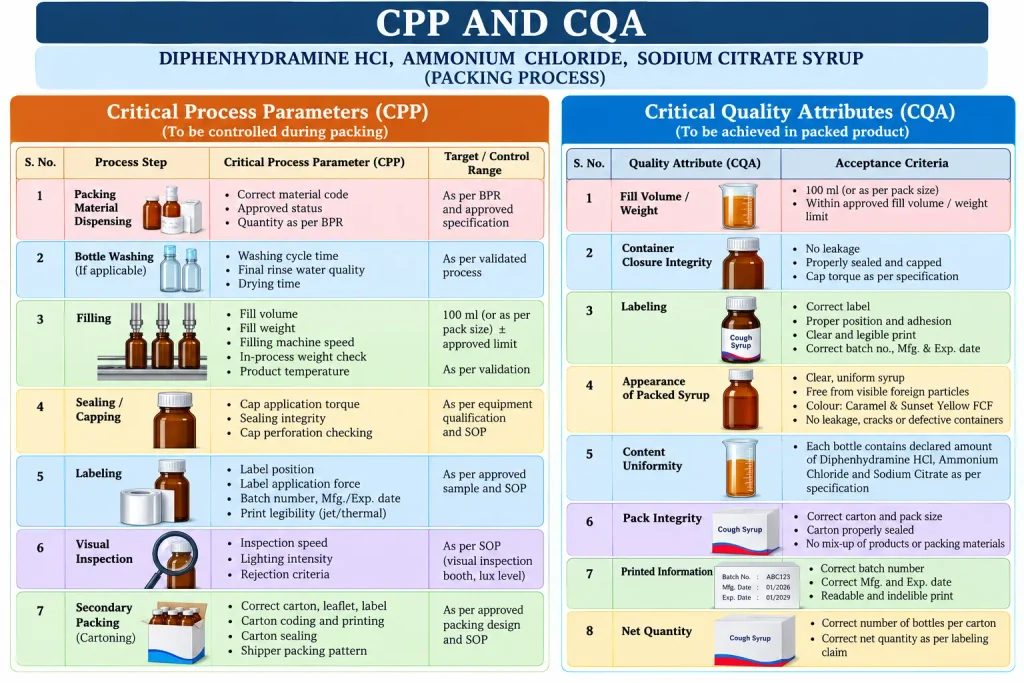
Critical Quality Attributes (CQA) include correct fill volume, container closure integrity, product appearance, absence of visible foreign particles, labeling accuracy, packaging integrity, and correct printed batch information. In-process checks, rejection analysis, packing material reconciliation, and Quality Assurance verification support effective quality control throughout the process. Systematic monitoring of CPPs and verification of CQAs help ensure that the finished syrup meets predefined quality standards, maintains batch traceability, and complies with Good Manufacturing Practices (GMP).
Note: The illustrated CPPs and CQAs are educational examples. Their criticality and numerical acceptance limits must be established through approved specifications, process validation, and documented quality risk assessment.