







1. Introduction – Isopropyl Alcohol Perfume Gel Base Sanitizer:
The Batch Manufacturing Record (BMR) of Isopropyl Alcohol Perfume Gel Base Sanitizer is a comprehensive GMP documentation system designed to ensure the consistent manufacturing, quality control, traceability, and compliance of alcohol-based hand sanitizer. The formulation contains Isopropyl Alcohol IP 70% v/v in a perfumed gel base, intended for hand hygiene and sanitization. The formulation includes Isopropyl Alcohol, Carbomer 934 USNF, Glycerin IP, Propylene Glycol IP, Dimethylamine, Perfume, and Purified Water. Each ingredient performs a specific function in developing the gel’s required characteristics, including consistency, appearance, spreadability, and fragrance. The manufacturing process involves raw material dispensing, preparation of the water phase, Carbomer dispersion, gel formation, addition of the neutralizing agent, incorporation of Isopropyl Alcohol, addition of other ingredients, pH adjustment, and final mixing. The BMR specifies a 300 kg batch size and a pH range of 5.0–8.0. The document also covers equipment cleaning, line clearance, environmental controls, manufacturing instructions, in-process quality checks, bulk sampling, yield reconciliation, and Quality Assurance verification. Proper implementation of the BMR supports batch-to-batch consistency, minimizes manufacturing errors, maintains product quality, and ensures complete documentation throughout production, filling, and packing operations in accordance with Good Manufacturing Practices (GMP).
Skip to PDF content2. Flow Diagram – Isopropyl Alcohol Perfume Gel Base Sanitizer (BMR):
The manufacturing process flow diagram of Isopropyl Alcohol Perfume Gel Base Sanitizer illustrates the sequential operations involved in manufacturing, quality control, filling, and packaging of the sanitizer under Good Manufacturing Practices (GMP). The process begins with raw material dispensing and verification, followed by preparation of the water phase using Purified Water and Carbomer 934 USNF. The Carbomer is dispersed under continuous stirring to obtain a uniform gel base. The gel is transferred into the main manufacturing vessel, followed by addition of the specified neutralizing agent, Isopropyl Alcohol, Glycerin, Propylene Glycol, and Perfume according to the approved Batch Manufacturing Record.
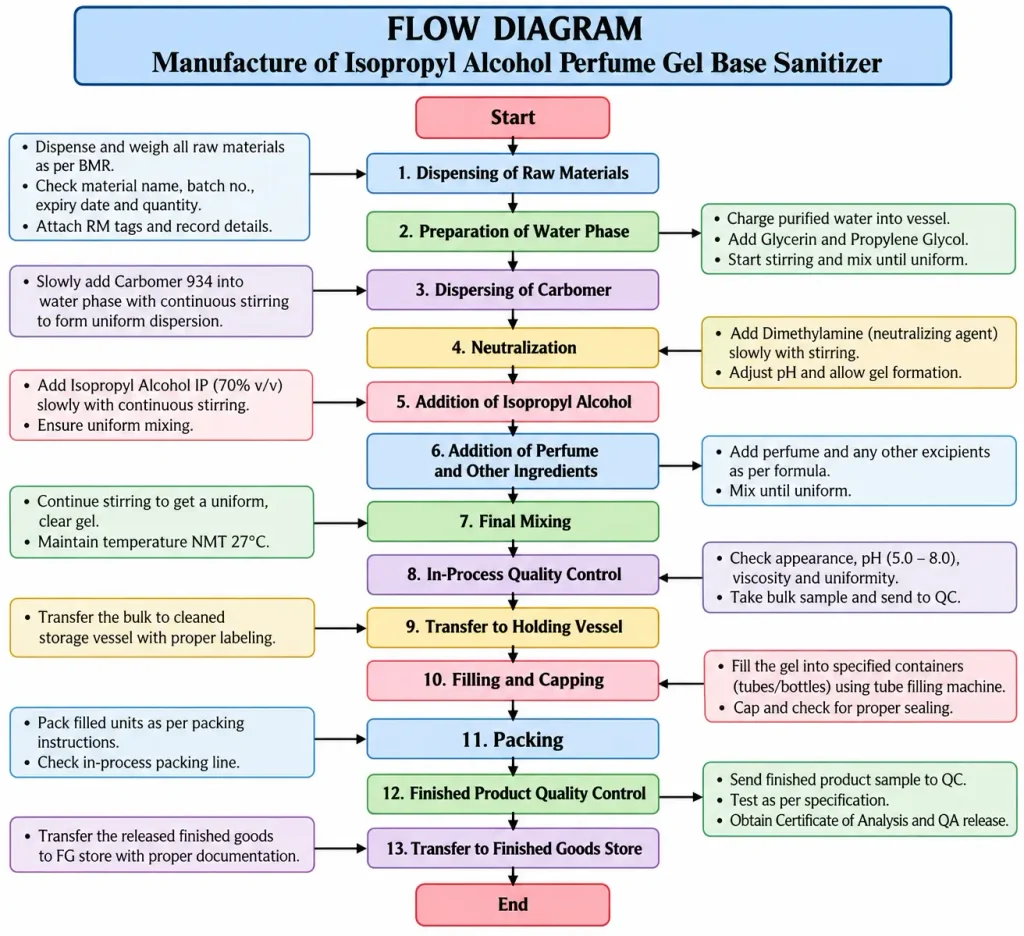
After ingredient addition, final mixing is performed to achieve a homogeneous gel. The product undergoes in-process quality control, including pH verification within the specified range of 5.0–8.0 and other applicable quality checks. Following satisfactory bulk testing, the sanitizer is transferred into cleaned stainless steel holding vessels for subsequent filling and capping operations. The filled containers undergo packing, inspection, and finished-product quality testing. After Quality Assurance approval and release, the finished goods are transferred to the designated storage area. This flow diagram supports process standardization, product traceability, GMP compliance, and consistent batch quality throughout the manufacturing cycle.
3. Critical Process Parameters (CPP) and Critical Quality Attributes (CQA) of Isopropyl Alcohol Perfume Gel Base Sanitizer:
The Critical Process Parameters (CPP) and Critical Quality Attributes (CQA) of Isopropyl Alcohol Perfume Gel Base Sanitizer are essential for maintaining manufacturing consistency, product quality, safety, and compliance with Good Manufacturing Practices (GMP). Critical Process Parameters (CPP) include mixing speed, temperature, Carbomer dispersion time, neutralization, Isopropyl Alcohol addition, and final mixing time. Proper control of these parameters ensures uniform gel formation, effective ingredient distribution, and prevention of manufacturing defects. The manufacturing process involves dispersing Carbomer 934 in Purified Water, incorporating the specified neutralizing agent, and adding Isopropyl Alcohol, Glycerin, Propylene Glycol, and Perfume under controlled conditions. Temperature, agitation, and processing time must be monitored according to the approved Batch Manufacturing Record (BMR).
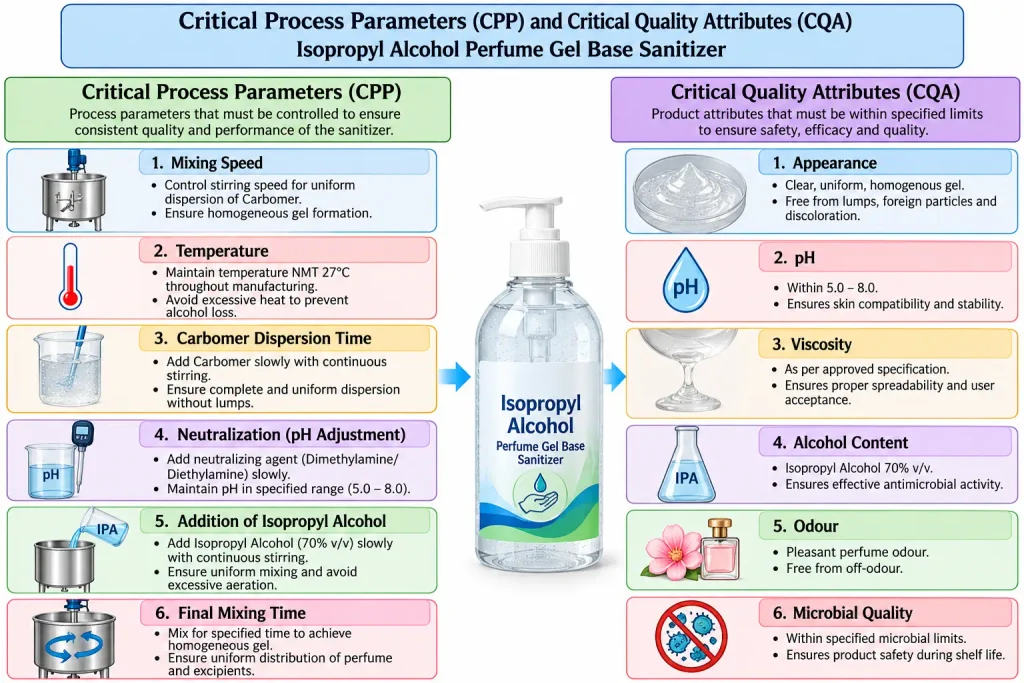
Critical Quality Attributes (CQA) include appearance, pH, viscosity, alcohol content, odour, and microbial quality. The attached BMR specifies a pH range of 5.0–8.0 and identifies Isopropyl Alcohol at 70% v/v in the product description. In-process quality checks and final product testing help confirm that the sanitizer meets approved specifications before release. Effective CPP monitoring and CQA evaluation support batch-to-batch consistency, process validation, product traceability, and regulatory compliance.
Note: The listed attributes and parameters are potential CPPs and CQAs; their criticality must be established through documented quality risk assessment and process validation. The original BMR also contains inconsistencies in neutralizing-agent terminology and temperature instructions that require verification before implementation.