







1. Introduction to Isopropyl Alcohol 70% v/v Perfume Gel Base Sanitizer – Batch Manufacturing Record (BMR)
Isopropyl Alcohol 70% v/v Perfume Gel Base Sanitizer is an alcohol-based hand hygiene formulation designed to provide effective antimicrobial action while ensuring convenient application and user comfort. The formulation contains 70% v/v Isopropyl Alcohol as the active ingredient, incorporated into a perfumed gel base with suitable excipients to achieve the desired consistency, appearance, and fragrance.
The Batch Manufacturing Record (BMR) is an essential Good Manufacturing Practice (GMP) document that provides comprehensive instructions for manufacturing, filling, sealing, packaging, and quality control activities. It ensures that each batch is manufactured consistently according to approved procedures, predefined specifications, and established quality standards.
The manufacturing process involves raw material dispensing, preparation of the gel base, controlled mixing, incorporation of Isopropyl Alcohol, homogenization, bulk quality testing, filling, and final packaging. Critical process parameters, including mixing conditions, temperature, alcohol concentration, pH, and product uniformity, must be appropriately monitored and documented.
The BMR also includes equipment clearance, line clearance, in-process checks, material reconciliation, yield calculations, and quality assurance verification. Proper documentation supports batch traceability, regulatory compliance, deviation management, and product quality.
This BMR serves as a comprehensive reference for ensuring the safe, consistent, and controlled manufacturing of Isopropyl Alcohol Perfume Gel Base Sanitizer.
Skip to PDF content2. Manufacturing Process Flow Diagram of Isopropyl Alcohol 70% v/v Perfume Gel Base Sanitizer
The manufacturing process flow diagram of Isopropyl Alcohol 70% v/v Perfume Gel Base Sanitizer illustrates the systematic sequence of operations required to manufacture a safe, effective, and consistent hand hygiene product in accordance with Good Manufacturing Practices (GMP).
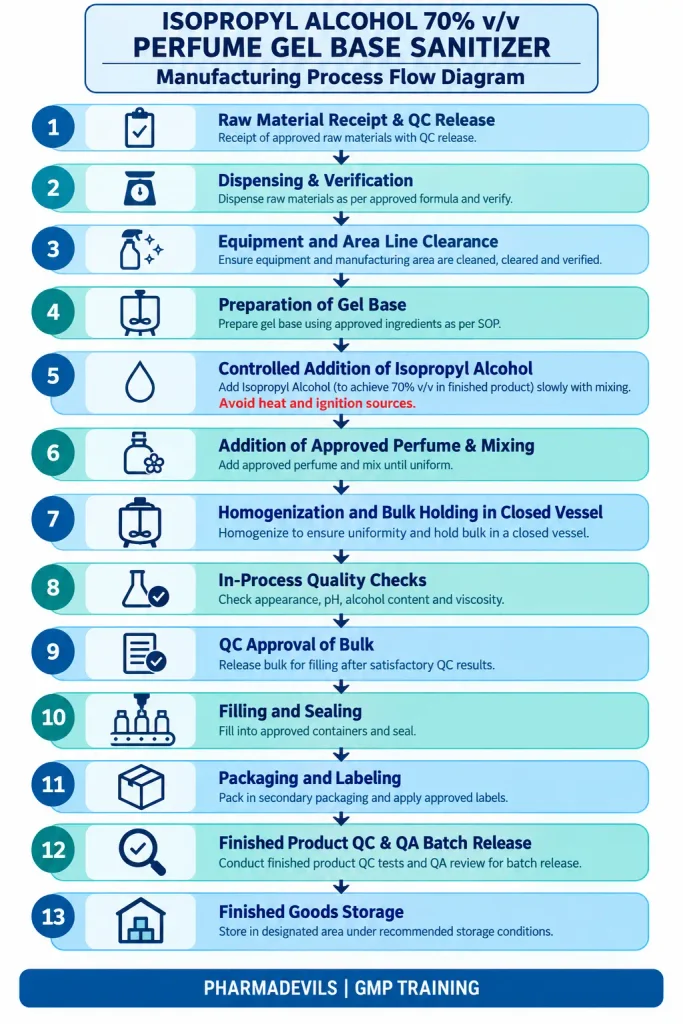
The process begins with raw material receipt, quality control approval, dispensing, and verification of ingredients according to the approved Batch Manufacturing Record (BMR). Equipment cleaning and area line clearance are performed before manufacturing activities commence. The gel base is prepared using approved excipients under controlled mixing conditions. Isopropyl Alcohol is incorporated carefully to achieve the specified final concentration of 70% v/v, followed by the addition of approved perfume and thorough mixing to ensure product uniformity. Critical process parameters, including mixing speed, mixing time, temperature, pH, viscosity, and alcohol concentration, are monitored according to established specifications. Appropriate precautions are maintained to prevent alcohol evaporation, contamination, and exposure to ignition sources. Following satisfactory bulk quality control approval, the sanitizer undergoes filling, sealing, labeling, and secondary packaging operations. Finally, finished product testing, batch documentation review, and Quality Assurance approval ensure compliance with predefined quality standards before the batch is released for distribution and storage.
3. Critical Process Parameters (CPPs) and Critical Quality Attributes (CQAs) of Isopropyl Alcohol 70% v/v Perfume Gel Base Sanitizer
Critical Process Parameters (CPPs) and Critical Quality Attributes (CQAs) play an essential role in ensuring the consistent quality, safety, and effectiveness of Isopropyl Alcohol 70% v/v Perfume Gel Base Sanitizer. Their identification, monitoring, and control support compliance with Good Manufacturing Practices (GMP) and established product specifications.
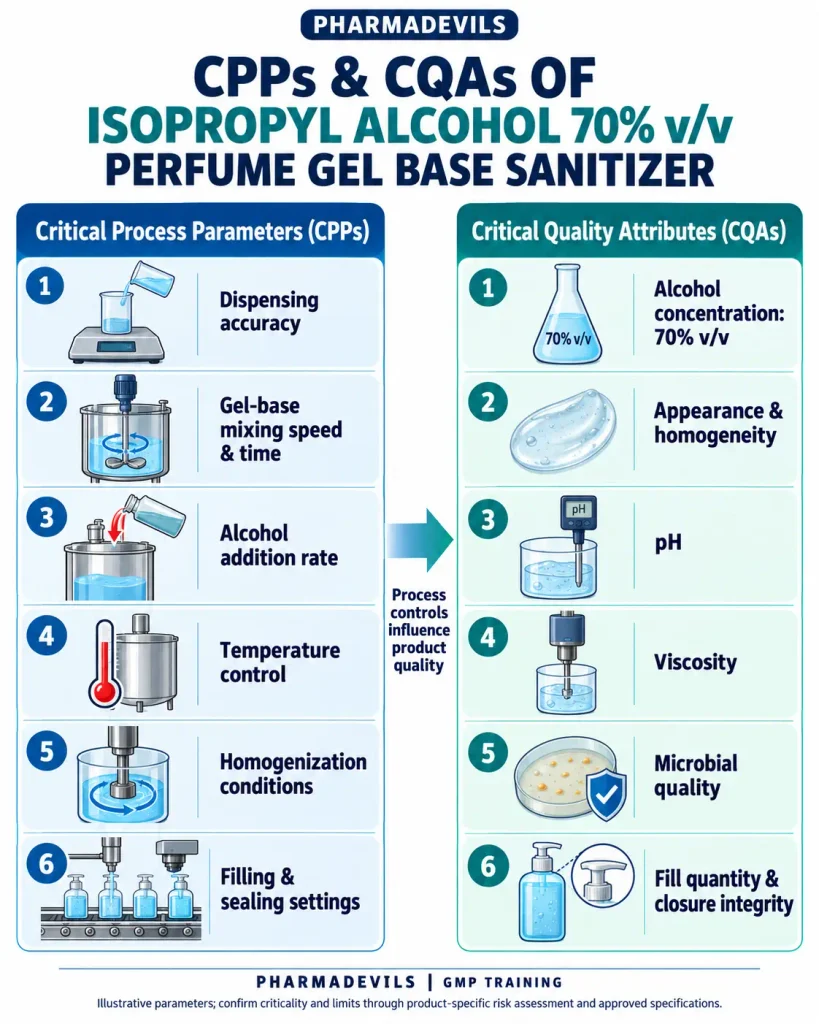
Critical Process Parameters (CPPs) include raw material dispensing accuracy, gel base mixing speed and duration, alcohol addition rate, manufacturing temperature, homogenization conditions, bulk holding time, and filling and sealing parameters. These parameters require appropriate control to maintain formulation uniformity, minimize alcohol evaporation, and prevent manufacturing inconsistencies. Critical Quality Attributes (CQAs) include Isopropyl Alcohol concentration (70% v/v), appearance, homogeneity, pH, viscosity, microbial quality, net fill quantity, and container closure integrity. These attributes help establish whether the finished sanitizer meets its predefined quality requirements. In-process quality checks are performed at designated manufacturing stages to identify potential deviations and ensure satisfactory product characteristics. Appropriate monitoring of alcohol concentration is particularly important because it directly influences antimicrobial performance. Effective control of identified CPPs and verification of CQAs through approved testing procedures, documented acceptance criteria, and Quality Assurance review help ensure consistent manufacturing, product reliability, batch traceability, and regulatory compliance.
Note: Final CPP and CQA classifications and acceptance limits must be established through product-specific quality risk assessment, development studies, and approved specifications.