






1. Introduction to Batch Manufacturing Record (BMR) of Isopropyl Alcohol 70% v/v Perfume Gel Base Sanitizer
The Batch Manufacturing Record (BMR) of Isopropyl Alcohol 70% v/v Perfume Gel Base Sanitizer is a comprehensive pharmaceutical manufacturing document designed to ensure consistent product quality, safety, efficacy, and compliance with Good Manufacturing Practices (GMP). This formulation contains 70% v/v Isopropyl Alcohol in a perfumed gel base, providing an alcohol-based hand sanitizer intended for effective hand hygiene. The BMR provides systematic documentation of manufacturing activities, including raw material dispensing, equipment cleanliness, line clearance, material verification, mixing, gel preparation, filling, sealing, packaging, and finished product inspection. Each manufacturing stage is monitored and recorded to maintain batch traceability, process consistency, and quality assurance. Critical manufacturing parameters include alcohol concentration, mixing conditions, temperature control, product appearance, homogeneity, viscosity, and filling accuracy. Appropriate precautions are essential during manufacturing because Isopropyl Alcohol is highly flammable and volatile. The document also incorporates in-process quality checks, equipment identification, personnel responsibilities, reconciliation, deviation management, and Quality Assurance approval requirements. This BMR serves as an essential reference for production personnel, Quality Control, and Quality Assurance departments, supporting regulatory compliance, data integrity, batch release decisions, and continuous improvement in sanitizer manufacturing operations while ensuring that every manufactured batch meets established specifications and approved quality standards.
Skip to PDF content2. Manufacturing Flow Diagram Description of Isopropyl Alcohol 70% v/v Perfume Gel Base Sanitizer
The manufacturing flow diagram of Isopropyl Alcohol 70% v/v Perfume Gel Base Sanitizer illustrates the systematic production process followed to ensure product quality, consistency, and compliance with Good Manufacturing Practices (GMP).
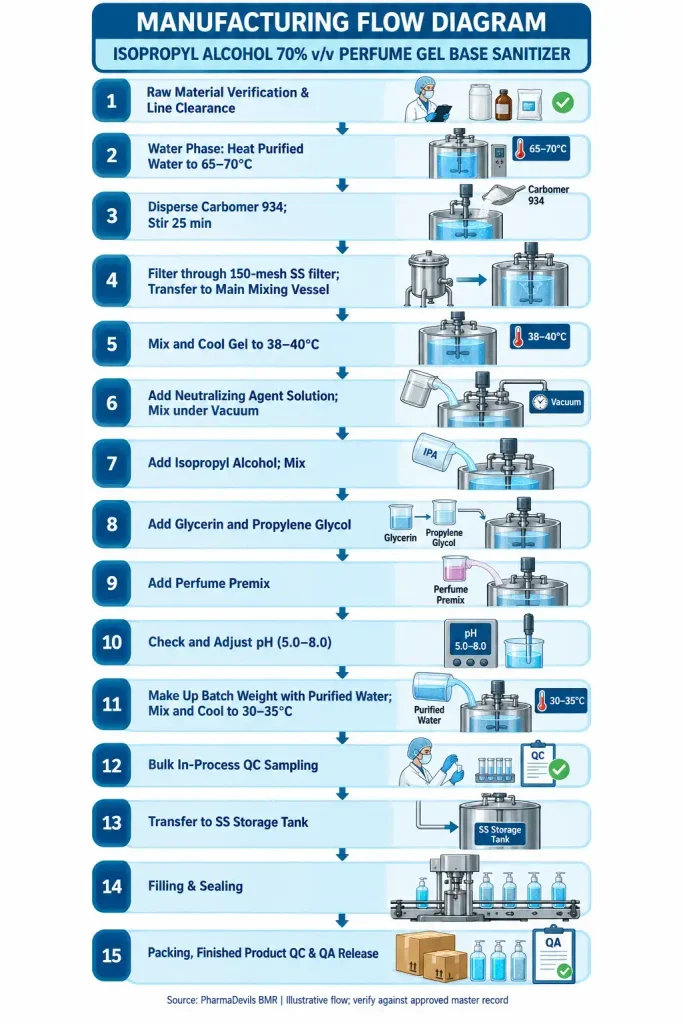
The manufacturing process begins with raw material verification, equipment cleaning, and line clearance. Purified Water is heated to 65–70°C, followed by the gradual addition of Carbomer 934 under continuous stirring for 25 minutes to obtain a uniform gel. The prepared gel is filtered through a 150-mesh stainless steel filter and transferred into the main mixing vessel. After cooling to the specified temperature, the neutralizing agent solution is added under controlled mixing conditions. Isopropyl Alcohol is subsequently incorporated, followed by Glycerin, Propylene Glycol, and Perfume to achieve the required formulation characteristics. The pH is checked and adjusted within the specified range of 5.0–8.0. Purified Water is added to achieve the final batch weight, followed by controlled mixing and cooling. In-process quality control testing is performed before transferring the bulk sanitizer into stainless steel storage tanks. The product subsequently undergoes filling, sealing, packaging, finished product testing, and Quality Assurance release, ensuring batch traceability and compliance with approved specifications.
Note: The BMR contains inconsistent neutralizing-agent names, which require verification before implementation.
3. Critical Process Parameters (CPPs) and Critical Quality Attributes (CQAs) of Isopropyl Alcohol 70% v/v Perfume Gel Base Sanitizer
Critical Process Parameters (CPPs) and Critical Quality Attributes (CQAs) play an essential role in ensuring the consistent manufacturing, safety, effectiveness, and quality of Isopropyl Alcohol 70% v/v Perfume Gel Base Sanitizer in accordance with Good Manufacturing Practices (GMP).
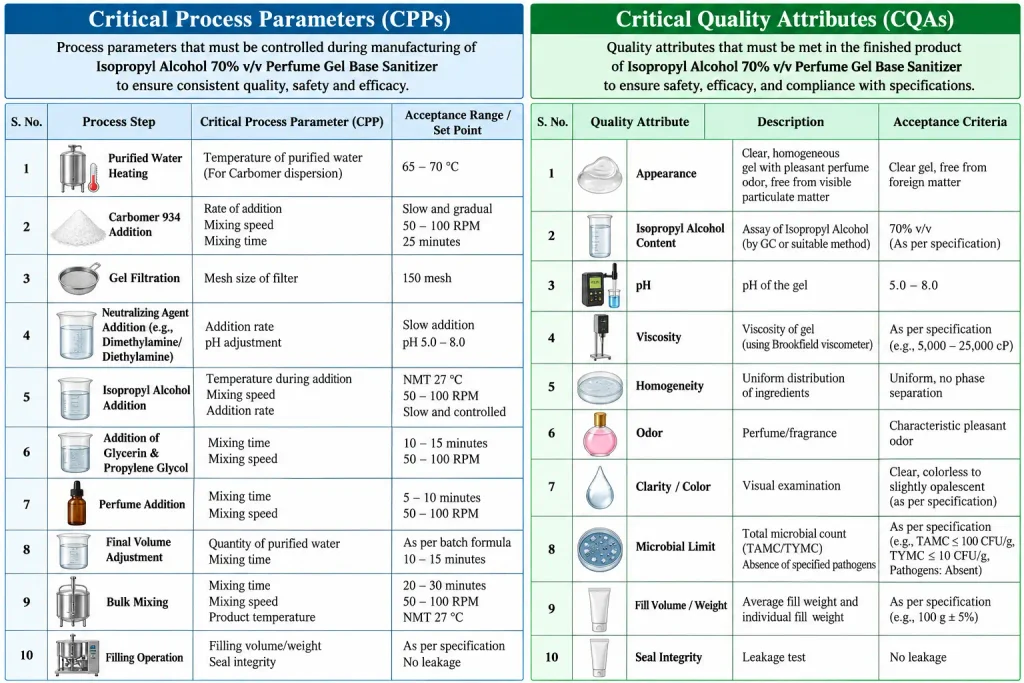
Critical Process Parameters (CPPs) include purified water heating temperature (65–70°C), Carbomer 934 dispersion time (25 minutes), filtration through a 150-mesh stainless steel filter, controlled mixing, neutralizing agent addition, and pH adjustment. Proper incorporation of Isopropyl Alcohol, Glycerin, Propylene Glycol, and Perfume is essential to achieve a uniform gel formulation. Final mixing, temperature monitoring, and batch weight adjustment also influence product consistency. Critical Quality Attributes (CQAs) include Isopropyl Alcohol concentration (70% v/v), pH (5.0–8.0), appearance, viscosity, homogeneity, fragrance, microbial quality, and packaging integrity. These attributes help determine whether the finished sanitizer meets established quality requirements. Effective monitoring of CPPs and evaluation of CQAs support batch reproducibility, process validation, quality assurance, and regulatory compliance. Proper documentation, in-process testing, and Quality Assurance verification help minimize manufacturing deviations and ensure consistent product performance.
Note: CPP classifications and acceptance criteria require confirmation through approved specifications and quality risk assessment.