




Brief Description:
This document provides the justification and rationale for routine and non-routine interventions performed during media fill in an aseptic filling area. It covers solution, suspension, bulk sterilization and processes related to Brinzolamide products. The interventions are designed to simulate actual activities that may occur during commercial production and to evaluate their possible contamination risk.
The document includes activities such as aseptic assembly of filling machine parts, addition of bottles, droppers and caps, clearing bottle blockages, machine adjustments, environmental monitoring, operator fatigue, shift changeover, cleaning and machine disassembly. It also covers non-routine situations such as machine breakdown, filling-area door opening, pressure disturbances and glove changes.
For each intervention, the document defines the type, duration, frequency, applicable process, machine-door requirement, activity and rationale. The selected times and frequencies are mainly based on production/media-fill experience and maximum batch-size considerations so that realistic contamination risks can be challenged during media fill.
Flow Diagram:
The flow diagram explains how routine and non-routine interventions are planned, performed, and evaluated during media fill. The process starts by defining the media fill scope and identifying interventions that may occur during aseptic filling. Routine activities include machine assembly, addition of bottles, droppers and caps, clearing blockages, environmental monitoring, operator fatigue, and shift changeover.
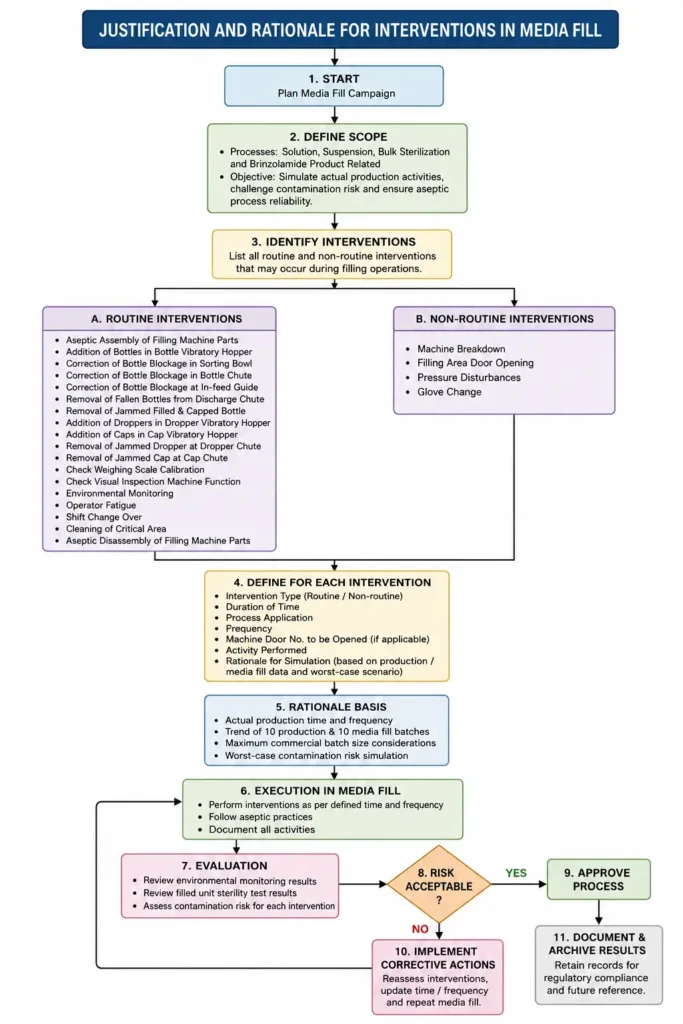
For every intervention, details such as intervention type, duration, frequency, applicable process, machine door opening, activity, and rationale are defined. The selected time and frequency are based mainly on actual production experience, media fill trends, maximum batch size, and contamination-risk considerations.
During media fill, the interventions are performed under controlled aseptic conditions and their impact is evaluated. If the contamination risk remains acceptable, the process is approved and documented. If the risk is unacceptable, corrective actions are taken and the intervention is reassessed before final approval.
Media fill, also known as aseptic process simulation (APS), is a critical validation activity in sterile pharmaceutical manufacturing. It involves simulating the aseptic filling process using a sterile microbial growth medium (e.g., Tryptic Soy Broth) to assess the capability of the environment, equipment, and personnel to maintain sterility.
Interventions during media fills are simulated manipulations or activities that could occur during actual aseptic production. These are performed deliberately to evaluate whether they pose any risk of contamination.
Poka-Yoke:
Poka-Yoke means error-proofing. It is a simple method used to prevent mistakes or detect them quickly during media fill interventions. In aseptic filling, Poka-Yoke helps avoid errors such as using the wrong machine part, adding an incorrect bottle, dropper or cap, exceeding intervention time, missing environmental monitoring, or incomplete shift handover.
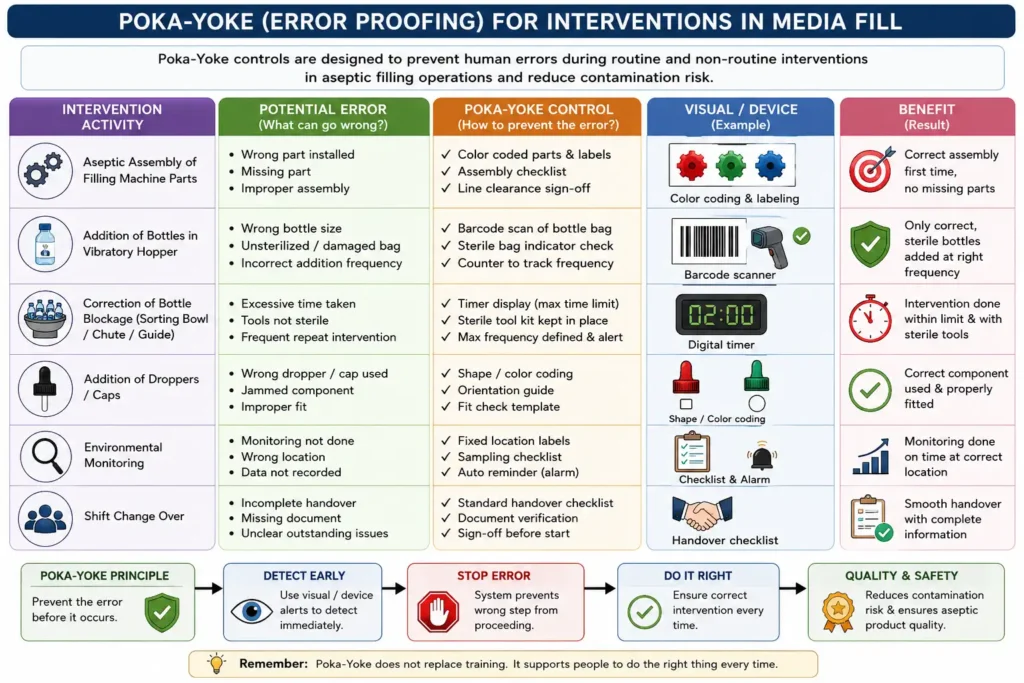
Typical controls include color coding, labels, barcodes, checklists, digital timers, alarms, sterile tool kits, orientation guides, and sign-off checks. These controls guide operators to perform each intervention correctly and consistently.
Questions & Answers – Interventions in Media Fill
1. What is the purpose of interventions during media fill?
The purpose is to simulate activities that occur during actual aseptic production and evaluate their possible contamination risk.
2. What are the main types of interventions?
They are mainly classified as routine interventions and non-routine interventions.
3. What is an example of a routine intervention?
Aseptic assembly of filling machine parts, bottle addition, blockage correction, cap/dropper addition, operator fatigue and shift changeover are examples.
4. How long is aseptic assembly of filling machine parts simulated?
It is simulated for up to 3 hours and performed once at the start of filling.
5. Why are bottles added repeatedly during media fill?
Repeated bottle addition represents the frequency expected during the maximum commercial production batch and challenges contamination risk.
6. How is bottle blockage corrected during media fill?
Depending on the location, the blockage is cleared using sterilized forceps under LAF or through glove ports.
7. Why are droppers and caps added during media fill?
Their addition simulates actual filling operations and evaluates contamination risk associated with repeated component charging.
8. What is the duration of cap addition intervention?
Addition of caps at the cap vibratory hopper is performed for a maximum of 2 minutes at a time.
9. Is operator fatigue considered during media fill?
Yes. Operator fatigue is simulated for 10 minutes, representing an operator working in the filling area for more than four hours.
10. Why is shift changeover included in media fill?
It simulates job handover between operators and evaluates contamination risk during shift changes. The document specifies a 10-minute intervention and simulation twice because production runs in three shifts.
11. What are examples of non-routine interventions?
Examples include correction of abnormal bottle/dropper/cap movement, machine-related interventions, filling-area door opening and glove change.
12. Why is filling-area door opening simulated?
The filling-area door may need to open during activities such as personnel movement or transfer of mobile LAF. The document simulates this condition for up to 2 minutes to evaluate contamination risk.
13. Why is opening of filling-machine guard doors included?
Opening the guard doors creates a contamination challenge, so it is simulated to evaluate whether aseptic conditions remain adequately controlled.
14. Why is glove change simulated?
Glove change represents a non-routine activity that may occur during filling operations and is evaluated for its potential impact on the aseptic process.
15. How are intervention duration and frequency decided?
They are mainly based on actual production experience, media-fill batch trends, maximum production batch size and the contamination risk associated with the activity.
16. What is the overall objective of simulating these interventions?
The overall objective is to demonstrate that routine and unexpected activities can be handled during aseptic filling while appropriately evaluating their potential contamination risk.