







1. Introduction for Operator Exposure Level Test Procedure for Compression Machine Isolator:
The Operator Exposure Level (OEL) Test Procedure evaluates the containment performance of a compression machine isolator fitted with a de-duster, metal detector, and tablet collection glove box. The study uses Naproxen Sodium as surrogate material and follows SMEPAC principles. Operator exposure is assessed through personal breathing-zone sampling, background static air sampling, continuous sampling, and surface swab testing. Sampling pumps are calibrated and positioned at defined critical locations around the isolator. Multiple operating cycles are performed under controlled conditions to determine potential powder leakage and surface contamination. The study demonstrates whether the isolator can maintain operator exposure within the specified containment limits. Operator Exposure Level Test Pr…
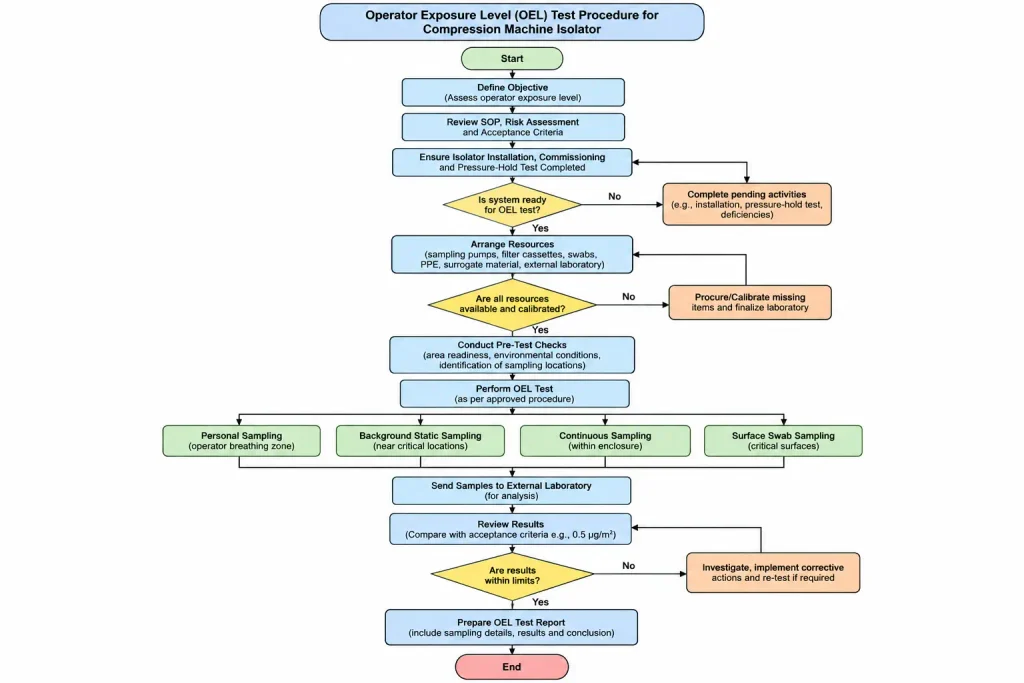
Skip to PDF content2. Flow Diagram of OEL Test Procedure:
The flow diagram summarizes the Operator Exposure Level (OEL) Test Procedure for the Compression Machine Isolator from initial preparation through final reporting. The process begins with defining the test objective, reviewing the SOP, risk assessment, and acceptance criteria, followed by verification of isolator installation, commissioning, and pressure-hold testing. Required resources such as calibrated sampling pumps, filter cassettes, swabs, PPE, surrogate material, and laboratory support are then arranged. After pre-test checks, personal, static, continuous, and surface swab sampling are performed. Samples are analyzed, results are compared with limits, corrective actions are taken if needed, and the final OEL test report is prepared.
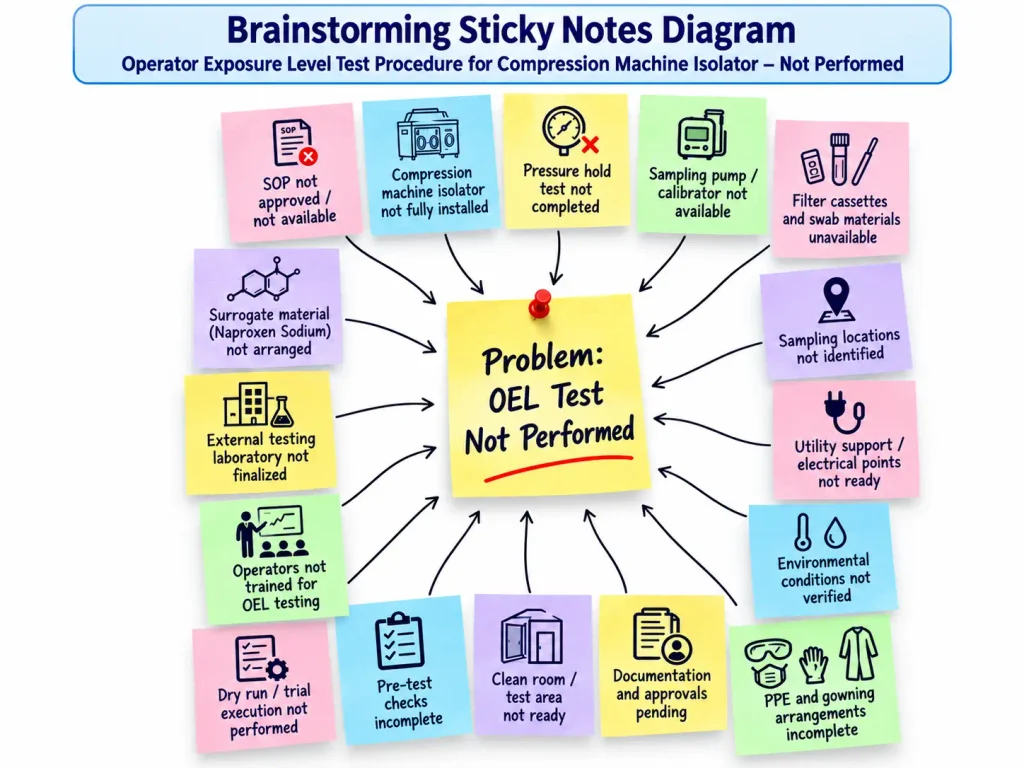
3. Brainstorming Analysis for OEL Test Not Performed:
The brainstorming analysis identifies possible reasons for the Operator Exposure Level Test for the Compression Machine Isolator not being performed. Potential causes include an unavailable or unapproved SOP, incomplete isolator installation, pending pressure-hold testing, lack of calibrated sampling pumps, unavailable filter cassettes and swab materials, and non-availability of Naproxen Sodium surrogate material. Other contributing factors may include an unfinalized external laboratory, unidentified sampling locations, incomplete pre-test checks, unavailable cleanroom facilities, inadequate operator training, pending documentation, unsuitable environmental conditions, incomplete PPE arrangements, and missing utility support. These factors should be evaluated before planning OEL testing.
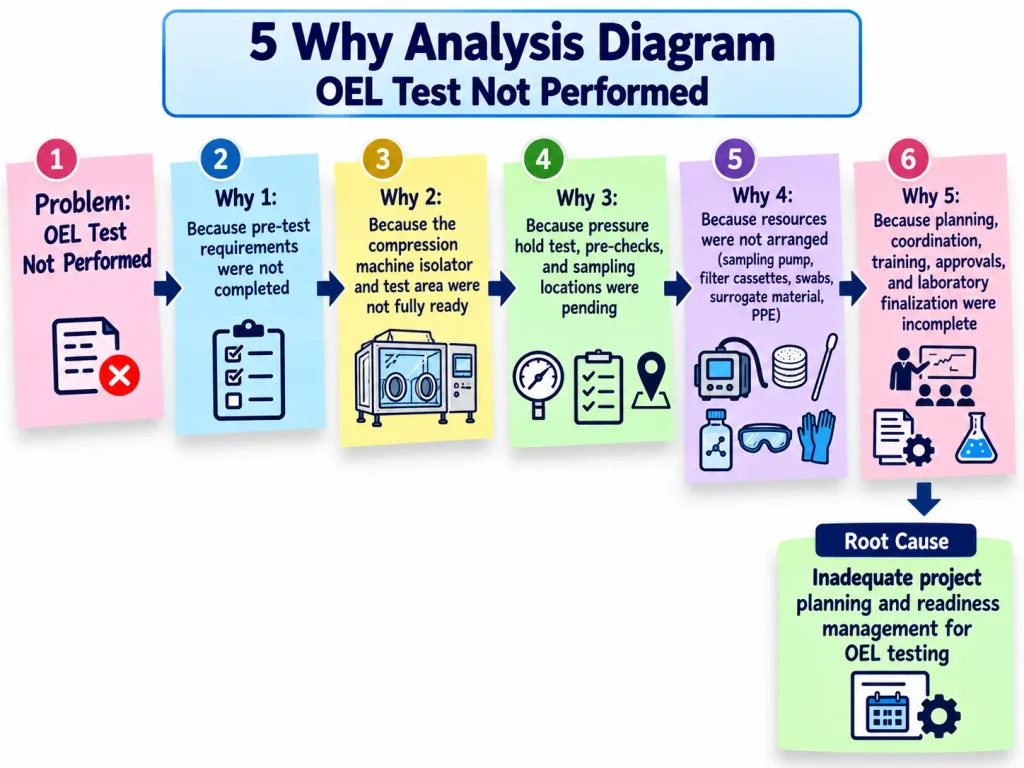
4. 5 Why Analysis for OEL Test Not Performed:
The 5 Why Analysis identifies the underlying reasons why the Operator Exposure Level test for the compression machine isolator was not performed. The investigation shows that pre-test requirements were incomplete because the isolator and test area were not fully ready. This was further linked to pending pressure-hold testing, incomplete pre-checks, and unidentified sampling locations. Required resources such as sampling pumps, filter cassettes, swabs, surrogate material, and PPE were also not adequately arranged. Ultimately, the root cause was identified as inadequate project planning, coordination, training, approvals, laboratory finalization, and overall readiness management for OEL testing.
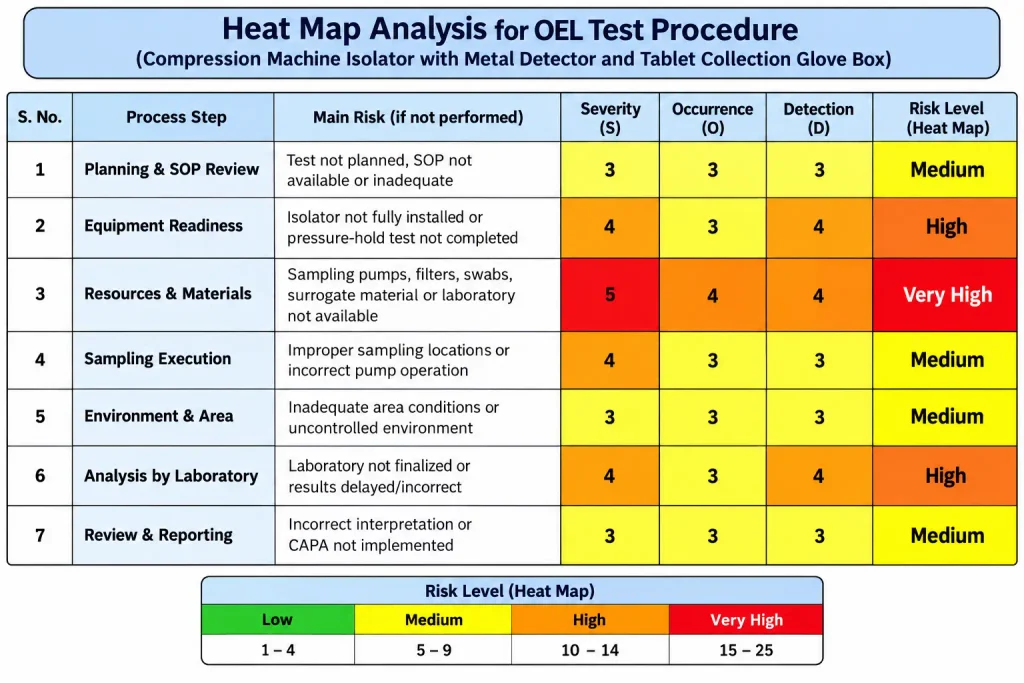
5. Heat Map Analysis for OEL Test Procedure:
The Heat Map Analysis highlights the major risks associated with the Operator Exposure Level test procedure for the compression machine isolator. Each activity is assessed using Severity, Occurrence, and Detection ratings to identify its overall risk level. Planning, sampling execution, environmental conditions, and reporting are considered medium-risk activities, while equipment readiness and laboratory analysis are classified as high risk. Availability of critical resources and materials, including sampling pumps, filters, swabs, surrogate material, PPE, and laboratory support, is identified as the highest-risk area. The heat map helps prioritize corrective actions before execution of the OEL test.
6. Fishbone Analysis for OEL Test Procedure:
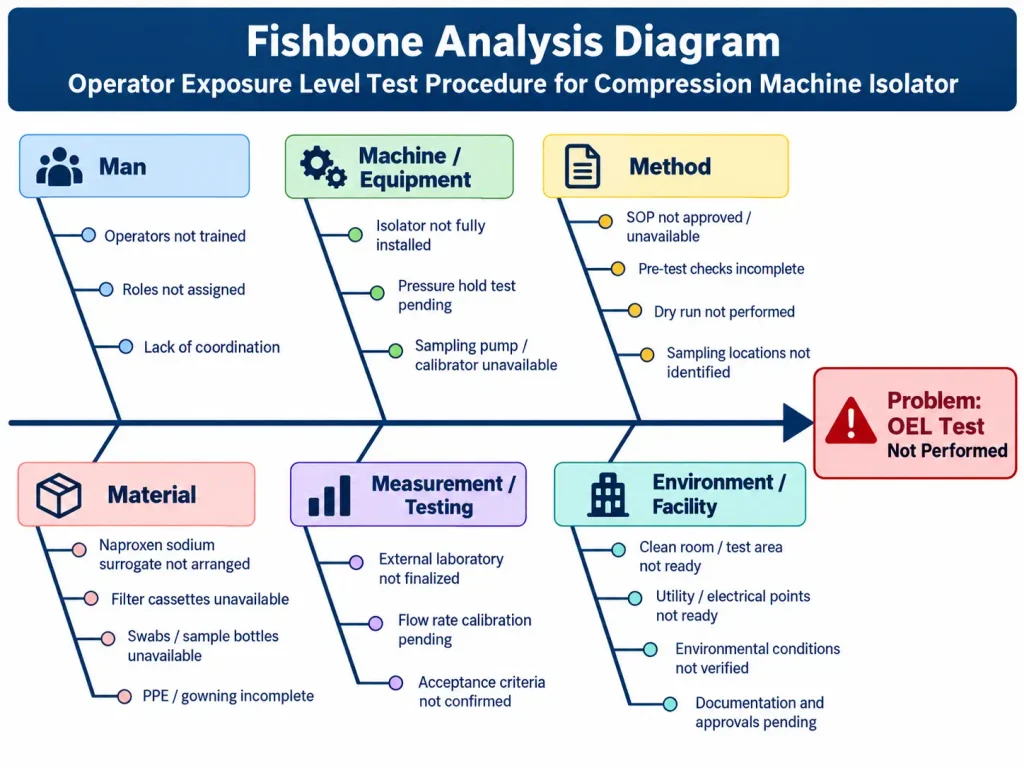
The Fishbone Analysis identifies the major causes that may lead to the Operator Exposure Level Test for the Compression Machine Isolator not being performed. Causes are grouped under Man, Machine/Equipment, Method, Material, Measurement/Testing, and Environment/Facility. Key issues include untrained operators, incomplete isolator installation, pending pressure-hold testing, unavailable sampling pumps, missing SOPs, unidentified sampling locations, unavailable Naproxen Sodium surrogate, filters and swabs, pending laboratory finalization, incomplete flow-rate calibration, unsuitable test-area conditions, and delayed approvals. This analysis helps systematically identify root causes and supports planning of corrective and preventive actions before OEL testing.
7. Fault Tree Analysis for OEL Test Not Performed:
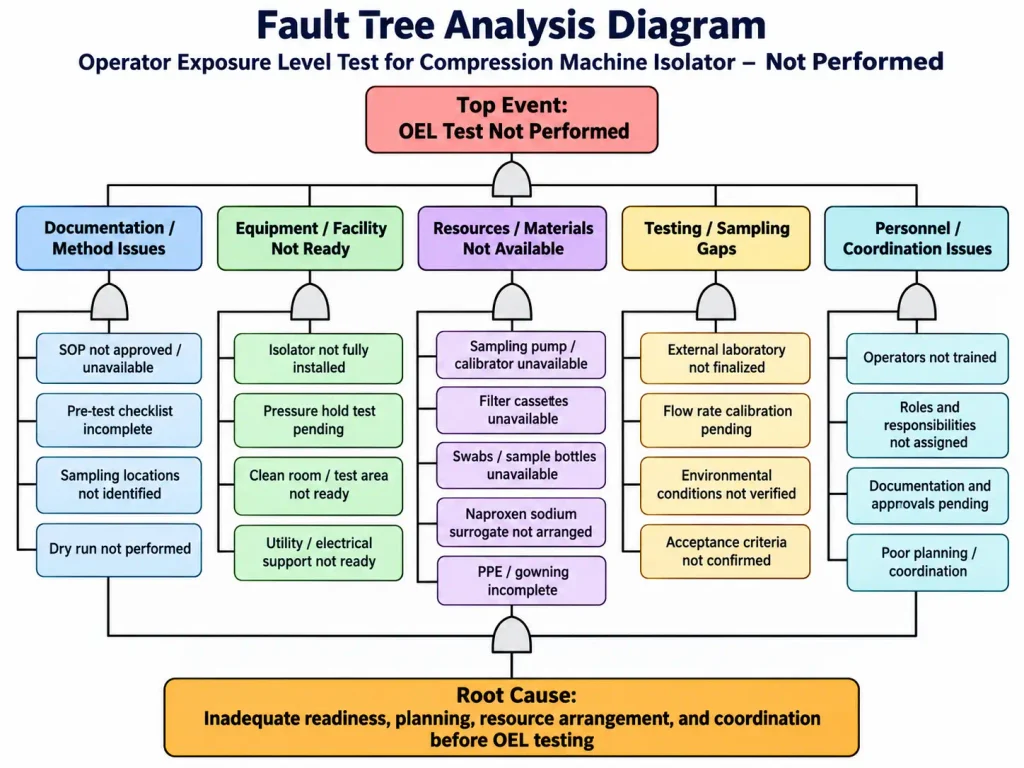
The Fault Tree Analysis identifies the possible causes leading to the top event: Operator Exposure Level Test for the Compression Machine Isolator not being performed. Major contributing branches include documentation and method issues, equipment or facility readiness problems, unavailable resources and materials, testing and sampling gaps, and personnel or coordination failures. Examples include an unapproved SOP, incomplete pre-test checks, pending pressure-hold testing, unavailable sampling pumps and filters, unarranged Naproxen Sodium surrogate, incomplete laboratory finalization, unverified environmental conditions, and inadequate operator training. The analysis indicates that insufficient readiness planning and coordination are key underlying causes.
8. Pareto Chart Analysis for OEL Test Not Performed:
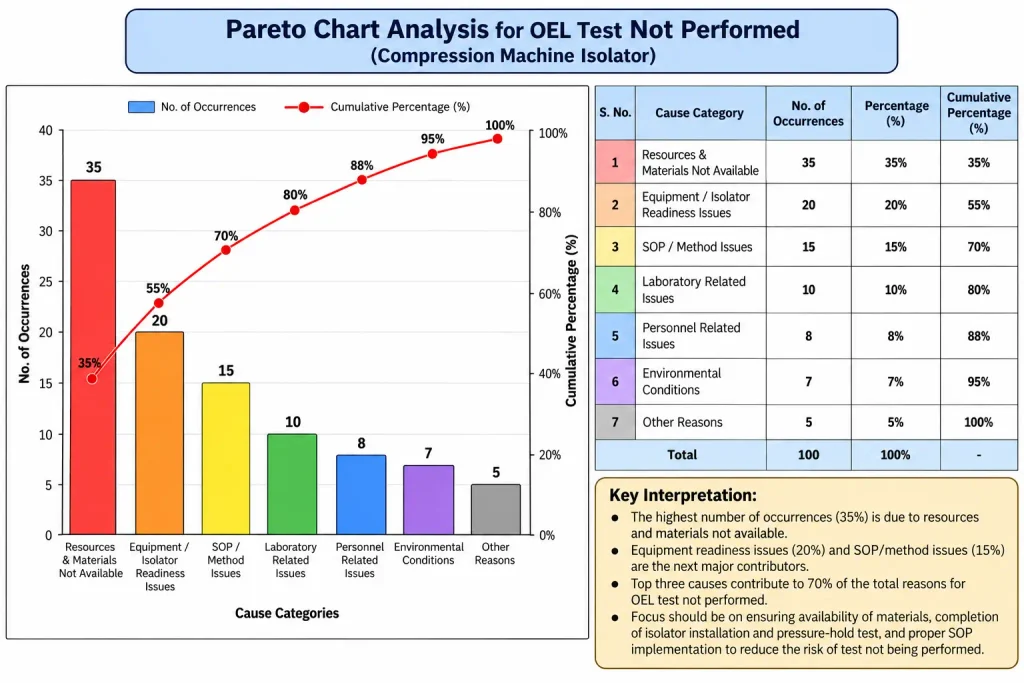
The Pareto Chart Analysis prioritizes the major causes responsible for the OEL Test not being performed for the compression machine isolator. The highest contribution is from resources and materials not being available, followed by equipment or isolator readiness issues and SOP/method-related problems. Together, these top three causes account for the majority of identified reasons. Other contributing factors include laboratory-related issues, personnel-related problems, environmental conditions, and miscellaneous causes. The Pareto analysis helps focus corrective actions on the few critical factors that contribute most significantly to failure of OEL test execution.
9. Corrective Action and Preventive Action with Effectiveness Review – OEL Test Not Performed:
The CAPA should address the gaps that prevented execution of the Operator Exposure Level (OEL) Test for the Compression Machine Isolator. The source procedure requires the isolator to be ready, the SOP to be available, operators to be trained, pressure-hold testing to be satisfactory, required materials and sampling equipment to be available, and an external laboratory to perform sample analysis.
| No. | Identified Issue | Corrective Action | Preventive Action | Responsibility | Target Timeline | Effectiveness Review |
|---|---|---|---|---|---|---|
| 1 | OEL test not performed | Prepare and approve a detailed OEL test execution plan with responsibilities and dates. | Include OEL testing in the qualification/containment validation master schedule. | QA / Engineering / EHS | 15 days | Verify OEL test completed as per approved protocol without delay. |
| 2 | SOP/protocol not approved | Review, finalize and approve the OEL test procedure before execution. | Introduce document-readiness checklist before scheduling containment studies. | QA | 7 days | Confirm current approved SOP/protocol was used during execution. |
| 3 | Isolator not fully ready | Complete installation, commissioning and all pending equipment-related activities. | Link OEL testing to formal equipment-readiness approval. | Engineering | 15 days | Review approved equipment handover and readiness records. |
| 4 | Pressure-hold test pending | Perform pressure-hold test and ensure results meet specified acceptance criteria before OEL study. | Make satisfactory pressure-hold testing a mandatory prerequisite in the OEL checklist. | Engineering / QA | Before OEL test | Verify satisfactory pressure-hold test report is available before test initiation. |
| 5 | Sampling equipment unavailable | Arrange calibrated sampling pumps, calibrator, rotameter, filter cassettes and accessories. | Maintain approved inventory and calibration status of OEL sampling equipment. | QC / EHS | 10 days | Review calibration certificates and confirm no test interruption due to equipment unavailability. |
| 6 | Surrogate and consumables unavailable | Arrange Naproxen Sodium surrogate, swabs, sample bottles, polybags, PPE and other consumables. | Prepare a material requirement checklist and verify availability before test scheduling. | QC / Warehouse / EHS | 7 days | Confirm 100% material availability through pre-execution checklist. |
| 7 | Laboratory not finalized | Qualify and finalize the laboratory responsible for OEL sample analysis. | Maintain an approved laboratory list and technical agreement for containment testing. | QA / QC | 15 days | Confirm samples are analyzed by the approved laboratory and reports are received within agreed timelines. |
| 8 | Sampling locations not finalized | Identify and document personal breathing-zone, static, continuous and surface-swab sampling locations. | Include approved sampling-location diagrams in the protocol. | EHS / QA | Before testing | Verify all samples were collected from predefined locations and properly identified. |
| 9 | Operators not trained | Train operators and test personnel on the approved SOP, sampling procedure and contamination-control requirements. | Introduce periodic OEL/containment training and competency assessment. | QA / EHS | Before execution | Review training records and observe successful execution without procedural error. |
| 10 | Pre-test checks incomplete | Execute documented pre-test checks, environmental verification and dry runs before actual sampling. | Introduce a mandatory QA-approved pre-test readiness checklist. | QA / Engineering / EHS | Before test | Confirm checklist completion and no major deviation during the OEL test. |
Effectiveness Review
The CAPA may be considered effective when the OEL test is successfully completed according to the approved procedure, all prerequisite checks are documented, calibrated sampling equipment and required materials are available, trained personnel execute the study without interruption, and samples are analyzed by the designated laboratory. The final report should demonstrate compliance with the specified containment criteria. The procedure identifies a design value of ≤ 0.5 µg/m³ for 8-hour TWA and a surface-swab limit of ≤ 5 µg/cm².
10. Operator Exposure Level Test Procedure for Compression Machine Isolator:
- What is the purpose of the OEL test?
The purpose is to evaluate operator exposure during operation of the compression machine isolator and verify the effectiveness of its containment performance using air and surface sampling. - Which surrogate material is used for the study?
Naproxen Sodium is specified as the surrogate material. - Which guideline is followed for OEL testing?
The procedure refers to the latest SMEPAC – Standardised Measurement of Equipment Particulate Airborne Concentration guidance. - What types of air samples are collected?
The procedure includes personal breathing-zone samples, background static samples, and continuous static samples. - Where is the personal breathing-zone sampler positioned?
It is positioned within a 300 mm radius of the operator’s mouth and nose, typically on the lapel. - What is the specified sampling flow rate?
Sampling is performed at 2 litres per minute ± 0.1 L/min. - How long should each sampling run be?
Each of the three sampling runs should be approximately 180 minutes, depending on the required OEL and analytical detection capability. - How many protocol cycles are planned?
The procedure requires sufficient material to complete three protocol cycles. - What pre-test checks are required?
Pre-test checks include verification of glove-port fittings, visor clamps, filter-housing connections, equipment operating conditions, environmental conditions, and dry runs. - Why is a pressure-hold test important?
The isolator should undergo a satisfactory pressure-hold test before containment performance testing to confirm enclosure integrity. - What is the purpose of surface swab sampling?
Surface swab sampling determines the degree of contamination on external surfaces that may be exposed during operation. - What swab area is preferred?
Where feasible, a 100 cm² area (10 cm × 10 cm) should be swabbed in horizontal and vertical zigzag patterns. - Why should gloves be changed between swab samples?
New gloves are required for each sample to prevent cross-contamination of the swab sample. - What sampling equipment is required?
Required equipment includes an air sampler, swabs, calibrator, rotameter, beakers, labels, bags, gloves and related accessories. - Who should perform the test?
The test should be performed by regular trained staff associated with the isolator, supported by the testing personnel. - What is the air-containment design criterion stated in the procedure?
The conclusion section specifies a design value of ≤ 0.5 µg/m³ for 8-hour TWA. - What is the stated surface swab limit?
The procedure specifies a surface-swab limit of ≤ 5 µg/cm². - Why is an external laboratory required?
The laboratory performs analysis of OEL samples using a validated analytical method and supports preparation of the final test results. - What should be done if the OEL test results do not meet the acceptance criteria?
The source procedure provides for reporting compliance as pass/fail; failure should therefore trigger investigation and corrective action before closure of the study. - What is the main outcome of the OEL test?
The test demonstrates whether the compression machine isolator adequately controls airborne and surface contamination and whether operator exposure remains within the defined limits.
11. Reference Guidelines – Operator Exposure Level Test Procedure for Compression Machine Isolator:
- ISPE SMEPAC Guideline – Standardized Measurement of Equipment Particulate Airborne Concentration
Primary reference for evaluating containment performance and operator exposure through airborne particulate sampling. The procedure specifically states that testing is performed in accordance with the latest SMEPAC guide. - SMEPAC – Test Enclosure Environmental Conditions
The procedure references SMEPAC requirements for temperature, relative humidity, room pressure and air-change conditions during containment testing. - British Pharmacopoeia (BP)
The surrogate material specified in the procedure is Naproxen Sodium BP, making the applicable pharmacopoeial specification relevant for surrogate material quality. - Functional Design Specification (FDS)
The operating sequence and containment design criterion should be evaluated against the approved FDS for the isolator system. Operator. - Factory Acceptance Test (FAT) Requirements
The isolator pressure-hold test should meet the limits specified in the FAT before containment performance testing is conducted. - Approved Equipment SOP / Operating Procedure
A written SOP for operation of the compression machine isolator must be available, and operators must be trained before execution of the containment performance test.