





1. Introduction for Operator Exposure Level Test Procedure for Sampling, Dispensing & Blending Isolator:
The Operator Exposure Level (OEL) Test Procedure explains how to evaluate the containment performance of a dispensing, sieving, and blending isolator. Its main purpose is to confirm that operators are protected from exposure to pharmaceutical powder during routine activities. The test follows the latest SMEPAC guidance and uses Naproxen Sodium as a surrogate material. Before testing, the isolator, gloves, clamps, filters, connections, ventilation, and operating conditions are carefully checked. Trained personnel must wear clean gowns, masks, headgear, shoe covers, and non-powder-shedding gloves. Dry runs are performed to ensure that the approved operating procedure can be completed without interruption or failure. Air samples are collected using calibrated sampling pumps positioned at important locations. A personal breathing-zone sampler is attached near the operator’s nose and mouth. Static samplers are placed near glove ports, chamber doors, rapid transfer ports, drum-loading areas, and behind the isolator. Background samples are also collected before starting the operation. Sampling is generally performed at 2 litres per minute, and three test cycles are conducted. Surface swab samples are taken before and after the air-sampling cycles. Typical swabbing locations include the sifter connection, glove port, rapid transfer port, door gasket, and drum-loading liner. Wherever possible, an area of 100 cm² is wiped horizontally and vertically. Fresh gloves must be used for every sample to prevent cross-contamination. All samples are properly identified, sealed, stored, and sent to an accredited laboratory for analysis. The laboratory uses a validated analytical method to measure Naproxen Sodium. The acceptance criteria are not more than 0.5 µg/m³ for an eight-hour time-weighted average and not more than 5 µg/cm² for surface contamination. Results are recorded in the final report, compared with the design limits, and concluded as pass or fail. Any deviations from SMEPAC requirements must be documented, assessed, scientifically justified, and approved by Quality Assurance and Environmental Health and Safety personnel.
Skip to PDF content2. Flow Diagram for Operator Exposure Level Test Procedure for Sampling, Dispensing & Blending Isolator:
The flow diagram explains how the Operator Exposure Level Test is performed to check whether an isolator protects workers from pharmaceutical powder. The process begins by preparing the test area and checking the isolator, equipment, utilities, gloves, filters, clamps, and connections. Trained employees and the required quantity of Naproxen Sodium are arranged before testing.
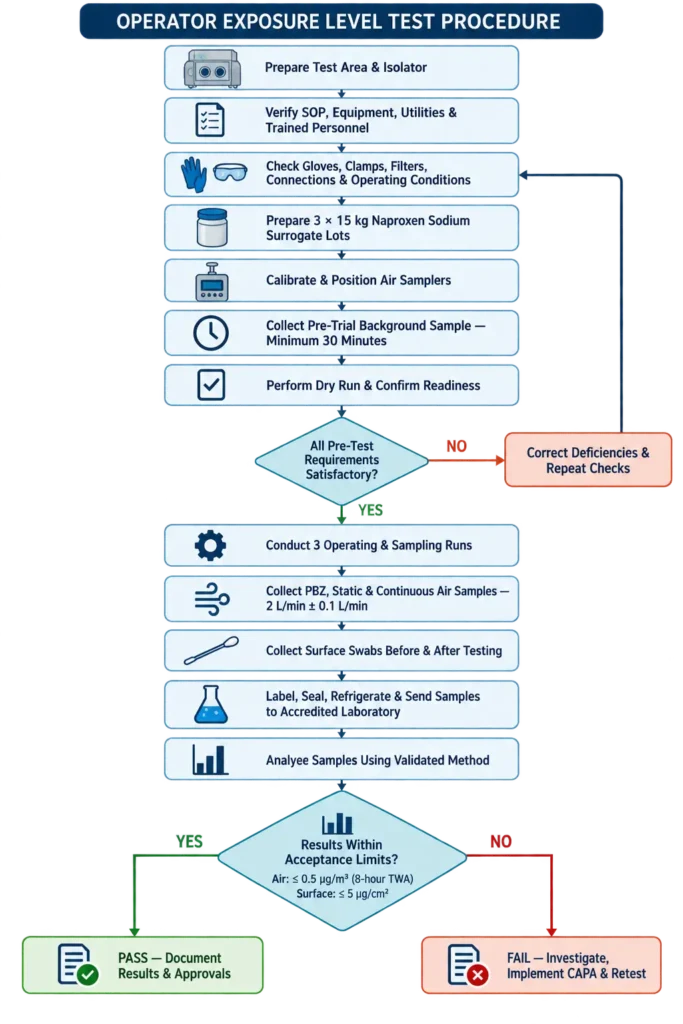
Air-sampling pumps are calibrated and placed near the operator and other high-risk locations. A background air sample is collected for at least 30 minutes. A dry run is then conducted to confirm that all activities can be completed safely. If any requirement is unsatisfactory, the problem is corrected before testing continues. Three operating and sampling runs are performed. Personal, static, and continuous air samples are collected, along with surface swabs before and after testing. Samples are labelled, sealed, refrigerated, and sent to an accredited laboratory. Results are compared with approved limits. Compliant results are documented; failed results require investigation, CAPA, and retesting.
3. Brainstorming for Operator Exposure Level Test Procedure for Sampling, Dispensing & Blending Isolator not available:
The brainstorming diagram identifies the main reasons why an Operator Exposure Level Test Procedure may not be available for the sampling, dispensing, and blending isolator. It shows that the procedure may not have been drafted, reviewed, or approved. Responsibility may also be unclear, with no department or person assigned to plan and complete the test. Other possible causes include failure to assess containment risks, limited knowledge of SMEPAC requirements, and lack of essential resources such as air samplers, filters, swabs, and surrogate material. Testing may also be delayed because an accredited laboratory, validated analytical method, or trained personnel are unavailable.
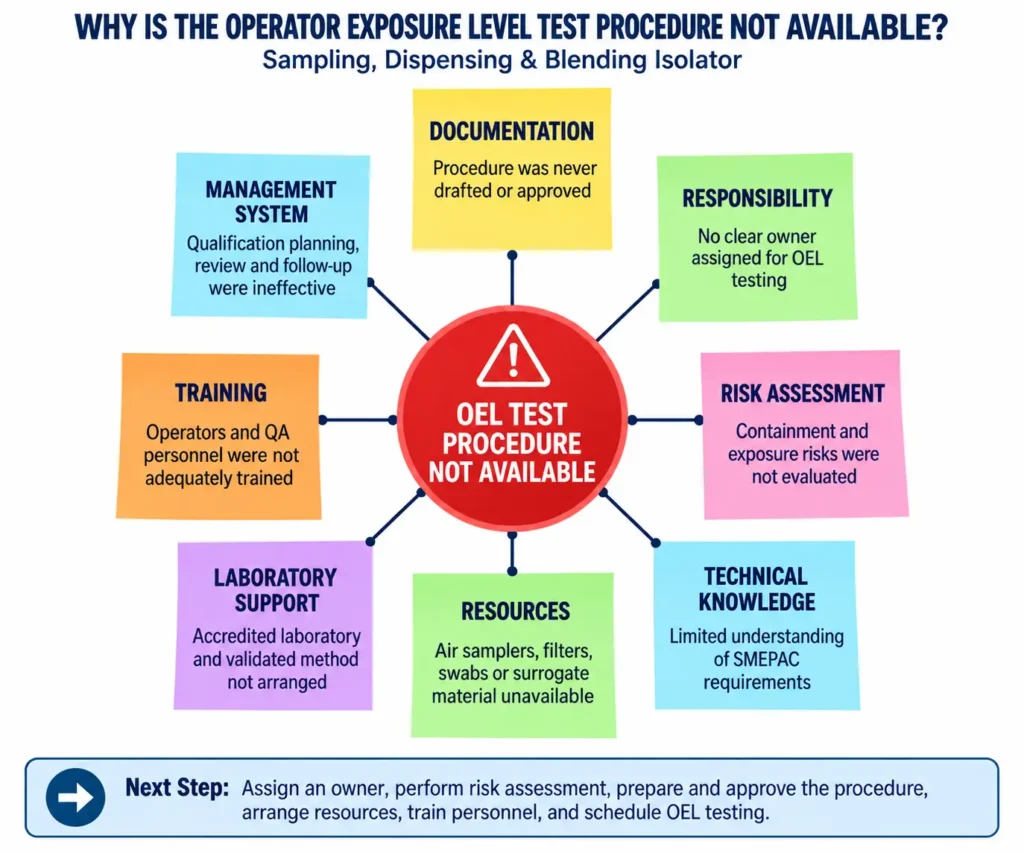
The diagram further highlights weak qualification planning, management review, and follow-up. These combined gaps can prevent confirmation that the isolator adequately protects operators from pharmaceutical powder exposure. The recommended action is to assign ownership, complete a risk assessment, prepare and approve the procedure, arrange resources, train employees, and schedule testing.
4. 5-Why Analysis for Operator Exposure Level Test Procedure for Sampling, Dispensing & Blending Isolator not available:
The 5-Why analysis explains why the Operator Exposure Level Test Procedure was not available for the sampling, dispensing, and blending isolator. The first why shows that the procedure had not been prepared, reviewed, or approved. This occurred because no responsible person or department had been assigned to develop and control it. The next why identifies that responsibility was not assigned because OEL testing was omitted from the isolator qualification plan. It was omitted because the risk assessment did not properly identify operator exposure hazards and containment requirements. Further investigation found that the risk assessment was inadequate because the quality management system lacked clear SMEPAC-based guidance, defined ownership, and effective management review.
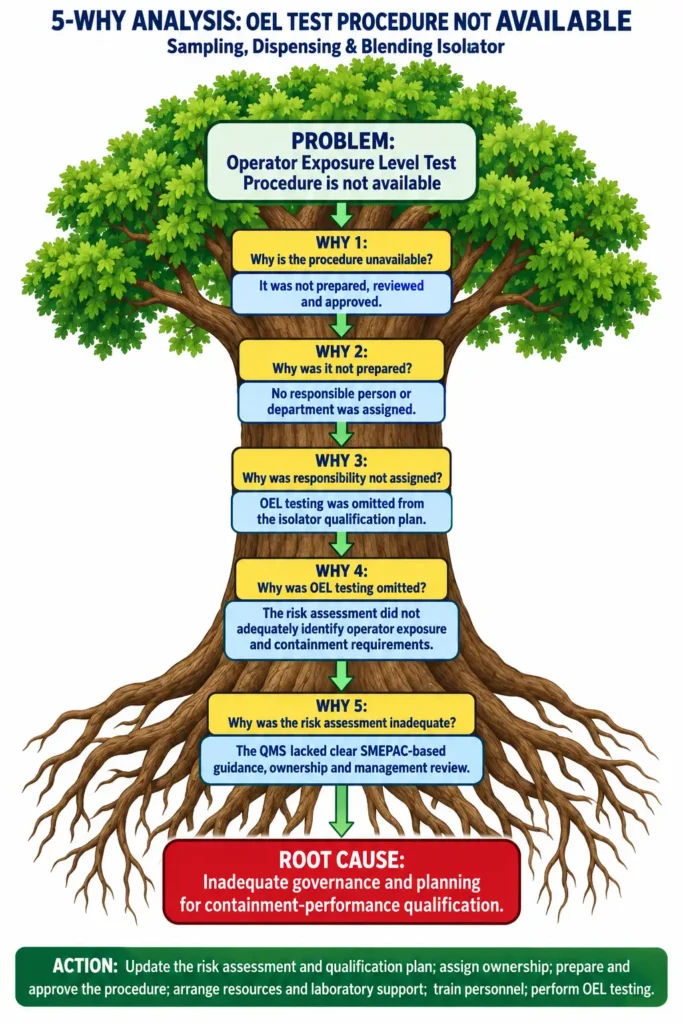
The root cause is therefore inadequate governance and planning for containment-performance qualification. To correct the problem, the company should update the risk assessment and qualification plan, assign ownership, approve the procedure, arrange testing resources, train personnel, and perform testing.
5. Heat Map analysis for Operator Exposure Level Test Procedure for Sampling, Dispensing & Blending Isolator not available:
The heat map evaluates the risks created when the Operator Exposure Level Test Procedure is unavailable for the sampling, dispensing, and blending isolator. Each risk is rated by severity and likelihood. Multiplying these two ratings gives the overall risk score and classification. The analysis identifies unknown operator exposure as the highest risk, with a score of 20, classified as critical. Unverified isolator containment scores 15, while regulatory non-compliance and the missing approved procedure each score 16. These are also critical risks. Powder leakage, cross-contamination, inadequate sampling or laboratory support, and personnel training gaps score 12, placing them in the high-risk category.
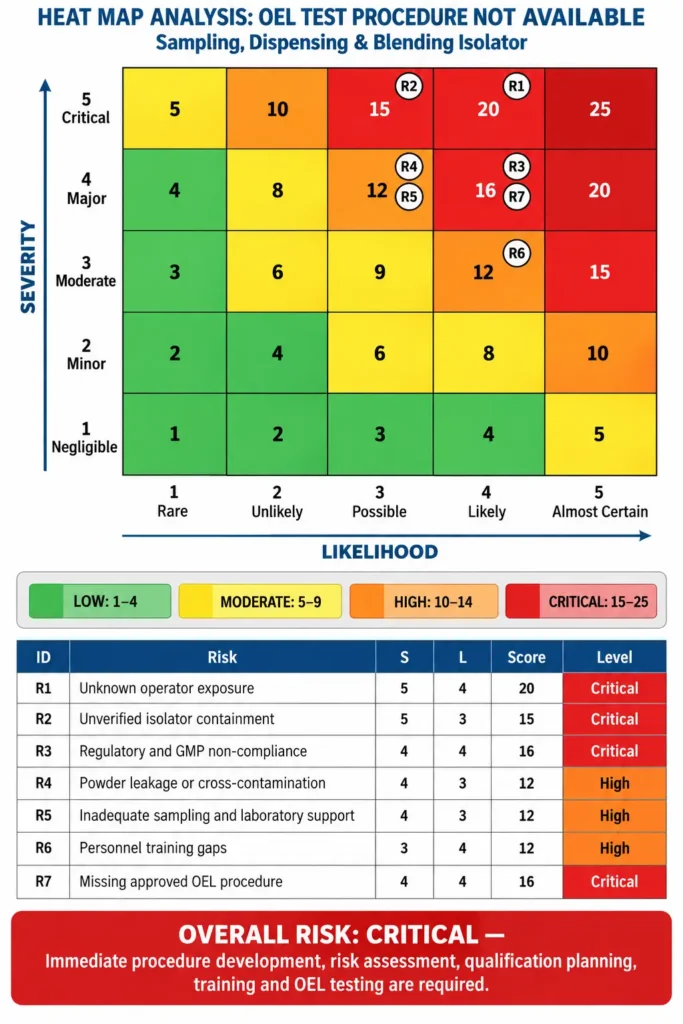
The overall risk is critical because worker protection and containment performance have not been demonstrated. Immediate action is required to prepare and approve the procedure, update the risk assessment and qualification plan, arrange suitable sampling equipment and laboratory support, train personnel, conduct OEL testing, document results, and verify effectiveness.
6. Fault Tree Analysis for Operator Exposure Level Test Procedure for Sampling, Dispensing & Blending Isolator not available:
The Fault Tree Analysis explains how several failures can lead to the Operator Exposure Level Test Procedure being unavailable for the sampling, dispensing, and blending isolator. The top event is connected through OR gates, meaning that any one of the identified failures may contribute to the problem. The first branch covers document-control failures, including no assigned owner, an unprepared or unapproved procedure, and ineffective follow-up. The second branch identifies qualification and risk-planning failures, such as omission of OEL testing from the qualification plan, inadequate identification of exposure hazards, and poor application of SMEPAC requirements. The third branch covers resource and execution failures, including unavailable sampling equipment, absent laboratory support, and insufficiently trained personnel.
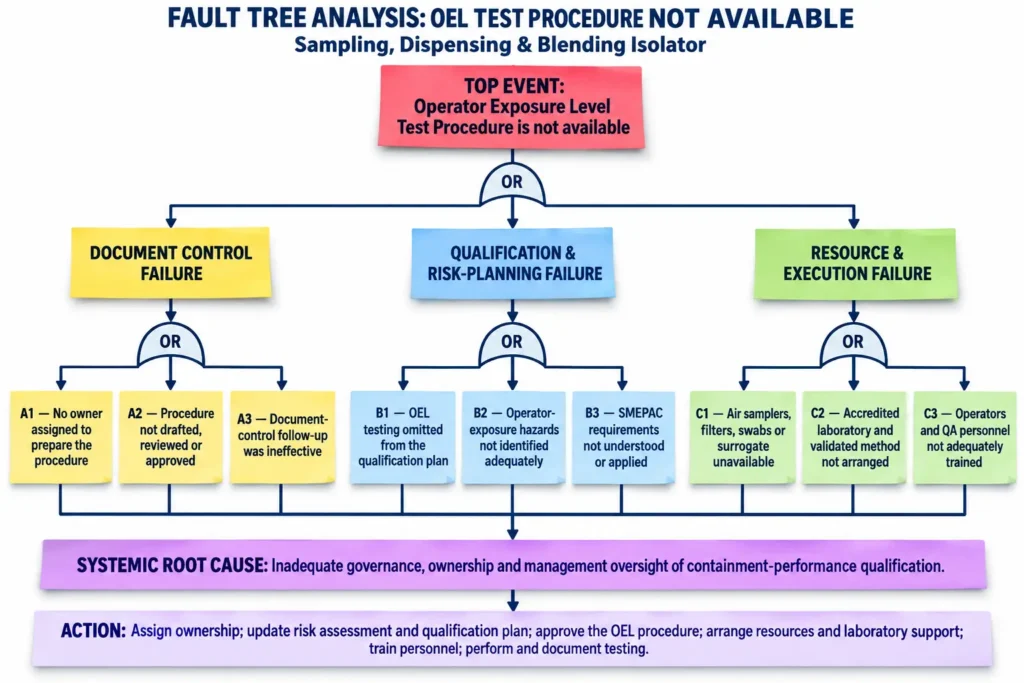
Together, these failures indicate inadequate governance, ownership, and management oversight of containment-performance qualification. Corrective action should assign responsibility, strengthen the risk assessment and qualification plan, approve the procedure, arrange resources, train employees, conduct testing, and document results.
7. Pareto Chart for Operator Exposure Level Test Procedure for Sampling, Dispensing & Blending Isolator not available:
The Pareto chart ranks the main causes responsible for the Operator Exposure Level Test Procedure being unavailable for the sampling, dispensing, and blending isolator. The bars show each cause’s percentage contribution, while the orange line shows the cumulative percentage. Missing ownership is the largest cause at 24%, followed by omission of OEL testing from the qualification plan at 20%. Inadequate risk assessment contributes 18%, the SMEPAC knowledge gap contributes 14%, and resource or laboratory gaps contribute 10%. Together, these first five causes account for 86% of the problem and represent the vital few requiring immediate attention. Document-control delays and training gaps contribute the remaining 14%.
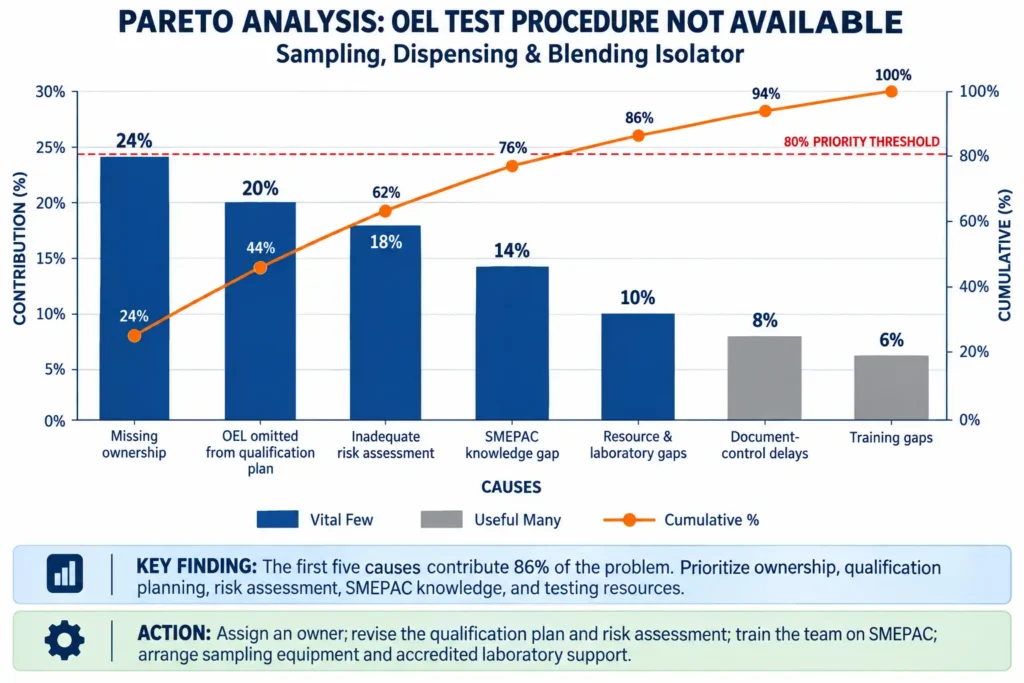
The chart helps management focus resources on actions that will provide the greatest improvement. Priority actions include assigning an owner, revising the qualification plan and risk assessment, improving SMEPAC knowledge, arranging sampling equipment and accredited laboratory support, approving the procedure, and verifying completion through testing.
8. Corrective Action and Preventive Action Plan for Operator Exposure Level Test Procedure for Sampling, Dispensing & Blending Isolator not available:
Problem: The approved Operator Exposure Level (OEL) Test Procedure was unavailable for the Sampling, Dispensing and Blending Isolator.
Immediate Correction
- Suspend handling of hazardous or highly potent materials in the isolator until the exposure risk is assessed.
- Perform a documented interim risk assessment covering operator exposure, powder leakage and cross-contamination.
- Review the isolator qualification status, containment design and existing operating procedures.
- Introduce temporary controls such as suitable PPE, restricted access, enhanced cleaning and environmental monitoring.
Corrective Actions
| No. | Corrective action | Responsibility |
|---|---|---|
| 1 | Initiate deviation and conduct documented root-cause analysis. | QA |
| 2 | Assign an owner for preparation and execution of the OEL procedure. | QA Head |
| 3 | Prepare, review and approve an SMEPAC-based OEL test procedure and protocol. | QA/EHS/Engineering |
| 4 | Define surrogate material, sampling locations, flow rate, duration, number of runs and acceptance criteria. | QA/EHS |
| 5 | Qualify an accredited laboratory with a validated analytical method and suitable LOQ. | QC/QA |
| 6 | Arrange calibrated air samplers, filters, swabs and required accessories. | Engineering/QC |
| 7 | Train operators, QA, QC and EHS personnel on the approved procedure. | QA/Training |
| 8 | Conduct background, personal breathing-zone, static air and surface-swab sampling. | Qualified Team |
| 9 | Evaluate results, investigate failures and approve the final OEL report. | QA/EHS |
Preventive Actions
- Include OEL testing in the Validation Master Plan and isolator qualification lifecycle.
- Add containment assessment to change controls for products, equipment and processes.
- Maintain an approved OEL-testing schedule and responsibility matrix.
- Establish periodic procedure review, refresher training and equipment-calibration reminders.
- Audit containment systems and laboratory arrangements annually.
- Maintain controlled templates for protocols, sampling records and reports.
Effectiveness Check
Verify within 60–90 days that the procedure is approved, personnel are trained, testing is completed, results meet limits, records are complete and no repeat deviation occurs.
9. Questions and Answers for Operator Exposure Level Test Procedure for Sampling, Dispensing & Blending Isolator not available:
1. What is an Operator Exposure Level Test?
It measures the amount of pharmaceutical powder present in the operator’s breathing zone and surrounding work area during operation.
2. Why is OEL testing required for an isolator?
It confirms that the isolator contains the product effectively and protects operators from harmful exposure.
3. What is the main concern when the OEL test procedure is unavailable?
The company cannot scientifically demonstrate that the sampling, dispensing and blending operations are adequately contained.
4. What are the possible risks?
Possible risks include operator exposure, powder leakage, cross-contamination, regulatory non-compliance and unverified isolator performance.
5. What was the identified root cause?
The primary root cause was inadequate governance, responsibility assignment and planning for containment-performance qualification.
6. Who should prepare the procedure?
A qualified multidisciplinary team involving QA, EHS, Engineering, Production and QC should prepare and review it.
7. Which guideline may be followed?
The current SMEPAC guidance and applicable occupational-exposure, GMP and industrial-hygiene requirements should be considered.
8. Which surrogate material may be used?
Naproxen Sodium may be used when scientifically justified and compatible with the validated analytical method.
9. Which samples should be collected?
Samples normally include pre-test background, personal breathing-zone, static area, continuous air and surface-swab samples.
10. How many test runs should be conducted?
The supplied procedure specifies three operating and sampling runs representing routine or worst-case conditions.
11. What are the proposed acceptance limits?
The procedure specifies an air limit of ≤0.5 µg/m³ as an eight-hour TWA and a surface limit of ≤5 µg/cm², subject to approved project requirements.
12. What equipment is required?
Calibrated air-sampling pumps, suitable filters, swabs, flow calibrators, sampling containers, labels and protective clothing are required.
13. What should be done before testing?
Complete the risk assessment, approve the procedure, verify isolator integrity, calibrate instruments, qualify the laboratory and train personnel.
14. What happens if the results fail?
Initiate an investigation, assess operator and product impact, identify leakage sources, implement CAPA and repeat testing after corrections.
15. How is CAPA effectiveness verified?
Effectiveness is confirmed through approved documentation, completed training, acceptable OEL results, closed observations and absence of repeat deviations.
10. Reference Guidelines for Operator Exposure Level Test Procedure for Sampling, Dispensing & Blending Isolator not available:
- ISPE Good Practice Guide: SMEPAC, Third Edition
Standardized methodology for evaluating airborne particulate emissions from pharmaceutical containment systems. This is the principal reference for surrogate testing, sampling positions, test cycles and containment-performance reporting.
ISPE SMEPAC Guide - ISPE Good Practice Guide: Containment for Potent Compounds
Provides guidance on occupational exposure limits, containment strategies, isolators, risk assessment and verification of containment performance.
ISPE Containment Guide - EU Guidelines for Good Manufacturing Practice—EudraLex Volume 4
- Chapter 1: Pharmaceutical Quality System
- Chapter 3: Premises and Equipment
- Chapter 5: Production and prevention of cross-contamination
- Annex 15: Qualification and Validation
- ICH Q9(R1)—Quality Risk Management
Applicable to identifying operator-exposure hazards, evaluating containment failures and establishing risk-based controls.
ICH Quality Guidelines - ICH Q10—Pharmaceutical Quality System
Supports defined responsibilities, document control, CAPA, management review, training and continual improvement.
ICH Quality Guidelines - OSHA Technical Manual—Personal Sampling for Air Contaminants
Provides principles for breathing-zone sampling, sampling pumps, flow calibration, sampling media and exposure assessment.
OSHA Technical Manual - NIOSH Manual of Analytical Methods
Provides validated approaches for workplace air sampling and analytical measurement of occupational contaminants.
NIOSH NMAM - ISO 14644-7—Separative Devices
Covers clean-air hoods, gloveboxes, isolators and mini-environments used to separate operators, products and surrounding environments. - WHO Good Manufacturing Practices
Supports documented procedures, trained personnel, qualification, validation and contamination-control requirements.
WHO GMP Guidance
Important: OEL and surface-contamination acceptance limits should be scientifically established for the specific API or surrogate. SMEPAC provides the testing methodology but does not prescribe one universal acceptance limit for every product.