







1. Introduction of Operator Exposure Level Test Procedure for IPQC Isolator:
The Operator Exposure Level Test Procedure for IPQC Isolator describes the method for evaluating operator exposure and containment performance during isolator operations using Naproxen Sodium as a surrogate material. The study follows SMEPAC principles and includes personal breathing-zone air sampling, background static sampling, continuous sampling, and surface swab testing. Sampling pumps are calibrated and positioned at predetermined worst-case locations, while controlled operating cycles are performed under defined conditions. The procedure specifies pre-test checks, sampling durations, flow rates, swab locations, sample handling, laboratory analysis, acceptance limits, documentation, and final compliance assessment to demonstrate effective containment and operator protection.
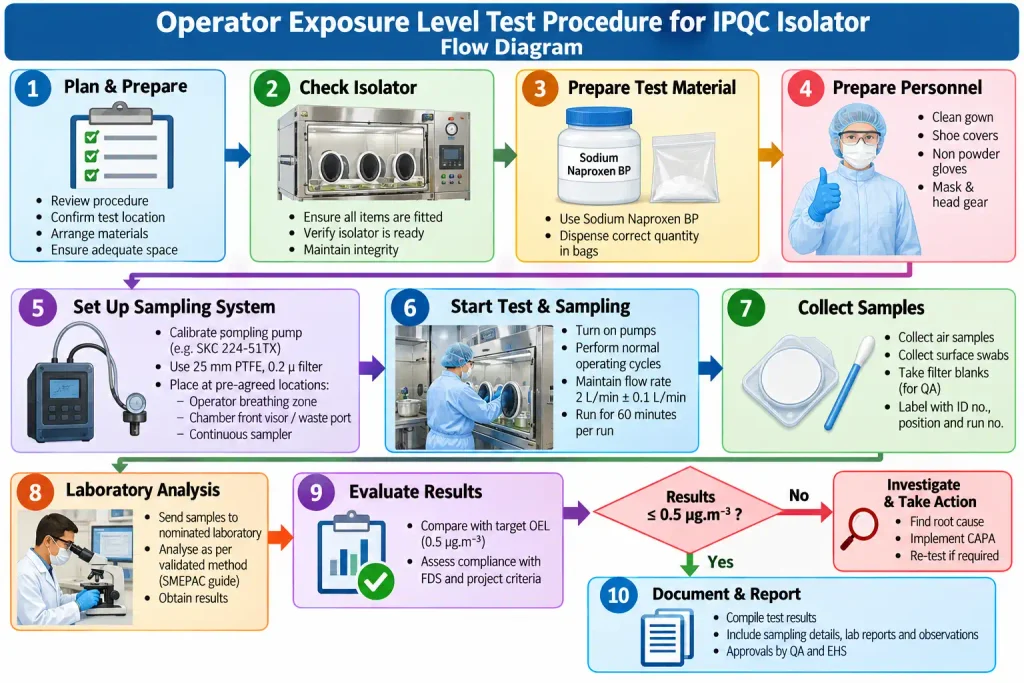
Skip to PDF content2. Flow Diagram Analysis for Operator Exposure Level Test Procedure for IPQC Isolator:
The flow diagram summarizes the Operator Exposure Level Test Procedure for an IPQC Isolator in a simple sequence. It begins with planning, isolator readiness checks, preparation of Naproxen Sodium surrogate material, and gowning of personnel. Sampling systems are then calibrated and positioned at defined locations. The test is conducted under normal operating conditions while air samples, filter blanks, and surface swabs are collected. Samples are sent to a qualified laboratory for analysis. Results are compared with the specified operator exposure limit. If acceptable, the study is documented and approved; otherwise, deviations are investigated, CAPA is implemented, and retesting is performed.
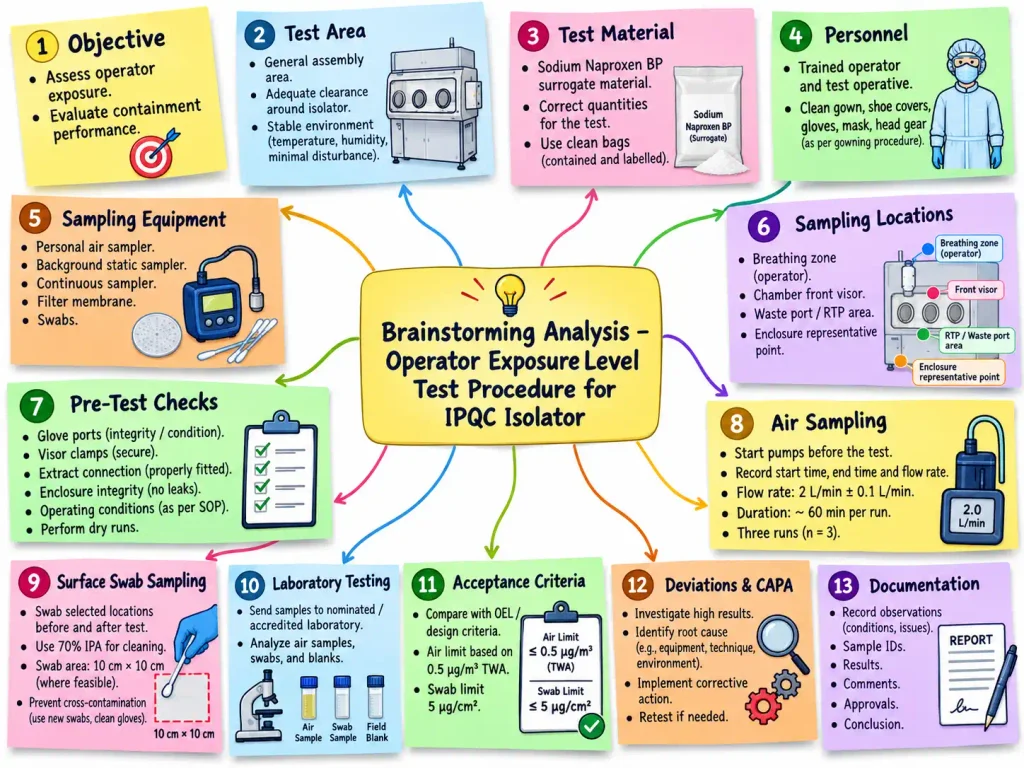
2. Brainstorming Analysis for Operator Exposure Level Test Procedure for IPQC Isolator:
The brainstorming analysis for the Operator Exposure Level Test Procedure for IPQC Isolator summarizes the key elements required for effective containment testing. It covers the objective, test area, surrogate material, trained personnel, sampling equipment, sampling locations, and pre-test checks. It also addresses air sampling, surface swab sampling, laboratory analysis, acceptance criteria, deviation handling, CAPA, and final documentation. The approach ensures sampling is performed under controlled conditions using defined locations and calibrated equipment. Results are compared with established exposure and surface contamination limits, while any unacceptable findings are investigated, corrected, documented, and retested to confirm satisfactory isolator containment performance and operator safety.
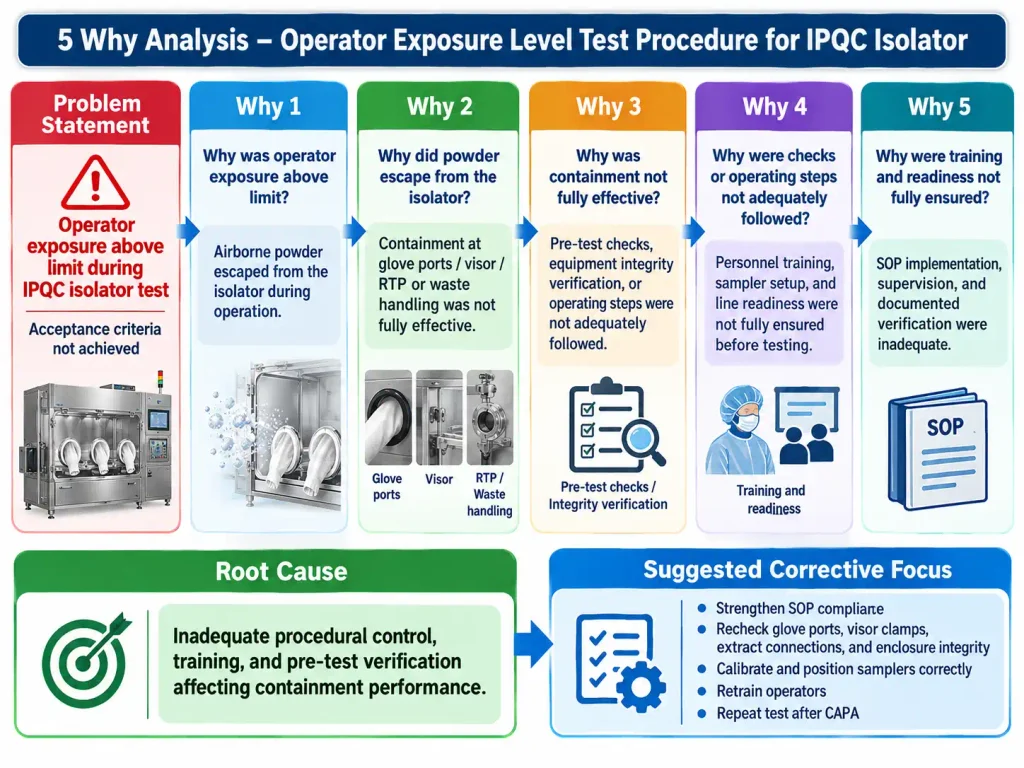
4. 5 Why Analysis for Operator Exposure Level Test Procedure for IPQC Isolator:
The 5 Why Analysis identifies possible reasons for operator exposure exceeding the acceptance limit during IPQC isolator testing. The analysis begins with airborne powder escaping from the isolator and traces the issue through ineffective containment at glove ports, visor, RTP, or waste-handling points. It further considers inadequate pre-test checks, equipment integrity verification, incorrect operating practices, insufficient sampler setup, and gaps in personnel training or readiness. The likely root cause is inadequate procedural control, training, and pre-test verification. Corrective actions should therefore focus on strengthening SOP compliance, verifying isolator integrity, ensuring correct sampler positioning, retraining operators, and repeating the test after CAPA implementation.
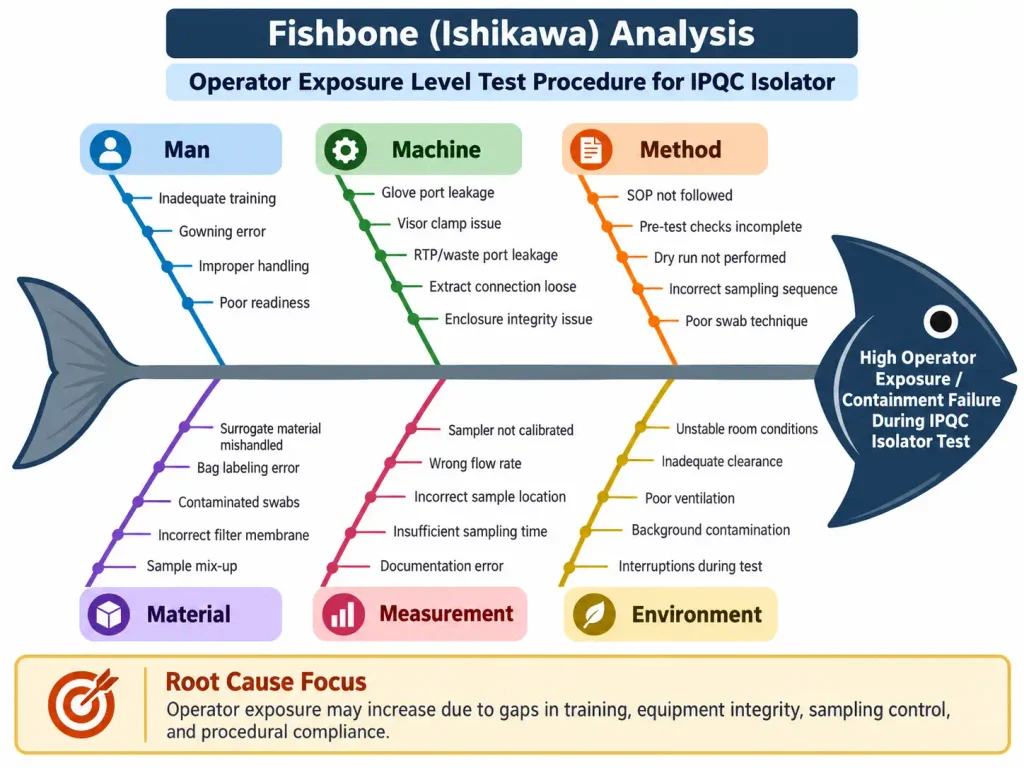
5. Fishbone Analysis for Operator Exposure Level Test Procedure for IPQC Isolator:
The Fishbone Analysis identifies potential causes of high operator exposure or containment failure during IPQC isolator testing. Causes are grouped under six major categories: Man, Machine, Method, Material, Measurement, and Environment. Key factors include inadequate training, gowning errors, glove-port or visor leakage, incomplete pre-test checks, improper sampling sequence, contaminated swabs, incorrect filter selection, uncalibrated samplers, wrong flow rate, unsuitable sampling locations, unstable room conditions, and background contamination. The analysis helps systematically identify weaknesses affecting containment performance and sampling reliability. It supports root-cause investigation, appropriate CAPA, improved procedural compliance, equipment integrity checks, operator training, and consistent exposure-control performance.
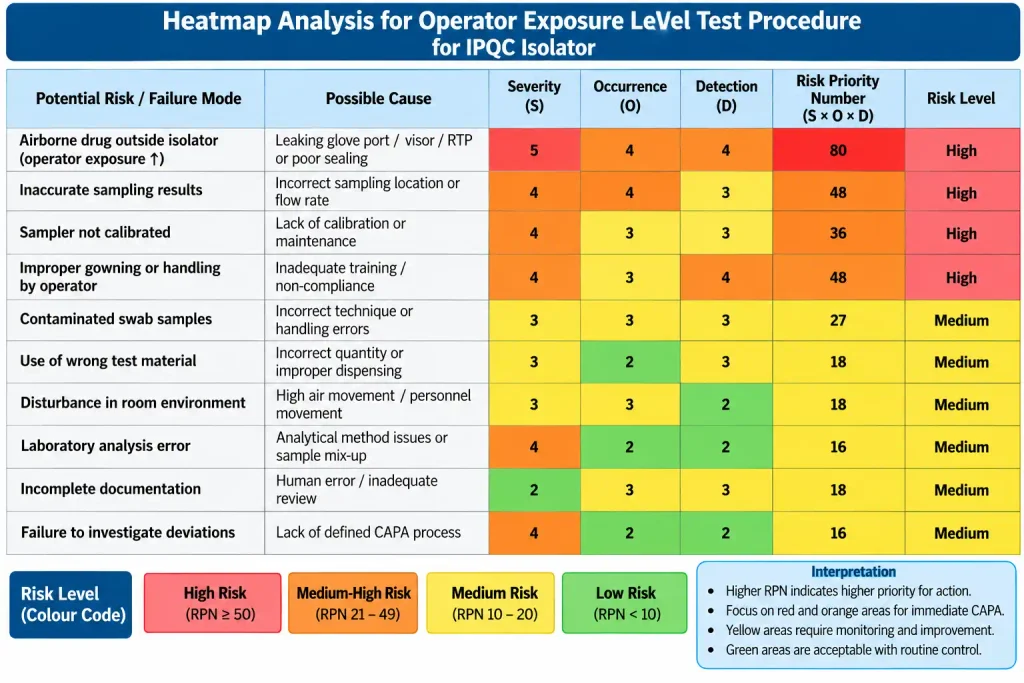
6. Heatmap Analysis for Operator Exposure Level Test Procedure for IPQC Isolator:
The Heatmap Analysis evaluates potential risks associated with the Operator Exposure Level Test Procedure for an IPQC Isolator using severity, occurrence, detection, and Risk Priority Number (RPN). Major risks include airborne drug leakage, inaccurate sampling, uncalibrated samplers, improper gowning, contaminated swabs, incorrect test material, environmental disturbances, laboratory errors, incomplete documentation, and inadequate deviation investigation. Higher RPN values indicate risks requiring greater attention and timely CAPA. Red and orange zones represent priority risks, while yellow and green zones indicate progressively lower concern. This analysis supports systematic risk control, improved containment, reliable sampling, operator protection, and consistent regulatory compliance during routine testing.
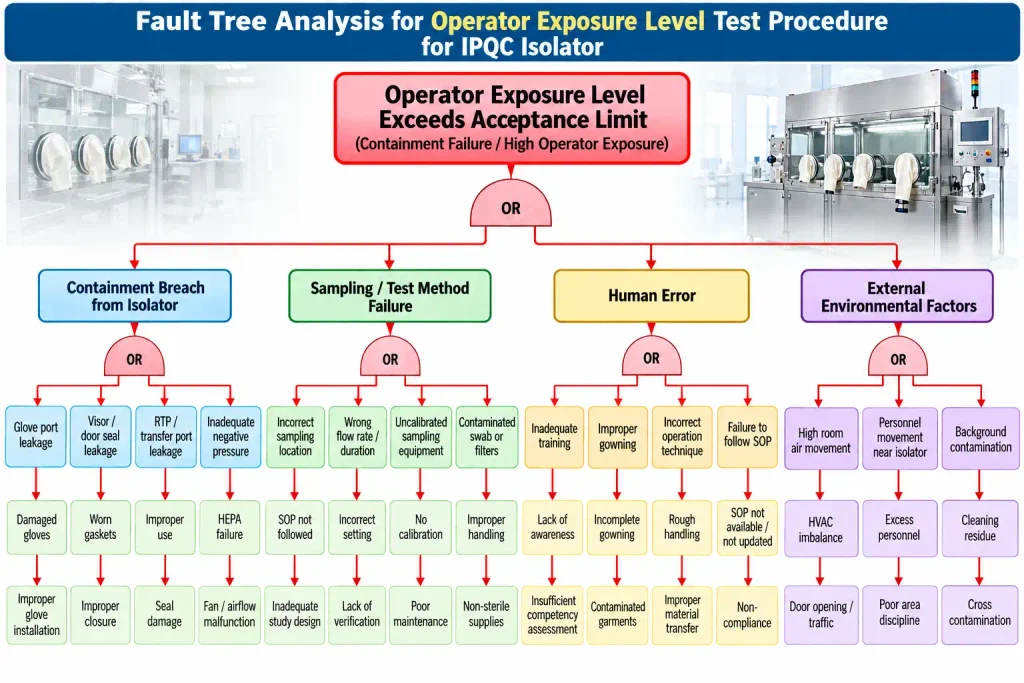
7. Fault Tree Analysis for Operator Exposure Level Test Procedure for IPQC Isolator:
The Fault Tree Analysis (FTA) evaluates potential causes of excessive operator exposure during IPQC isolator testing. The top event is operator exposure exceeding the acceptance limit, which may result from containment breaches, sampling or test-method failures, human errors, or environmental factors. Contributing causes include glove-port leakage, visor or RTP leakage, inadequate pressure control, incorrect sampling locations, wrong flow rate, uncalibrated equipment, contaminated swabs, insufficient training, improper gowning, SOP non-compliance, HVAC imbalance, personnel movement, and background contamination. The analysis helps identify critical failure pathways, determine root causes, prioritize CAPA, and improve containment reliability and operator protection.
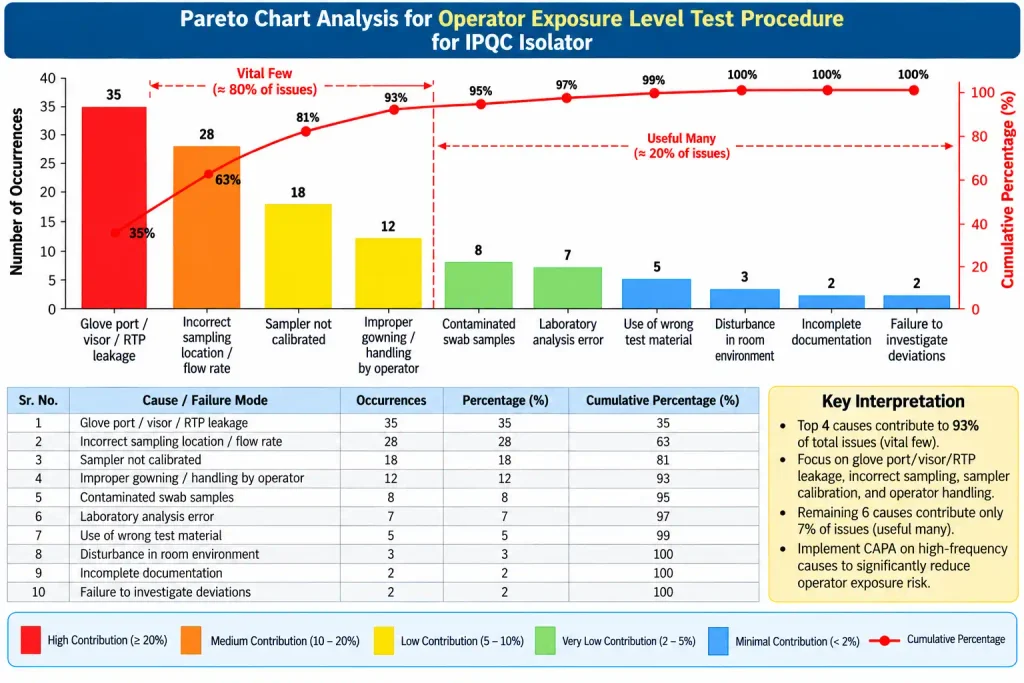
8. Pareto Chart Analysis for Operator Exposure Level Test Procedure for IPQC Isolator:
The Pareto Chart Analysis identifies the most significant causes that may contribute to operator exposure during IPQC isolator testing. The highest contributors are glove port, visor, or RTP leakage, incorrect sampling location or flow rate, uncalibrated samplers, and improper gowning or handling. Together, these leading causes account for most observed issues and therefore require priority attention. Lower-frequency causes include contaminated swab samples, laboratory analysis errors, incorrect test material, room disturbances, documentation gaps, and inadequate deviation investigation. The chart supports risk-based prioritization by focusing CAPA on the vital few causes to reduce exposure risk and improve containment performance during routine operations.
9. Corrective Action and Preventive Action (CAPA) – Operator Exposure Level Test Procedure for IPQC Isolator:
Based on the test procedure, CAPA should focus on isolator integrity, correct sampler positioning and calibration, operator practices, swab technique, environmental control, sample handling, and documentation. The procedure requires pre-test integrity checks, controlled sampling, trained personnel, defined sampling locations, and comparison of results against established limits.
| Observation / Failure | Corrective Action | Preventive Action |
|---|---|---|
| Operator exposure exceeds acceptance limit | Stop testing, review results, identify leakage or containment failure, investigate affected test run, and repeat testing after correction. | Establish periodic containment-performance verification and trend OEL results. |
| Glove port, visor, or RTP leakage | Inspect seals, O-rings, clamps, glove ports and RTP; repair or replace defective components. | Introduce documented pre-use integrity checks and preventive-maintenance frequency. |
| Incorrect isolator operating condition | Restore specified operating parameters and document adjustments before retesting. | Include operating-condition verification in the pre-test checklist. |
| Sampler not calibrated | Remove sampler from use and calibrate it before repeating the affected sampling run. | Maintain calibration status labels, calibration schedule, and pre-use verification. |
| Incorrect sampling flow rate | Adjust flow to the defined rate and assess validity of affected samples. | Verify and document initial and final flow rates for every sampling run. |
| Incorrect sampling location | Reposition PBZ, background and continuous samplers at approved locations and repeat sampling where required. | Use an approved sampling-location diagram and checklist for every study. |
| Improper surface swab sampling | Repeat swabbing using clean gloves, fresh swabs and the defined sampling area. | Train personnel on standardized horizontal/vertical zigzag swabbing and cross-contamination prevention. The procedure specifies approximately 100 cm² where feasible. |
| Improper gowning or material handling | Correct gowning deficiencies, replace contaminated PPE and retrain the operator before resuming testing. | Periodic qualification and observation of personnel involved in containment studies. |
| Background contamination | Clean the test area, verify surrogate-material handling and repeat the background sample. | Segregate surrogate preparation, clean external container surfaces and maintain controlled material-transfer practices. |
| Sample identification or mix-up | Quarantine affected samples, reconcile IDs and repeat sampling when traceability cannot be assured. | Use unique sample IDs indicating position and run number, with second-person verification. |
| Laboratory analysis issue | Investigate analytical error, sample integrity, blanks and validated method performance. | Use qualified laboratories, validated analytical methods and appropriate filter blanks. |
| Environmental disturbance during test | Control unnecessary movement, door opening and other disturbances; repeat affected run if necessary. | Define access restrictions and environmental conditions before starting the study. |
| Incomplete documentation | Complete missing records through controlled GDP-compliant correction and assess data validity. | Use controlled test forms covering start/stop time, flow rate, sample location, observations, results and approvals. |
| Repeated OEL failure | Perform formal root-cause analysis, implement engineering/procedural CAPA and requalify containment before routine use. | Periodically review OEL trends, deviations, maintenance and training effectiveness. |
The procedure specifically requires samples to be collected through personal, background and continuous sampling, with repeated sampling runs and surface-swab testing. The final assessment should document whether the test meets the defined design criteria, including the stated air-exposure and surface-swab limits.
CAPA effectiveness should be demonstrated by successful repeat testing, satisfactory isolator integrity, compliant sampling results, verified calibration, completed training, and absence of recurrence in subsequent OEL studies.
Note: the uploaded procedure defines testing requirements and acceptance criteria but does not contain a dedicated CAPA section; the CAPA actions above are derived recommendations aligned with the failure points controlled by that procedure.
10. Questions & Answers – Operator Exposure Level Test Procedure for IPQC Isolator:
Q1. What is the purpose of the Operator Exposure Level Test for an IPQC Isolator?
The purpose is to perform defined operating cycles and measure operator exposure during isolator operations using filter-membrane sampling in accordance with the SMEPAC approach.
Q2. Which surrogate material is used for the containment test?
The procedure specifies Naproxen Sodium BP as the surrogate material for the Operator Exposure Level study.
Q3. Why is a surrogate material used?
The surrogate material allows containment performance and potential operator exposure to be assessed during simulated operating activities without using the actual API.
Q4. What personal protective equipment is required during testing?
The operator and test personnel should use a clean gown, shoe covers, non-powder-shedding gloves, mask, and head gear to minimize contamination of the test.
Q5. What types of air samples are collected?
The procedure uses personal breathing-zone samples, background static samples, and continuous static samples at predetermined locations around the isolator.
Q6. Where should the personal air sampler be positioned?
The personal sampler should be positioned within the operator’s breathing zone, defined in the procedure as within approximately 300 mm of the mouth and nose.
Q7. What filter membrane is specified?
The procedure specifies a 25 mm PTFE, 0.2 µm filter membrane, subject to compatibility with the required OEL and laboratory recommendation.
Q8. How should sampling heads and swabs be identified?
Each filter head or swab should be clearly identified with an ID number, sampling position, and run number to maintain traceability.
Q9. What air-sampling flow rate is used?
Sampling is conducted at 2 litres per minute ± 0.1 litre per minute according to the procedure.
Q10. What pre-test checks are required for the isolator?
Checks include correct installation of visor gloves and O-rings, closure of visor clamps, secure extract connections, verification of operating conditions, monitoring of enclosure conditions, and satisfactory completion of dry runs.
Q11. How many sampling runs are performed?
The protocol describes three sampling runs, with each run typically lasting approximately 60 minutes.
Q12. What is the purpose of surface-swab sampling?
Surface-swab sampling determines the degree of contamination on external surfaces that may be exposed to the general environment, such as rapid transfer ports, glove-change areas, and door gaskets.
Q13. What swab area should be used?
Where feasible, a 100 cm² area (10 cm × 10 cm) should be sampled using a zigzag pattern in both horizontal and vertical directions.
Q14. How is cross-contamination prevented during swabbing?
Clean gloves should be used, and new gloves are required for each sample. Samples should be placed in clean, labelled containers and sealed after collection.
Q15. What prerequisites are required before performing the containment test?
A written SOP, suitable cleanroom, utilities, satisfactory isolator pressure-hold testing, installed and commissioned equipment, necessary materials, and trained operating personnel are required.
Q16. What equipment is required for sampling?
The procedure lists an air sampler, swabs, calibrator, rotameter, beakers, marker, labels, zip-lock bags, bag ties, scissors, and gloves among the required sampling accessories.
Q17. What air-exposure criterion is specified in the procedure?
The procedure references a design value of ≤ 0.5 µg/m³ for an 8-hour TWA for final compliance assessment.
Q18. What surface-swab acceptance limit is specified?
The procedure specifies a swab limit of ≤ 5 µg/cm².
Q19. How are samples handled after testing?
After completion of testing, sample heads and material samples are transferred to an accredited laboratory. Wet swab samples are refrigerated and shipped within the same week as sampling.
Q20. What should the final test report contain?
The final report should include laboratory analytical results, recorded observations, comparison with the specified design values, compliance status, and the final pass/fail conclusion.
Q21. What does SMEPAC stand for?
SMEPAC means Standardised Measurement of Equipment Particulate Airborne Concentration.
Q22. What should be done if the exposure results do not comply with the acceptance criteria?
The uploaded procedure provides a pass/fail compliance conclusion but does not define a detailed deviation or CAPA workflow. Any non-compliant result should therefore be handled through the site’s approved deviation, investigation, and CAPA procedures rather than adding requirements not specified in this document.
11. Reference Guidelines – Operator Exposure Level Test Procedure for IPQC Isolator:
Based on the uploaded procedure, the following references are directly supported:
- SMEPAC Guide – Standardised Measurement of Equipment Particulate Airborne Concentration
This is the principal reference used for measuring airborne particulate exposure and evaluating isolator containment performance. The procedure specifically states that operator exposure testing is performed in accordance with the latest SMEPAC guide. - Approved Standard Operating Procedure for the IPQC Isolator
A written SOP for operation of the specific isolator is required before containment-performance testing. Operators should be trained and should simulate the actual operational activities defined in the SOP. - Functional Design Specification (FDS)
The operating sequence and containment design criteria should be evaluated against the approved FDS. The procedure refers to an exposure design criterion of 0.5 µg/m³. - Factory Acceptance Test (FAT) Requirements
The isolator should undergo a satisfactory pressure-hold test and comply with the limits specified during FAT before containment-performance testing is performed. - Validated Analytical Method of the Testing Laboratory
Air samples, swabs, blanks, and surrogate samples should be analyzed by the nominated laboratory using a validated analytical method capable of meeting the required detection and quantification limits. - British Pharmacopoeia (BP)
The procedure identifies Naproxen Sodium BP as the surrogate test material, so the applicable BP specification may be referenced for the identity and quality of the surrogate material. - Approved Sampling and Swab Procedure
Surface sampling should use defined locations, controlled technique, appropriate PPE, clean swabs, documented sample areas, and precautions against cross-contamination. - Acceptance Criteria Defined in the Protocol
The procedure records a final design value of ≤ 0.5 µg/m³ for 8-hour TWA for air exposure and ≤ 5 µg/cm² for surface swab contamination.