






1. Introduction to Paracetamol & Caffeine Tablets IP (500 mg + 50 mg) – Batch Manufacturing Record (BMR):
Paracetamol & Caffeine Tablets IP are a combination pharmaceutical formulation containing Paracetamol IP 500 mg and Caffeine Anhydrous IP 50 mg per uncoated tablet. Paracetamol acts as an analgesic and antipyretic agent, while caffeine enhances its analgesic effectiveness, making this combination useful in managing headaches, migraine-related pain, and other mild to moderate painful conditions. The Batch Manufacturing Record (BMR) provides comprehensive documentation of manufacturing activities, ensuring product quality, consistency, traceability, and compliance with Good Manufacturing Practices (GMP). It contains detailed instructions for raw material dispensing, sifting, binder preparation, wet granulation, drying, sizing, blending, lubrication, tablet compression, and dedusting.The manufacturing process involves controlled granulation using starch paste, followed by drying and blending with caffeine and other specified excipients. Each manufacturing stage requires proper documentation, equipment verification, environmental monitoring, and Quality Assurance oversight.Critical quality parameters include granule moisture content, bulk density, tablet weight variation, hardness, thickness, friability, and disintegration time. The specified average tablet weight is 650 mg, with a disintegration time not exceeding 15 minutes.
Skip to PDF content2. Manufacturing Process Flow Diagram for Paracetamol & Caffeine Tablets IP:
The manufacturing process flow diagram for Paracetamol & Caffeine Tablets IP (500 mg + 50 mg) illustrates the systematic sequence of pharmaceutical manufacturing operations performed under Good Manufacturing Practices (GMP). The process begins with raw material dispensing, weighing, and verification of Paracetamol IP, Caffeine Anhydrous IP, and approved excipients according to the Batch Manufacturing Record (BMR). Initially, raw materials undergo sifting through specified mesh sizes to remove foreign particles and ensure uniform particle distribution. Starch paste is prepared separately as a binding agent, followed by wet granulation using a Rapid Mass Granulator (RMG).
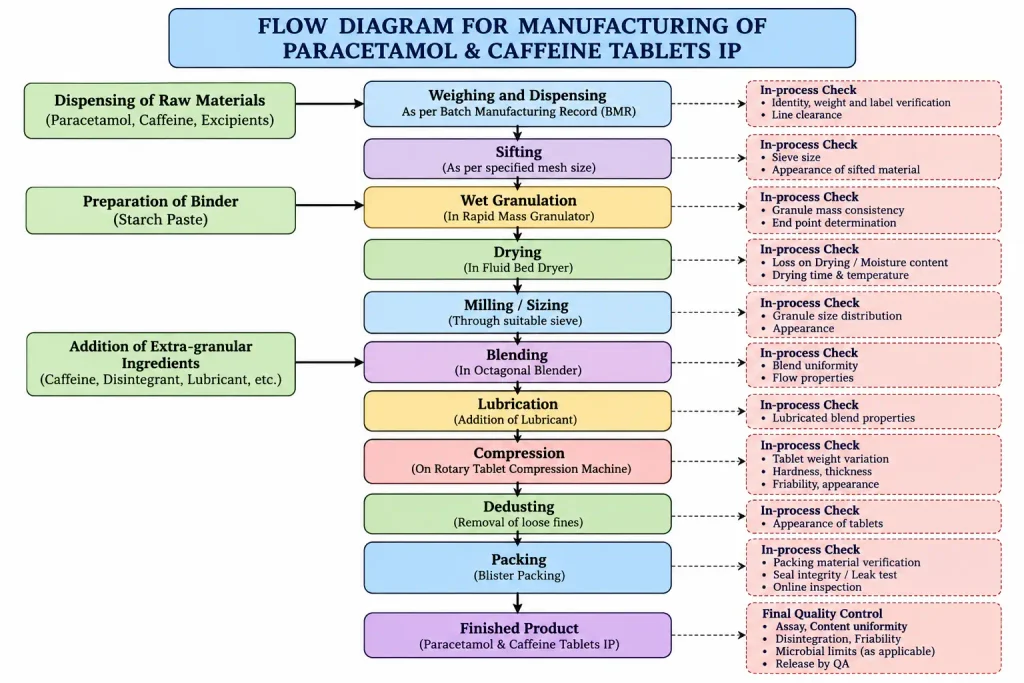
The wet granules are dried in a Fluid Bed Dryer (FBD), followed by milling and sizing to obtain the required granule characteristics. Subsequently, caffeine and other extra-granular ingredients are incorporated during blending in an octagonal blender. Lubrication is performed using magnesium stearate. The lubricated granules are compressed into tablets using a rotary compression machine. Critical in-process parameters include tablet weight variation, hardness, thickness, friability, and disintegration time. Finally, tablets undergo dedusting, blister packing, finished product testing, and Quality Assurance review before batch release. Each manufacturing stage requires appropriate documentation, verification, and quality control to ensure consistent product quality and regulatory compliance.
3. Critical Process Parameters (CPP) and Critical Quality Attributes (CQA) of Paracetamol & Caffeine Tablets IP:
The Critical Process Parameters (CPP) and Critical Quality Attributes (CQA) of Paracetamol & Caffeine Tablets IP (500 mg + 50 mg) are essential for ensuring consistent product quality, manufacturing efficiency, and compliance with Good Manufacturing Practices (GMP). Critical Process Parameters are manufacturing variables that require monitoring and control to maintain the desired product quality. These include sieve mesh size, granulation time, binder preparation, drying temperature, blending duration, lubrication time, and compression machine settings. Proper control of these parameters helps achieve uniform granule characteristics, appropriate powder flow, and consistent tablet formation.
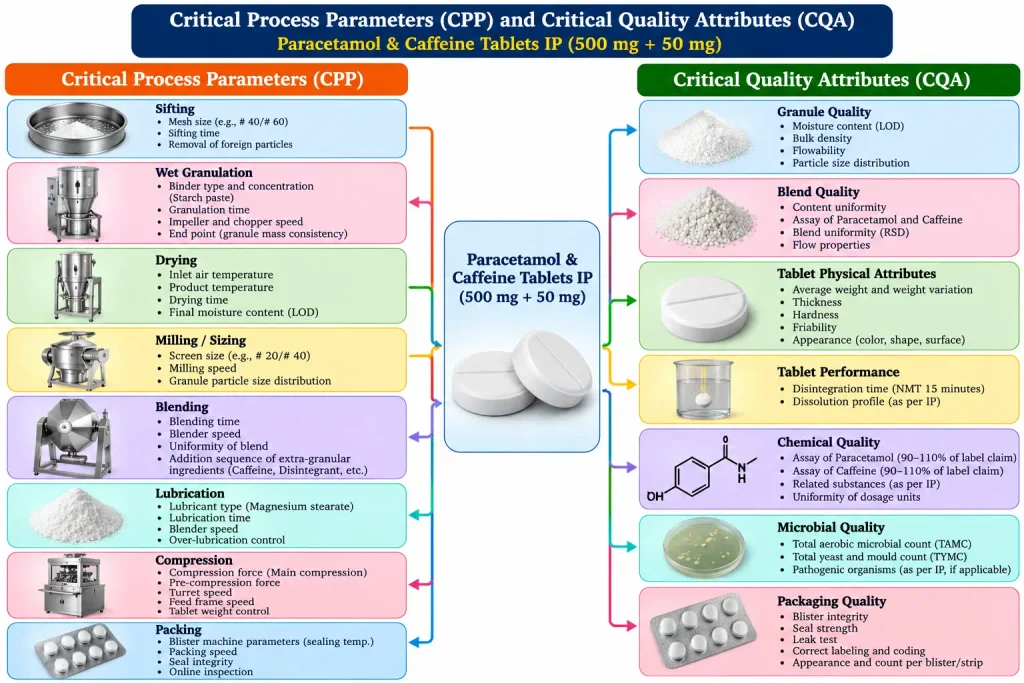
During wet granulation, binder addition and mixing conditions influence granule formation. Drying parameters affect moisture content, while blending and lubrication conditions influence content uniformity, flowability, and tablet compression performance.
Critical Quality Attributes (CQA) represent the physical, chemical, microbiological, and performance characteristics required to ensure product quality. Important quality attributes include granule loss on drying (LOD), bulk density, particle size distribution, blend uniformity, tablet weight variation, hardness, thickness, friability, disintegration time, assay, and dissolution. According to the BMR, the target tablet weight is 650 mg, disintegration time is NMT 15 minutes, and friability is NMT 1.0%. Effective CPP monitoring and CQA verification support batch consistency, product safety, regulatory compliance, and reliable manufacturing performance.