







1. Introduction for Site Acceptance Test (SAT) for HVAC:
The Site Acceptance Test (SAT) for the Heating, Ventilation and Air Conditioning (HVAC) system verifies that the installed system complies with approved design, cGMP, process, product, and safety requirements. The protocol covers a 5000 CFM HVAC system installed on the service floor and confirms suitability before further qualification. Key checks include installation location, area illumination, equipment dimensions, structural suitability, electrical connections, electrical supply, chilled water, warm water, manuals, certificates, drawings, and test reports. Responsibilities are assigned to User, Engineering, EHS, Validation QA, QA Head, and Plant Head for execution, review, and approval.
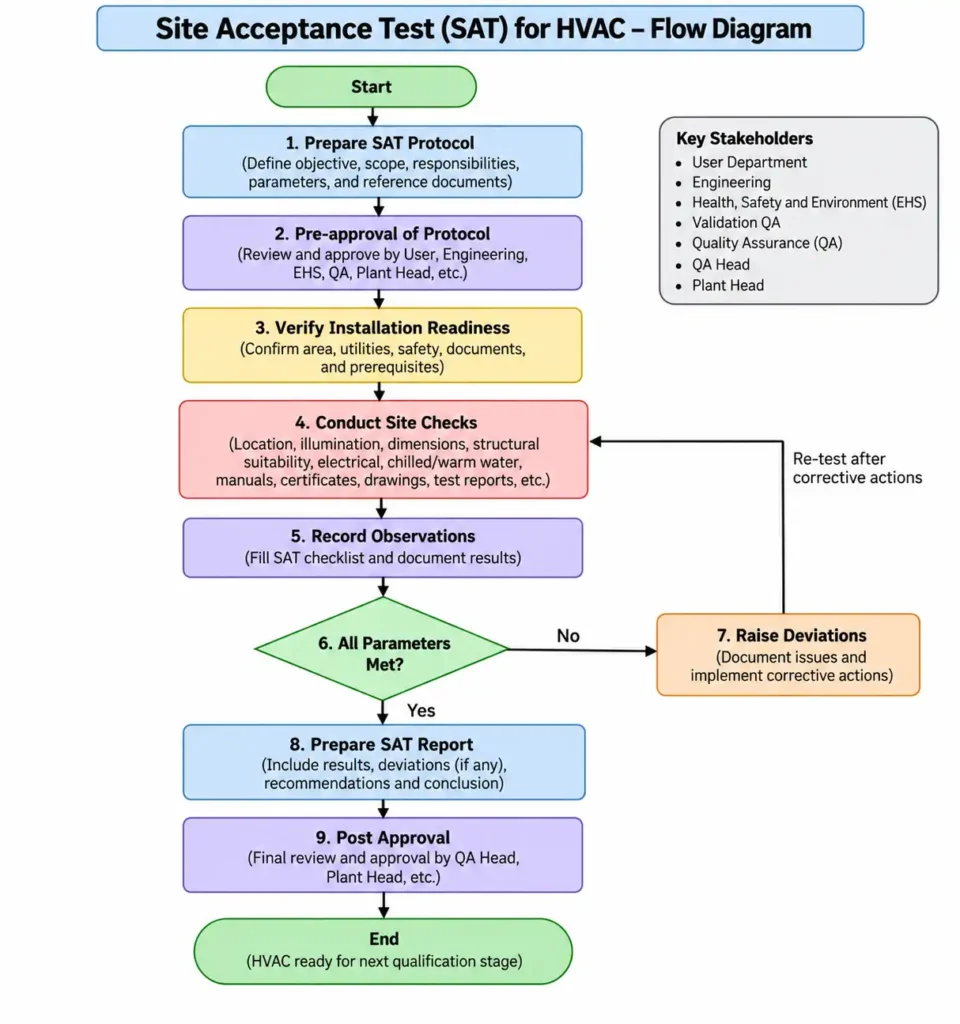
Skip to PDF content2. Flow Diagram for SAT for AHU:
The flow diagram presents the Site Acceptance Test (SAT) process for the HVAC system from protocol preparation to final approval. It begins with defining the objective, scope, responsibilities, parameters, and references, followed by pre-approval. Installation readiness is then verified by checking the area, utilities, safety, documents, and prerequisites. Site checks cover location, illumination, dimensions, structural suitability, electrical supply, chilled and warm water, manuals, certificates, drawings, and reports. Observations are recorded and assessed against acceptance criteria. Any deviations require corrective action and retesting. Once all parameters are satisfactory, the SAT report is prepared, reviewed, approved, and closed for subsequent qualification activities.
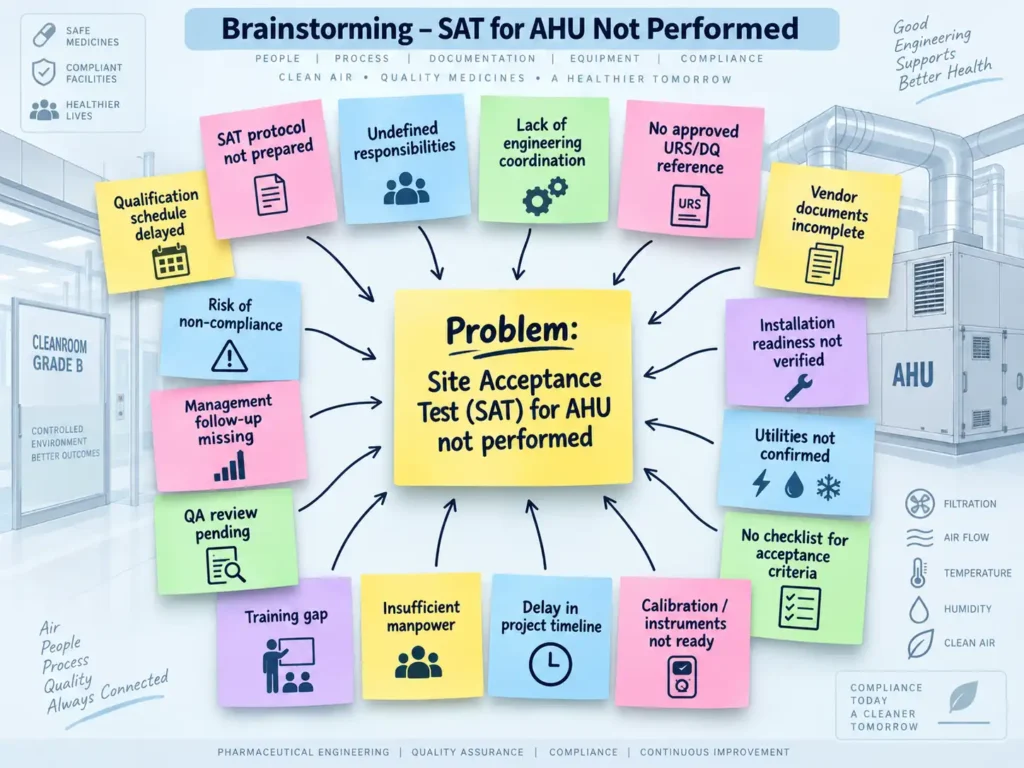
3. Brainstorming – SAT for AHU Not Performed:
The brainstorming diagram identifies major reasons why the Site Acceptance Test (SAT) for the Air Handling Unit (AHU) was not performed. Key contributing factors include an unprepared SAT protocol, undefined responsibilities, lack of engineering coordination, absence of approved URS/DQ references, incomplete vendor documentation, and unverified installation readiness. Additional concerns include unconfirmed utilities, missing acceptance criteria, unavailable calibrated instruments, project delays, insufficient manpower, training gaps, pending QA review, and weak management follow-up. These gaps may delay qualification activities and increase compliance risks. The analysis helps identify corrective actions required before completing SAT and proceeding with further AHU qualification stages.
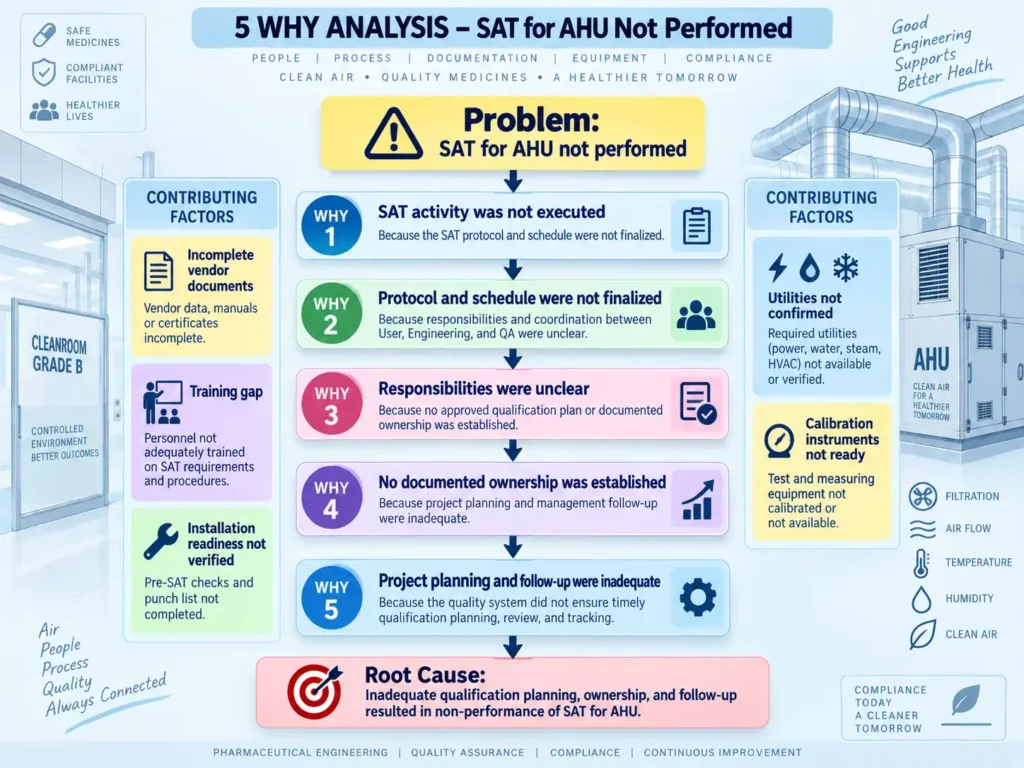
4. 5-Why Analysis – SAT for AHU Not Performed:
The 5-Why analysis identifies the underlying reasons for non-performance of the Site Acceptance Test (SAT) for the AHU. The investigation begins with the SAT activity not being executed because the protocol and schedule were not finalized. This occurred due to unclear responsibilities and poor coordination among User, Engineering, and QA. Further analysis shows that documented ownership and an approved qualification plan were not established. Inadequate project planning, management follow-up, incomplete vendor documents, unverified utilities, calibration readiness, and training gaps also contributed. The root cause is inadequate qualification planning, ownership, coordination, and systematic follow-up for timely SAT execution.
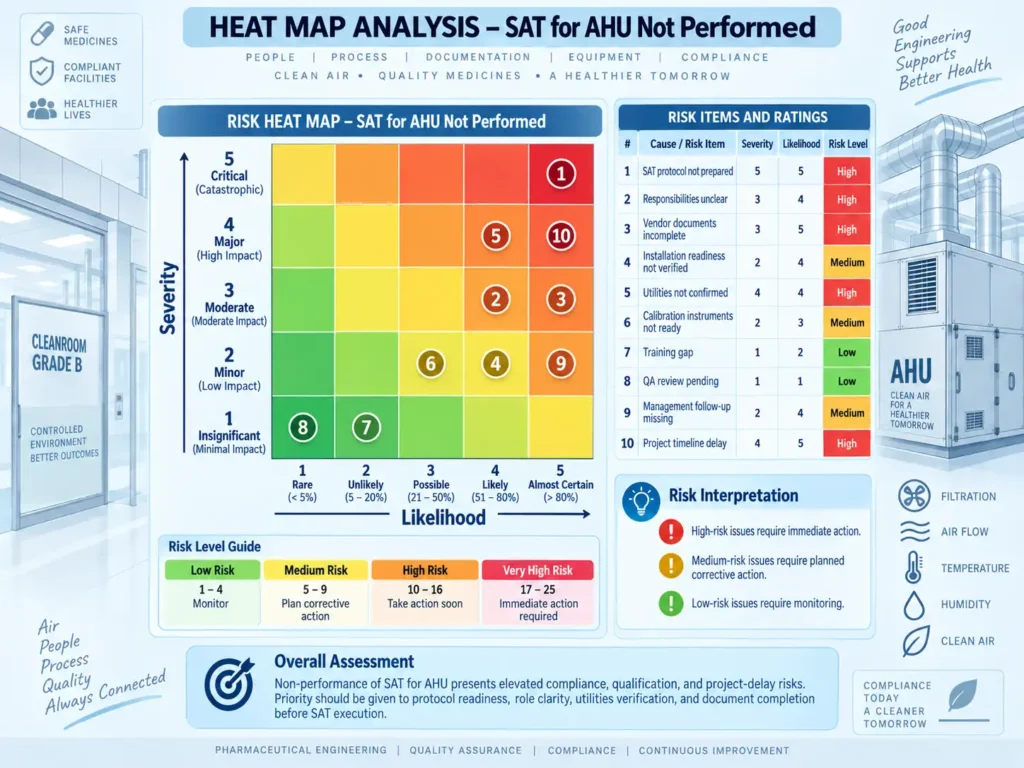
5. Heat Map Analysis – SAT for AHU Not Performed:
The heat map analysis evaluates the risks associated with non-performance of the Site Acceptance Test (SAT) for the AHU by considering severity and likelihood. Major risks include absence of the SAT protocol, incomplete vendor documents, unconfirmed utilities, unclear responsibilities, and project timeline delays. These factors fall mainly within high-risk zones and require prompt corrective action. Medium-risk concerns include installation readiness, calibration instrument availability, and inadequate management follow-up. Training gaps and pending QA review are comparatively lower risks but still require monitoring. The analysis helps prioritize actions before SAT execution and supports timely qualification, compliance, documentation readiness, and effective project control.
6. Fault Tree Analysis – SAT for AHU Not Performed:
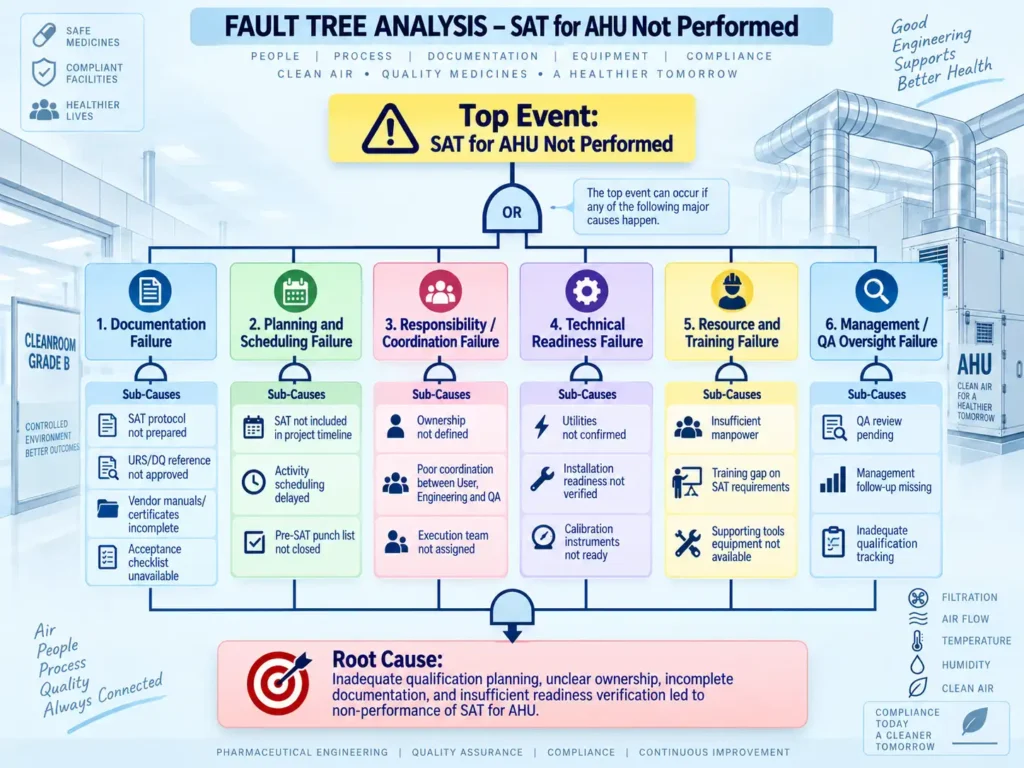
The Fault Tree Analysis identifies major causes responsible for non-performance of the Site Acceptance Test (SAT) for the AHU. The top event is linked with documentation failure, planning and scheduling gaps, unclear responsibilities, technical readiness issues, inadequate resources, and weak management oversight. Important sub-causes include an unprepared SAT protocol, incomplete URS/DQ references, missing vendor documents, delayed scheduling, unverified utilities, incomplete installation readiness, unavailable calibrated instruments, training gaps, pending QA review, and insufficient follow-up. The analysis indicates that inadequate qualification planning, ownership, documentation control, coordination, and readiness verification collectively contributed to failure to perform the SAT as planned.
7. Pareto Chart – SAT for AHU Not Performed:
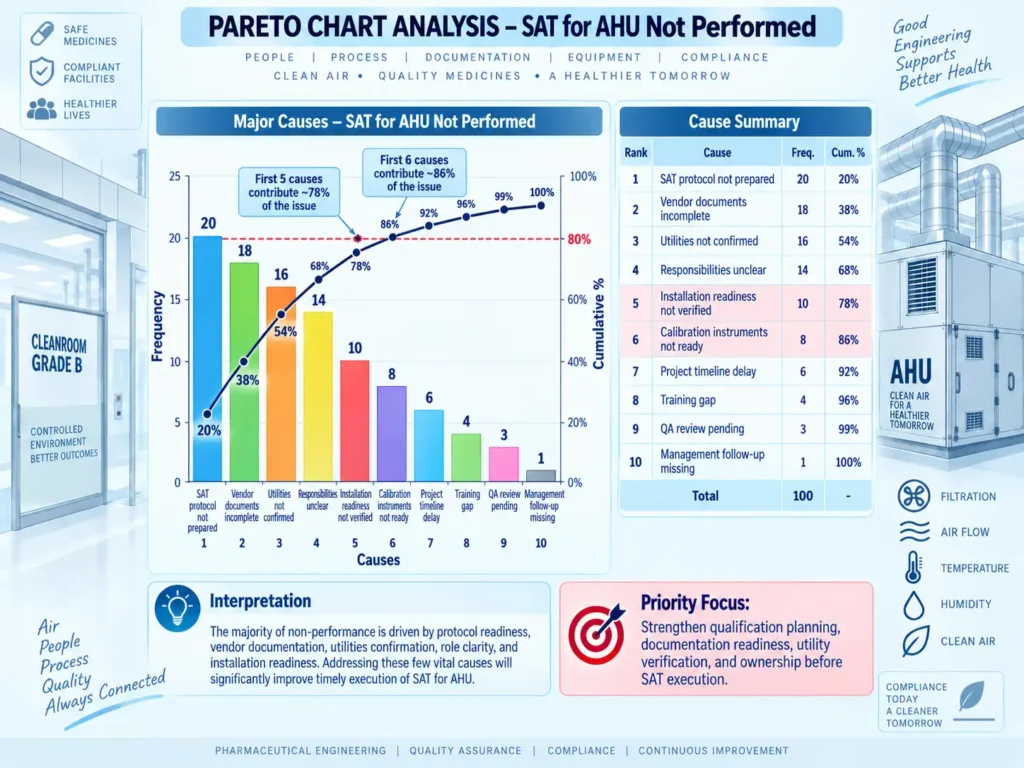
The Pareto chart highlights the major causes responsible for non-performance of the Site Acceptance Test (SAT) for the AHU. The most significant contributors are the SAT protocol not being prepared, incomplete vendor documents, unconfirmed utilities, unclear responsibilities, and unverified installation readiness. These few causes contribute to the majority of the overall problem and therefore require priority attention. Other contributing factors include unavailable calibrated instruments, project timeline delays, training gaps, pending QA review, and inadequate management follow-up. The analysis helps focus corrective actions on the most influential causes to improve SAT readiness, execution, documentation control, and timely completion of qualification activities.
8. Corrective Action, Preventive Action & Effectiveness Review – SAT for AHU Not Performed:
The SAT protocol requires verification of installation suitability, utilities, supporting documents, observations, deviations, recommendations, and formal review/approval by User, Engineering, EHS, Validation QA, QA Head, and Plant Head. The protocol also includes checks for electrical supply, chilled/warm water, manuals, certificates, drawings, and test reports.
| Type | Action | Responsibility | Effectiveness Review |
|---|---|---|---|
| Corrective Action | Prepare, review, and approve the SAT protocol for the AHU before further qualification activity. | Engineering / Validation QA | Confirm approved SAT protocol is available and executed. |
| Corrective Action | Verify AHU installation location, dimensions, structural suitability, illumination, utilities, electrical connections, chilled water, and warm water supply. | Engineering / User | Review completed SAT checklist with documented observations. |
| Corrective Action | Collect and verify vendor manuals, certificates, drawings, test reports, and applicable URS/DQ references. | Engineering / QA | Ensure all required documents are attached or referenced in the SAT package. |
| Corrective Action | Confirm availability and calibration status of instruments required for SAT verification. | Engineering / QA | Verify valid calibration certificates before SAT execution. |
| Corrective Action | Record any deviations identified during SAT and complete corrective actions before closure. | Engineering / QA | Verify all deviations are closed with documented evidence. |
| Corrective Action | Complete SAT execution, prepare recommendations/conclusion, and obtain post-approval. | Validation QA / QA Head / Plant Head | Check completed and approved SAT report. |
| Preventive Action | Include SAT activities in the project qualification master schedule with defined target dates. | Project / Engineering / QA | Review qualification schedule monthly; no overdue SAT activities. |
| Preventive Action | Establish a pre-SAT readiness checklist covering documents, utilities, installation, instruments, and manpower. | Engineering / QA | Audit next three SAT activities for 100% checklist completion. |
| Preventive Action | Clearly define ownership and responsibilities for SAT preparation, execution, review, and approval. | QA / Engineering | Verify responsibility matrix is included in future qualification plans. |
| Preventive Action | Train Engineering, User, and QA personnel on SAT requirements and documentation practices. | QA / Training Coordinator | Training effectiveness quiz or assessment target: ≥80%. |
| Preventive Action | Introduce periodic QA tracking of qualification activities and overdue actions. | Validation QA | Monthly review shows no unexplained overdue SAT activities. |
Effectiveness Review
Effectiveness should be evaluated after implementation by reviewing the next three AHU/HVAC or utility SAT activities. The CAPA may be considered effective when 100% of planned SATs are performed before IQ/OQ/PQ progression, approved protocols are available before execution, required documents and utilities are verified, calibrated instruments are used, deviations are properly closed, and no repeat observation of “SAT not performed” occurs. A formal effectiveness review may be conducted after 60–90 days, with the outcome documented as Effective / Partially Effective / Not Effective and additional actions initiated where required.
9. Questions & Answers – Site Acceptance Test (SAT) for AHU:
Q1. What is the purpose of the Site Acceptance Test for the AHU?
Answer: The SAT verifies that critical process, product, cGMP, and safety requirements have been considered and that the installed HVAC/AHU system and its components conform to approved design specifications at the site.
Q2. What HVAC capacity is covered in the SAT document?
Answer: The document covers an HVAC system with a capacity of 5000 CFM, installed on the service floor.
Q3. Why was the SAT document prepared?
Answer: The document identifies purchase of a utility system as the reason for conducting the SAT.
Q4. Who is responsible for preparing and executing the SAT protocol?
Answer: The User Department prepares the SAT protocol and verifies equipment and area requirements, while Engineering provides support and performs the SAT.
Q5. What is the role of Validation QA?
Answer: Validation QA participates in the qualification team and reviews the SAT of the HVAC system and associated documentation.
Q6. What installation parameters are checked during SAT?
Answer: Checks include installation location, area illumination, equipment dimensions, and the suitability of the supporting civil structure to accommodate the equipment and its load.
Q7. Which utilities are verified during the SAT?
Answer: Utilities include electrical connections with proper earthing, three-phase 50 Hz electrical supply, chilled water at 5–8°C, and warm water at 30–40°C.
Q8. Which documents should be available during SAT?
Answer: Manuals, certificates, drawings, and applicable test reports should be provided as part of the SAT documentation.
Q9. How are deviations or changes handled in the SAT document?
Answer: The SAT protocol contains a dedicated section for recording deviations/changes, if any, followed by recommendations and conclusions.
Q10. Who approves the completed SAT?
Answer: After execution and review, the completed SAT is approved by the QA Head and Plant Head.
Q11. Why is post-approval important?
Answer: Post-approval documents that the responsible functional personnel have reviewed the completed SAT and formally accepted its content and execution.
Q12. What should be ensured before SAT closure?
Answer: All applicable acceptance criteria should be verified, observations documented, relevant attachments compiled, deviations recorded where applicable, and recommendations/conclusions completed before final approval.
10. Reference Guidelines – Site Acceptance Test (SAT) for AHU/HVAC:
The uploaded SAT protocol itself lists its Reference Documents as “Nil”, so the following are external regulatory and industry references that can be used to strengthen an AHU/HVAC SAT and qualification package.
- EU GMP, EudraLex Volume 4, Annex 15 – Qualification and Validation — applicable for lifecycle qualification, verification, documentation, deviations, acceptance criteria, and approval of facilities, utilities, and equipment.
- WHO Technical Report Series No. 1010, Annex 8 – Guidelines on Heating, Ventilation and Air-Conditioning Systems for Non-Sterile Pharmaceutical Products — provides GMP principles for HVAC design, operation, control, and qualification.
- WHO TRS No. 1019, Annex 2 – GMP for HVAC Systems for Non-Sterile Pharmaceutical Products, Part 2 — provides additional interpretation, examples, and guidance for applying pharmaceutical HVAC requirements.
- WHO TRS No. 1019, Annex 3 – Good Manufacturing Practices: Guidelines on Validation — useful for planning and documenting qualification and validation activities.
- ISO 14644-1:2015 – Cleanrooms and Associated Controlled Environments: Classification of Air Cleanliness by Particle Concentration — relevant where the AHU serves classified cleanrooms or clean zones.
- ASHRAE Standards and Guidelines, particularly standards relating to HVAC ventilation, testing, adjusting, and balancing, may be referenced for appropriate engineering aspects of AHU performance.