







1. Introduction – SOP for Allocation of Identification Number:
The SOP for Allocation of Identification Number establishes a systematic method for assigning unique identification numbers to instruments and equipment used throughout the pharmaceutical facility. The primary purpose of this system is to ensure clear identification, traceability, documentation control, and easy reference of each instrument or equipment in related GMP records. The SOP applies to instruments and equipment installed across all departments, with QA responsible for execution and departmental heads along with Head QA/QC responsible for effective implementation. The procedure defines specific identification-number formats for Production, Quality Control, balances, hygrometers, fire extinguishers, AHUs, pressure gauges, racks, sampling/dispensing booths, rooms, and other facility items. A controlled list of identified instruments/equipment is prepared, approved by the concerned Department Head, and updated whenever required.
Skip to PDF content2. Flow Diagram – SOP for Allocation of Identification Number:
The SOP for Allocation of Identification Number defines a controlled process for assigning unique identification numbers to instruments, equipment, rooms, gauges, balances, racks, sampling/dispensing booths, and other applicable facility items. The process begins by identifying the equipment or instrument and determining its department, section, and applicable numbering format. A unique identification number is then assigned according to the defined coding system and entered into the approved instrument/equipment list.
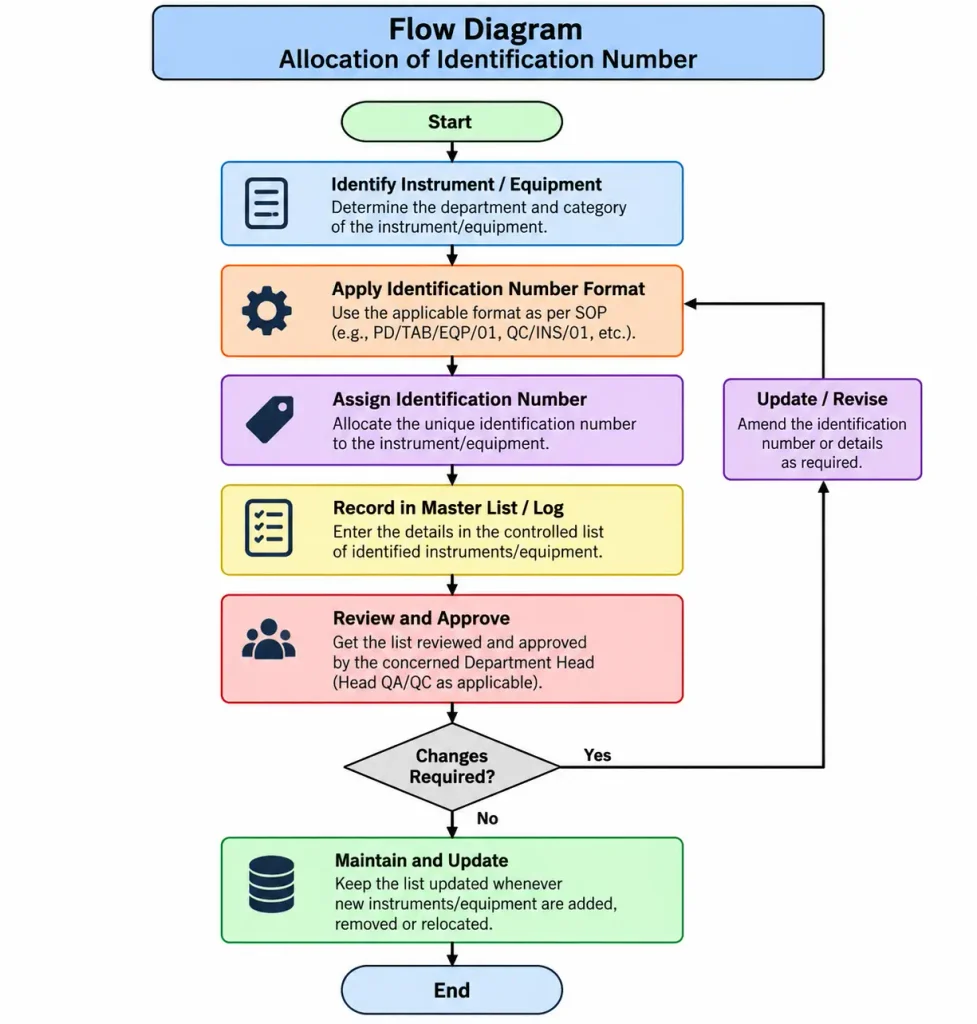
The identification list is reviewed and approved by the concerned Department Head. Whenever instruments or equipment are added, relocated, changed, or otherwise require revision, the list is updated and re-approved as necessary. This system supports consistent identification, better traceability, proper documentation, and easy reference of equipment throughout GMP-related records.
3. Benefits of Following SOP for Allocation of Identification Number:
Following the SOP for Allocation of Identification Number ensures that every instrument and equipment used in the pharmaceutical facility is provided with a clear and unique identity. This improves traceability, equipment control, documentation accuracy, and ease of reference across manufacturing, Quality Control, warehouse, and other departments. The SOP is specifically intended to establish better traceability and reference of instruments and equipment in related documents. A standardized identification system also reduces confusion between similar equipment, facilitates accurate entries in logbooks and GMP documents, and supports efficient maintenance, calibration, qualification, and validation activities. Department-wise identification formats help ensure consistency throughout the facility. Maintaining an approved and updated instrument/equipment list further strengthens document control and accountability.
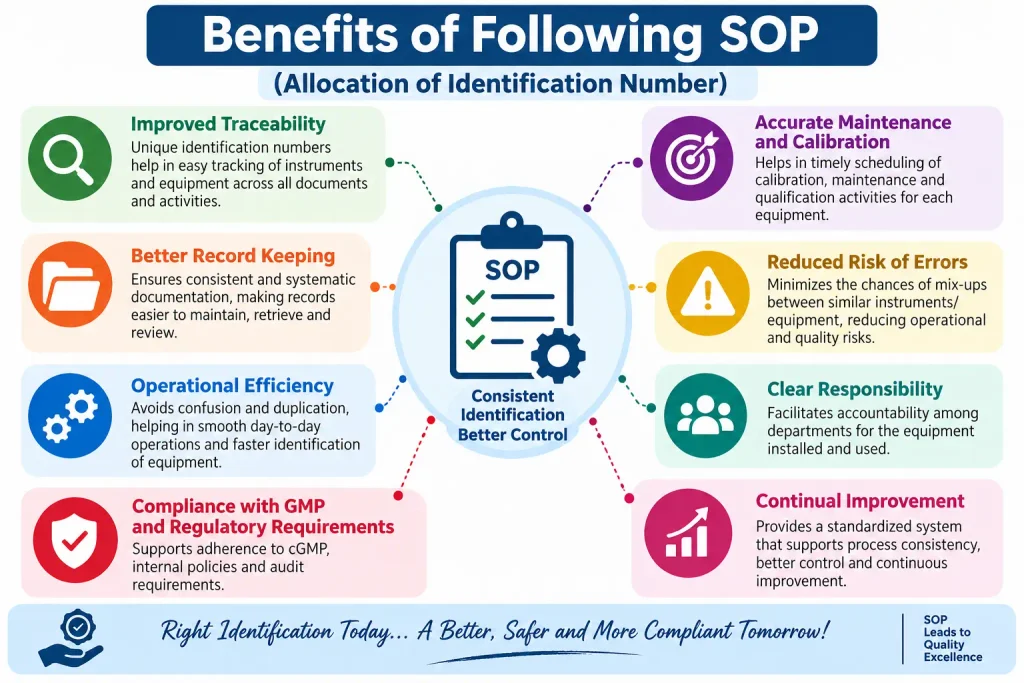
Overall, proper implementation of this SOP supports organized equipment management, faster identification, improved operational efficiency, stronger GMP compliance, and better readiness during audits and inspections.
4. Brainstorming for SOP Failure – Allocation of Identification Number:
The brainstorming analysis identifies potential causes that may lead to failure in implementing the SOP for Allocation of Identification Number. The SOP is intended to provide a systematic identification system for instruments and equipment to ensure proper traceability and reference in associated documents.
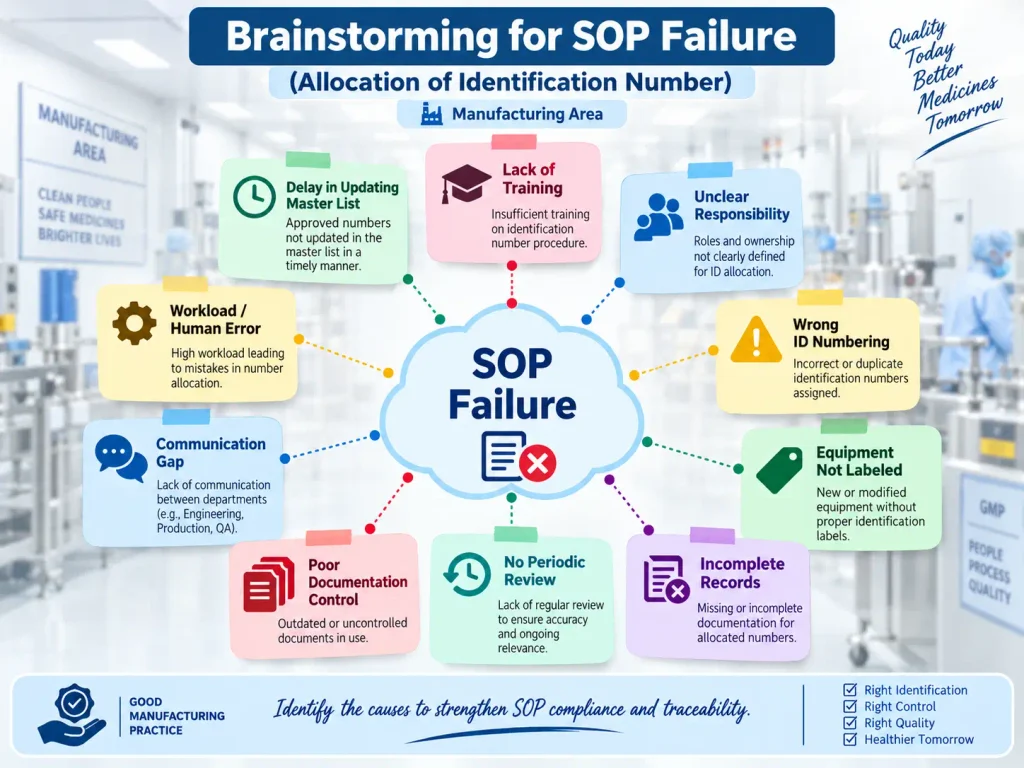
Major causes of SOP failure may include inadequate personnel training, unclear responsibility, incorrect or duplicate identification numbers, delayed updating of the master equipment list, poor documentation control, incomplete records, communication gaps between departments, human error, and failure to label newly installed or modified equipment. The SOP also requires preparation, approval, and periodic updating of the equipment/instrument identification list. Effective control of these factors improves traceability, prevents mix-ups, strengthens accountability, and supports consistent GMP documentation practices.
5. 5-Why Analysis for SOP Failure – SOP for Allocation of Identification Number:
The 5-Why Analysis evaluates the underlying reasons for failure to follow the SOP for Allocation of Identification Number in the manufacturing area. This SOP establishes a systematic method for assigning identification numbers to instruments and equipment to ensure proper traceability and reference in related documents. It also assigns responsibility to QA for execution and department heads/QA-QC management for effective implementation.
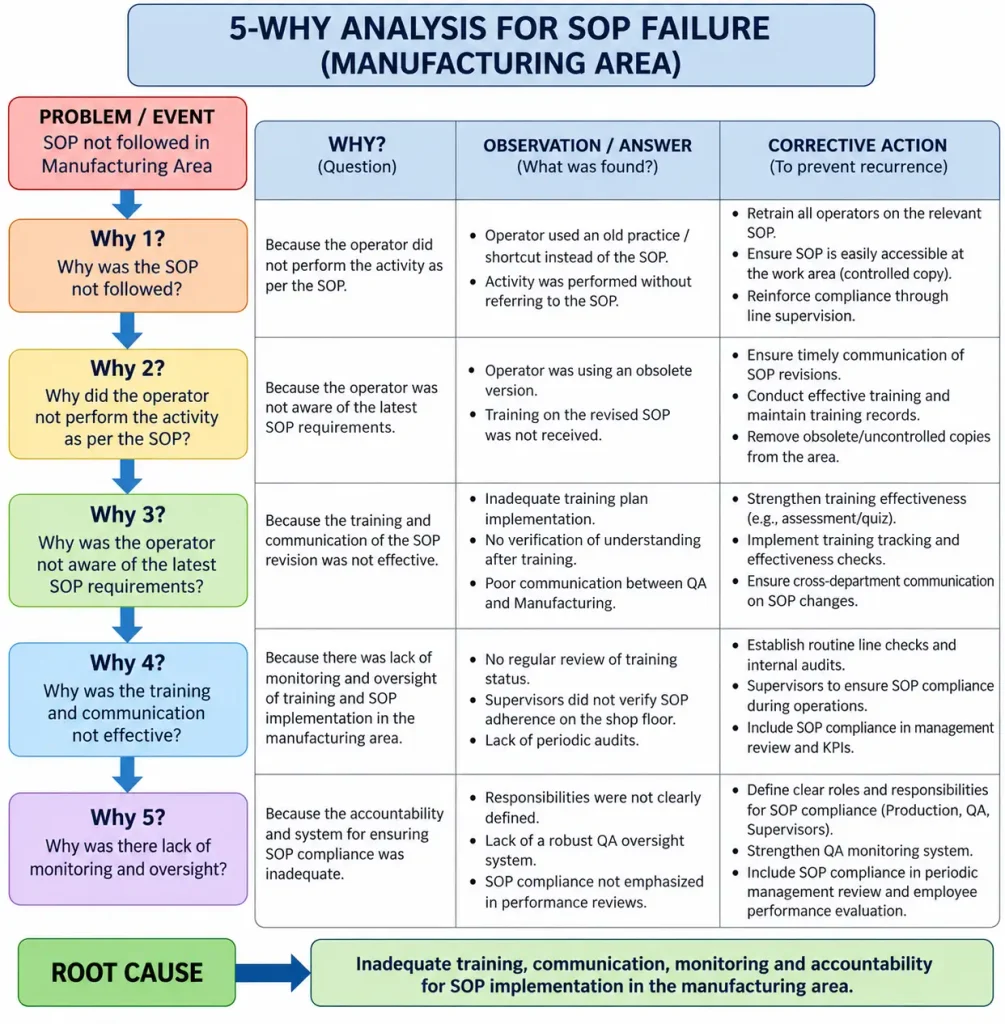
The analysis may begin with an incorrect, missing, or improperly assigned equipment identification number. Successive “Why?” questions can reveal causes such as use of an old practice, lack of awareness of the current SOP, ineffective training or communication, insufficient supervisory monitoring, and unclear accountability. Since the SOP defines specific identification formats for production equipment, failure to follow these requirements can affect equipment traceability and documentation control. The identified root cause should be addressed through retraining, controlled SOP availability, training-effectiveness checks, periodic compliance verification, and stronger QA oversight.
6. Fishbone Analysis for SOP Failure – SOP for Allocation of Identification Number:
The Fishbone Analysis identifies potential causes of failure in implementing the SOP for Allocation of Identification Number within the manufacturing area. The SOP is intended to provide a systematic method for assigning identification numbers to instruments and equipment so that proper traceability and reference can be maintained in associated documents.
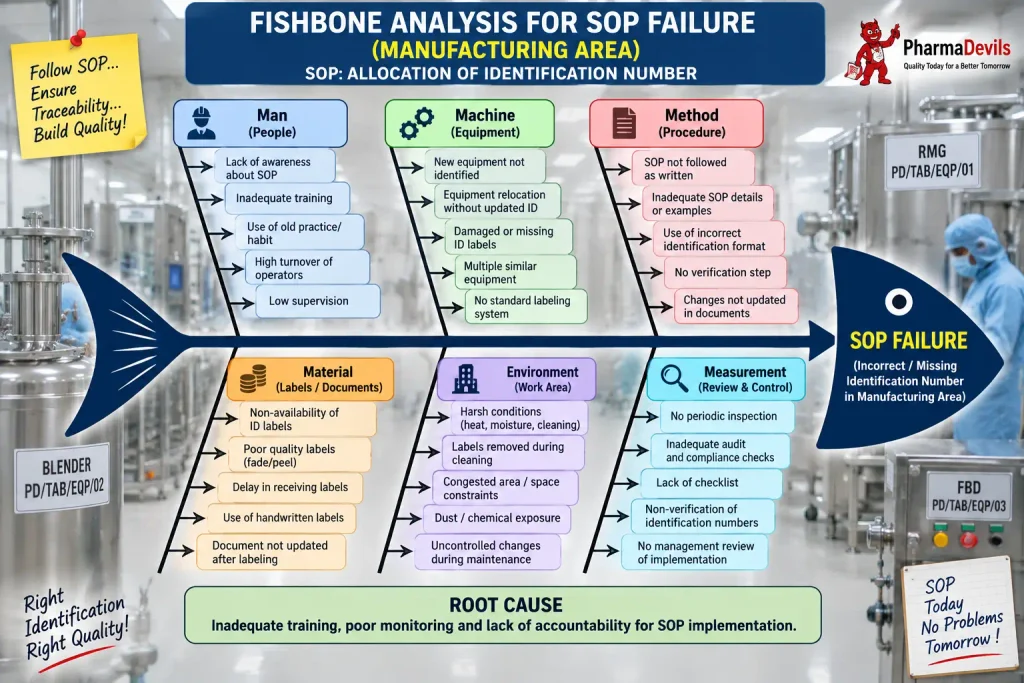
The analysis groups possible causes under Man, Machine, Method, Material, Environment, and Measurement. Typical causes include inadequate operator training, lack of awareness of the current SOP, use of incorrect identification formats, missing or damaged equipment labels, poor document updating, equipment relocation without updating identification, insufficient supervisory checks, and inadequate periodic verification. The SOP specifies defined identification-number formats for production equipment and requires preparation and approval of an equipment/instrument identification list. The fishbone analysis helps determine the contributing factors so that corrective actions can focus on training, document control, equipment labeling, routine inspection, QA monitoring, and clear accountability, thereby improving SOP compliance and equipment traceability.
7. Fault Tree Analysis for SOP Failure – SOP for Allocation of Identification Number:
The Fault Tree Analysis illustrates how different failures can lead to non-compliance with the SOP for Allocation of Identification Number in the manufacturing area. The SOP is intended to establish a controlled system for assigning identification numbers to instruments and equipment so that proper traceability and reference are maintained in related documents. The top event is SOP failure due to an incorrect, missing, duplicate, or outdated identification number. Contributing events may include failure to assign an identification number, use of the wrong identification format, equipment relocation without updating the number, damaged or illegible labels, inadequate training, lack of SOP availability at the workplace, human error, poor supervisory verification, and weak change control. The SOP defines specific identification formats for production equipment and other instruments, making correct allocation essential for consistency and traceability.
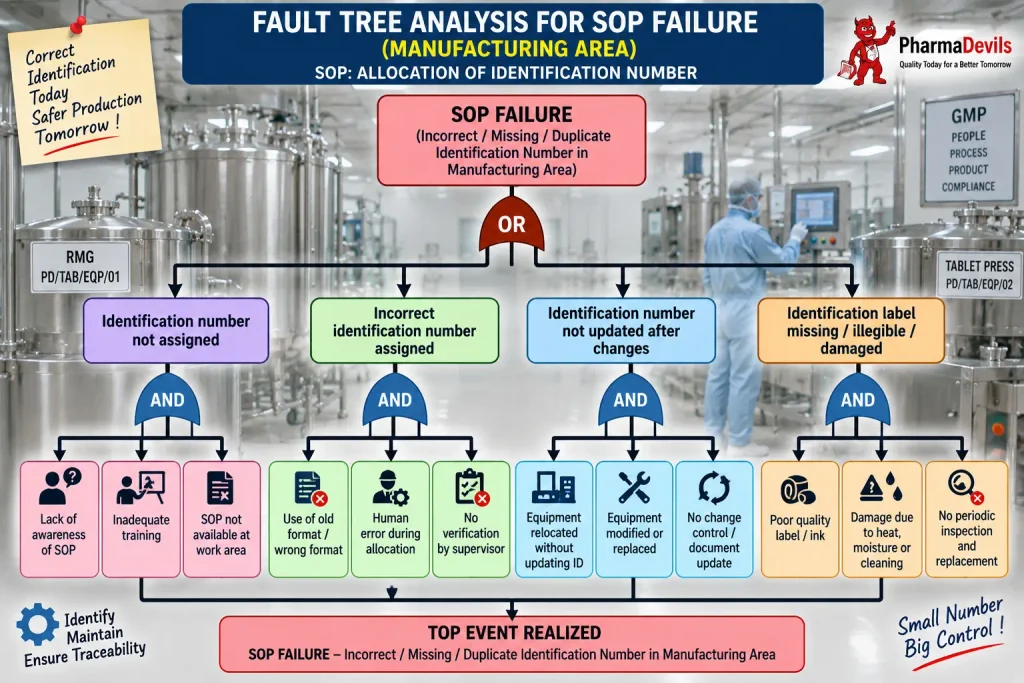
The analysis also highlights the importance of maintaining an approved list of instruments and equipment with their identification numbers and updating that list whenever required. Overall, the fault tree helps identify the combinations of failures that can result in SOP non-compliance and supports corrective actions such as retraining, verification of identification numbers, periodic inspection of labels, stronger supervisory checks, document updates, and effective QA monitoring.
7. Impact Assessment – SOP for Allocation of Identification Number:
The positive impact assessment demonstrates the benefits of effectively implementing the SOP for Allocation of Identification Number for instruments and equipment in the manufacturing area. The SOP is designed to establish a systematic identification system that improves traceability and reference in all related documents. Proper allocation of unique identification numbers supports accurate equipment recognition, reduces the possibility of mix-ups or duplicate numbering, and improves control of maintenance, calibration, qualification, and operational records. The SOP also requires preparation of an approved list of instruments and equipment with their respective identification numbers and updating the list whenever required.
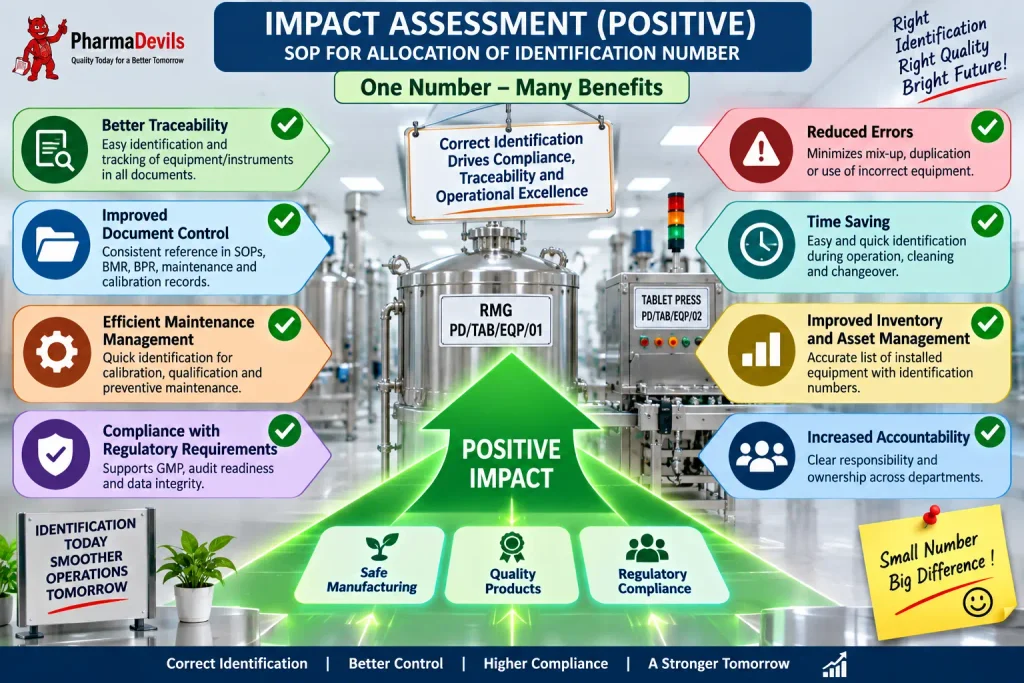
Effective implementation provides several positive outcomes, including better traceability, improved document control, faster equipment identification, stronger accountability, easier audit verification, improved asset management, and enhanced GMP compliance. Overall, a controlled equipment identification system strengthens operational control, supports data integrity, and improves reliability of manufacturing documentation.
Question & Answer – SOP for Allocation of Identification Number:
Q1. What is the objective of the SOP for Allocation of Identification Number?
Answer: The objective is to provide a system for allocating identification numbers to instruments and equipment to ensure better traceability and reference in related documents.
Q2. What is the scope of this SOP?
Answer: The SOP is applicable to all instruments and equipment installed in all departments.
Q3. Who is responsible for execution of this SOP?
Answer: The Executive/Chemist-QA is responsible for execution of the SOP.
Q4. Who is responsible for effective implementation of the SOP?
Answer: All Department Heads and the Head-QA/QC are responsible for effective implementation.
Q5. What identification-number format is used for equipment in the tablet section?
Answer: The format is XX/YYY/ZZZ/01, where XX represents Production (PD), YYY represents Tablet section (TAB), ZZZ represents Equipment (EQP), and 01 represents the serial number.
Q6. What identification-number format is used for equipment in the liquid section?
Answer: The format is XX/YYY/ZZZ/01, using PD for Production, LIQ for Liquid section, EQP for Equipment, followed by the serial number.
Q7. How are instruments/equipment in the Quality Control department identified?
Answer: The format specified is XX/YYY/01, where XX represents Quality Control (QC), YYY represents Instrument (INS), and 01 is the serial number.
Q8. How are air handling units identified?
Answer: Air Handling Units are assigned an identification number using the company code, AHU, and a serial number.
Q9. How are FBD bags identified?
Answer: FBD bags in the granulation section use a format containing the company code, FBDB, and a serial number such as 01, 02, 03, and so on.
Q10. How are pressure gauges in the tablet and liquid sections identified?
Answer: The SOP uses department, section, equipment, instrument ID, pressure-gauge code, and serial number. Examples include PD/LIQ/EQP/01/PG/01 for Liquid and PD/TAB/EQP/01/PG/01 for Tablet.
Q11. How are sampling and dispensing booths identified?
Answer: Dispensing booths use the code DB, while sampling booths use SB, together with the company code and serial number.
Q12. How are rooms identified under this SOP?
Answer: Rooms are identified using the floor code and serial number, such as B-01 for Basement, F-01 for First Floor, S-01 for Second Floor, and G-01 for Ground Floor.
Q13. What list is required after assigning identification numbers?
Answer: A list of instruments/equipment along with their identification numbers is to be prepared and approved by the Department Head.
Q14. When should the equipment/instrument identification list be updated?
Answer: The SOP requires the list to be updated and approved wherever required, with a serial number assigned to the prepared list.
Q15. What is the annexure provided with the SOP?
Answer: Annexure-I is the List of Instrument/Equipment, containing fields for serial number, equipment/instrument name, equipment/instrument ID number, and location.
Q16. Why is correct equipment identification important according to this SOP?
Answer: Correct identification supports traceability and provides a consistent reference for instruments and equipment in related documentation.
Reference Guidelines – SOP for Allocation of Identification Number:
- WHO Good Manufacturing Practices for Pharmaceutical Products – Main Principles, TRS 986, Annex 2. WHO GMP emphasizes controlled manufacturing systems, documented procedures, equipment records, and traceability. (World Health Organization)
- WHO Quality Assurance of Pharmaceuticals, Volume 2 – Good Manufacturing Practices and Inspection, 10th Edition, 2024. This compendium covers pharmaceutical quality systems, equipment, documentation, validation, and GMP controls. (World Health Organization)
- EU GMP – EudraLex Volume 4, Chapter 3: Premises and Equipment. Applicable for appropriate control, maintenance, and management of pharmaceutical equipment. (Public Health)
- EU GMP – EudraLex Volume 4, Chapter 4: Documentation. Requires controlled, approved, current and traceable documentation and emphasizes preventing unintended use of obsolete procedures. (Public Health)
- PIC/S Guide to GMP – PE 009, Part I. Provides GMP principles covering pharmaceutical quality systems, personnel, premises/equipment, documentation and production controls. The current PIC/S publications page lists PE 009-17. (PIC/S)
- Applicable Site SOPs: Document Control, Equipment Qualification, Calibration, Preventive Maintenance, Change Control, and Equipment/Instrument Usage Log procedures should be cross-referenced where applicable.