





1. Introduction:
A Standard Operating Procedure (SOP) is a written instruction that explains how a particular activity should be performed in a correct and consistent manner. In a pharmaceutical company, SOPs are very important because they help employees perform their work in the same approved way every time. This reduces mistakes, confusion, and differences in working practices. The Design and Control of Standard Operating Procedure system explains how SOPs should be prepared, checked, approved, numbered, issued, distributed, reviewed, revised, and stored. The SOP is prepared by the concerned user department, checked by the department head, and approved by Quality Assurance or Quality Control, as applicable. It also defines the standard format and important sections of an SOP, such as Objective, Scope, Responsibility, Procedure, References, Annexures, Abbreviations, Distribution, and Revision History. Proper SOP control ensures that employees use only the current and approved version of a procedure. Old or superseded copies are withdrawn, while controlled copies are issued to authorized persons. In simple words, this SOP helps a pharmaceutical organization keep its procedures clear, uniform, traceable, controlled, and easy to follow, supporting consistent working practices and effective document management.
Skip to PDF content2. Flow Diagram:
The flow diagram explains the Design and Control of Standard Operating Procedure (SOP) in a simple step-by-step manner. The process starts when the concerned user department prepares a draft SOP according to the required format and applicable requirements. The department head then checks the SOP for correctness, completeness, and practical suitability. After review, the SOP is sent to the Head of Quality Assurance/Quality Control for approval.
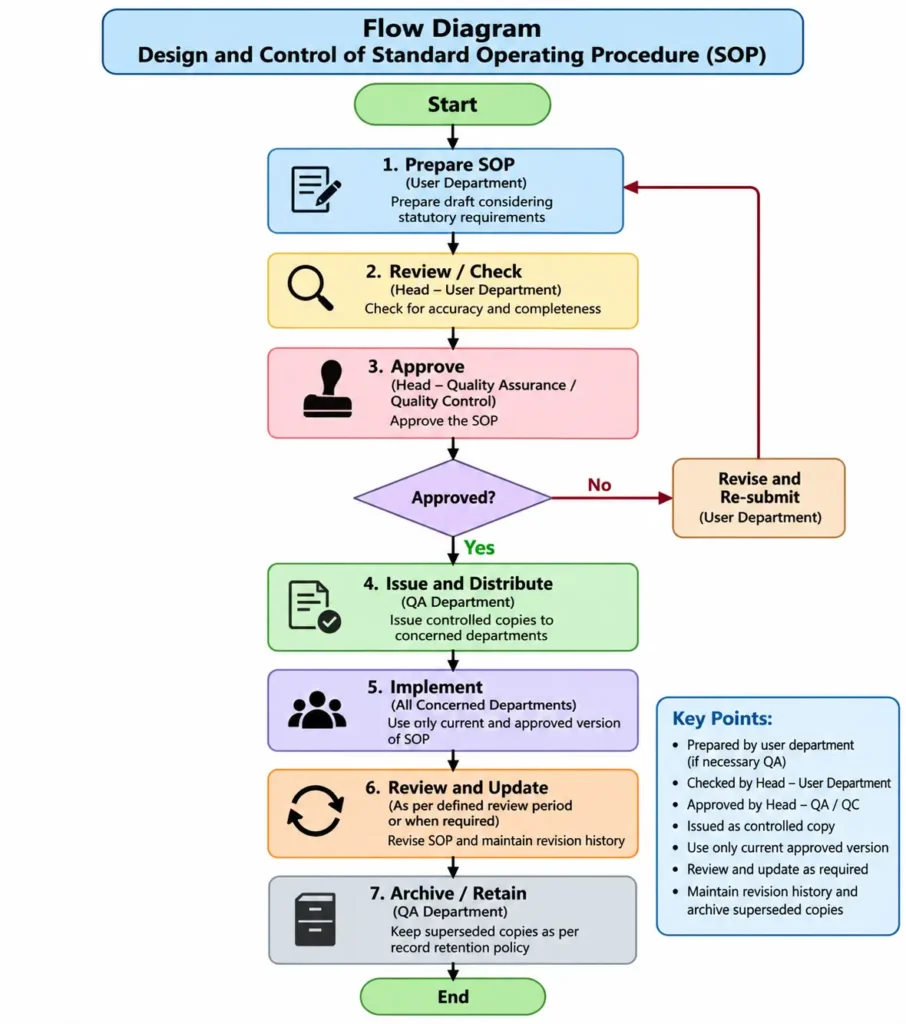
If corrections are required, the SOP is revised and submitted again. Once approved, QA prepares and issues the required controlled copies to authorized departments. Employees are trained and should use only the current approved version during their routine activities. The SOP is periodically reviewed and updated whenever necessary. When a revised SOP becomes effective, old controlled copies are withdrawn, marked obsolete where applicable, and properly retained or destroyed according to document-control requirements.
3. Benefits of Following SOP:
Following an approved Standard Operating Procedure (SOP) helps employees perform their work in the correct and same way every time. In pharmaceutical core areas, this is very important because even a small mistake can affect product quality, safety, or compliance.SOPs help reduce human errors, mix-ups, contamination, and unnecessary rework. They give clear instructions to operators, so everyone knows what to do, how to do it, and what records need to be completed. Proper SOP following also supports good documentation and makes activities easier to trace during audits or investigations.
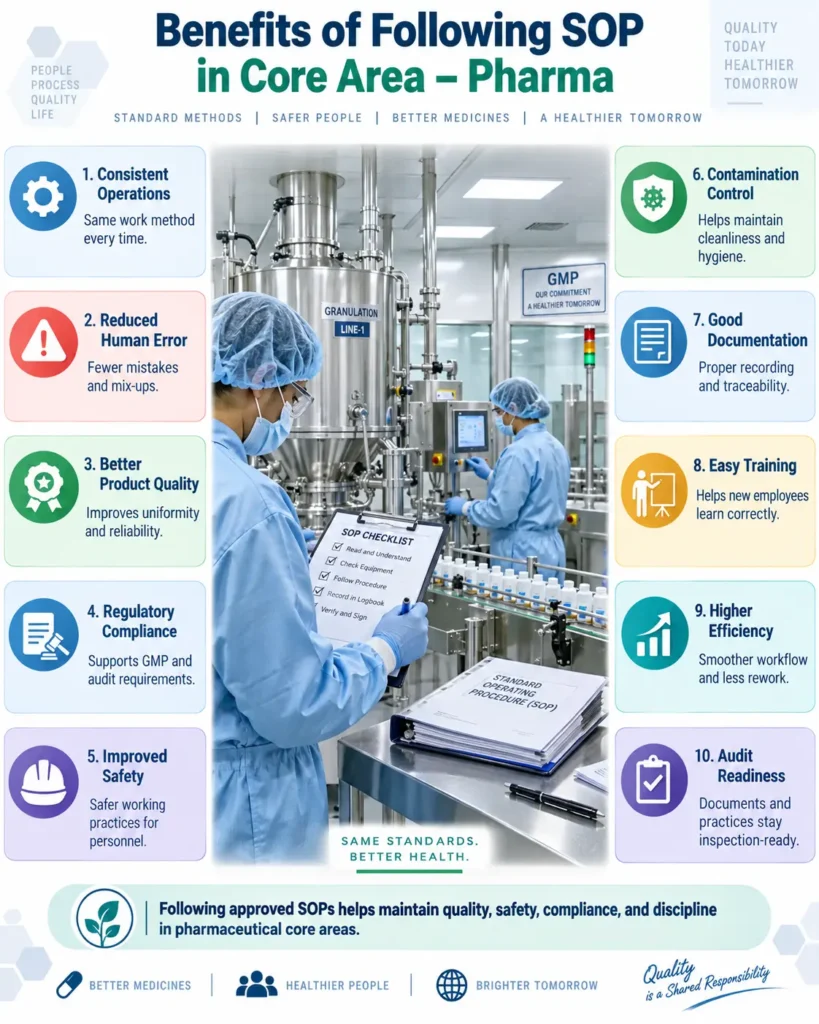
SOPs improve product quality and process consistency because each activity is carried out using an approved method. They also support GMP requirements, personnel safety, cleanliness, and contamination control. For new employees, SOPs make training easier because the correct method is already written step by step. Overall, following SOPs helps maintain quality, safety, discipline, compliance, efficiency, and audit readiness in pharmaceutical manufacturing areas.
4. Brainstorming for SOP Failure:
The brainstorming diagram shows the possible reasons why an SOP may not be followed correctly in a pharmaceutical core area. The main problem is placed in the center as “SOP Failure in Core Area,” while different possible causes are shown around it. Common reasons include inadequate training, poor understanding of the procedure, documentation errors, missed line clearance, weak supervision, time pressure, communication gaps, incorrect gowning, incomplete cleaning, equipment problems, material mix-ups, failure to report deviations, lack of checklist use, and inadequate review.
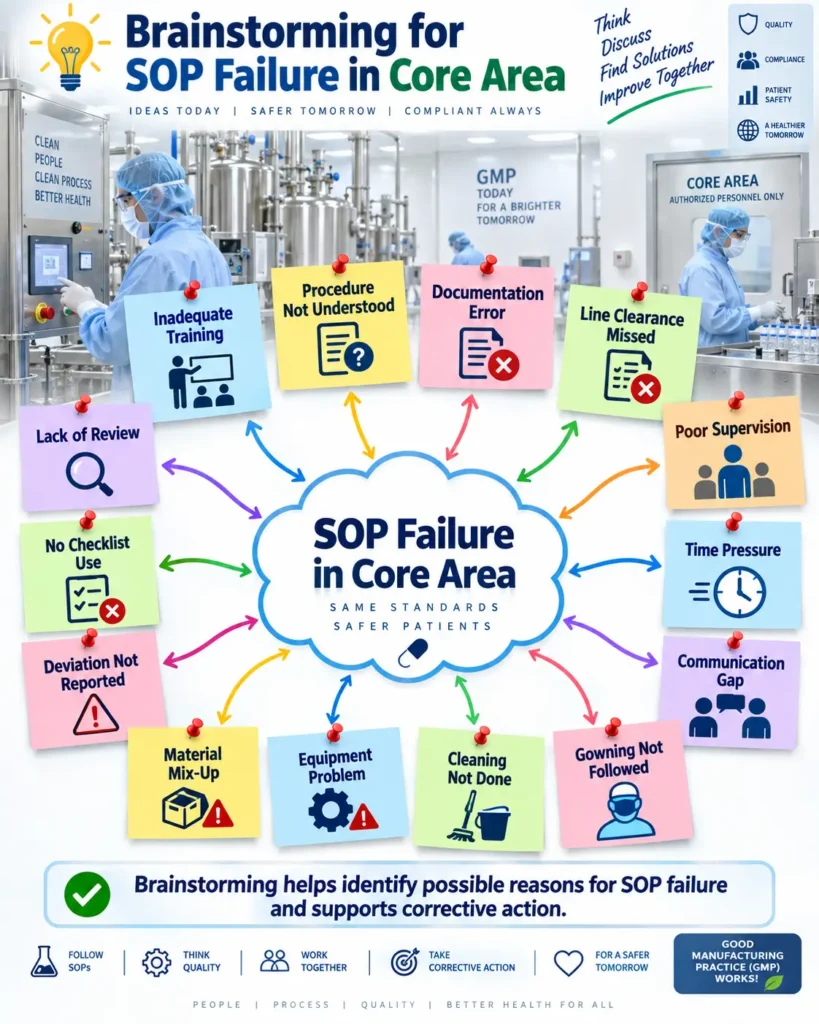
Brainstorming helps the team collect different ideas without immediately deciding the final root cause. It allows Production, QA, Engineering, and other concerned personnel to discuss what may have gone wrong during the activity. After identifying these possible causes, the team can investigate them further using tools such as 5-Why Analysis, Fishbone Analysis, or Fault Tree Analysis. This helps identify the actual cause and supports suitable corrective and preventive actions to avoid repetition of the SOP failure.
5. 5-Why Analysis for SOP Failure:
The 5-Why Analysis is used to find the actual reason behind an SOP failure by repeatedly asking “Why?” until the root cause becomes clear. In this example, the problem starts because the operator did not follow the approved SOP. The next question identifies that the SOP steps were not fully understood. Further analysis shows that the training and explanation were inadequate. The next “Why” points to weak training planning and insufficient supervisor follow-up. Finally, the analysis shows that the department did not have a strong system for training review and regular compliance monitoring.
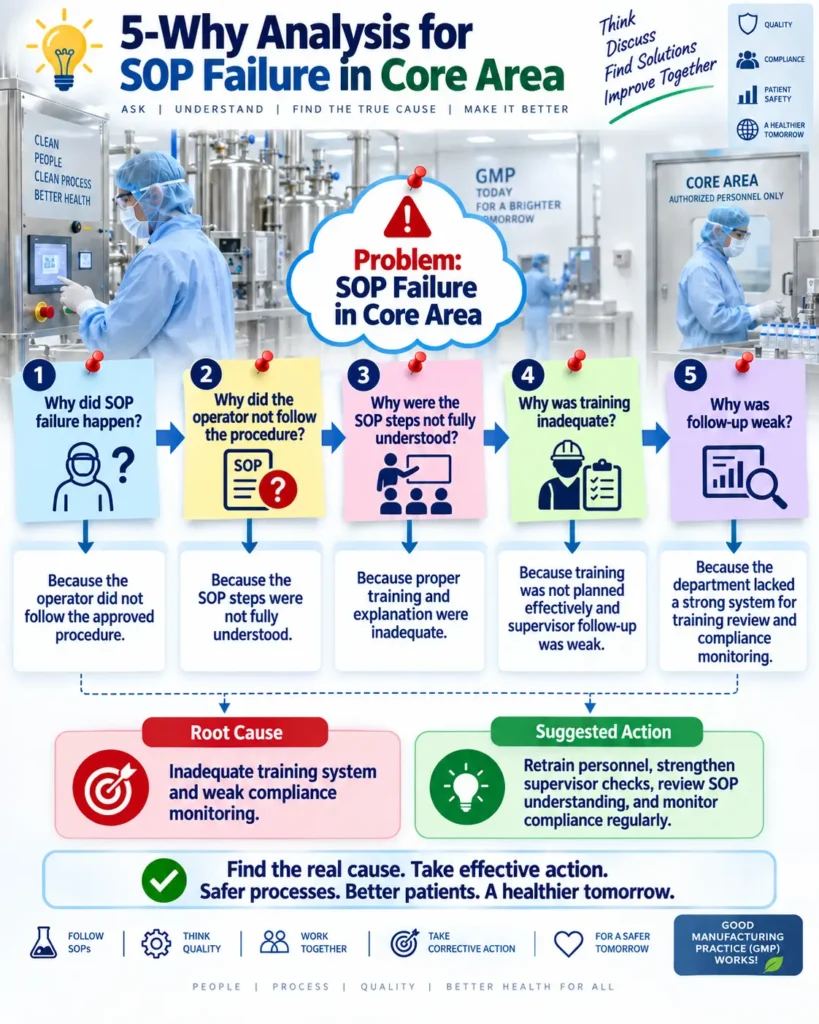
The likely root cause is therefore an inadequate training system together with weak compliance monitoring. Suitable actions include retraining concerned personnel, improving supervisor checks, verifying SOP understanding, and regularly monitoring compliance. This method helps the team move beyond the immediate mistake and identify the deeper system weakness that allowed the SOP failure to occur.
6. Fishbone Analysis for SOP Failure:
The Fishbone Analysis helps identify different possible reasons for an SOP failure in a pharmaceutical core area. The main problem is shown at the head of the fish, while possible causes are grouped into different categories.
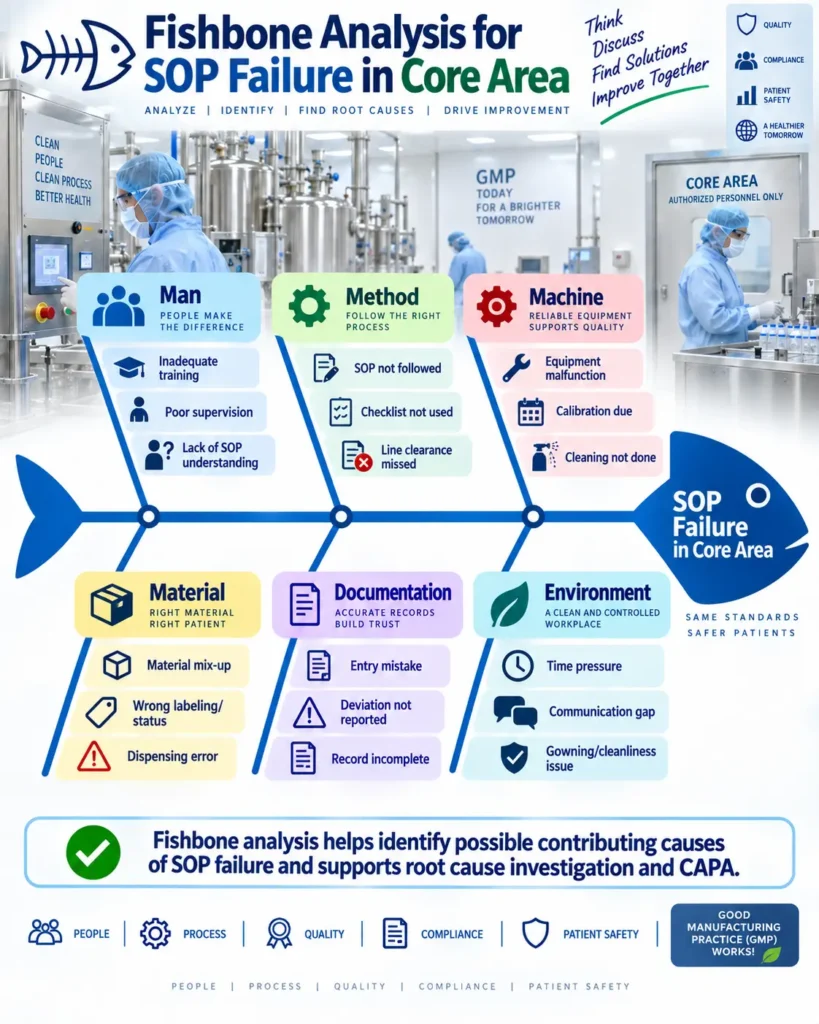
Under Man, the causes may include inadequate training, poor supervision, or lack of SOP understanding. Under Method, problems may include not following the SOP, not using a checklist, or missing line clearance. Under Machine, equipment malfunction, overdue calibration, or improper cleaning may contribute to failure. The Material category may include material mix-up, wrong labeling, or dispensing errors. Documentation problems can include incorrect entries, incomplete records, or failure to report deviations. Environment factors may include time pressure, communication gaps, or poor gowning and cleanliness practices. In simple words, the Fishbone Diagram helps the team look at the problem from different angles so that the real cause can be identified and suitable CAPA can be taken.
7. Fault Tree Analysis for SOP Failure:
The Fault Tree Analysis (FTA) diagram shows how different problems can lead to SOP failure in a pharmaceutical core area. The main problem, or Top Event, is “SOP Failure in Core Area.” From this main event, possible causes are divided into different groups. Personnel-related failures may include inadequate training, poor supervision, or lack of SOP understanding. Procedure or method failures may include not using checklists, missing line clearance, or not following gowning requirements. Documentation failures can occur due to wrong entries, unreported deviations, or incomplete records. Equipment and environmental failures may include equipment problems, improper cleaning, time pressure, or communication gaps.
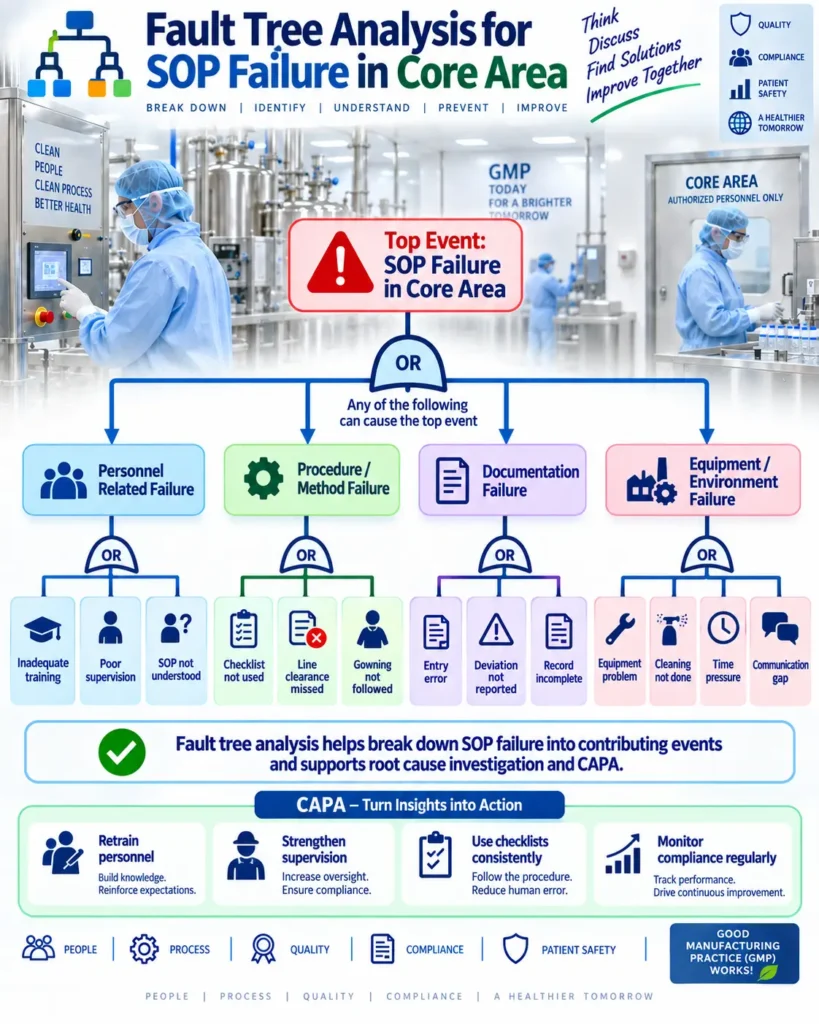
The diagram uses OR gates, which means that any one or a combination of these problems may contribute to SOP failure. In simple words, Fault Tree Analysis helps the investigation team break a large problem into smaller possible causes. This makes it easier to identify the real root cause and take suitable corrective and preventive actions (CAPA) to prevent the problem from happening again.
8. Impact Assessment:
The Impact Assessment diagram shows what may happen when an SOP failure, deviation, contamination, mix-up, or documentation error occurs in a pharmaceutical core area. Such an event can affect product quality by causing contamination, mix-ups, out-of-specification results, reduced stability, or even batch rejection. It may also affect patient safety if the product becomes unsafe or ineffective. The event can create problems in production activities, such as process stoppage, rework, delays, extra testing, and loss of productivity. It may also affect personnel, especially if there is exposure to chemicals or a need for retraining.
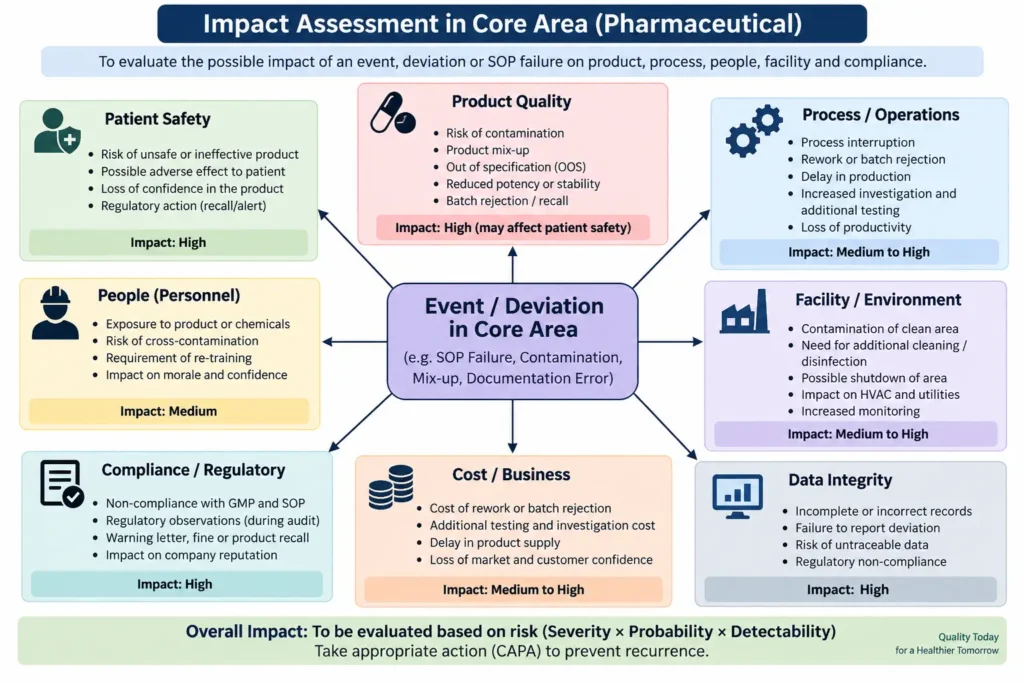
The facility and environment may require extra cleaning, disinfection, monitoring, or temporary shutdown. Poor documentation can also create data integrity and compliance issues, which may lead to audit observations or regulatory concerns. In simple words, impact assessment helps determine how serious the problem is, what areas are affected, and what CAPA is required to prevent recurrence.
Questions & Answers:
1. What is an SOP?
An SOP is a written document that explains step-by-step how a specific activity should be performed in a correct and consistent way.
2. Why is SOP control important in a pharmaceutical company?
SOP control ensures that only the correct and approved version is used, helping maintain consistency, traceability, and proper document management.
3. Who prepares an SOP?
The SOP is generally prepared by the concerned user department, with QA involvement where required.
4. Who checks and approves an SOP?
The Head of the User Department checks the SOP, and the Head of Quality Assurance/Quality Control approves it.
5. What are the main sections of an SOP?
The SOP includes Objective, Scope, Responsibility, Procedure, References, Annexures, Abbreviations, Distribution, and Revision History.
6. What is a Master Copy?
A Master Copy is the original approved document containing original signatures and marked as “MASTER COPY.” It is maintained by Quality Assurance.
7. What is a Controlled Copy?
A Controlled Copy is an authorized photocopy of the Master Copy issued for use within the organization to approved document holders.
8. What is an Uncontrolled Copy?
An Uncontrolled Copy is generally a photocopy of the Master Copy provided for customers or external agencies, as defined in this SOP.
9. What is an Obsolete Copy?
An Obsolete Copy is an old or discontinued SOP/document that has been removed from use by Quality Assurance.
10. What happens when an SOP is revised?
The revised SOP is issued according to the document-control procedure. Superseded controlled copies are withdrawn, and the old Master Copy is marked “OBSOLETE.”
11. How often should the SOP be reviewed?
According to this SOP, it should be reviewed within 30 working days before completion of two years, or earlier when a relevant change is required.
12. Can changes be made manually in an approved Master Copy?
No. Once the Master Copy is authorized, manual corrections are not permitted, even if signed and dated.
13. Why is training required before an SOP becomes effective?
A training copy is issued so concerned personnel can be trained before routine implementation of the approved SOP.
14. Why is revision history maintained?
Revision history records the reason and details of changes made to the SOP, providing traceability of document updates.
15. Why should old SOP copies be removed from the workplace?
Old copies are withdrawn to prevent employees from accidentally following an outdated procedure. The SOP requires superseded controlled copies to be removed when revised documents are issued.
16. What is the purpose of SOP numbering?
SOP numbering provides unique identification of each procedure using an alphanumeric system linked to the department and document sequence.
17. How should SOPs and records be stored?
They should be stored safely to protect them from damage, loss, or deterioration and should remain easy to retrieve when required.
18. What is the main benefit of following an approved SOP?
Following an approved SOP helps ensure that activities are carried out in a clear, uniform, controlled, and traceable manner, reducing the chance of errors and improper practices.
Reference Guideline:
Regulatory References such as WHO GMP, PIC/S, EU GMP, US FDA, and India Schedule M for SOP/document control.