







1. Introduction:
The Design Qualification Guideline for Minimizing the Risk of Product Cross-Contamination by Air Handling System explains the important points that should be considered while designing an HVAC system for pharmaceutical manufacturing areas. Its main purpose is to prevent dust, particles, or product residues from one manufacturing area from reaching another area through the movement of air. The guideline is intended to be applied during the HVAC design phase and involves Maintenance, Production, Quality Control, and Quality Assurance personnel. In pharmaceutical manufacturing, cross-contamination may occur because of poorly designed air handling systems, incorrect airlock arrangements, unsuitable room pressure differences, or contaminated process and environmental air. Therefore, product containment at the source is important, especially where powders or materials are exposed. Local exhaust ventilation, containment booths, and properly designed air systems help control this risk. The guideline also considers dedicated air handling units, separation of manufacturing and non-manufacturing areas, airlocks, pressure differentials, HEPA filtration, room air distribution, recirculation or once-through air systems, and safe positioning of fresh-air intakes and exhausts. These controls help maintain clean and controlled manufacturing conditions and reduce the possibility of one product contaminating another. Overall, proper HVAC design qualification provides documented assurance that the air handling system is suitably designed to support safe pharmaceutical manufacturing and minimize product cross-contamination.
Skip to PDF content2. Flow Diagram:
This flow diagram explains in simple language how an HVAC air handling system should be designed to reduce the risk of product cross-contamination in a pharmaceutical facility.The process starts by understanding the product, manufacturing process, and facility requirements. After that, the HVAC system is designed with important controls such as dedicated air handling systems, proper airlocks, suitable room pressure differences, HEPA filters, correct air distribution, fresh-air intake, exhaust arrangement, and local dust control.
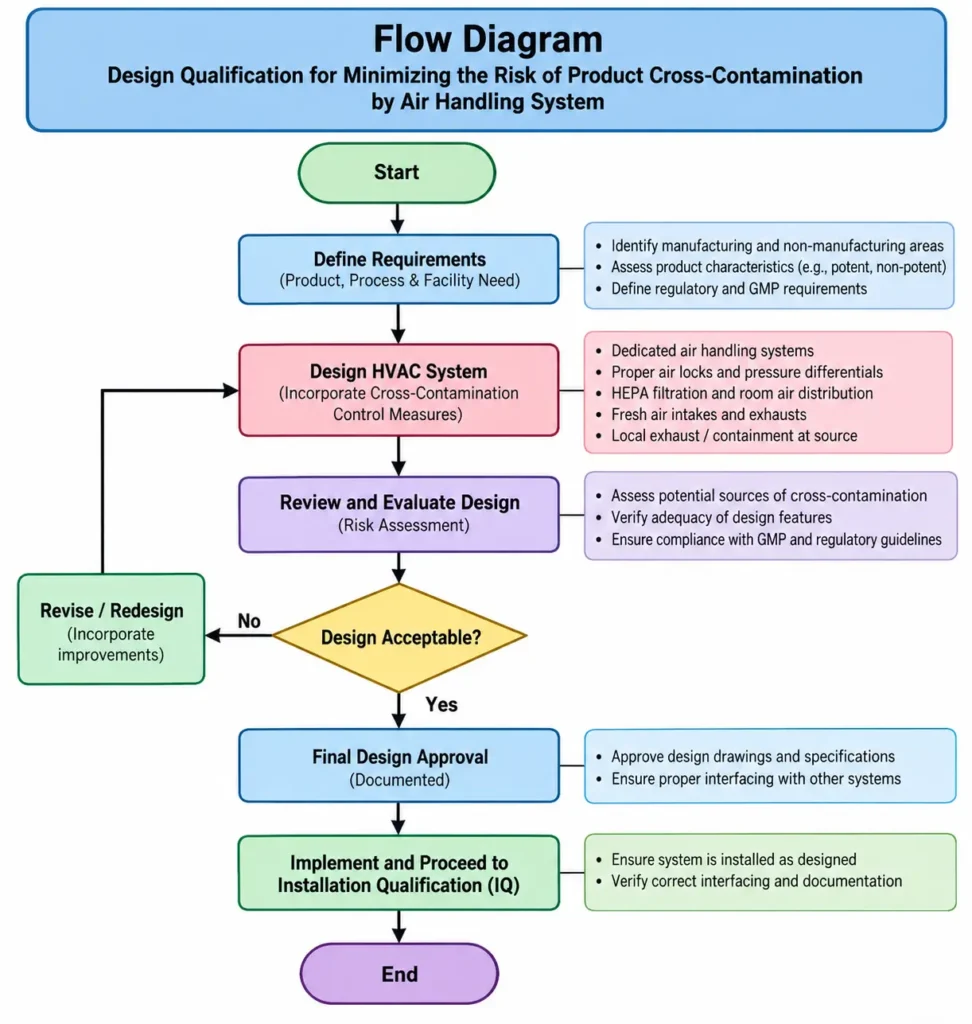
The proposed design is then reviewed to identify any possible risk of contamination from one area or product to another. If the design is not acceptable, it is revised and improved. If it is acceptable, the design is formally approved and documented. After approval, the system is installed and checked during Installation Qualification (IQ) to confirm that it has been installed according to the approved design and is properly connected with other systems. In simple words, the flow ensures that the HVAC system is planned, checked, corrected, approved, installed, and verified before routine use, helping protect product quality and prevent cross-contamination.
3. Benefits of following the SOP:
The image shows the benefits of following the SOP in a pharmaceutical core manufacturing area. Following the SOP helps maintain a clean, controlled, and safe working environment where products can be manufactured with minimum contamination risk.
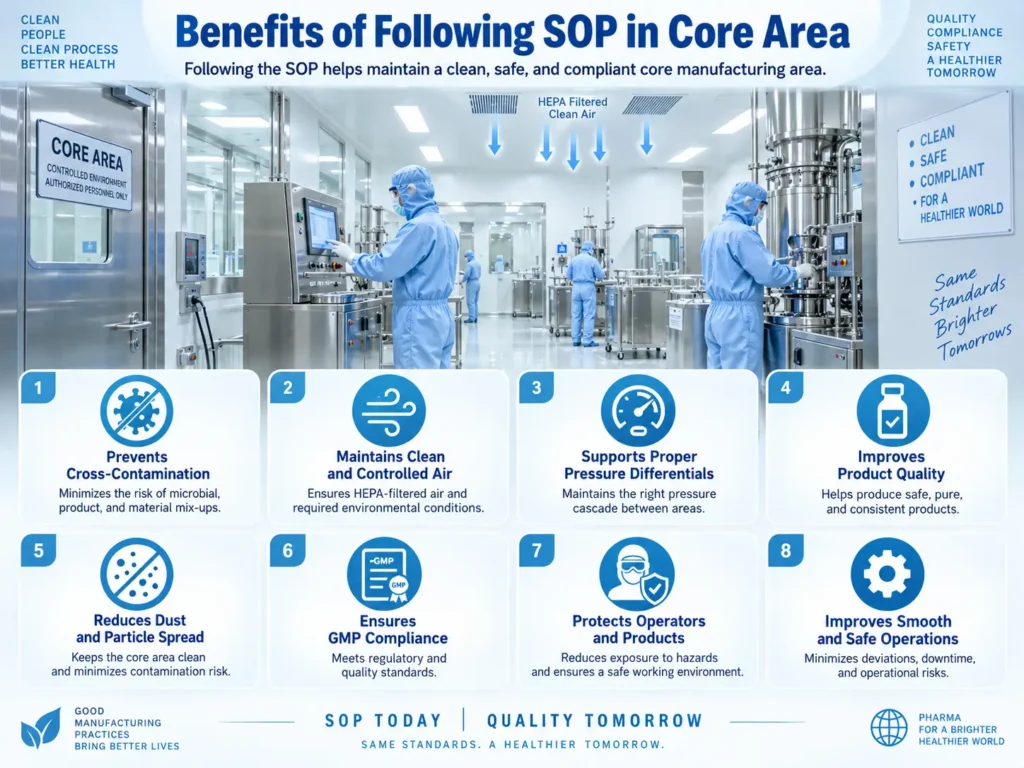
Proper SOP compliance helps prevent cross-contamination between products and manufacturing areas. It also supports clean air conditions by ensuring effective HEPA filtration and proper airflow. Correct room pressure differentials help control the direction of air movement and reduce the spread of dust and particles. The SOP also supports consistent product quality by reducing mix-ups, contamination, deviations, and operational errors. At the same time, it helps protect operators by promoting safe working practices and proper use of controlled systems.Following the SOP also supports GMP compliance because activities are performed in a defined, documented, and controlled manner. In simple words, following the SOP keeps the core area clean, products safe, operators protected, processes controlled, and manufacturing compliant with quality requirements.
4. Brainstorming for SOP Failure:
This brainstorming diagram shows the possible reasons why an SOP may fail in a pharmaceutical core manufacturing area. The main problem, “SOP Failure in Core Area,” is shown in the center, while different possible causes are placed around it. The diagram highlights problems such as inadequate training, poor gowning practice, improper cleaning, documentation errors, HVAC or airflow problems, pressure differential not maintained, material handling mistakes, equipment not properly sanitized, weak supervision, and line clearance not being completed.
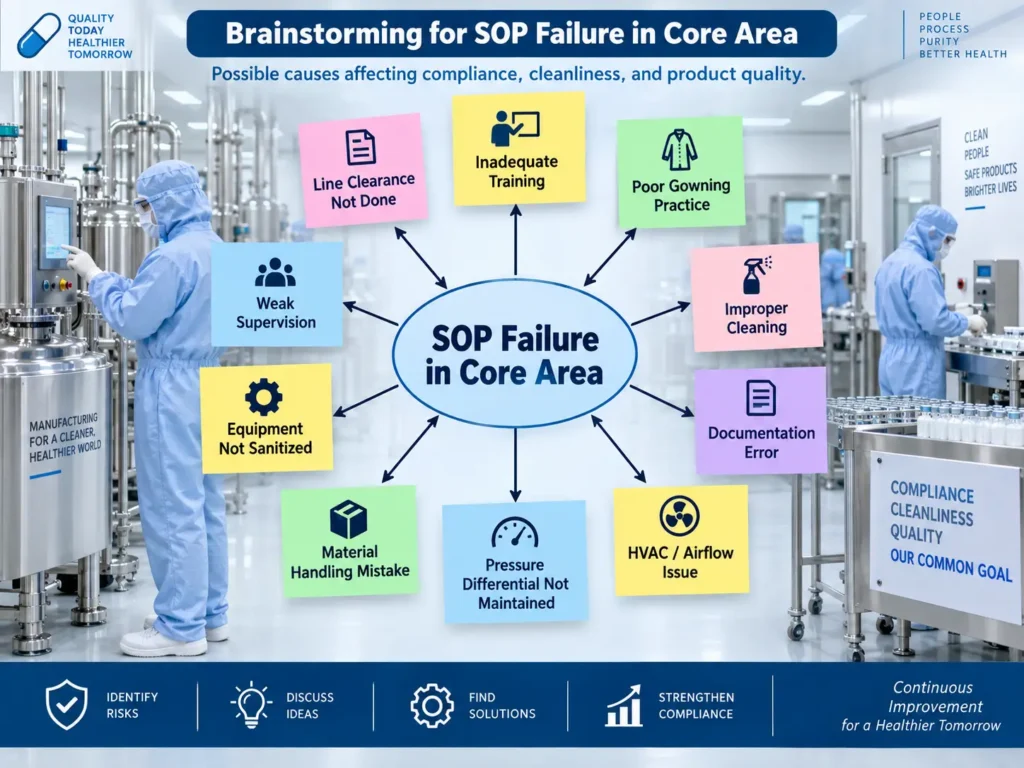
In simple language, SOP failure usually does not happen because of only one reason. It may occur due to a combination of people, equipment, cleaning, documentation, material handling, and environmental control problems. Brainstorming helps the team collect all possible causes before starting a detailed investigation. Once the causes are identified, the team can check which ones are actually responsible and take suitable corrective and preventive actions. Overall, this method helps find problems early, improve compliance, protect product quality, maintain cleanliness, and reduce the chance of repeated SOP failures in the core manufacturing area.
5. 5-Why Analysis for SOP Failure:
This 5-Why Analysis explains in simple language why an SOP may not be followed properly in a pharmaceutical core area. The problem starts when an operator does not follow the required SOP step during activities such as operation, cleaning, gowning, or process control. The next question is why the operator did not follow it. One possible reason is that the operator was not fully aware of the SOP requirements.The analysis then goes deeper and asks why the operator was not fully aware. This may happen because the training was not effective or refresher training was not provided. Further investigation may show that the training program was not properly planned and SOP compliance was not checked regularly.
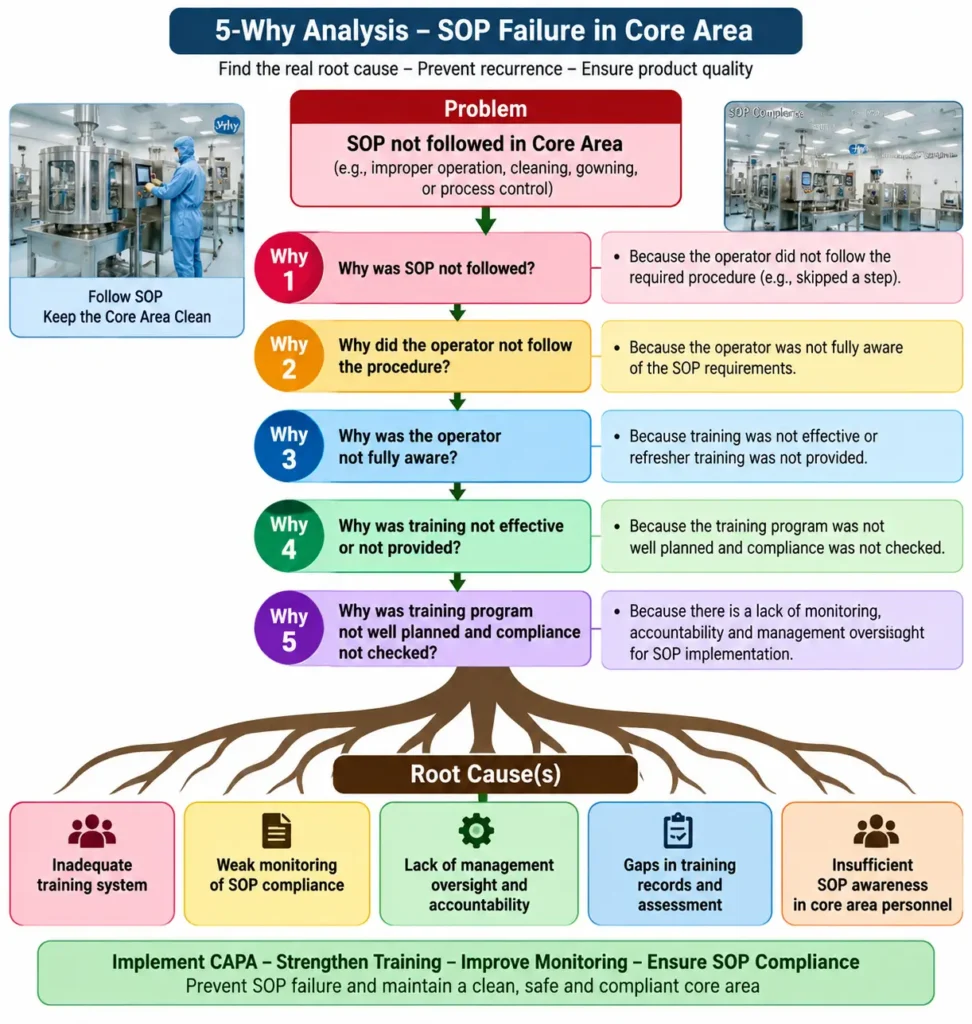
At the deepest level, the main causes may be weak monitoring, inadequate training, poor documentation, lack of accountability, and insufficient management oversight. In simple words, the 5-Why method helps the team move from the visible problem to the real root cause. Once the root cause is identified, suitable CAPA can be taken to improve training, monitoring, accountability, and SOP compliance.
6. Fishbone Analysis for SOP Failure:
This Fishbone Analysis shows the possible reasons for SOP failure in a pharmaceutical core area. It helps the investigation team look at different types of causes instead of blaming only one person or one activity. The possible causes are grouped into six areas: Man, Method, Machine, Material, Measurement/Documentation, and Environment.For Man, the causes may include inadequate training, poor gowning practice, or weak supervision. Under Method, the problem may come from not following the SOP, improper cleaning, or incomplete line clearance. Machine-related causes can include equipment not being sanitized, maintenance gaps, or machine malfunction.
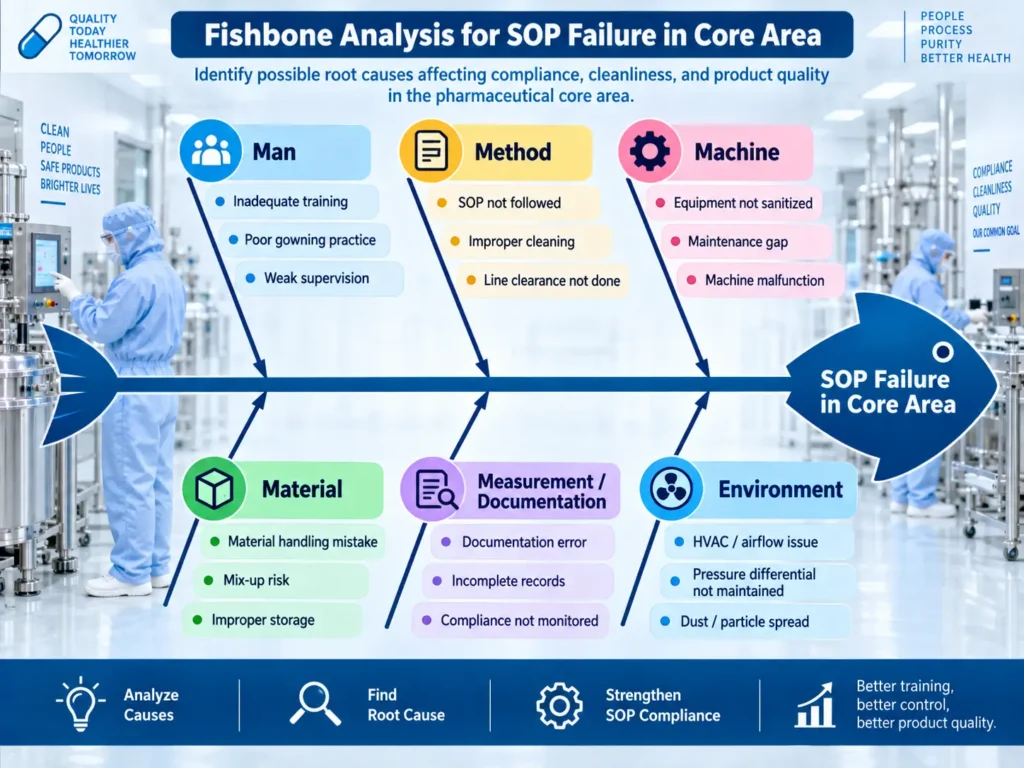
Material-related problems may involve handling mistakes, mix-up risk, or improper storage. Under Measurement/Documentation, errors can happen because of incorrect or incomplete records and poor compliance monitoring. Environmental causes may include HVAC problems, incorrect pressure differential, or dust and particle spread. In simple language, this diagram helps identify where the SOP failure may be coming from, so the actual root cause can be found and suitable CAPA can be taken.
7. Fault Tree Analysis for SOP Failure:
This Fault Tree Analysis explains the possible reasons behind an SOP failure in a pharmaceutical core area. The main problem, called the Top Event, is “SOP Failure in Core Area.” The diagram then breaks this problem into different possible failure groups such as personnel failure, method/procedure failure, equipment failure, material handling failure, documentation failure, and environment/HVAC failure.Personnel-related causes may include inadequate training, poor gowning, and weak supervision. Method-related causes may include not following the SOP, improper cleaning, or missed line clearance. Equipment-related causes can include poor sanitization, maintenance gaps, or machine malfunction.
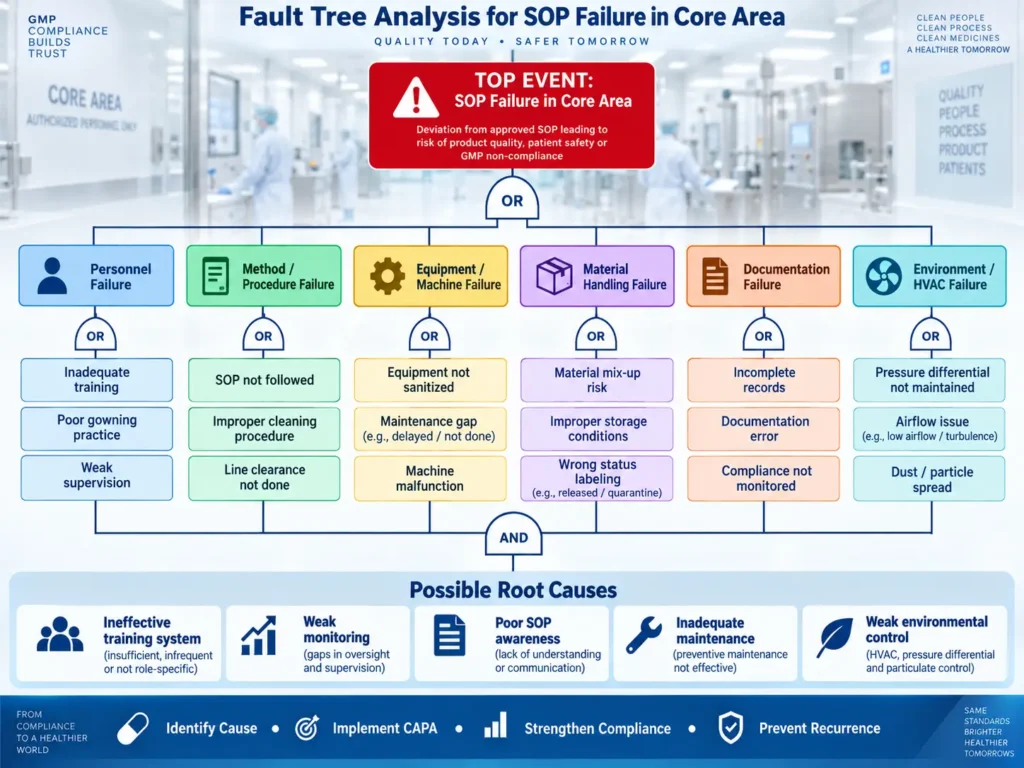
Material mix-up, improper storage, incomplete records, documentation errors, pressure differential problems, poor airflow, and dust spread may also contribute to SOP failure. In simple language, the fault tree helps the investigation team break one big problem into smaller possible causes. This makes it easier to identify the actual root cause and implement suitable CAPA to prevent the same failure from happening again.
8. Impact Assessment:
This Impact Assessment image shows the possible effects of an SOP failure in a pharmaceutical core area. The main concern is that improper control of the air handling system can increase the risk of product contamination and cross-contamination. The SOP specifically emphasizes proper containment, dedicated air handling arrangements, airlocks, HEPA filtration, and controlled air movement to reduce this risk.The diagram also shows that an SOP failure may affect product quality, personnel safety, regulatory compliance, manufacturing operations, cost, reputation, and the working environment. For example, poor HVAC control or incorrect pressure differential can allow dust or product particles to move from one area to another. The SOP requires controlled room pressure differentials and suitable HEPA filtration to minimize such movement.
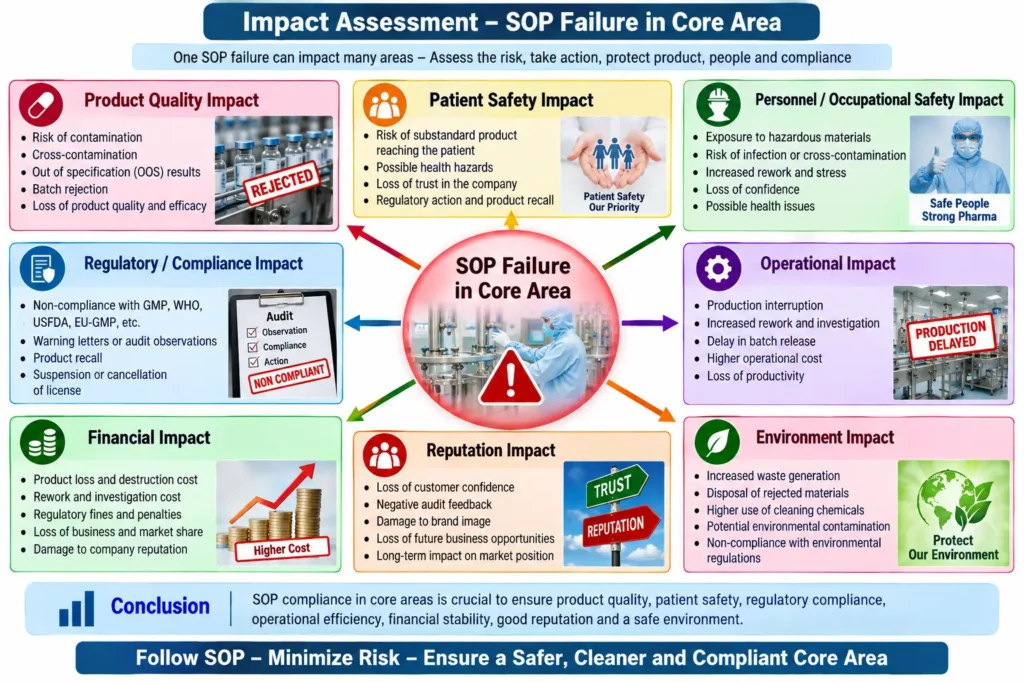
In simple words, the assessment helps the team understand how serious an SOP failure could be and where corrective action is required. Proper SOP compliance helps maintain a clean, controlled manufacturing area and reduces the possibility of contamination, deviations, and repeated failures.
Questions & Answers:
Q1. What is the main purpose of this SOP?
Answer: The purpose is to provide guidelines for minimizing the risk of product cross-contamination through the air handling system.
Q2. Where is this SOP applicable?
Answer: It is applicable during the design phase of HVAC systems used in pharmaceutical facilities.
Q3. Who is responsible for implementing this SOP?
Answer: Maintenance, Production, Quality Control, and Quality Assurance personnel are responsible for execution, while their respective department heads are responsible for effective implementation.
Q4. What are the main sources of cross-contamination mentioned in the SOP?
Answer: Possible sources include poorly designed air handling systems, airlocks, incorrect room pressure differentials, contaminated environmental or process air, and contamination during cleaning and maintenance.
Q5. How can product contamination be controlled at the source?
Answer: Product should be contained within the manufacturing process wherever possible. Local exhaust ventilation and containment booths may be used where materials are exposed.
Q6. Why are dedicated air handling systems important?
Answer: Dedicated air handling systems help separate manufacturing areas and reduce the possibility of contaminated air moving from one product or area to another.
Q7. Why are airlocks important?
Answer: Airlocks help minimize the spread of product between different air handling zones and support controlled movement of air.
Q8. What is the purpose of room pressure differential?
Answer: Room pressure differential helps control the direction of air movement and reduces unwanted movement of product particles from one area to another.
Q9. What is the role of HEPA filters?
Answer: HEPA filters help provide protection against product cross-contamination and can reduce the migration of particles through the air distribution system.
Q10. What is meant by once-through and recirculation air systems?
Answer: A once-through system uses air without recirculating it, while a recirculation system returns part of the air back through the air handling system. The SOP requires consideration of contamination risk before selecting the arrangement.
Q11. Why is proper room air distribution necessary?
Answer: Proper air distribution helps maintain required temperature and humidity and reduces room particle levels by supplying cleaner air.
Q12. What precautions should be considered for air handling plants?
Answer: Precautions may include locating dust collection systems outside the manufacturing building, using safe-change filters, and segregating air handling plants.
Q13. Why should fresh-air intakes and exhausts be properly located?
Answer: Their location should prevent discharged contaminated air from being drawn back into the fresh-air intake and causing cross-contamination.
Q14. What happens if the SOP is not followed properly?
Answer: Poor implementation can increase the risk of uncontrolled air movement and product cross-contamination, especially where airlocks, pressure differentials, containment, or filtration are inadequate.
Q15. What is the overall benefit of following this SOP?
Answer: Following the SOP helps ensure that the HVAC system is designed and installed in a controlled manner to minimize product cross-contamination and support safe pharmaceutical manufacturing.
Reference Guidelines:
- WHO Technical Report Series No. 1010, Annex 8 (2018) – Guidelines on Heating, Ventilation and Air-Conditioning Systems for Non-Sterile Pharmaceutical Products. This guideline covers HVAC design, airlocks, pressure differentials, filtration, airflow, qualification, and prevention of contamination and cross-contamination. (World Health Organization)
WHO TRS 1010 Annex 8 - WHO Technical Report Series No. 1019, Annex 2 (2019) – WHO GMP for HVAC Systems for Non-Sterile Pharmaceutical Products, Part 2: Interpretation of Guidelines. This provides additional practical interpretation of pharmaceutical HVAC requirements. (World Health Organization)
WHO TRS 1019 Annex 2 - EU GMP – EudraLex Volume 4, Part I, Chapter 3: Premises and Equipment. It requires premises and equipment to be designed and maintained to minimize contamination, cross-contamination, dust accumulation, and other adverse effects on product quality; it also addresses suitable temperature, humidity, and ventilation. (Public Health)
- EU GMP – EudraLex Volume 4, Part I, Chapter 5: Production. Sections on prevention of cross-contamination include appropriate airlocks and air extraction, control of recirculated or re-entering air, segregation, closed systems, and effective cleaning. (Public Health)
EU GMP EudraLex Volume 4