






Brief Description
This SOP describes the procedure for the preparation, identification, storage, usage, monitoring, documentation, and upkeep of reference solutions used in the Quality Control laboratory. Reference solutions may be prepared from reference standards, test/working standards, impurity standards, or mixtures of these standards and are assigned unique solution numbers for traceability. The procedure requires proper labeling, storage in tightly closed glass bottles or vials, use of amber containers for light-sensitive solutions, and maintenance of reference-solution lists and preparation/usage logs. Before use, solutions are checked for colour, clarity, and foreign particles, and analytical results are compared with the initial analysis to detect degradation or significant changes. Reference solutions are generally assigned a six-month validity, unless suitability or standard validity requires earlier replacement. The SOP also defines requirements for transfer between units, record retention, training, and associated annexures for labeling and usage documentation.
Skip to PDF content1. Flow Diagram:
The flow diagram describes the systematic process for preparation, identification, storage, use, monitoring, and control of reference solutions in the Quality Control laboratory. It begins with preparation of the reference solution and assignment of a unique solution number, followed by proper labeling and storage in tightly closed glass bottles or vials, with amber containers used for light-sensitive solutions.
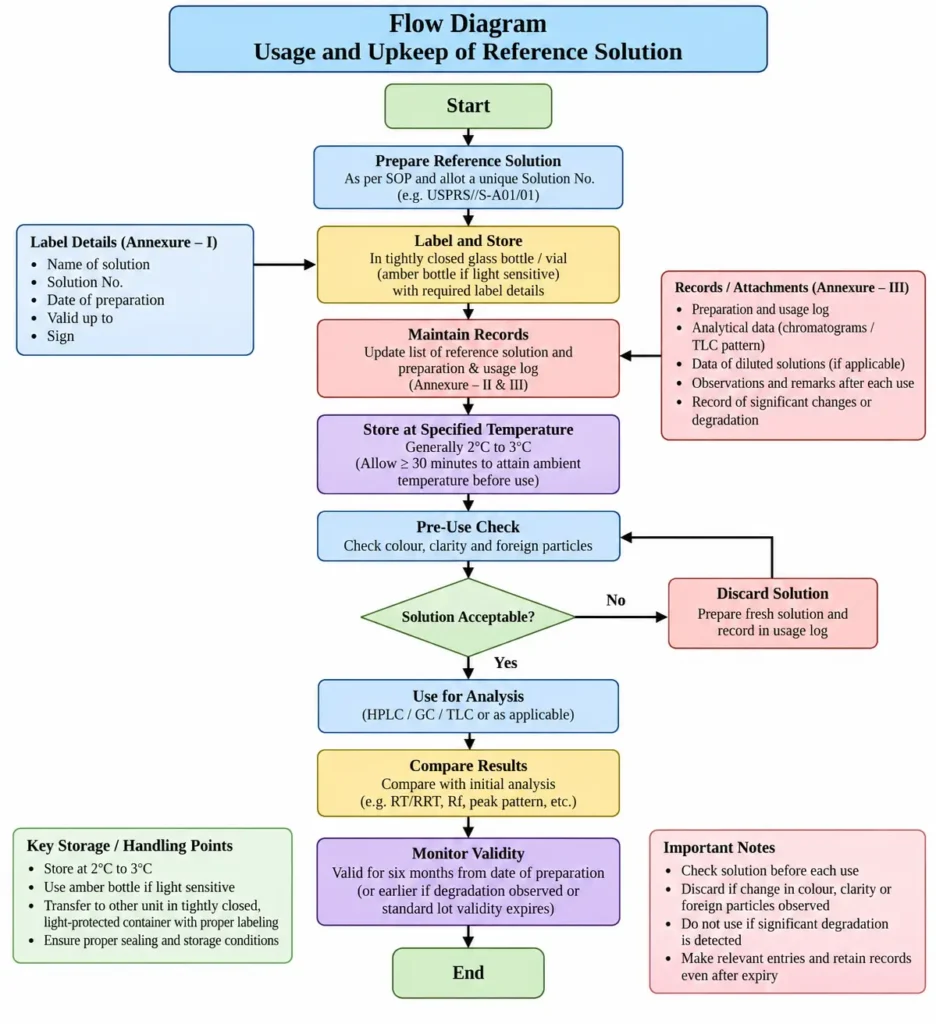
Required preparation and usage records are maintained, and the solution is stored under the specified conditions. Before every use, the analyst checks the solution for colour, clarity, and foreign particles. Any unacceptable or degraded solution is discarded and replaced with a freshly prepared solution. Acceptable solutions are used for analysis, and results are compared with initial analytical data to confirm continued suitability. Significant degradation or analytical changes require rejection of the solution. Validity is normally maintained for six months from preparation, subject to solution suitability and standard validity.
2. Brainstorming for SOP Failure:
The brainstorming diagram highlights the major factors that can lead to SOP failure in a pharmaceutical manufacturing environment. Possible causes are grouped around the central problem and include human error, inadequate training, poor supervision, unclear or complicated SOPs, equipment problems, material-related issues, documentation gaps, time pressure, inadequate facilities, and insufficient management support.
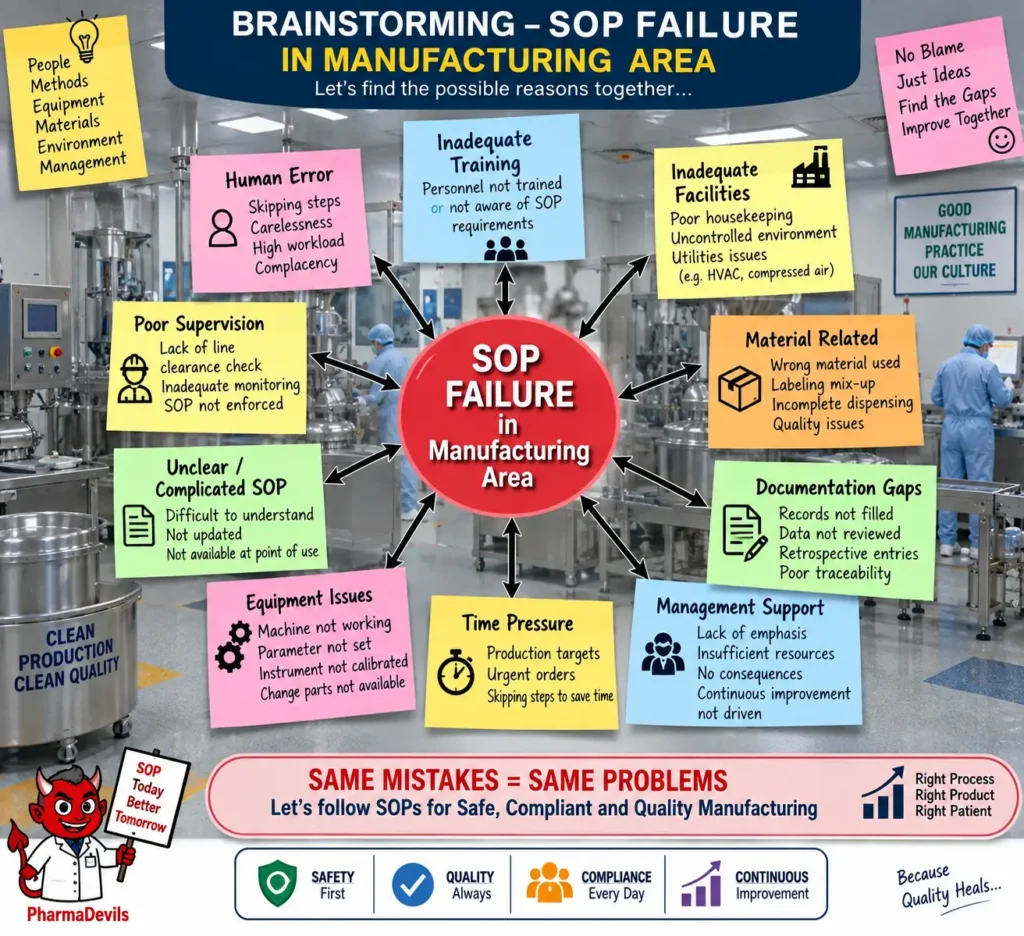
For the Usage and Upkeep of Reference Solution SOP, these weaknesses may result in incorrect preparation or identification of solutions, improper labeling or storage, missed pre-use checks, failure to maintain preparation and usage records, or continued use of degraded/expired reference solutions. The SOP specifically requires controlled preparation, labeling, storage, documentation, visual inspection before use, and comparison with initial analytical results. The brainstorming exercise supports root-cause identification, CAPA development, GMP compliance, personnel awareness, and prevention of repeated SOP deviations.
3. 5-Why Analysis for SOP Failure:
The 5-Why Analysis identifies the underlying reasons for failure to follow the SOP for Usage and Upkeep of Reference Solution. It starts with the observed problem: required steps such as proper preparation, labeling, storage, pre-use checking, and record entry were not followed. The SOP specifically requires controlled labeling and storage, maintenance of preparation and usage records, and verification of the solution’s condition before use.
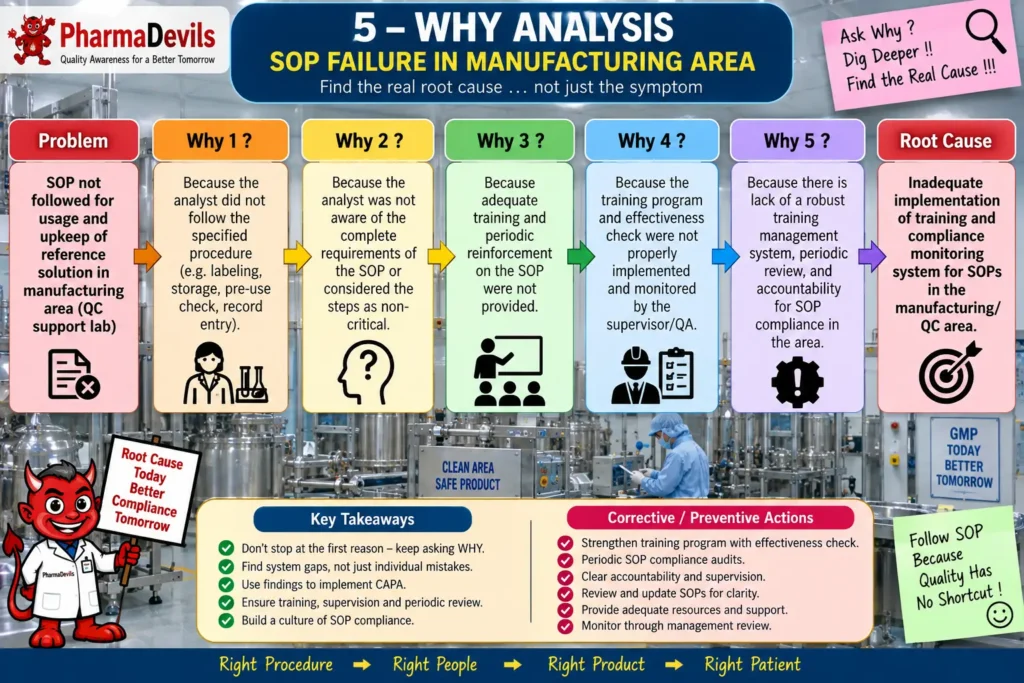
The analysis progressively links the failure to lack of awareness of SOP requirements, inadequate training and reinforcement, ineffective training-effectiveness checks, insufficient supervision, and weak periodic compliance monitoring.The identified root cause is an inadequate system for SOP training, supervision, compliance monitoring, and accountability. Corrective actions should therefore focus on refresher training, effectiveness assessment, routine SOP compliance checks, stronger supervisory review, clear responsibility, and periodic management monitoring to prevent recurrence.
4. Fishbone Analysis for SOP Failure:
The Fishbone Analysis identifies the potential causes of failure to follow the SOP for Usage and Upkeep of Reference Solution by grouping them into major categories such as Man, Method, Machine, Material, Measurement, Environment, Management, and external factors.
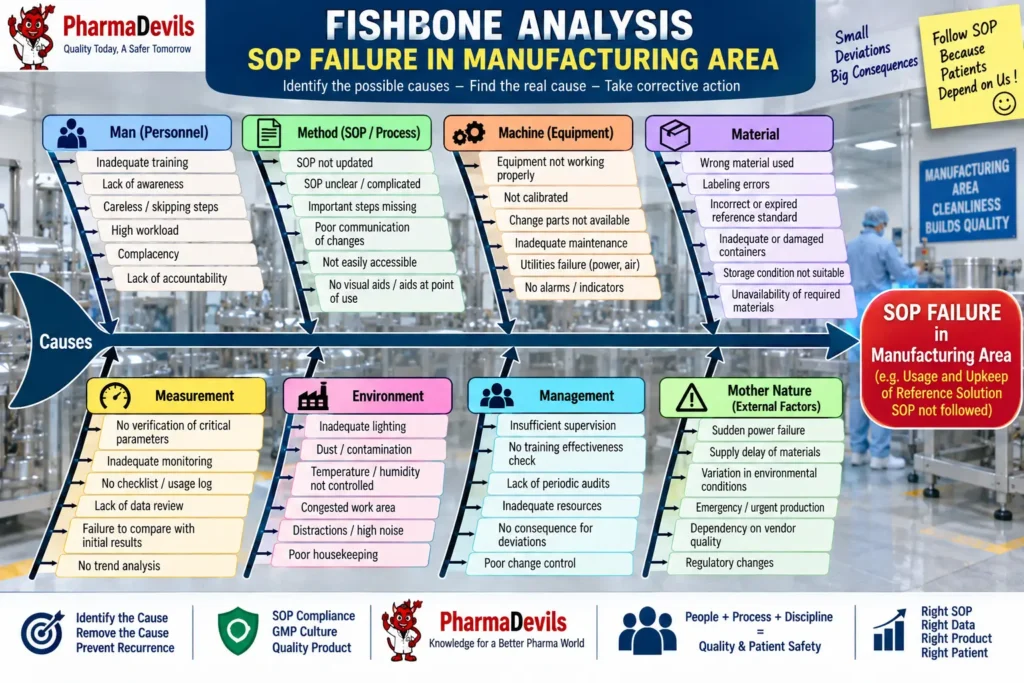
Personnel-related causes may include inadequate training, lack of awareness, carelessness, workload, and poor accountability. Method-related causes include unclear or outdated SOPs, missing critical steps, poor communication, and limited accessibility. Material and equipment factors can include unsuitable containers, incorrect or expired standards, equipment malfunction, calibration issues, or utility failures. Measurement and documentation failures may involve missing usage logs, inadequate monitoring, lack of data review, or failure to compare current analytical results with the initial analysis. The SOP itself requires proper labeling, storage, record maintenance, pre-use checking, and comparison of analytical data to confirm continued suitability.This analysis helps identify systemic root causes, prioritize CAPA, improve SOP compliance, and prevent recurrence of similar deviations.
5. Fault Tree Analysis for SOP Failure:
The Fault Tree Analysis (FTA) illustrates how failure to follow the SOP for Usage and Upkeep of Reference Solution can result from several contributing events. The top event, “SOP Failure,” is linked to major failures such as incorrect preparation of reference solution, improper labeling or identification, unsuitable storage conditions, omission of pre-use checks, and incomplete documentation.
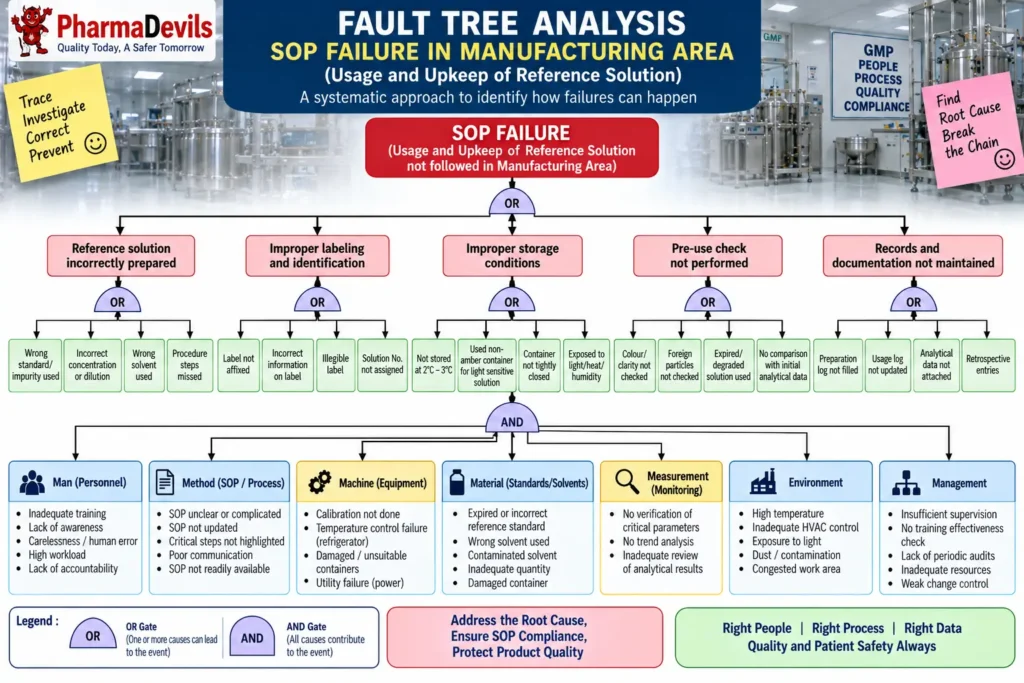
These failures may arise from personnel-related errors, unclear procedures, equipment or utility issues, incorrect or expired standards, inadequate monitoring, unsuitable environmental conditions, and weak supervision. The SOP specifically requires proper preparation and numbering, correct labeling and storage, maintenance of preparation and usage records, and inspection for colour, clarity, and foreign particles before use.The FTA helps trace the failure from the final event back to its potential root causes so that suitable corrective and preventive actions (CAPA) can be implemented to improve SOP compliance, data reliability, and laboratory control.
Questions & Answers – SOP for Usage and Upkeep of Reference Solution
- What is the objective of this SOP?
Answer: To establish a procedure for the usage and upkeep of reference solutions used in the laboratory. - What is a reference solution?
Answer: A solution prepared using a reference standard, test standard, working standard, impurity standard, or a mixture of these standards for analytical purposes. - Who is responsible for implementing this SOP?
Answer: The Manager-QC and Head QA/QC are responsible for effective implementation of the SOP. - How should a reference solution be identified?
Answer: A unique solution number should be allotted to each prepared reference solution according to the defined numbering system. - How should reference solutions be stored?
Answer: They should be stored in tightly closed glass bottles or vials. Light-sensitive solutions should be stored in amber-colored glass containers. - What information should appear on the reference-solution label?
Answer: The label should include the solution name, solution number, date of preparation, valid-up-to date, and signature. - What records are required for reference solutions?
Answer: A reference-solution list and a preparation and usage log should be maintained, including preparation details, standard number, validity, application, description, usage, observations, remarks, and signatures. - What storage temperature is specified for reference solutions?
Answer: Unless otherwise specified, the SOP requires storage between 2°C and 3°C and at least 30 minutes at ambient temperature before use. - What checks should be performed before using a reference solution?
Answer: The analyst should check the solution for colour, clarity, and foreign particles. - What should be done if an abnormal change is observed?
Answer: The solution should be discarded, a fresh solution prepared, and the observation recorded in the preparation and usage log. - What analytical records should be retained after initial analysis?
Answer: HPLC/GC chromatograms or TLC observations should be retained with the reference-solution preparation and usage log. - Why are current analytical results compared with the initial analysis?
Answer: To verify that the reference solution has not undergone significant change or degradation and remains suitable for use. - When should a reference solution be discarded due to chromatographic changes?
Answer: It should be discarded when significant degradation, major extraneous peaks, interfering peaks, or undesired prominent TLC spots are observed. - What should be done if the lot or batch number of the reference standard changes?
Answer: If the earlier lot is no longer valid, the existing reference solution should be discarded, replaced with a fresh solution, and the change recorded in the usage log. - What is the normal validity period of a reference solution?
Answer: The validity is six months from the date of preparation, unless the solution becomes unsuitable earlier or the validity of the standard used expires sooner. - How should a reference solution be transferred to another unit?
Answer: It should be sent in a tightly closed, properly labeled, light-protected glass bottle or vial under the required storage condition, along with preparation/usage records and relevant analytical data. - What should be checked when receiving a reference solution from another unit?
Answer: Proper sealing, labeling, storage condition, light protection, and availability of preparation/usage records and analytical data should be verified. - Should reference-solution records be retained after expiry or exhaustion?
Answer: Yes. The preparation and usage log should be retained even after the solution is exhausted or expired. - Who should receive training on this SOP?
Answer: Quality Control personnel should receive training, with Head-QC/QA acting as trainer. - Which annexures support this SOP?
Answer: The SOP includes a reference-solution vial label, list of reference solutions, and preparation and usage records as annexures.
Reference Guidelines:
- EU GMP – EudraLex Volume 4, Part I, Chapter 6: Quality Control
Sections 6.19–6.22 specifically address laboratory reagents, solutions, reference standards, their preparation, control, qualification, labeling, storage, expiry, and documentation. EU GMP also recommends using officially recognized compendial reference standards where available. (Public Health)
EU GMP Chapter 6 – Quality Control - WHO Technical Report Series No. 1052, Annex 4 – Good Practices for Pharmaceutical Quality Control Laboratories (2024)
Provides current WHO guidance for pharmaceutical QC laboratories, including control of reference substances/materials, reagents, documentation, equipment, analytical work, and laboratory quality systems. (World Health Organization)
WHO Good Practices for Pharmaceutical Quality Control Laboratories - USP–NF General Chapter <11> – USP Reference Standards
Covers appropriate use, labeling, storage, handling, and validity considerations for USP Reference Standards used in compendial testing. (USP)
USP General Chapter <11> Reference Standards - EU GMP – Chapter 4: Documentation
Applicable to preparation records, usage logs, traceability, corrections, retention of records, and controlled laboratory documentation associated with reference solutions. The European Commission lists Chapter 4 as part of the current EU GMP Part I framework. (Public Health)
EudraLex Volume 4 GMP Guidelines - Applicable Pharmacopoeia – USP/NF, Ph. Eur., BP or IP
The relevant individual monograph and pharmacopoeial instructions should also be followed for the particular reference standard, analytical method, preparation, storage conditions, and intended use. USP specifically advises consulting the applicable monograph, Reference Standard label/certificate, and General Chapter <11>. (USP)