







1. Introduction for Validation Master Plan for ERP System:
The Validation Master Plan (VMP) for the ERP System defines the overall strategy, responsibilities, documentation, and controls required to validate the computerized system used in GxP-regulated pharmaceutical operations. It covers applicable ERP modules, risk-based validation, GxP assessment, user requirements, design qualification, installation qualification, operational qualification, performance qualification, data integrity, discrepancy management, and validation reporting. The plan follows the GAMP 5 lifecycle approach and considers 21 CFR Part 11 requirements where applicable. It also establishes requirements for change control, backup and restore, security, training, periodic review, maintenance, requalification, and revalidation to maintain the ERP system’s validated state throughout its operational lifecycle.
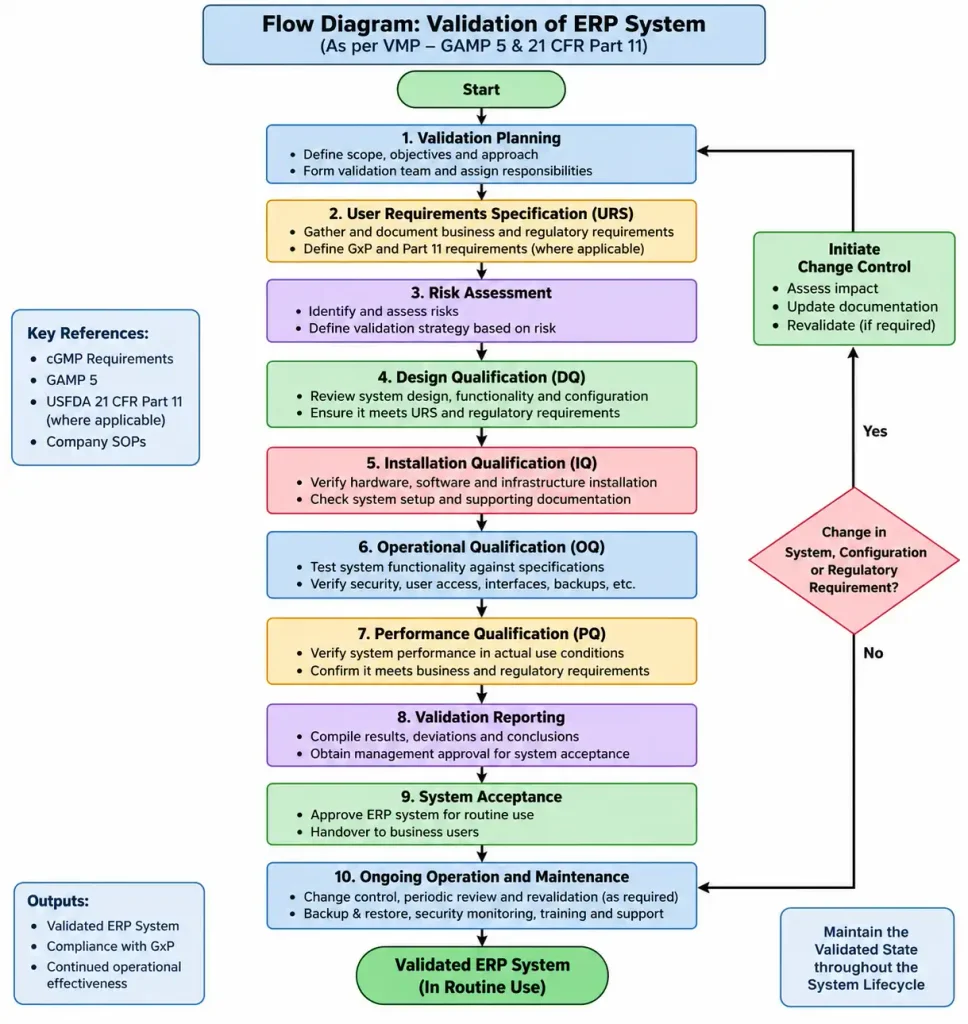
Skip to PDF content2. Flow Diagram for Validation of ERP System:
The flow diagram illustrates the complete lifecycle for validation of an ERP system in a pharmaceutical GxP environment. It begins with validation planning, followed by preparation of User Requirement Specifications, risk assessment, Design Qualification, Installation Qualification, Operational Qualification, and Performance Qualification. Results are then compiled in the validation report for management review and system acceptance. After approval, the ERP system enters routine operation and maintenance with backup, security, training, periodic review, and support controls. Any significant system, configuration, or regulatory change triggers formal change control, impact assessment, documentation updates, and revalidation where required to maintain the validated state throughout its lifecycle.
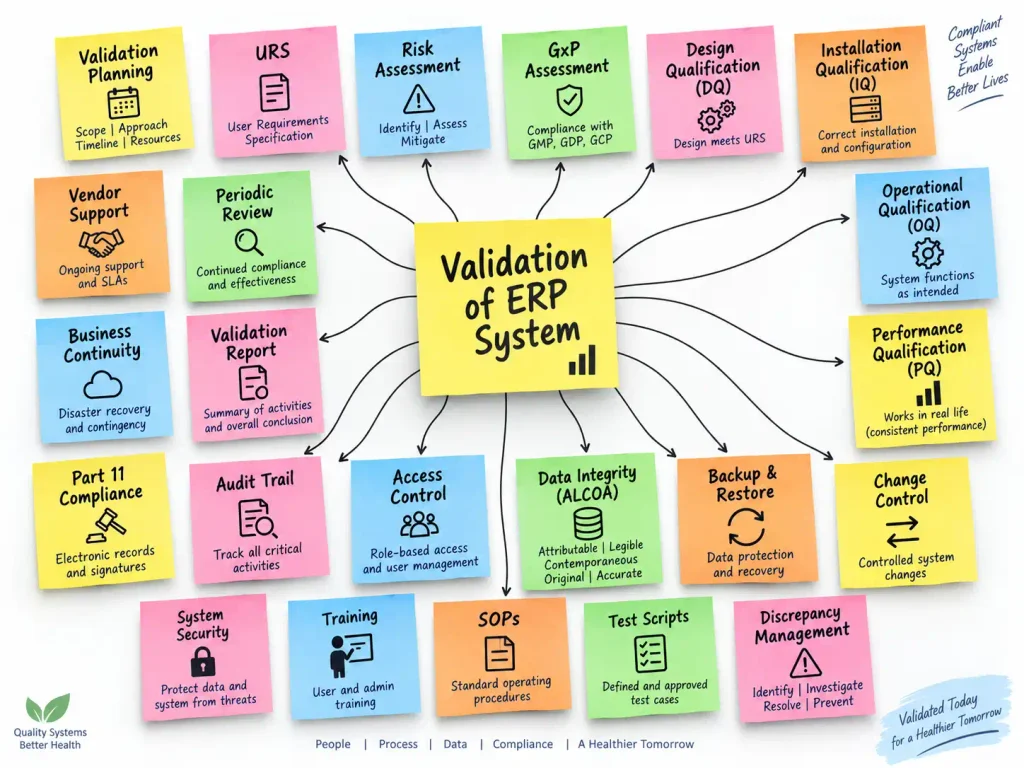
3. Brainstorming for Validation of ERP System:
The brainstorming diagram identifies the major elements that should be considered during validation of an ERP system in a pharmaceutical GxP environment. It covers validation planning, User Requirement Specifications, GxP and risk assessment, Design Qualification, Installation Qualification, Operational Qualification, and Performance Qualification. Supporting controls include access management, audit trails, data integrity, backup and restore, system security, change control, business continuity, SOPs, training, test scripts, discrepancy management, vendor support, and periodic review. Together, these elements help ensure that the ERP system performs as intended, meets regulatory and business requirements, protects electronic data, and remains in a controlled and validated state throughout its lifecycle.
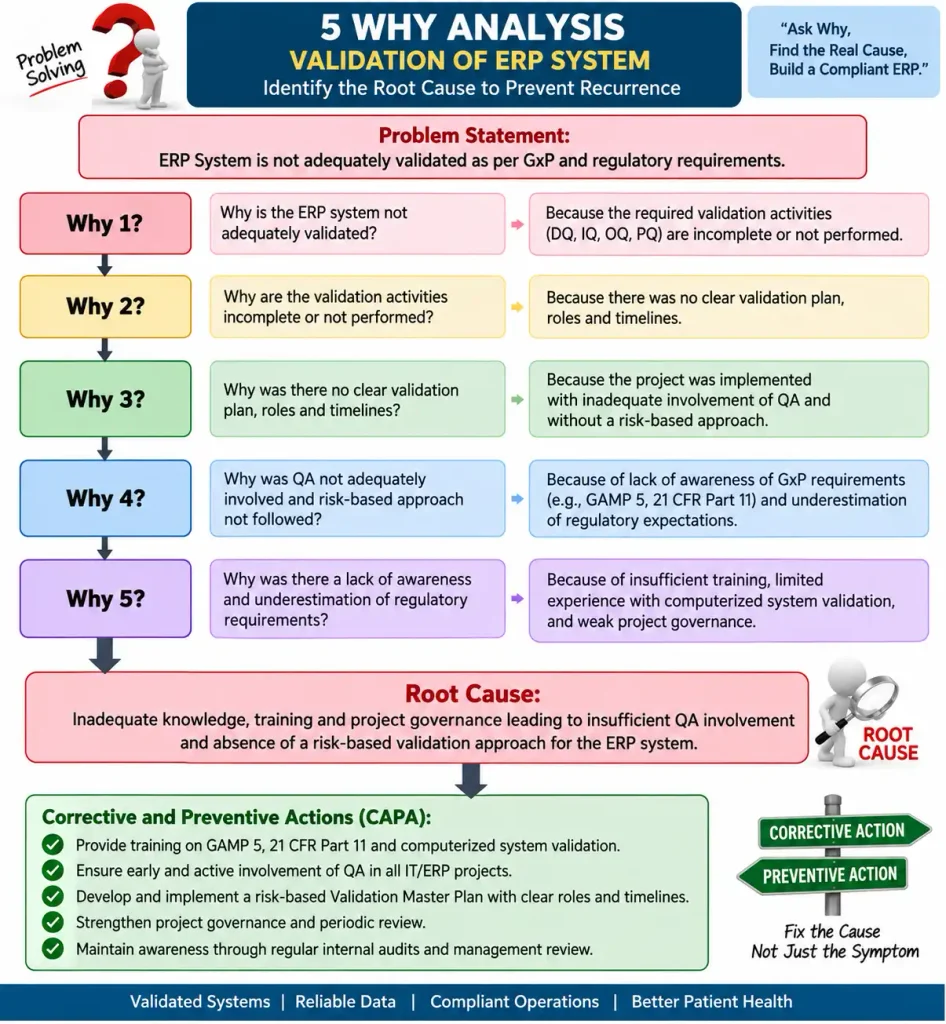
4. 5 Why Analysis for Validation of ERP System:
The 5 Why Analysis identifies the underlying reasons for inadequate validation of an ERP system in a pharmaceutical GxP environment. It traces the problem from incomplete validation activities such as DQ, IQ, OQ, and PQ to insufficient planning, unclear responsibilities, limited QA involvement, and lack of a risk-based approach. Further analysis links these weaknesses to inadequate awareness of GAMP 5, 21 CFR Part 11, and computerized system validation requirements. The root cause is associated with insufficient training, experience, and project governance. Corrective and preventive actions include enhanced training, stronger QA participation, defined validation planning, periodic review, and improved governance.
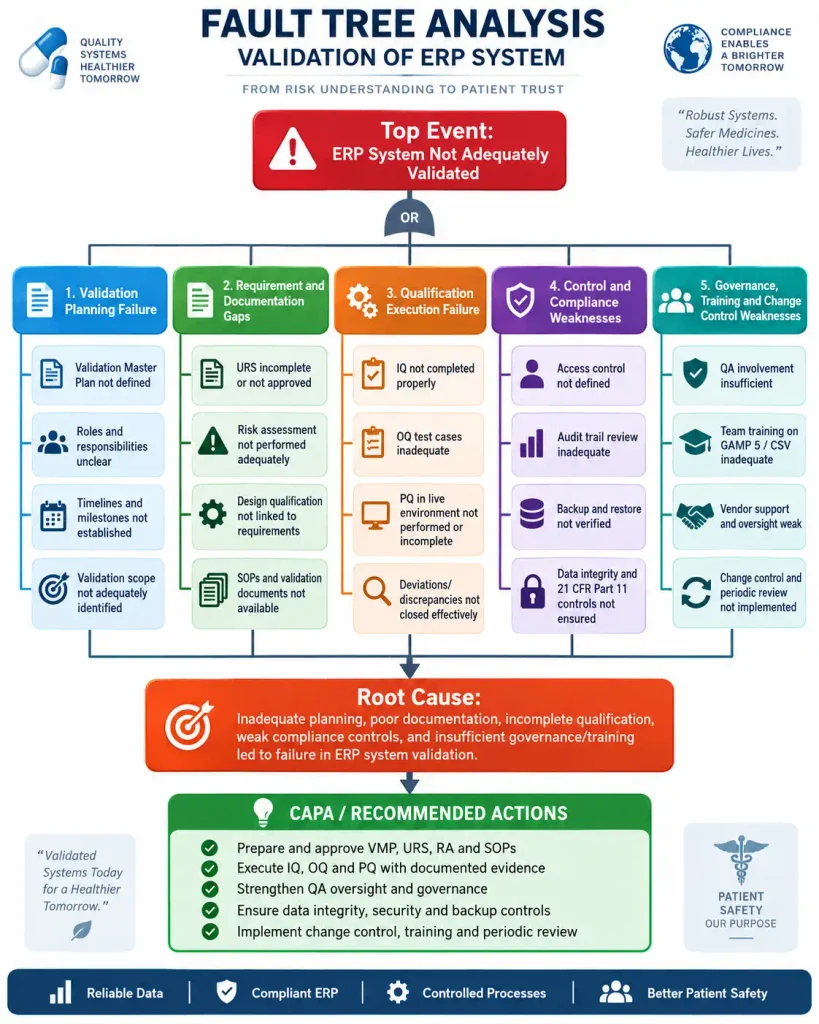
5. Fault Tree Analysis for Validation of ERP System:
The Fault Tree Analysis identifies major causes that may lead to inadequate validation of an ERP system in a pharmaceutical GxP environment. The top event is linked to failures in validation planning, requirement documentation, qualification execution, compliance controls, governance, training, and change management. Contributing factors include incomplete URS, weak risk assessment, improper IQ/OQ/PQ execution, inadequate access control, poor audit-trail review, insufficient backup verification, and limited QA involvement. The analysis highlights inadequate planning, documentation, qualification, compliance oversight, and training as root causes. Recommended CAPA includes approved validation documents, complete qualification, stronger QA governance, data-integrity controls, training, change control, and periodic review.
6. Pareto Chart Analysis for Validation of ERP System:
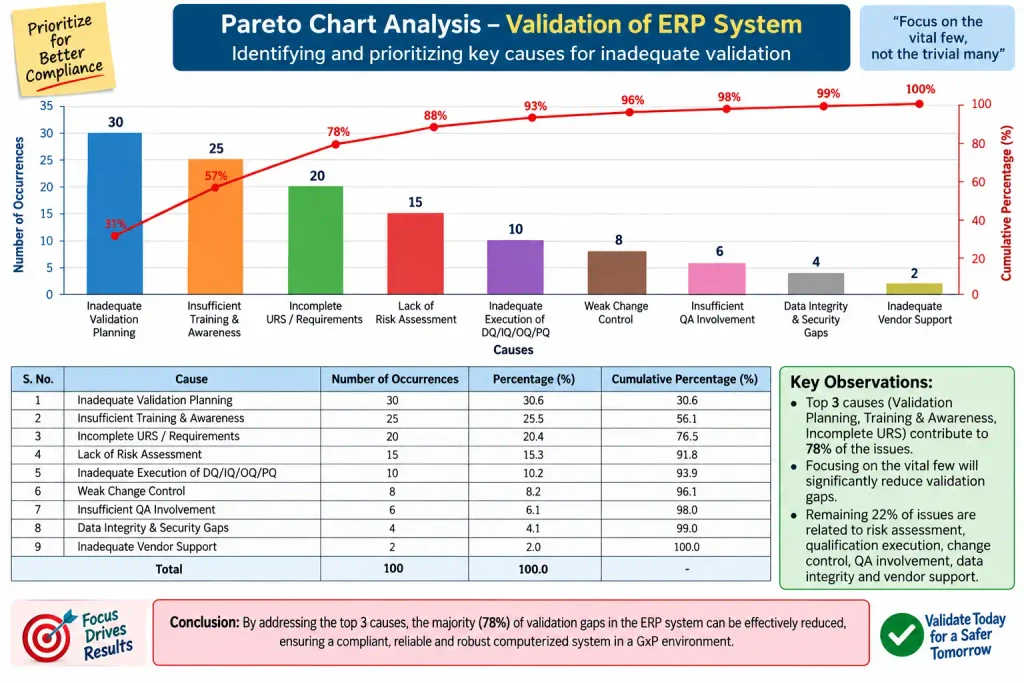
The Pareto Chart Analysis highlights the major causes contributing to inadequate validation of an ERP system. The causes are arranged from highest to lowest occurrence, while the cumulative percentage line shows their combined impact. The chart indicates that inadequate validation planning, incomplete User Requirement Specifications, and insufficient QA involvement represent the most significant contributors. Other causes include improper execution of IQ/OQ/PQ, limited GxP knowledge, weak change control, poor documentation, insufficient training, and inadequate system review. The analysis helps prioritize corrective actions on the vital few causes, supporting stronger validation planning, regulatory compliance, data integrity, and sustained ERP system reliability.
7. Fishbone Analysis for Validation Master Plan of ERP System:
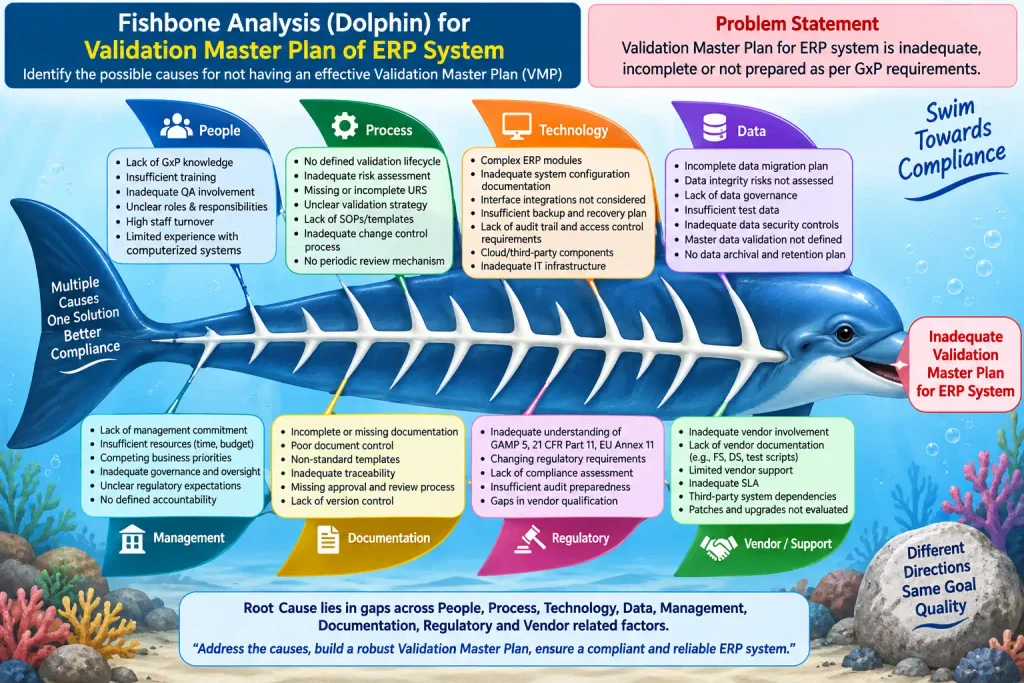
The Fishbone Analysis identifies potential causes responsible for an inadequate, incomplete, or ineffective Validation Master Plan for an ERP system. The causes are grouped into key categories including People, Process, Technology, Data, Management, Documentation, Regulatory, and Vendor/Support. Major contributing factors include insufficient GxP knowledge, unclear responsibilities, incomplete URS, weak risk assessment, inadequate data governance, poor change control, insufficient QA involvement, missing documentation, regulatory gaps, and limited vendor support. The analysis helps systematically identify root causes affecting ERP validation planning and supports development of targeted corrective actions to establish a robust, compliant, well-documented, and sustainable validation lifecycle.
8. Heat Map Analysis for Validation Master Plan of ERP System:
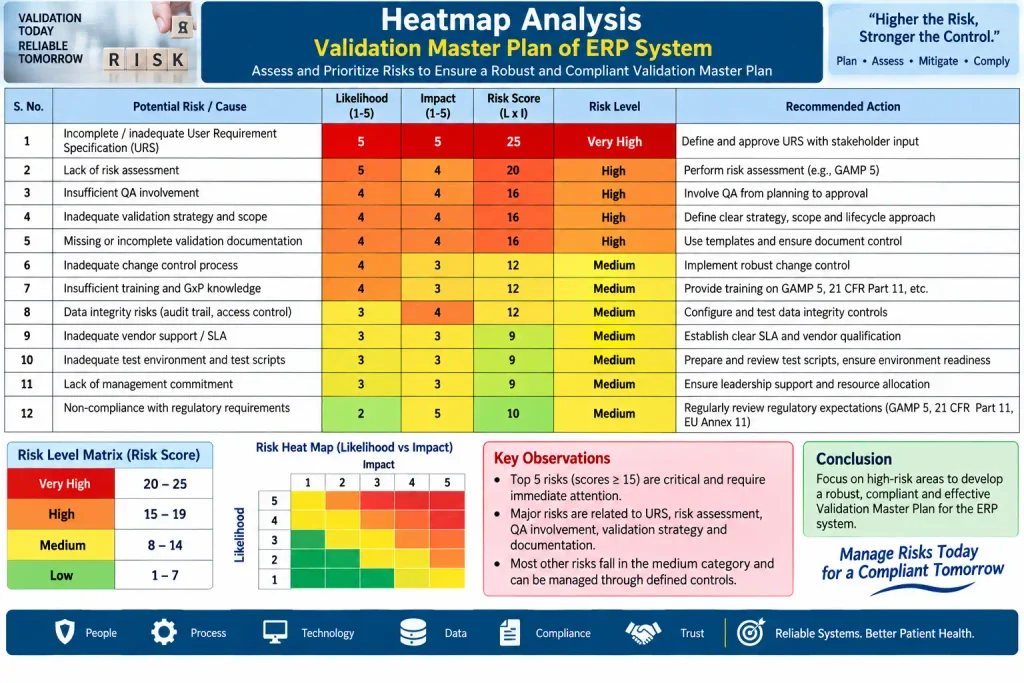
The Heat Map Analysis evaluates and prioritizes risks associated with preparation and implementation of the Validation Master Plan for an ERP system. Risks are assessed using likelihood and impact scores to determine overall risk levels. Key high-risk areas include incomplete User Requirement Specifications, inadequate risk assessment, insufficient QA involvement, weak validation strategy, and missing validation documentation. Medium risks include inadequate change control, insufficient training, data integrity concerns, vendor support issues, and inadequate test preparation. The heat map helps management focus resources on critical risks, establish appropriate controls, strengthen compliance, and maintain a robust, reliable, and sustainable ERP validation lifecycle.
9. Corrective Action & Preventive Action (CAPA) – Validation Master Plan for ERP System:
Based on the ERP Validation Master Plan, the CAPA should address gaps in risk assessment, qualification, documentation, discrepancy closure, data integrity, training, change control, and periodic review. The VMP requires IQ, OQ and PQ; documented evidence and independent review of testing; closure of discrepancies before validation completion; and a Validation Summary Report before the system is considered validated.
| Type | CAPA Action | Expected Outcome |
|---|---|---|
| Corrective Action | Perform a comprehensive gap assessment of the existing ERP validation package against the approved VMP, URS, GxP requirements and applicable Part 11 requirements. | Identification of missing or inadequate validation activities. |
| Corrective Action | Prepare, review and approve missing or incomplete URS, risk assessment, DQ, IQ, OQ and PQ documents. | Complete documented validation lifecycle. |
| Corrective Action | Execute pending IQ/OQ/PQ tests with approved test scripts and objective evidence such as reports and screen prints. | Demonstrated evidence that the ERP system operates as intended. |
| Corrective Action | Review all validation deviations/discrepancies, classify their impact, implement corrections and formally close them before validation approval. | No unresolved critical or major validation deficiencies. |
| Corrective Action | Verify user access, authorization levels, audit trails, electronic records, backup/restore and security controls. | Improved data integrity and controlled system access. |
| Corrective Action | Conduct required training for ERP users, QA, IT and supporting personnel before completion of qualification activities. | Competent personnel capable of operating and supporting the validated system. |
| Corrective Action | Prepare and approve the Validation Summary Report summarizing testing, deviations, resolutions and final validation conclusion. | Formal documented approval and release of the ERP system. |
| Preventive Action | Implement formal change control for all future ERP hardware, software, configuration and functional changes. | Prevention of uncontrolled changes affecting validated status. |
| Preventive Action | Perform documented risk assessment for every significant ERP change and determine the extent of retesting or revalidation. | Risk-based maintenance of validated status. |
| Preventive Action | Establish periodic review of validation documents, IT SOPs, qualification status, authorizations, change controls, training records and incident logs. | Early detection of compliance deterioration. |
| Preventive Action | Maintain controlled SOPs for incident management, backup/restore, security, disaster recovery, system administration and user operation. | Consistent control of ERP operations throughout the lifecycle. |
| Preventive Action | Establish periodic refresher training on computerized system validation, data integrity, GAMP principles and applicable regulatory requirements. | Sustained awareness and reduced recurrence of validation errors. |
| Preventive Action | Define requalification/revalidation criteria for software updates, hardware replacement, regulatory changes and other major changes. | Timely revalidation when system changes could affect GxP functions. |
| Preventive Action | Maintain QA oversight throughout ERP lifecycle activities, including document approval, change control, deviations and periodic review. | Strong governance and continued compliance. |
| Preventive Action | Periodically challenge backup restoration, access control and audit-trail functionality and retain documented evidence. | Continued assurance of data availability, security and integrity. |
CAPA Effectiveness Check
CAPA effectiveness should be verified by confirming that all required validation documents are approved, IQ/OQ/PQ activities are successfully completed, deviations are closed, personnel are trained, access and data-integrity controls function correctly, and no critical validation gaps remain during subsequent periodic review or internal audit. The VMP requires operational controls and procedures to maintain the ERP system in its validated state throughout its lifecycle.
10. Questions & Answers – Validation Master Plan for ERP System:
1. What is the purpose of the Validation Master Plan for the ERP System?
The purpose is to provide an overview of the controls, procedures, validation scope, and planning approach used to ensure that the ERP system complies with cGMP requirements and applicable standards such as GAMP 5 and 21 CFR Part 11.
2. What is the main objective of ERP system validation?
The objective is to ensure that the ERP system is fit for its intended use, complies with applicable regulatory requirements, and that validation responsibilities, strategies, testing methods, protocols, and reporting requirements are clearly defined.
3. Which ERP modules are included within the validation scope?
The VMP includes GMP-relevant modules such as Purchase, Manufacturing Inventory, Quality Control, Production, Sales Inventory, Setup, Centralized System Administration, Requisition, and Quality Assurance.
4. How is the ERP system categorized according to GAMP 5?
The ERP system is classified as Category 4 – Configurable Software Package. Therefore, version, configuration, and system operation are verified against approved system requirements.
5. Which lifecycle approach is used for ERP validation?
The ERP validation follows the GAMP 5 V-model lifecycle approach, including URS, design/configuration specifications, IQ, OQ, and PQ.
6. What is the purpose of the User Requirement Specification (URS)?
The URS defines the basic and functional requirements that the ERP system must satisfy and establishes the criteria against which the system is evaluated during validation.
7. Why is risk assessment required during ERP validation?
Risk assessment is performed to identify GMP-related risks and determine the required scope and extent of validation, preventive maintenance, SOPs, and qualification activities. Identified risks are challenged during Operational Qualification.
8. What are the main qualification stages for the ERP System?
The standard validation format includes Installation Qualification (IQ), Operational Qualification (OQ), and Performance Qualification (PQ).
9. What is verified during Installation Qualification?
IQ verifies the installation of the ERP application, associated hardware, interfaces, server configuration, antivirus, access, security policies, backup and restoration, users, and date/time synchronization.
10. What is the objective of Operational Qualification?
OQ verifies ERP functionality under critical operating ranges and challenges the system to demonstrate that it operates according to approved functional requirements and generates appropriate electronic records.
11. What is the purpose of Performance Qualification?
PQ verifies that the ERP process performs satisfactorily in the live environment according to system requirements after successful completion of Operational Qualification.
12. How should validation test results be documented?
Tests must be executed by designated personnel, independently verified, supported by objective evidence where practical, signed and dated, and discrepancies must be documented and resolved before the system is considered validated.
13. How are discrepancies classified during ERP validation?
Discrepancies are classified according to their impact as Minor, Major, or Critical. Critical discrepancies require mandatory rectification before system release.
14. How is data integrity addressed in ERP validation?
The validation includes controls for electronic records and signatures and verifies that data generated, stored, retrieved, and archived complies with applicable data integrity expectations, including ALCOA principles.
15. What is the purpose of the Validation Summary Report?
The Validation Summary Report consolidates qualification results, discrepancies, and conclusions. Approval of the report constitutes approval of the validation, after which the system is managed through formal change control.
16. What operational controls are required after ERP validation?
Required controls include incident management, change/configuration management, backup and restore, disaster recovery, security management, system administration, and user operating procedures.
17. Why is training important for an ERP system?
ERP users and technical staff must be trained on relevant SOPs before Performance Qualification, and training records must demonstrate that personnel are competent to operate and support the system.
18. Why is periodic review required?
Periodic review helps maintain the validated and GxP status of the ERP system by reviewing validation documents, SOPs, qualification status, authorizations, change controls, training records, and incident logs.
19. When is requalification required?
Requalification is required when software is replaced, reinstalled, or updated; when critical hardware is replaced or updated; or when regulatory requirements change.
20. When is revalidation required?
Revalidation is performed periodically or following major changes to hardware, software, accessories, or system configuration. Changes are evaluated through change control and risk assessment to determine the required extent of retesting.
11. Reference Guidelines – Validation Master Plan for ERP System:
The uploaded Validation Master Plan states that the latest applicable versions of the referenced publications should be considered.
- GAMP 5 – A Risk-Based Approach to Compliant GxP Computerized Systems.
- US FDA 21 CFR Part 11 – Electronic Records and Electronic Signatures.
- EudraLex Volume 4, EU GMP Annex 11 – Computerised Systems.
- PIC/S Guide to GMP for Medicinal Products – Annex 11 – Computerized Systems.
- GAMP Good Practice Guide – A Risk-Based Approach to Testing of GxP Systems, 2nd Edition, 2012.
- MHRA GMP Data Integrity Definitions and Guidance for Industry, January 2015.
- GAMP Guide – Records and Data Integrity.