







Brief Description
The SOP for Allocating A.R. No. of Bulk Products defines a standardized method for assigning a unique Analytical Report Number (A.R. No.) to bulk products handled by the Quality Control Department. Its objective is to ensure proper identification, traceability, documentation, and systematic control of bulk-product samples and analytical records. The A.R. numbering system is structured using defined alphanumeric elements. The first alphabet represents the company name, the second alphabet “B” identifies the material as a bulk product, followed by two digits representing the year, two digits representing the month, and a three-digit sequential number indicating the order in which the bulk product was received. The SOP assigns responsibility to QC and QA personnel and requires training of Quality Control personnel. Controlled and master copies are maintained by QC and QA respectively, supporting consistent implementation and GMP documentation control.
Skip to PDF content1. Flow Diagram:
The flow diagram presents the systematic procedure for allocation of an Analytical Report Number (A.R. No.) to bulk products received by the Quality Control Department. The process begins with receipt of the bulk product, followed by identification of the required numbering details such as the company code, year, month, and sequential receipt number.
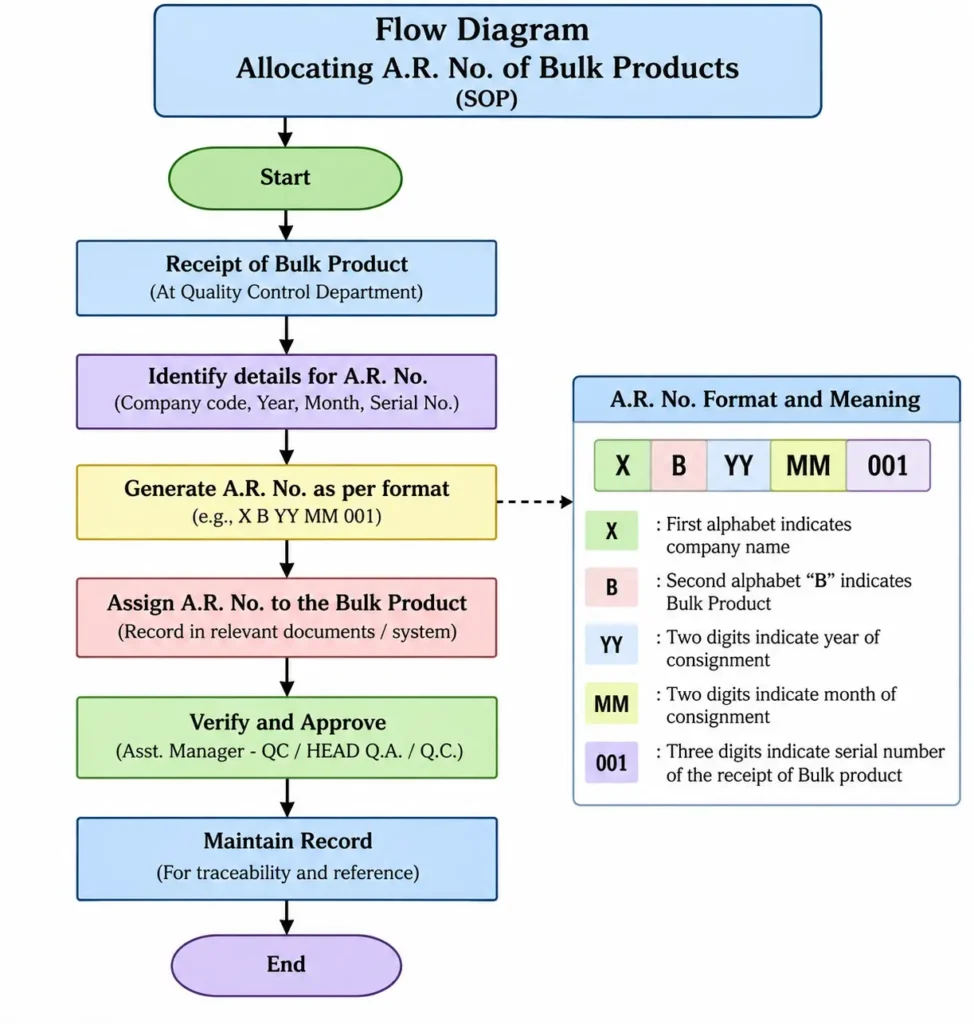
The A.R. No. is then generated in the prescribed format, for example X B YY MM 001, where the first alphabet represents the company name, “B” indicates Bulk Product, the next two digits represent the year, the following two digits indicate the month, and the final three digits represent the serial number of receipt.After allocation, the A.R. No. is recorded in the relevant documentation. The assigned number is verified by authorized QC/QA personnel and the record is maintained to ensure traceability, identification, and controlled documentation throughout the analytical process.
2. Brainstorming for SOP Failure:
The brainstorming diagram illustrates potential causes and consequences of failure to correctly implement the SOP for allocating A.R. Numbers to bulk products under a worst-case granulation-area scenario. The SOP requires a structured A.R. numbering system for bulk products to support identification and traceability.
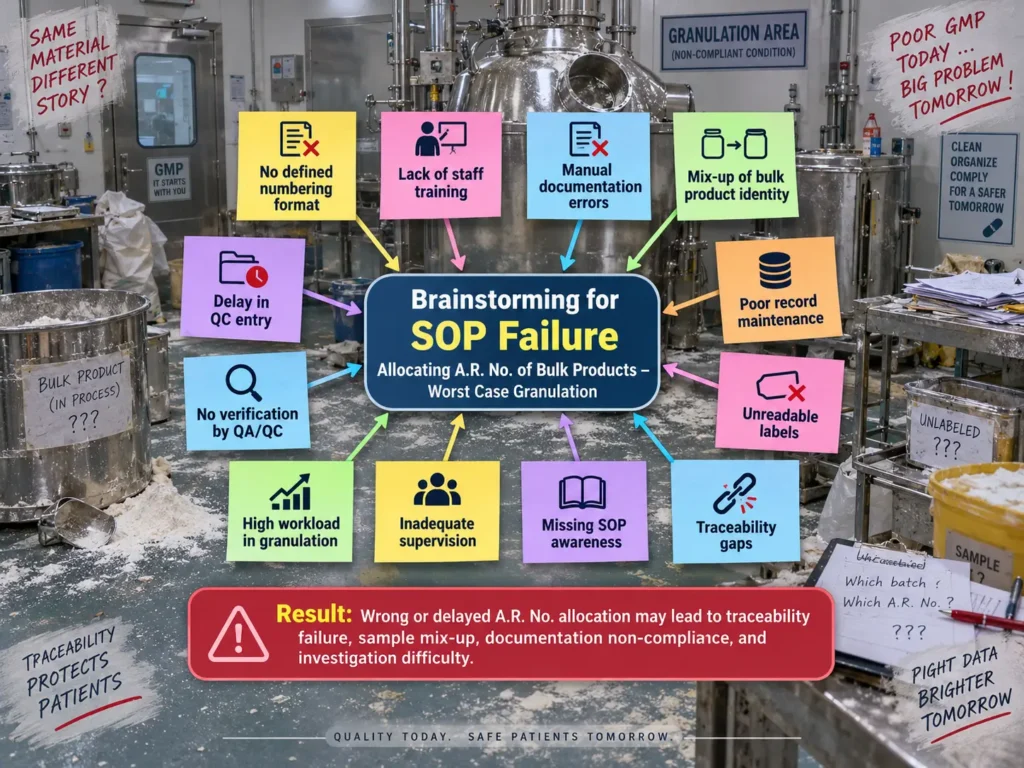
The diagram highlights possible failure factors such as lack of a defined numbering format, inadequate staff training, manual documentation errors, bulk-product mix-up, delayed QC entry, poor record maintenance, unreadable labels, insufficient QA/QC verification, high workload, weak supervision, lack of SOP awareness, and traceability gaps. In a poorly controlled granulation environment, these weaknesses may result in incorrect or delayed A.R. number allocation, loss of sample or batch traceability, documentation non-compliance, investigation difficulties, and potential product mix-ups. The brainstorming exercise therefore helps identify areas requiring stronger procedural controls, training, supervision, documentation discipline, and verification.
3. 5-Why Analysis for SOP Failure:
The 5-Why Analysis diagram evaluates the underlying causes of incorrect or delayed allocation of A.R. Numbers for bulk products in a worst-case granulation location. The investigation begins with the immediate issue that bulk-product details were not properly entered at the time of receipt. It then identifies inconsistent understanding or application of the prescribed A.R. numbering format, followed by reliance on manual documentation and resulting entry or labeling errors.
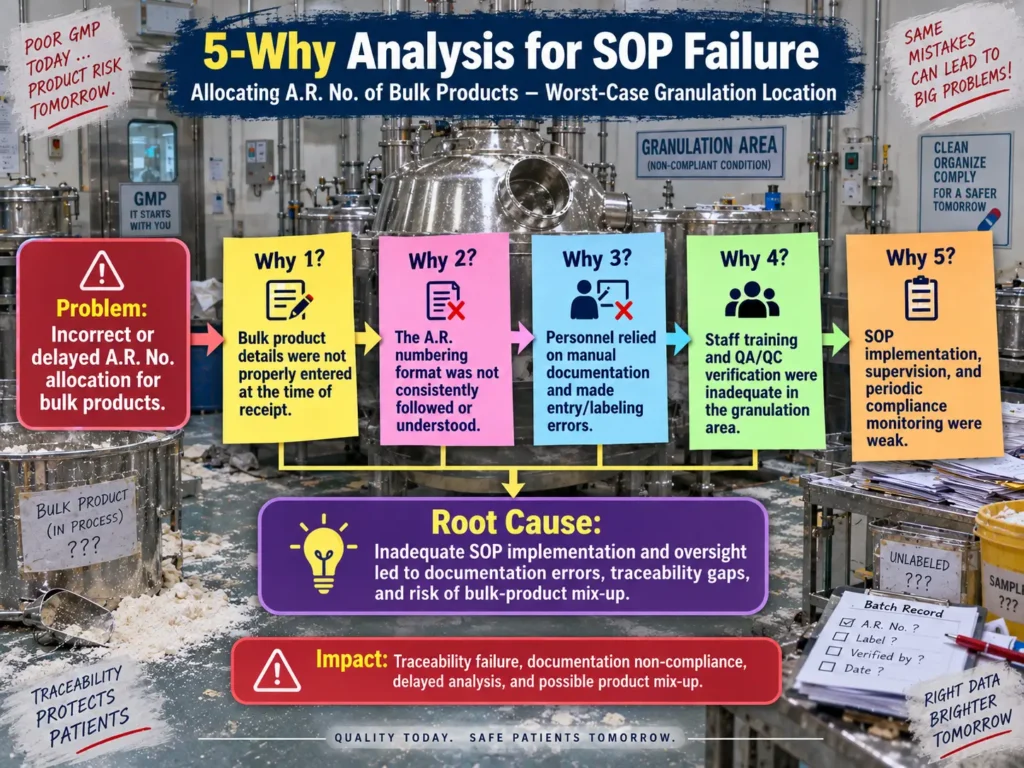
The analysis further indicates that inadequate personnel training and insufficient QA/QC verification contributed to the failure. At the deeper systemic level, weak SOP implementation, supervision, and periodic compliance monitoring were identified as the principal root causes. Since the SOP defines a specific structured numbering sequence for bulk products, failure to follow it can compromise identification and traceability.The potential impact includes traceability gaps, documentation non-compliance, delayed analysis, investigation difficulty, and risk of bulk-product mix-up.
4. Fishbone Analysis for SOP Failure:
The Fishbone (Ishikawa) Analysis identifies potential causes of failure in the SOP for allocation of A.R. Numbers to bulk products, with emphasis on a worst-case coating machine area. The analysis organizes possible causes under six major categories: Man, Machine, Method, Material, Measurement, and Environment.
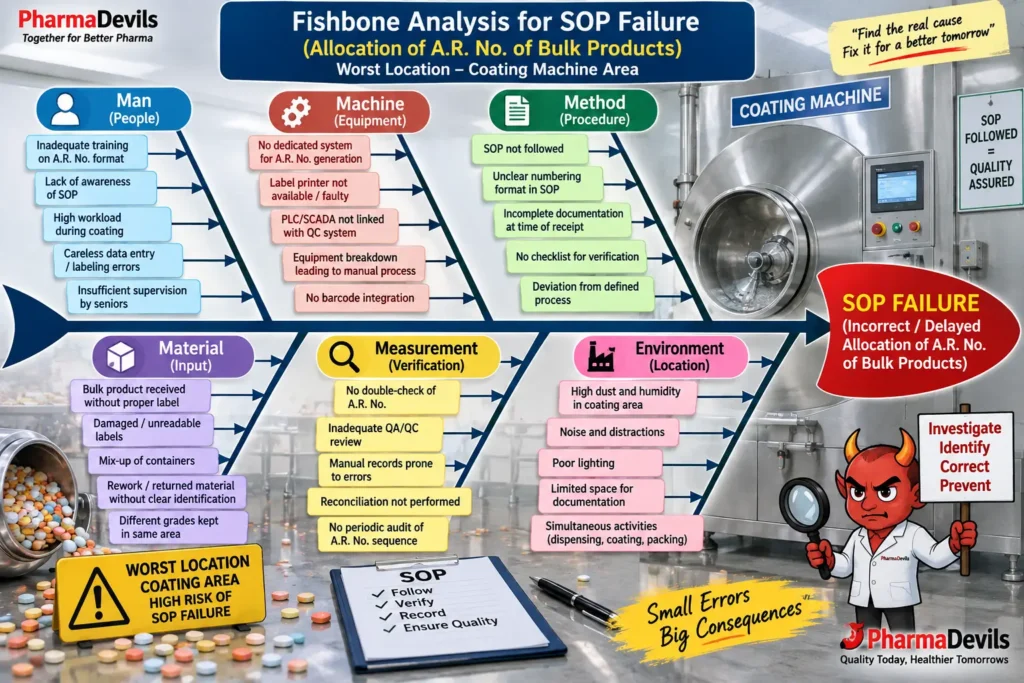
Under Man, key issues include inadequate training, poor SOP awareness, high workload, careless data entry, and insufficient supervision. Machine-related factors include absence of a dedicated A.R. number system, faulty label printing, lack of system integration, and reliance on manual processes. Method causes include non-adherence to the SOP, unclear numbering practices, incomplete documentation, and absence of verification checklists. Material and measurement factors include incorrect or unreadable labels, container mix-ups, insufficient QA/QC review, lack of reconciliation, and inadequate periodic checks. Environmental conditions such as dust, noise, poor lighting, limited documentation space, and simultaneous activities can further increase the risk of error. The analysis helps identify root causes so that corrective and preventive actions can strengthen traceability and SOP compliance.
5. Fault Tree Analysis for SOP Failure:
The Fault Tree Analysis (FTA) illustrates how multiple failures can lead to the top event: incorrect, delayed, or missing allocation of A.R. Numbers for bulk products in the compression area. The analysis breaks the failure into major contributing events such as incorrect A.R. number generation, failure to allocate the number, assignment of a wrong or duplicate number, incomplete documentation, and system or equipment failure.
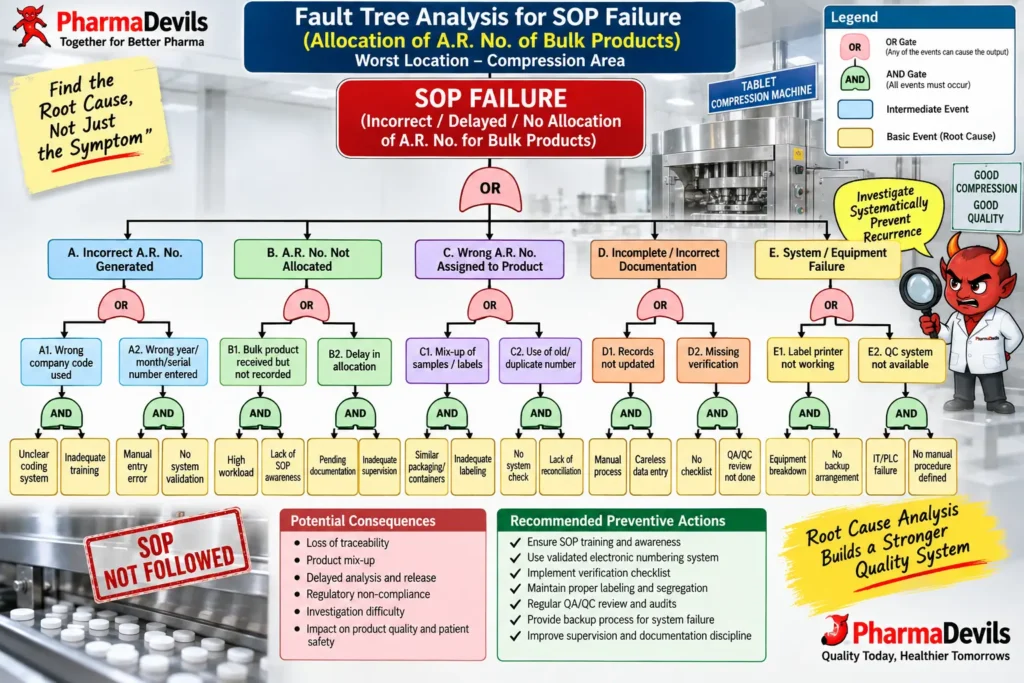
Basic causes include wrong company code or year/month/serial entry, manual data-entry errors, inadequate training, high workload, poor SOP awareness, weak supervision, sample or label mix-up, missing reconciliation, incomplete QA/QC verification, label-printer failure, and unavailability of the QC system. Since the SOP defines a structured A.R. numbering format for bulk products, deviations from this process can directly affect identification and traceability. The analysis supports identification of root causes and highlights preventive controls such as training, verification checklists, proper labeling, reconciliation, system backup, QA/QC review, and stronger documentation practices.
Questions & Answers – SOP for Allocating A.R. No. of Bulk Products
- Q: What is the objective of this SOP?
A: To define the procedure for allocating an A.R. No. to bulk products. - Q: Which department does this SOP apply to?
A: It is applicable to the Quality Control Department for allocation of A.R. Numbers to bulk products. - Q: Who is responsible for implementation of this SOP?
A: Sr. Executive QC, Assistant Manager-QC, and Head QA/QC are responsible. - Q: What does A.R. No. mean?
A: A.R. No. stands for Analytical Report Number. - Q: What does the first alphabet of the A.R. Number indicate?
A: The first alphabet indicates the company name. - Q: What does the second alphabet “B” represent?
A: The alphabet “B” represents Bulk Product. - Q: What do the next two digits indicate?
A: They indicate the year of the consignment. - Q: What do the following two digits indicate?
A: They indicate the month of the consignment. - Q: What do the final three digits indicate?
A: They indicate the serial number of receipt of the bulk product. - Q: Who provides training for this SOP?
A: The Executive – Quality Control is designated as the trainer. - Q: Who are the trainees for this SOP?
A: Quality Control personnel are the trainees. - Q: What is the specified training duration?
A: The training period is half an hour. - Q: Where is the controlled copy maintained?
A: The controlled copy is maintained with the Head of Department – Quality Control. - Q: Where is the master copy maintained?
A: The master copy is maintained with the Head of Department – Quality Assurance. - Q: What reference is specified in the SOP?
A: The reference is stated as “In House.”
Reference Guidelines:
- WHO Good Manufacturing Practices (GMP) – requirements for documentation, identification, traceability, laboratory controls, and controlled records.
- PIC/S Guide to GMP – PE 009, Chapter 4: Documentation – principles for controlled, accurate, attributable, and traceable GMP documentation.
- EU GMP Guidelines, Part I, Chapter 4 – Documentation – requirements for document control, recording of activities, corrections, and traceability.
- 21 CFR Part 211.160 – General Requirements, Laboratory Controls – establishes scientifically sound and controlled laboratory procedures.
- 21 CFR Part 211.194 – Laboratory Records – requirements for complete laboratory records, identification of samples, test records, calculations, and reviewer information.
- ICH Q10 – Pharmaceutical Quality System – supports controlled procedures, documentation systems, process management, and continual improvement.
- WHO Good Practices for Pharmaceutical Quality Control Laboratories – applicable to sample receipt, unique identification, testing records, and laboratory traceability.