







Brief Description
The SOP “Allocating AR No. of Packing Material” defines the standardized procedure for assigning an A.R. (Analytical Report) Number to packing materials received by the Quality Control Department. Its purpose is to ensure proper identification, traceability, documentation, and control of each packing-material consignment. The SOP assigns responsibility for execution to the Executive-QC, while the Manager-QC and Head QA/QC are responsible for effective implementation.The A.R. number is structured using identifiers representing the company, packing material, year, month, and sequential receipt number. After allocation, the relevant details are entered in Annexure-I – Log Book of Packing Material.The log book on page 2 records key information such as material name, store reference number, invoice number, quantity received, A.R. number, manufacturer, supplier, sampling details, release details, checking status, and retesting date, providing complete traceability of packing materials.
Skip to PDF content1. Flow Diagram:
The flow diagram illustrates the systematic process for allocating an A.R. Number to packing materials. The process starts with receipt of packing material along with the invoice and relevant documents, followed by verification of material details, quantity, and other information. After verification, a unique A.R. Number is assigned according to the defined numbering format covering company identification, packing material code, year, month, and serial receipt number.
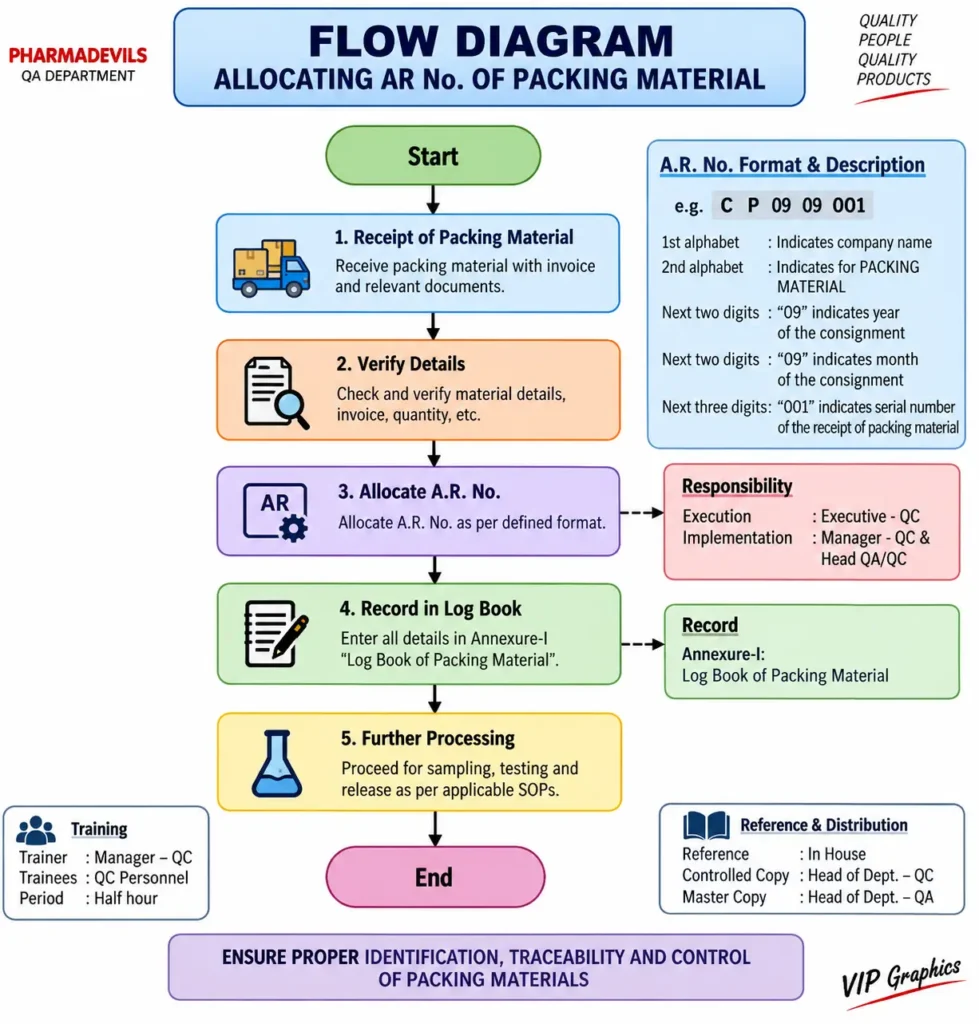
The allocated A.R. Number and related information are then entered in Annexure-I – Log Book of Packing Material for proper documentation and traceability. The material subsequently proceeds for sampling, testing, and release as applicable. The diagram also highlights that the Executive-QC is responsible for execution, while the Manager-QC and Head QA/QC ensure effective implementation.
2. Brainstorming for SOP Failure:
The Brainstorming for SOP Failure diagram uses a government-school classroom theme where the PharmaDevils character teaches students about possible causes of failure in the SOP for Allocating A.R. No. of Packing Material. The original SOP requires the Executive-QC to execute the procedure and specifies a defined A.R. numbering system followed by recording details in the Packing Material Log Book.
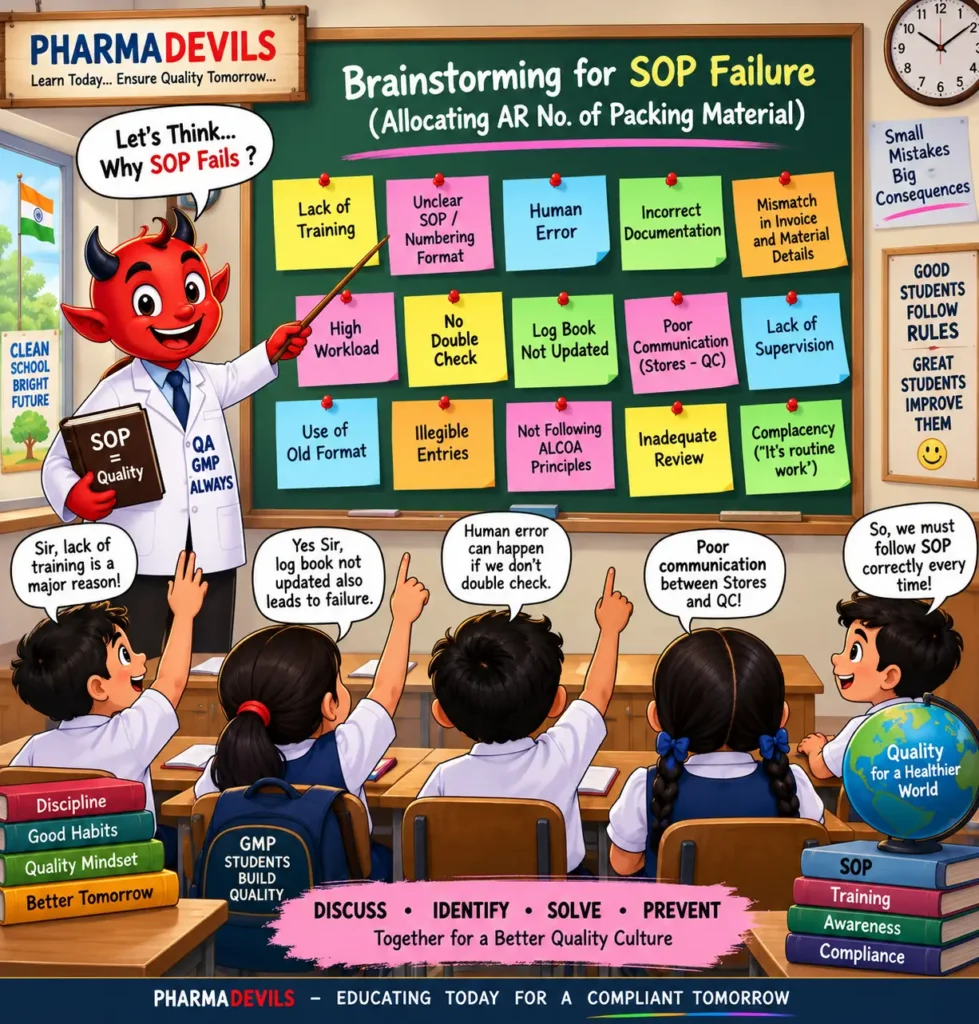
The brainstorming graphic expands on this by highlighting potential failure causes such as lack of training, unclear numbering format, human error, incorrect documentation, invoice/material mismatch, high workload, absence of double-checking, incomplete log-book entries, poor Stores–QC communication, inadequate supervision, use of outdated formats, illegible entries, weak ALCOA practices, insufficient review, and complacency.The classroom concept makes SOP-failure training simple and memorable, emphasizing the message: Discuss → Identify → Solve → Prevent, helping personnel build stronger GMP awareness and documentation discipline.
3. 5-why for SOP Failure:
The 5-Why Analysis for SOP Failure diagram explains the root-cause investigation for incorrect allocation or improper recording of the A.R. Number of Packing Material. It shows a step-by-step questioning approach in which each “Why?” moves deeper from the visible error toward the underlying cause.
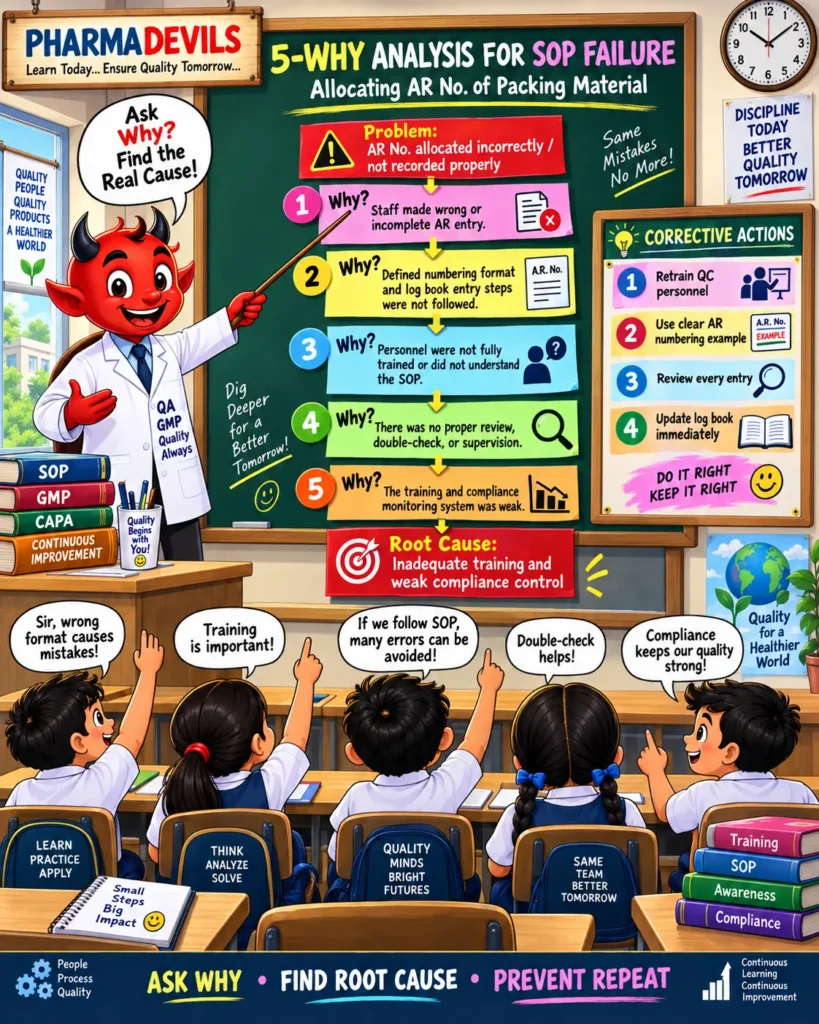
The analysis identifies possible reasons such as wrong or incomplete A.R. entries, failure to follow the defined numbering format and log-book procedure, inadequate SOP understanding, insufficient review or double-checking, and weak training and compliance monitoring. The final root cause is summarized as inadequate training and weak compliance control.The diagram also presents corrective actions including retraining QC personnel, using clear A.R. numbering examples, reviewing each entry, and updating the log book immediately. This approach helps personnel understand that repeated questioning can identify systemic causes and prevent recurrence through stronger training, supervision, documentation, and SOP compliance.
4. Fishbone Analysis for SOP Failure:
The Fishbone Analysis for SOP Failure diagram presents a structured root-cause assessment for incorrect allocation or recording of the A.R. Number of Packing Material. The original SOP requires QC personnel to allocate the A.R. number using the defined format and record the details in Annexure-I – Log Book of Packing Material.
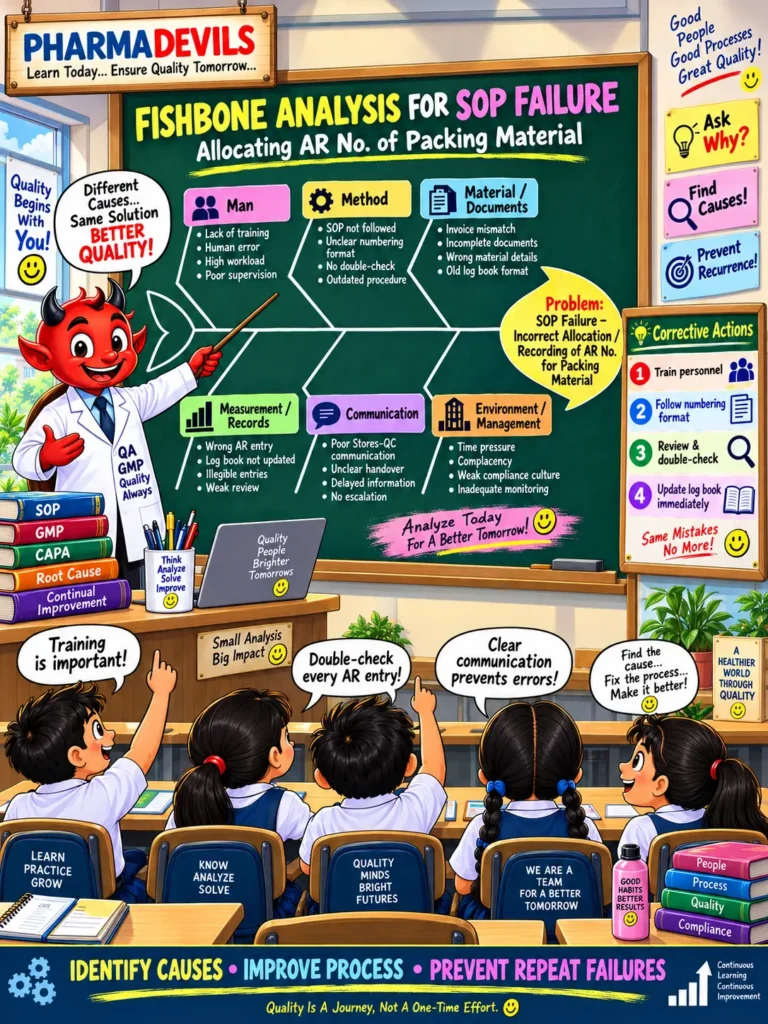
The diagram groups potential causes under six main categories: Man, Method, Material/Documents, Measurement/Records, Communication, and Environment/Management. Possible contributing factors include lack of training, human error, unclear numbering format, failure to follow the SOP, invoice mismatch, incomplete documents, wrong A.R. entries, delayed log-book updates, poor Stores–QC communication, time pressure, weak supervision, and inadequate compliance monitoring.The diagram also highlights corrective actions such as training personnel, following the approved numbering format, reviewing and double-checking entries, and updating the log book immediately. This fishbone approach helps teams systematically identify causes, strengthen the process, and prevent repeated SOP failures.
5. Fault Tree Analysis for SOP Failure:
The Fault Tree Analysis (FTA) for SOP Failure diagram evaluates how failures can occur during allocation and recording of the A.R. Number for packing materials. The SOP requires QC to allocate the A.R. number according to the defined numbering format and record the information in Annexure-I – Log Book of Packing Material.
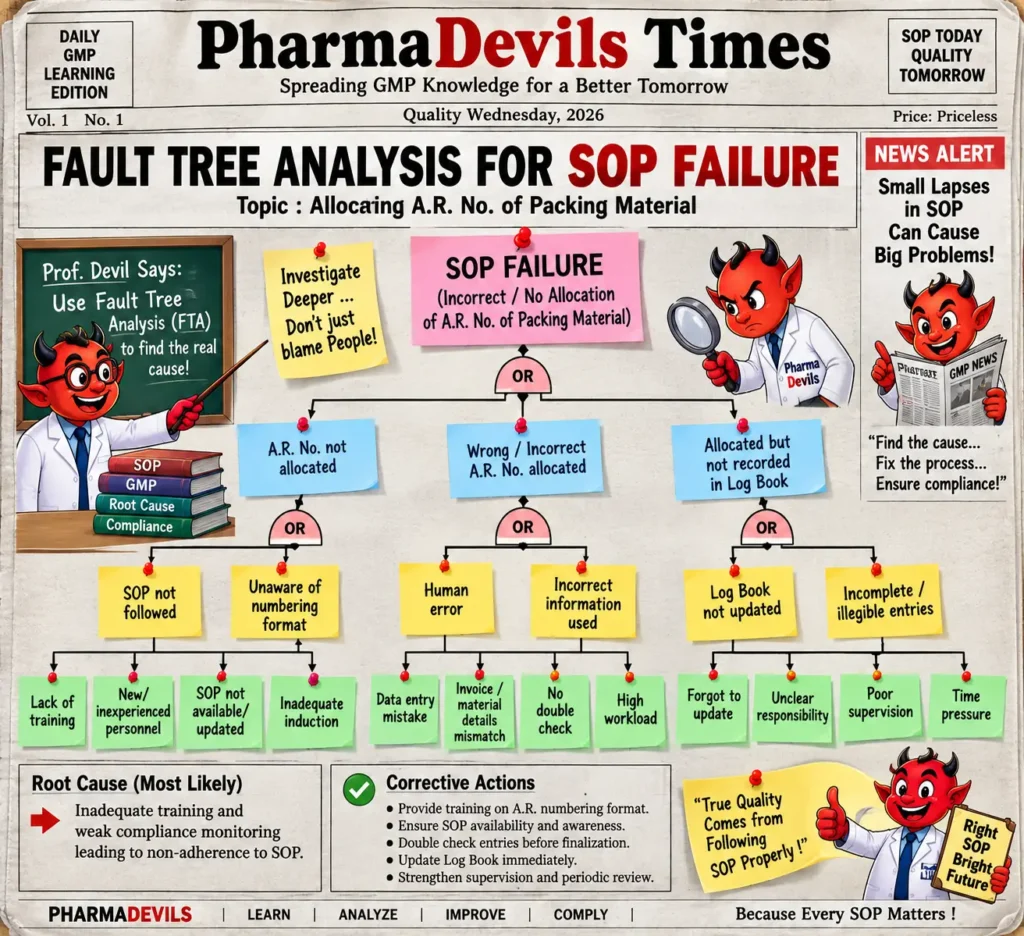
The fault tree starts with the top event “SOP Failure” and divides it into major failure paths such as A.R. number not allocated, incorrect A.R. number allocated, or allocated number not recorded in the log book. Contributing causes shown in the diagram include lack of training, unfamiliarity with the numbering format, human error, incorrect material information, absence of double-checking, high workload, poor supervision, time pressure, and delayed log-book updating.The analysis highlights inadequate training and weak compliance monitoring as likely systemic causes and recommends retraining, stronger review, timely documentation, and improved supervision to prevent recurrence.
Questions & Answers – Allocating A.R. No. of Packing Material
Q1. What is the objective of this SOP?
Answer: To lay down a procedure for allocating the A.R. No. of Packing Material.
Q2. Which department is covered under this SOP?
Answer: The SOP is applicable to the Quality Control Department for allocation of A.R. numbers to packing materials.
Q3. Who is responsible for execution of this SOP?
Answer: The Executive-QC is responsible for execution of the SOP.
Q4. Who is responsible for effective implementation of the SOP?
Answer: The Manager-QC and Head QC/QA are responsible for effective implementation.
Q5. What does A.R. stand for?
Answer: A.R. stands for Analytical Report.
Q6. What does the first alphabet in the A.R. number indicate?
Answer: The first alphabet indicates the company name.
Q7. What does the second alphabet indicate?
Answer: The second alphabet indicates Packing Material.
Q8. What do the next two digits indicate?
Answer: The next two digits indicate the year of the consignment.
Q9. What do the following two digits indicate?
Answer: They indicate the month of the consignment.
Q10. What do the last three digits indicate?
Answer: The last three digits indicate the serial number of receipt of the packing material.
Q11. Where are packing-material receipt details recorded?
Answer: Details are recorded in Annexure-I – Log Book of Packing Material.
Q12. What important details are maintained in the Packing Material Log Book?
Answer: The log book includes date, material name, store reference number, invoice number, quantity received, A.R. No., manufacturer, supplier, sampling details, release details, checking information, and retesting date.
Q13. Who provides training on this SOP?
Answer: The Manager – Quality Control is the trainer.
Q14. Who should receive training on this SOP?
Answer: Quality Control Personnel are the designated trainees.
Q15. What is the specified training duration?
Answer: The training period is half an hour.
Q16. Who holds the controlled copy of this SOP?
Answer: The controlled copy is maintained by the Head of Department – Quality Control.
Q17. Who holds the master copy?
Answer: The master copy is maintained by the Head of Department – Quality Assurance.
Q18. What is the reference for this SOP?
Answer: The reference is In House.
Q19. What is the enclosure attached to the SOP?
Answer: Annexure-I – Log Book of Packing Material.
Q20. Why is correct allocation of an A.R. number important?
Answer: Based on the SOP structure, correct allocation and log-book recording support systematic identification and traceability of each packing-material receipt.