







Brief Description
The SOP for Allocating A.R. No. of Water defines a standardized method for assigning a unique Analytical Report (A.R.) Number to water samples received for testing in the Quality Control Department. Its objective is to ensure systematic identification, traceability, and proper documentation of each water sample. The SOP is applicable to QC personnel, with the Executive-QC responsible for execution and the Manager-QC and Head QA/QC responsible for effective implementation.The A.R. number is structured using specific alphabets and numerical digits representing the company name, designated code, year, month, and serial number of water receipt. This coding system helps maintain chronological and unique identification of water samples.The SOP also specifies training for QC personnel, controlled and master-copy distribution, abbreviations, references, and revision-history requirements to support consistent document control and GMP-compliant laboratory practices.
Skip to PDF content1. Flow Diagram:
The Highway Flow Diagram for Allocating A.R. No. of Water visually represents the step-by-step process used by the Quality Control Department for assigning a unique Analytical Report (A.R.) Number to each received water sample. The process begins with receipt of the water sample in QC, followed by selection of the defined A.R. number format.
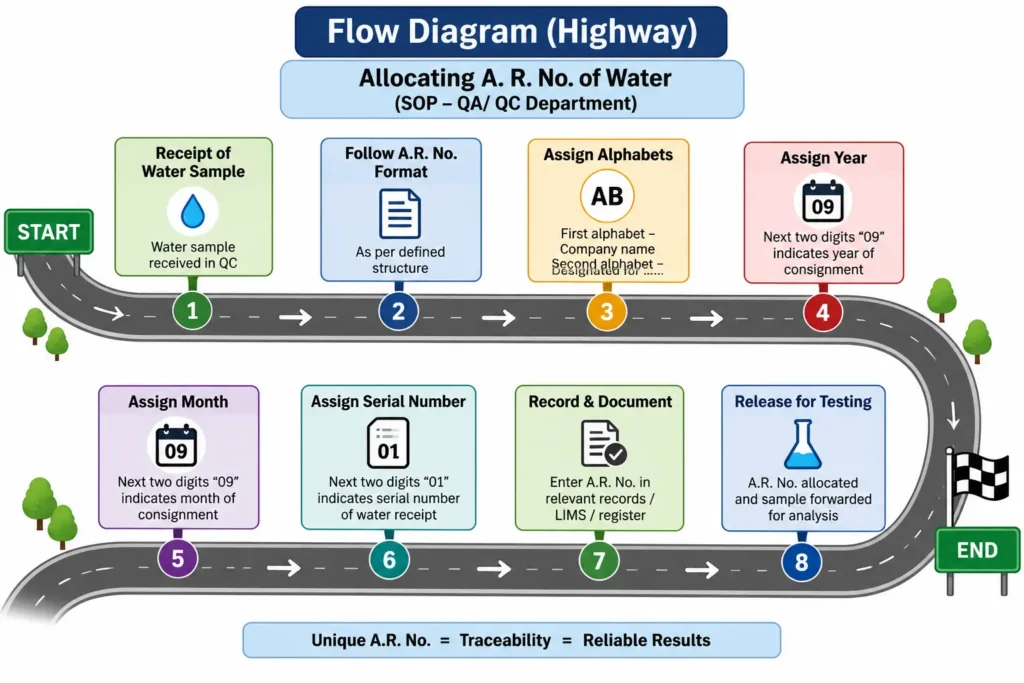
The identification code is then created sequentially using designated alphabets for company/system identification, followed by numerical digits representing the year, month, and serial number of water receipt.The highway-style route clearly illustrates the controlled movement from sample receipt → A.R. number formation → recording/documentation → release for testing. This structured approach supports proper sample identification, chronological tracking, traceability, and consistent laboratory documentation, helping QC personnel avoid duplication or incorrect allocation of water sample numbers.
2. Brainstorming for SOP Failure:
The Brainstorming for SOP Failure – Allocating A.R. No. of Water diagram explores possible reasons why a water sample A.R. number may be missed, incorrectly generated, or improperly documented. The SOP requires QC personnel to allocate the number using a defined sequence containing designated alphabets followed by the year, month, and serial number of water receipt.

Potential failure causes identified during brainstorming include unclear A.R. number format, inadequate training, incomplete SOP compliance, human data-entry errors, incorrect year/month selection, poor supervision, lack of verification, outdated documentation, communication gaps, workload pressure, and absence of effective checklists or controls. These are brainstorming hypotheses rather than confirmed causes.The activity encourages the QC team to discuss each possible factor systematically and identify the actual root cause before implementing CAPA. Since the SOP assigns execution responsibility to the Executive-QC and implementation oversight to Manager-QC and Head QA/QC, effective training, supervision, and document control are important preventive measures.
3. 5-Why Analysis for SOP Failure:
The 5-Why Analysis for SOP Failure – Allocating A.R. No. of Water examines why a water sample may receive an incorrect A.R. number or no number at all. The SOP requires the A.R. number to follow a defined structure containing designated alphabets followed by digits representing the year, month, and serial number of water receipt.
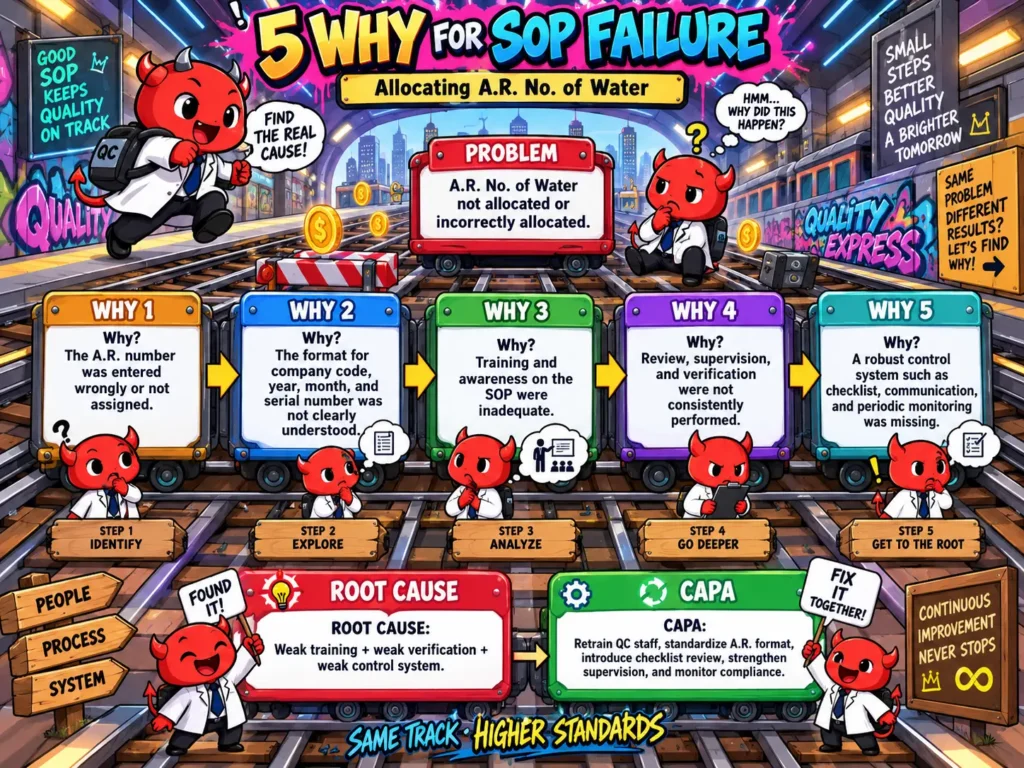
The analysis traces the problem from an incorrect or missed entry to unclear understanding of the numbering format, inadequate training and awareness, inconsistent review and supervision, and finally a weak control system. The identified root cause is therefore associated with insufficient training, verification, and procedural controls. Recommended CAPA includes retraining QC personnel, standardizing the A.R. number format, introducing a verification checklist, strengthening supervisory review, and periodically monitoring compliance to prevent recurrence.
4. Fishbone Analysis for SOP Failure:
The Fishbone Analysis for SOP Failure – Allocating A.R. No. of Water identifies possible causes that may lead to incorrect, delayed, or missed allocation of a water sample A.R. number. The SOP requires QC personnel to assign the number using a defined structure containing designated alphabets followed by digits representing the year, month, and serial number of water receipt.
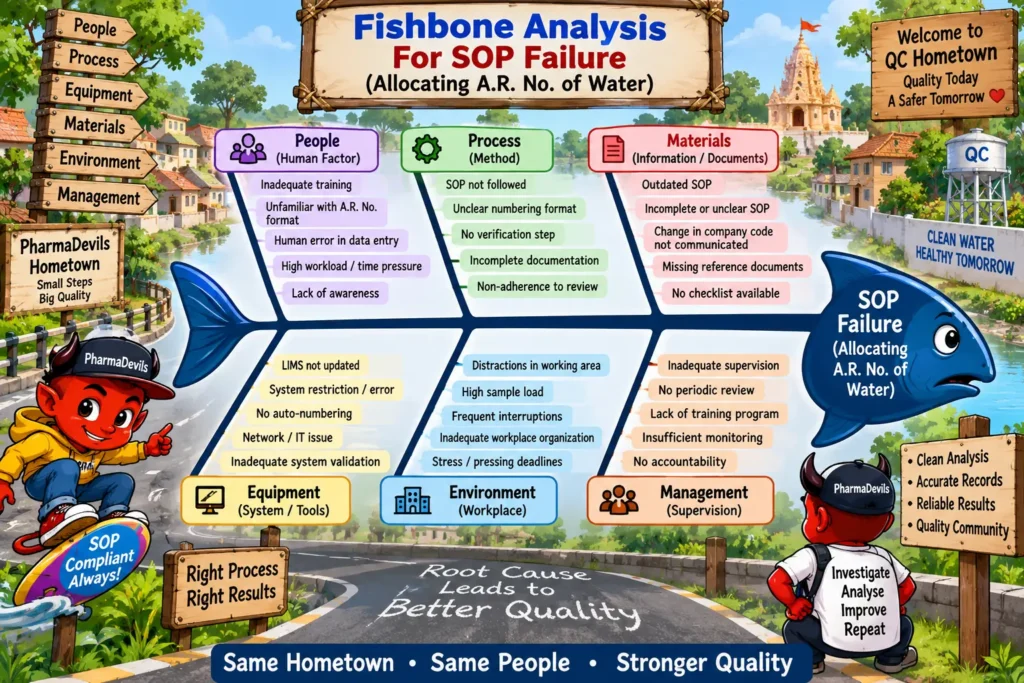
The fishbone diagram groups potential causes under six categories: People, Process, Materials/Documents, Equipment/System, Environment, and Management. Possible contributors include inadequate training, misunderstanding of the numbering format, human data-entry errors, incomplete SOP compliance, lack of verification, outdated documents, communication gaps, system or LIMS issues, workplace distractions, high workload, insufficient supervision, and weak periodic monitoring.These are brainstormed potential causes, not confirmed root causes. The analysis helps the QC team systematically evaluate each category, identify the actual cause of failure, and establish suitable CAPA to strengthen SOP compliance and traceability.
5. Fault Tree Analysis SOP Failure:
The Fault Tree Analysis for SOP Failure – Allocating A.R. No. of Water visually breaks the failure into logical causes and sub-causes to identify how an incorrect or missing A.R. number can occur. The SOP requires a defined numbering sequence using specific alphabets followed by digits representing the year, month, and serial number of water receipt.
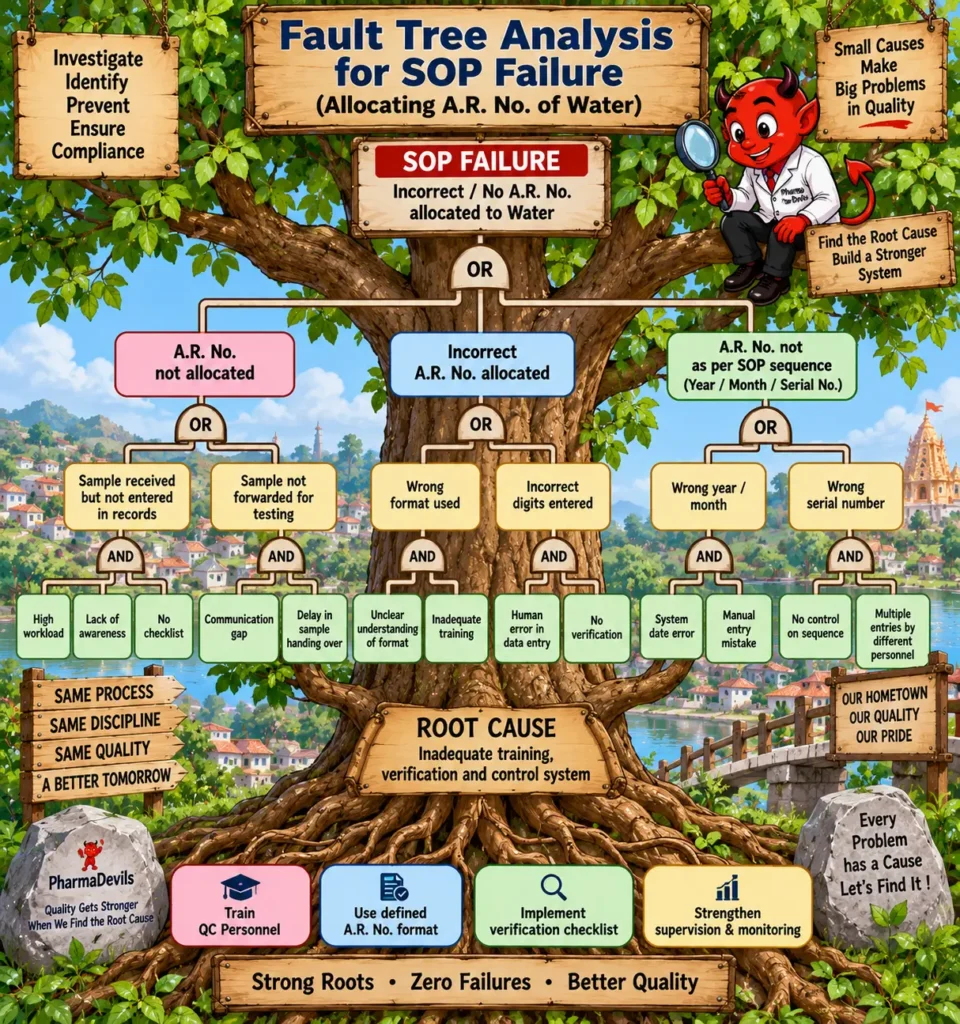
The fault tree considers three main failure paths: A.R. number not allocated, incorrect A.R. number allocated, and A.R. number not assigned according to the prescribed sequence. Contributing causes may include poor record entry, wrong format selection, incorrect digits, human data-entry errors, inadequate training, lack of verification, communication gaps, workload pressure, and weak sequence controls.The analysis helps trace the failure from the top event down to basic causes. It supports identification of likely root causes and development of CAPA such as training QC personnel, standardizing the A.R. number format, introducing verification checklists, and strengthening supervision and monitoring.
Questions & Answers – SOP for Allocating A.R. No. of Water
Q1. What is the objective of this SOP?
Answer: To define the procedure for allocating the A.R. No. of water samples.
Q2. Which department is covered under this SOP?
Answer: The SOP is applicable to the Quality Control Department for allocating A.R. numbers to water samples.
Q3. Who is responsible for executing this SOP?
Answer: The Executive-QC is responsible for execution of the SOP.
Q4. Who is responsible for effective implementation of the SOP?
Answer: The Manager-QC and Head QC/QA are responsible for effective implementation.
Q5. What does A.R. No. stand for?
Answer: A.R. No. stands for Analytical Report Number.
Q6. What does the first alphabet in the A.R. No. indicate?
Answer: The first alphabet indicates the company name, as defined in the SOP format.
Q7. What does the second alphabet represent?
Answer: The second alphabet represents the designated identification mentioned in the approved A.R. numbering format. The specific designation is left blank in the source SOP.
Q8. What do the first two numerical digits indicate?
Answer: They indicate the year of the consignment; the SOP gives “09” as an example.
Q9. What do the next two digits indicate?
Answer: They indicate the month of the consignment.
Q10. What do the final two digits indicate?
Answer: They indicate the serial number of the receipt of water, with “01” shown as an example.
Q11. Who provides training for this SOP?
Answer: The Manager – Quality Control is designated as the trainer.
Q12. Who are the trainees and what is the training duration?
Answer: Quality Control personnel are the trainees, and the specified training period is half an hour.
Q13. Where is the controlled copy maintained?
Answer: The controlled copy is maintained with the Head of Department – Quality Control.
Q14. Where is the master copy maintained?
Answer: The master copy is maintained with the Head of Department – Quality Assurance.
Q15. What is the reference for this SOP?
Answer: The reference is stated as In House.