







1. Introduction to Cetirizine Hydrochloride Tablets IP – Batch Packing Record (BPR):
Cetirizine Hydrochloride Tablets IP are widely used antihistamine medications indicated for the management of allergic conditions such as allergic rhinitis, urticaria (hives), sneezing, runny nose, itching, and watery eyes. Cetirizine Hydrochloride is a second-generation histamine H1-receptor antagonist that helps relieve allergic symptoms by blocking the action of histamine in the body. It is generally associated with less sedation than first-generation antihistamines. The Batch Packing Record (BPR) is an essential Good Manufacturing Practice (GMP) document that provides comprehensive information about the packaging operations performed for each batch of Cetirizine Hydrochloride Tablets IP. It ensures that packaging activities are conducted according to approved procedures, established specifications, and applicable regulatory requirements. The BPR includes details of packaging material issuance, line clearance, equipment identification, batch coding, blister or strip packing operations, in-process quality checks, reconciliation of printed packaging materials, and finished product transfer. Proper documentation of packaging activities helps maintain product identity, quality, traceability, and compliance with regulatory requirements, including USFDA 21 CFR Parts 210 and 211 and applicable Indian GMP requirements. An accurately completed BPR supports batch review, deviation investigation, prevention of packaging mix-ups, and final product release by the Quality Assurance department, ensuring that Cetirizine Hydrochloride Tablets IP are consistently packed according to approved quality standards.
Skip to PDF content2. Cetirizine Hydrochloride Tablets IP – Batch Packing Process Flow Diagram:
The Batch Packing Process Flow Diagram of Cetirizine Hydrochloride Tablets IP illustrates the systematic sequence of packaging operations performed in a pharmaceutical manufacturing facility. Each stage is designed to ensure product quality, safety, identification, traceability, and compliance with Good Manufacturing Practices (GMP). The packaging process begins with the receipt and verification of approved bulk tablets and packaging materials. Before initiating operations, Quality Assurance (QA) performs line clearance to ensure that the packaging area and equipment are free from materials and documents associated with previous batches. Following line clearance, packaging materials are issued and verified against the approved Batch Packing Record (BPR). Primary packaging is performed using the approved blister or strip packaging configuration, with appropriate controls for sealing temperature, pressure, machine speed, and seal integrity.
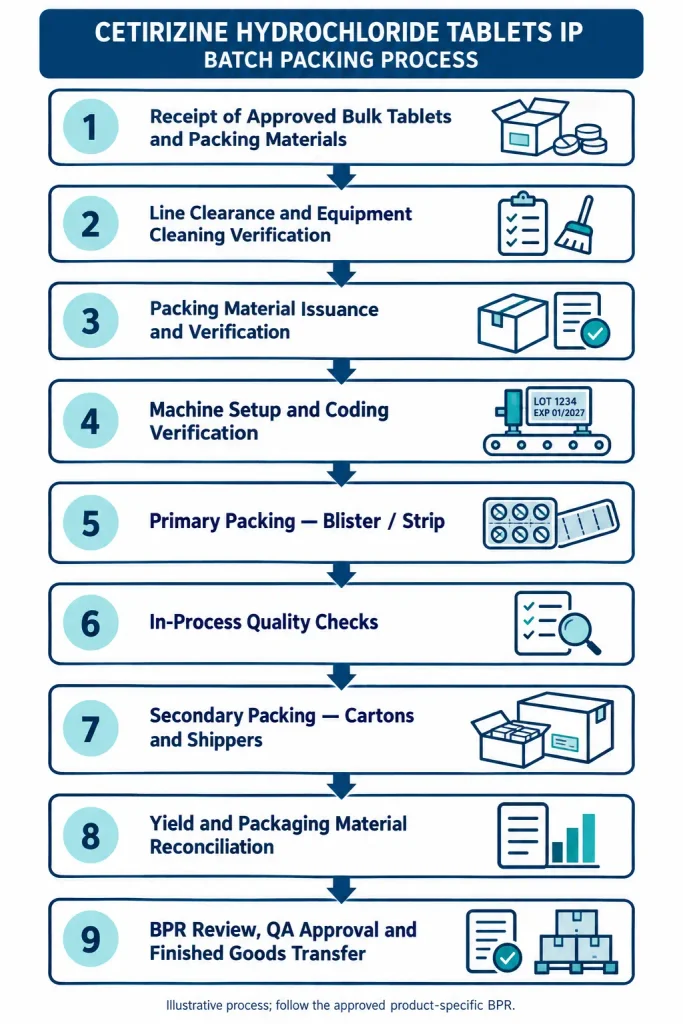
In-process quality checks include verification of batch coding, packaging appearance, tablet count, printing accuracy, and packaging integrity. Secondary packaging involves carton packing, leaflet insertion, labeling, and shipper identification according to approved specifications. Finally, packaging material reconciliation, yield calculations, documentation review, and finished product transfer are completed. The complete packing process ensures batch traceability, prevents mix-ups, minimizes packaging defects, and supports regulatory compliance and final batch release by Quality Assurance.
3. Critical Process Parameters (CPPs) and Critical Quality Attributes (CQAs) of Cetirizine Hydrochloride Tablets IP:
The Critical Process Parameters (CPPs) and Critical Quality Attributes (CQAs) of Cetirizine Hydrochloride Tablets IP play an essential role in ensuring product quality, packaging integrity, stability, and compliance with Good Manufacturing Practices (GMP).
Critical Process Parameters (CPPs)
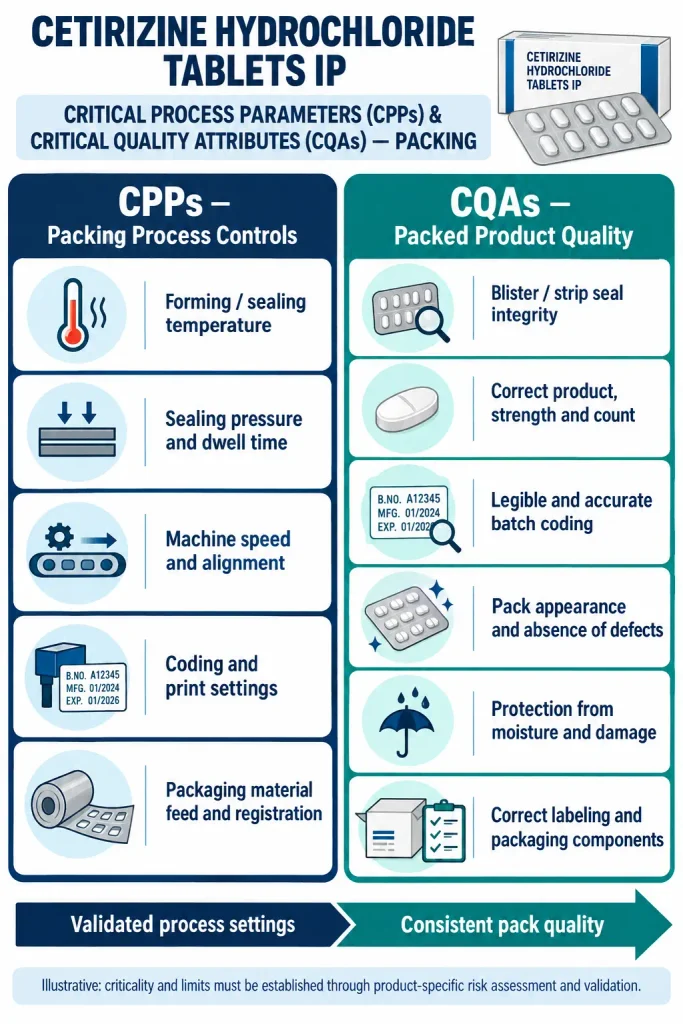
CPPs are process variables whose variability can affect product quality and therefore require appropriate monitoring and control. During tablet packaging, important parameters include forming temperature, sealing temperature, sealing pressure, dwell time, machine speed, and packaging material alignment. Batch coding settings and printing accuracy are also controlled to prevent labeling errors and ensure product traceability.
These parameters must be established through product-specific risk assessment, process development, and qualification or validation activities.
Critical Quality Attributes (CQAs)
CQAs are physical, chemical, biological, or microbiological characteristics that must remain within established limits to ensure the required product quality. Important packaging-related quality attributes include blister or strip seal integrity, packaging appearance, protection against moisture, and maintenance of product quality throughout shelf life. Correct tablet count, batch details, labeling accuracy, and packaging component verification are essential packaging quality requirements.
Conclusion
Effective CPP monitoring and CQA verification help prevent packaging defects, maintain product stability, minimize batch rejection, and ensure consistent quality of Cetirizine Hydrochloride Tablets IP throughout their intended shelf life.