







1. Introduction to Batch Packing Record (BPR) of Cyproheptadine, Tricholine Citrate & Sorbitol Syrup:
The Batch Packing Record (BPR) of Cyproheptadine, Tricholine Citrate & Sorbitol Syrup is an essential pharmaceutical documentation system designed to ensure proper control, monitoring, traceability, and compliance throughout the filling and packing operations. The BPR provides detailed instructions and records for packaging activities in accordance with Good Manufacturing Practices (GMP) and approved Standard Operating Procedures (SOPs). Each 5 mL of syrup contains Cyproheptadine Hydrochloride IP 2 mg, Tricholine Citrate 275 mg, and Sorbitol (70%) IP 3.575 g, formulated in a flavoured syrupy base with caramel colour. The product is classified as a Schedule G prescription drug and requires medical supervision. The packing process includes receiving approved bulk syrup, dispensing packaging materials, line clearance, bottle washing, filling, sealing, labelling, cartoning, and shipper packing. Critical in-process checks include fill volume verification, sealing integrity, leakage testing, cap perforation inspection, labelling accuracy, and rejection analysis. The BPR also covers material reconciliation, packing yield calculation, sample accountability, rejected material destruction, and finished product transfer to bonded stores. Proper execution and documentation of the BPR help prevent packaging errors, product mix-ups, and contamination while ensuring product quality, patient safety, regulatory compliance, and complete batch traceability.
Remove unverified regulatory classification
Skip to PDF content2. Flow Diagram Cyproheptadine, Tricholine Citrate & Sorbitol Syrup (BPR):
The Batch Packing Flow Diagram of Cyproheptadine, Tricholine Citrate & Sorbitol Syrup illustrates the systematic sequence of packing operations, ensuring product quality, traceability, and compliance with Good Manufacturing Practices (GMP). The process begins with the transfer of approved bulk syrup from the manufacturing department to the packing section, where the received quantity is verified using the dipstick method. Packing materials, including 200 ml amber-coloured PET bottles, polypropylene caps, printed labels, cartons, and corrugated shippers, are dispensed according to the approved Batch Packing Record (BPR).
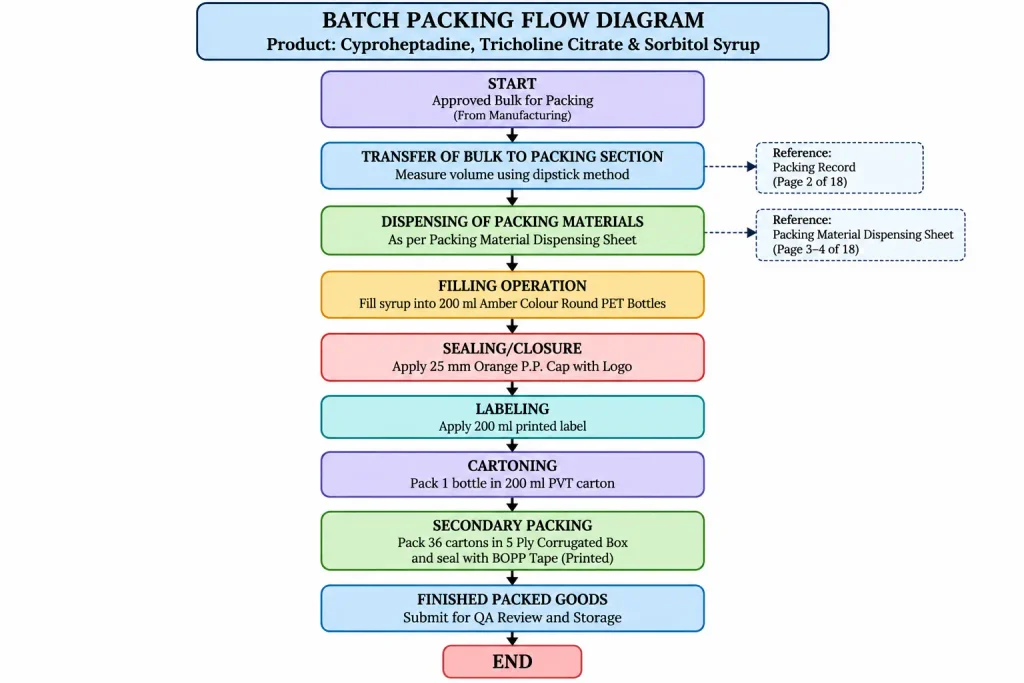
Before commencing operations, line clearance is performed to ensure that equipment and packing areas are clean and free from previous product materials. Bottles undergo washing, followed by filling with the specified volume of syrup. Filled bottles are sealed using polypropylene caps and subjected to in-process quality checks, including fill volume verification, sealing integrity, leak testing, and cap perforation inspection. The sealed bottles are labelled with the required product and batch information, followed by individual cartoning. Subsequently, 36 cartons are packed into each five-ply corrugated shipper and sealed using printed BOPP tape. Finally, packed units undergo inspection, yield calculation, packing material reconciliation, and documentation review before transfer to bonded storage.
3. Critical Process Parameters (CPP) and Critical Quality Attributes (CQA) of Cyproheptadine, Tricholine Citrate & Sorbitol Syrup (BPR):
Introduction
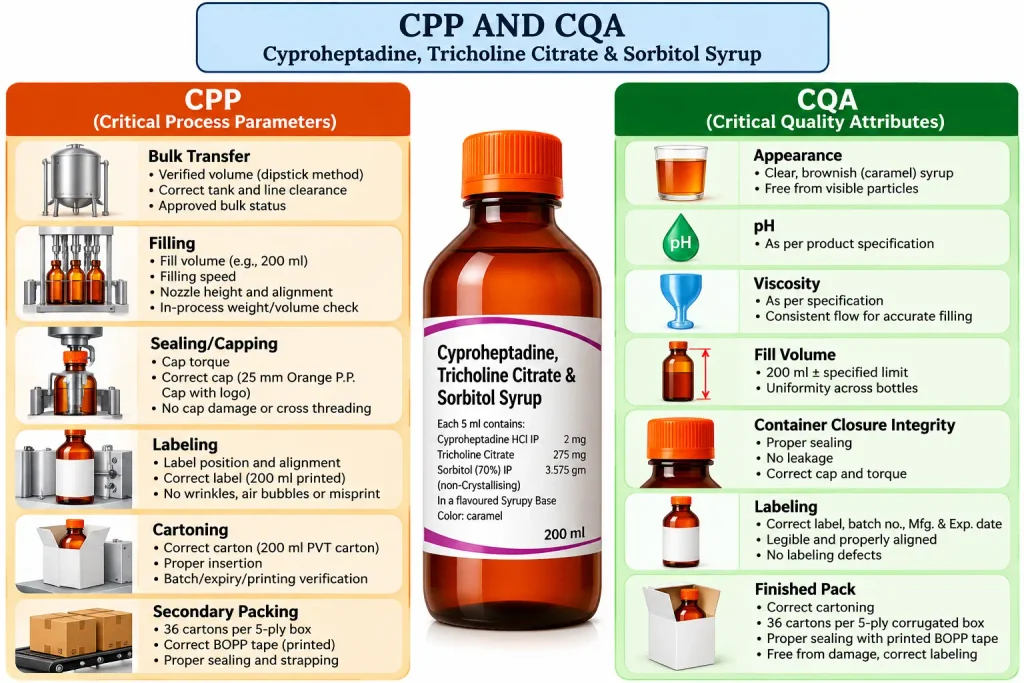
Critical Process Parameters (CPPs) and Critical Quality Attributes (CQAs) play an important role in maintaining the quality, safety, consistency, and packaging integrity of Cyproheptadine, Tricholine Citrate & Sorbitol Syrup during pharmaceutical filling and packing operations. Proper identification and monitoring of these parameters support compliance with Good Manufacturing Practices (GMP) and approved Batch Packing Record (BPR) requirements.
Critical Process Parameters (CPPs)
The major process parameters include bulk syrup transfer, bottle washing, filling, sealing, labeling, cartoning, and secondary packing. During bulk transfer, the approved status, received volume, and equipment cleanliness are verified. Bottle washing parameters include purified water temperature, jet pressure, and washing effectiveness. During filling, the filling speed, nozzle alignment, and dispensed volume are monitored to ensure consistent filling of 200 ml amber-coloured PET bottles. Sealing parameters include cap application, sealing quality, cap perforation, and leak-test performance. Labeling and cartoning operations require verification of printed information, label alignment, correct packaging materials, and proper shipper sealing.
Critical Quality Attributes (CQAs)
Important quality attributes include syrup appearance, specified fill volume, container closure integrity, labeling accuracy, and finished-pack quality. The syrup should maintain its specified caramel colour and meet applicable approved product specifications. Each filled bottle must comply with established fill-volume acceptance limits and remain free from leakage or defective closures. Correct batch numbers, manufacturing dates, expiry dates, and other required labeling information must be verified. Finished packs should be properly sealed, correctly identified, and free from visible packaging defects.
Conclusion
Effective monitoring of CPPs and verification of CQAs help minimize filling variations, leakage, labeling errors, packaging defects, and batch rejection. These controls support consistent product quality, regulatory compliance, and traceability throughout the packing process.
Note: The attached BPR specifies packing operations and in-process checks. Additional attributes illustrated in the AI-generated infographic, such as pH, viscosity, cap torque, and filling speed, should be considered potential control parameters rather than confirmed CPPs or CQAs unless supported by approved product specifications, validation studies, or documented quality risk assessments.